Autism levels describe how much support a person needs in daily life. The DSM-5, the manual clinicians use to diagnose autism, sets out three: Level 1 (requiring support), Level 2 (requiring substantial support) and Level 3 (requiring very substantial support). A level is not a grade, not a prediction, and not a measure of how "autistic" someone is. It is a clinician's snapshot of support needs at one point in time.
If your child just received a level, or you are comparing level 1 and level 2 to figure out what it means for your family, this guide walks through each level, what the label can and cannot tell you, and what to do next.
TL;DR
The DSM-5 uses three levels of support, based on two areas: social communication and restricted, repetitive behaviors (CDC).
Levels are clinician judgments, not standardized scores. Two professionals can assign different levels to the same person (Child Mind Institute).
Levels can change. One study noted that about 30% of autistic children had lower support needs at age six than at age three.
A level is a starting point. Functional assessments and a look at your child's real daily needs should drive therapy, school and funding decisions.
You do not have to sort this out alone. Write down what you see, ask questions, and build your plan one step at a time.
Table of Contents
Where autism levels came from
Before 2013, autism was split into several separate diagnoses, including autistic disorder and Asperger's syndrome. The DSM-5 folded these into one umbrella diagnosis, autism spectrum disorder (ASD), and added three levels of support (Child Mind Institute). The 2013 revision also brought the older labels under the single term ASD, with criteria organized around social communication and restricted, repetitive behaviors (Lee, 2015).
Researchers describe this as a move from a "you have it or you don't" view toward a spectrum, where autistic traits are seen as a continuous dimension and support needs depend on the environment (PMC). That last part matters for parents. The same child may need far more support in a loud cafeteria than at home with a familiar adult.
The three levels at a glance
The CDC explains that levels are based on support needs in the two core areas of diagnosis (CDC). The table below is a plain-language summary. Real children rarely fit one column neatly.
Level 1 | Level 2 | Level 3 | |
|---|---|---|---|
DSM-5 label | Requiring support | Requiring substantial support | Requiring very substantial support |
Support need | Some support, often with social situations and change | Frequent, noticeable support across settings | Constant, intensive support in most areas of daily life |
Communication | Often speaks in full sentences, but conversation and nonverbal cues can be hard | Simpler sentences or narrow topics; clear difficulty even with supports in place | Few words or no spoken language; communication may rely on AAC, gestures or other tools |
Routines and flexibility | Change causes distress; switching tasks is hard | Repetitive behaviors and distress with change are easy for others to notice | Extreme difficulty with change; repetitive behaviors interfere with nearly everything |
Here is what each level can look like in everyday life.
Level 1: requiring support
Children and adults at Level 1 often have spoken language and may do well academically. The difficulty tends to be social: reading tone, taking turns in conversation, making friends, handling an unexpected schedule change. Without support, these gaps can cause real problems at school or work.
Level 1 is sometimes called "mild" by outsiders. Many autistic people and families dislike that word, because the effort of masking, coping and recovering can be huge even when the difficulties are less visible to others.
Level 2: requiring substantial support
At Level 2, the differences are visible to most people, even with supports in place. A child may use shorter sentences, speak mostly about narrow interests, or have a hard time shifting attention. Changes to routine can bring strong distress, and repetitive behaviors show up often enough that others notice.
Supports typically need to be present across settings: a speech-language plan, classroom adjustments, visual schedules, and help with daily living skills. If you want to build communication practice into daily life, our guide to autism communication at home in 5 to 15 minute routines shows how.
Level 3: requiring very substantial support
Level 3 describes people who need intensive, near-constant support. Spoken language may be very limited or absent, and everyday activities such as dressing, eating and moving between places usually need hands-on help. Safety planning is often part of daily life. Our article on severe autism, first steps and U.S. resources covers what families in this situation can do now.
The ASHA practice portal notes that communication supports can include Augmentative and Alternative Communication (AAC), with individualized plans that involve speech-language pathology and occupational therapy (ASHA). A child without speech is communicating. The goal is to find the way that works.
Autism level 1 vs level 2: how to tell the difference
This is the question we hear most, and the honest answer is that the line is blurry. Clinicians weigh several things:
How visible the difficulties are. At Level 1, problems may show up mainly in complex social situations. At Level 2, they are obvious in most settings, even when supports are in place.
How much help is needed to function. Level 1 usually means some support. Level 2 means frequent, substantial support.
Flexibility. Level 2 behaviors and distress with change tend to interfere with functioning in more places and more often.
Language and social initiation. Level 1 often includes full sentences with awkward back-and-forth. Level 2 more often includes clearly limited conversation.
Two cautions apply. First, levels are subjective. The Child Mind Institute points out that they are not operationalized definitions, so practitioners can reach different conclusions about the same person based on how they weigh current support needs against functional capacity (Child Mind Institute). Second, a child can sit between levels, or have one level for social communication and another for repetitive behaviors. The DSM-5 asks for a rating in each domain, and a study of a clinical sample found those ratings did not always line up neatly with cognitive and adaptive scores (PubMed).
If you are comparing the two because your child received a Level 2 rating and you expected Level 1 (or the reverse), you are not alone, and it is fair to ask the evaluator how they reached the rating.
What a level cannot tell you
It is not a forecast
Levels measure current support needs, not future potential. Support needs shift with age, therapy, school demands and life changes. The Child Mind Institute notes that about 30% of autistic children in one study had lower support needs at age six than at age three (Child Mind Institute). A level on a report from age three is a record of that evaluation, not a ceiling.
It does not describe the whole child
A level does not capture sensory sensitivities, anxiety, attention, sleep, motor skills, strengths or interests. Experts quoted by the Child Mind Institute suggest that families think in terms of a "matrix of support needs": sensory sensitivities, cognitive abilities and behavior across different settings. Two children with the same level can need very different help. One may need sensory regulation strategies (a sensory diet is one example families explore with an occupational therapist), while another needs speech support first.

It is not the same as intellectual ability
Autism levels and intellectual disability are separate questions. A child can be rated Level 2 with strong cognitive skills, or Level 1 with a co-occurring learning difficulty. If you are sorting out how these relate, see our explainer on why autism is not a learning disability.
It may not unlock services by itself
A scoping review in the research literature notes that a diagnosis alone gives limited information about functioning, which is the information that matters for determining support and funding needs (PMC). Tools such as the Vineland Adaptive Behavior Scales (Vineland-3) and the Adaptive Behavior Assessment System (ABAS-3) measure daily living skills directly. If a school team, insurer or state program asks what your child can do independently, these results are often more useful than the level alone.
Getting a level in the first place
Diagnosis typically relies on two sources: what parents and caregivers describe about development, and a professional's observation of the child (CDC). That means your notes count. Before an evaluation, write down specific examples: how your child communicates, what happens during transitions, what overwhelms them, what helps.
The American Academy of Pediatrics recommends developmental surveillance at every well-child visit and standardized autism-specific screening at 18 and 24 months, with extra attention for children at higher risk, such as those with a sibling with autism or those born preterm (CDC). The same CDC page notes that earlier intervention, starting as soon as a concern is identified, can improve future skills and school performance.
If you are worried about a toddler's speech in particular, it can be hard to tell whether you are seeing autism versus language delay. Either way, you do not need to wait for a formal level to ask for help. Talk to your pediatrician about a referral, and ask about early intervention evaluations.
If Spanish is your family's first language, our article on señales tempranas de autismo entre los 6 y 36 meses gives caregivers a way to document what they see.
Using the level to plan, not to limit
Once you have a level, treat it as a conversation starter with your child's team. Here is a practical approach.
Ask what the rating was based on. Which observations, tools and reports fed into it? Were both domains rated?
Request a functional picture. Ask whether an adaptive behavior assessment makes sense, especially before an IEP meeting or a funding application.
List your child's top three daily challenges. Examples: mornings, mealtimes, bedtime, transitions, safety, communicating needs.
Match supports to those challenges. The ASHA portal stresses individualized plans, neurodiversity-affirming care and collaboration among families, educators and an interprofessional team (ASHA). If you are weighing therapy approaches, read about alternatives to ABA so you can ask informed questions of any provider.
Re-evaluate on a schedule. Because support needs move, review the plan at least when your child changes schools or hits a new developmental stage.
Keep your own records. Save reports, school notes and your own observations in one place. They become the backbone of every application you file later.
Adulthood and beyond
Levels do not stop mattering at 18. Adults may need support with work, housing and daily routines. Our pages on activity categories for autistic adults and housing assistance for caregivers are a good place to start planning ahead.
Our perspective: look past the number
We built Autism Victory for caregivers, and we hear the same pattern again and again. A family leaves an evaluation with a level and a stack of paper, and no clear idea of what comes next. The level feels like a verdict. It is not.
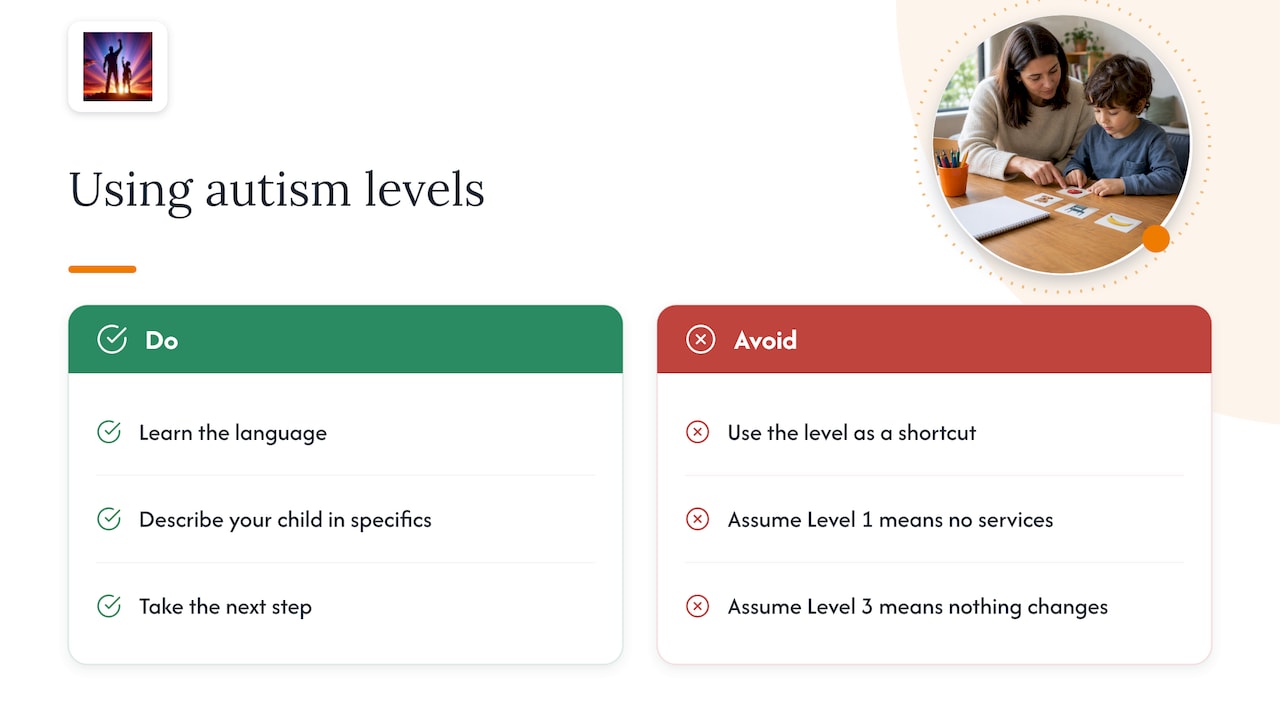
Here is how we see it. A level is useful because it gives a shared language for talking with schools, clinicians and agencies. It becomes a problem when anyone uses it as a shortcut: "Level 1, so no services," or "Level 3, so nothing will change." Neither is what the research says. Support needs are conditional on the environment and they change over time.
So we encourage parents to do three things. Learn the language, so the report makes sense. Describe your child in specifics, because "melts down at transitions" gets better help than a number. And take the next step that is in front of you, whether that is a referral, a school request or a funding application. Families do better when they can see the path, one stage at a time.
— Ronnie Talent
Where Autism Victory fits in
Autism Victory is a mobile app that puts caregiver-focused books and audiobooks (in English and Spanish), AI-powered guidance, a state-specific funding and support resource navigator, educational videos, a calming sound library and a caregiver community in one place. If a new level has left you with more questions than answers, you can ask them in the app and get step-by-step guidance on what to do next.
Plans are $6.95 per month or $49.95 per year, and there is a 5-day free trial. See the plans and pricing or visit Autism Victory to learn more. The app supports your decisions. It does not replace your child's clinicians.
Frequently asked questions
Can an autism level change?
Yes. Levels reflect support needs at a given time, and those can shift with age, intervention and changing demands. In one study cited by the Child Mind Institute, about 30% of autistic children had lower support needs at age six than at age three. A change does not mean the original rating was wrong.
Is Level 1 autism the same as Asperger's syndrome?
Not exactly. The DSM-5 folded Asperger's syndrome into the single diagnosis of autism spectrum disorder, and Level 1 covers many people who would once have received that label. But a level is a rating of support needs, not a replacement diagnosis, and some people with the older label are rated differently. Many still use the older term for themselves.
Does my child need a level to get services?
Not necessarily. Services are generally based on evaluations of what your child needs, such as speech, occupational therapy or school supports, and on the rules of each program. Functional assessments like the Vineland-3 often carry more weight than the level alone. Ask your child's team and each program what documentation they require.
Can two clinicians give different levels?
Yes. Levels are not standardized, operationalized definitions, so clinicians interpret support needs and functioning differently. If a rating does not match what you see at home, bring your notes and ask the evaluator to explain the reasoning. A second opinion from another qualified clinician is also reasonable.
Which level is more serious, 1 or 3?
Level 3 means a person needs more support, but "serious" is not a helpful way to compare. A person at Level 1 may struggle with anxiety, burnout or hidden difficulties, and a person at Level 3 may have clear strengths and joy. The levels describe how much help is needed, not a person's worth or potential.
Sources
Clinical Testing and Diagnosis for Autism Spectrum Disorder, CDC
Approach to autism spectrum disorder: Using the new DSM-V diagnostic criteria, PMC
Correlates of DSM-5 Autism Spectrum Disorder Levels of Support Ratings in a Clinical Sample, PubMed
Recommended