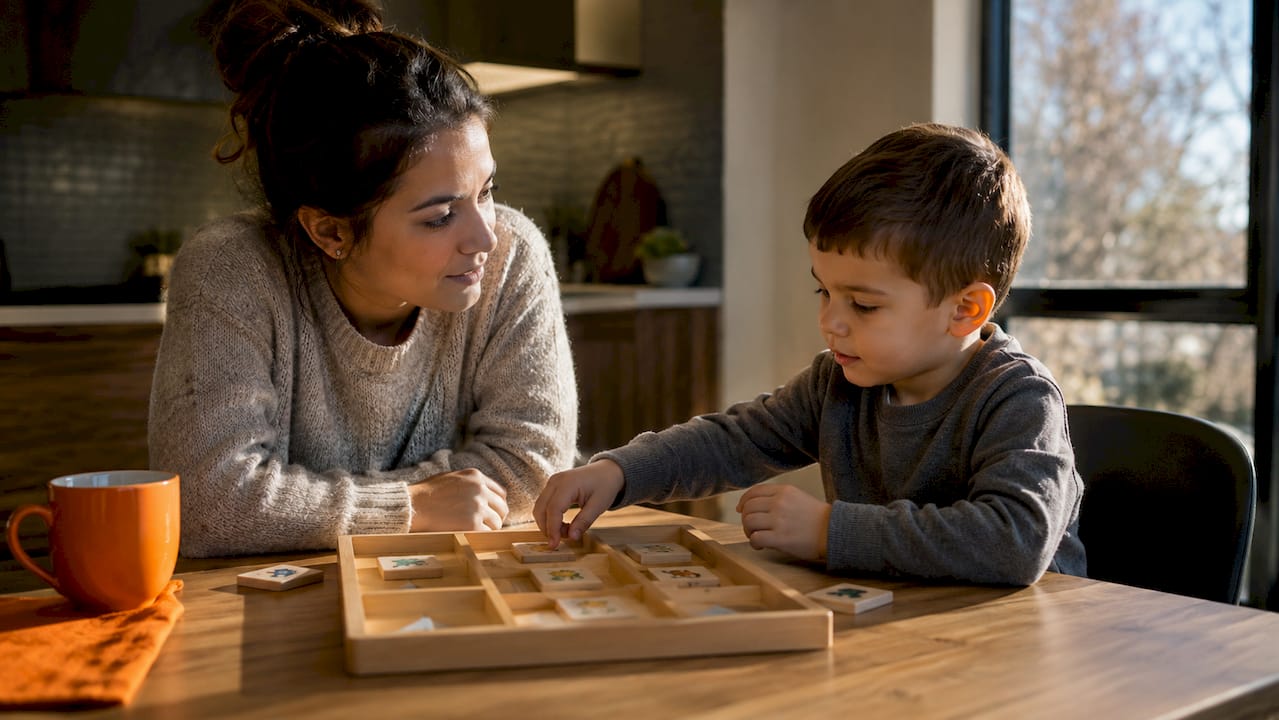
If your preschooler avoids eye contact, lines up toys instead of playing pretend, or melts down when the routine changes, you're likely watching the early signs of autism, not a phase to wait out. The right next step is simple: write down what you're seeing, call your pediatrician or your local early intervention program this week, and start one small support at home tonight. Autistic preschoolers who get help early tend to build language and social skills faster than those who wait.
TL;DR:
Most autistic preschoolers show clusters of social communication, repetitive behaviors, and sensory sensitivities, with many also experiencing anxiety and behavioral challenges.
Early intervention can foster language and social development, especially when tailored to a child's specific profile and involving family participation.
Simple daily strategies like visual schedules, scripted transitions, and linking activities to interests can make immediate improvements.
Parent-mediated communication supports and low-tech AAC tools are effective, with progress tracked through regular observation and personalized plans.
Address anxiety and meltdowns by identifying triggers, creating safe spaces, and preparing children for changes in routines to prevent escalation.
Table of Contents
What Are the Signs of Autism in Preschool-Aged Children?
Autism shows up differently in every child, but a few patterns repeat often enough that clinicians treat them as reliable flags. You're not looking for one dramatic behavior. You're looking for a cluster.
Social communication differences usually surface first. A preschooler might not point to show you something interesting, might struggle to take turns in back-and-forth play, or might play alongside other kids without ever really joining them. Pretend play often looks different too, sometimes absent entirely, sometimes fixated on the same script every time.
Language develops on its own timeline for autistic preschoolers. Some children speak in full sentences but take everything literally. Others repeat phrases from a favorite show (a pattern called echolalia). Some barely speak at all by age three. Longitudinal research has actually mapped this out into three distinct groups: language unimpaired, language impaired, and minimally verbal. Each group tends to respond to different kinds of intervention, which is part of why a one-size-fits-all approach rarely works.

Then there's the sensory and behavior side: insistence on sameness, repetitive movements like hand flapping or spinning, and reactions to sound, texture, or light that seem outsized to an outside observer but feel enormous to the child.
The CDC's guidance on autism signs groups these into three buckets worth tracking:
Social communication differences: limited eye contact, reduced joint attention, trouble reading facial expressions
Restricted or repetitive behaviors: rigid routines, intense narrow interests, repetitive motor movements
Sensory sensitivities: over- or under-reaction to sound, touch, taste, or light
A 2026 secondary analysis of 760 children found that roughly 76% of autistic preschoolers scored above the clinical range on standardized behavior checklists. That means most autistic preschoolers are dealing with more than the core autism traits alone. Anxiety, irritability, and behavioral struggles frequently ride alongside, which is exactly why early screening matters so much.
Why Early Intervention Actually Changes the Trajectory
Early intervention doesn't just help. It tends to reshape how a child's language and social skills develop over the following years. The evidence for this isn't thin or anecdotal, it comes from randomized trials and long-term cohort studies tracking real outcomes.
One intervention study found that autistic preschoolers with limited language who received active, structured early intervention gained about six months of language development over a six-month period. That's a meaningful pace, though results depended heavily on where each child started. Kids with stronger baseline social communication or receptive language tended to progress faster than those starting further behind.
The NICHD's overview of early intervention makes a point worth repeating to any parent feeling behind: individualized plans built around a child's specific profile outperform generic programs, and family involvement is a core ingredient, not an add-on.
A few things to keep in mind as you weigh options:
Outcomes vary widely based on a child's starting language and cognitive skills, so comparing your child's progress to another family's timeline rarely helps.
Parent-mediated approaches, where you're coached to use specific techniques during everyday moments, show real evidence of effectiveness and cost far less than clinic-only models.
Starting earlier gives more runway before kindergarten, but starting later still produces gains. There's no cutoff where intervention stops working.
Practical Strategies Parents and Teachers Can Use Today
You don't need a clinical degree to make a real difference this week. Small, consistent changes to routine and environment often do more than any single therapy session.
Build a visual schedule. Use photos or simple icons showing the sequence of the day, morning routine, preschool, snack, home. Post it somewhere your child passes constantly, like the kitchen or the front door, and walk through it together each morning. Visual supports reduce anxiety by making an uncertain day feel predictable.
Script transitions before they happen. A simple line like "In five minutes, we're leaving the park, then we're getting in the car" said twice, calmly, works better than a surprise announcement.
Set up sensory options in advance. A quiet corner with pillows, noise-canceling headphones, or a "heavy work" task like carrying books or pushing a loaded cart can help a preschooler regulate before a meltdown starts, not after.
Link activities to your child's interests. If your preschooler loves trains, use trains to teach turn-taking, counting, or waiting. Motivation built on genuine interest teaches faster than motivation built on compliance.
Practice in short, frequent bursts. Five minutes of focused practice, three times a day, beats one exhausting 30-minute session. Track what worked in a notebook or your phone so patterns emerge over weeks, not just days.
Pro Tip: Rehearse a new transition with a toy or stuffed animal before asking your child to do it themselves. Watching the "practice run" first lowers resistance more than any verbal explanation.
Communication and Language Supports That Actually Work
The strongest evidence points toward coaching parents directly, not just scheduling more therapy hours. Parent-mediated interventions train you to scaffold communication during ordinary moments, snack time, bath time, car rides, rather than confining language work to a therapist's office.
For preschoolers who are minimally verbal, low-tech augmentative and alternative communication (AAC) tools like communication boards give a child a way to express needs before speech catches up. Starting with a small board of five or six core words at home costs almost nothing and can reduce frustration-driven behavior fast.
Two structured approaches show up often in the research: JASPER, which builds joint attention and symbolic play, tends to help preschoolers with weaker social communication skills. DTT (Discrete Trial Training) uses repeated, structured practice and often benefits kids who need more explicit, step-by-step teaching. Which one fits depends on your child's language profile, so personalizing intervention to that profile matters more than picking the trendiest method.
Track new words or gestures weekly in a simple log
Ask your speech-language pathologist which profile (verbal, language-impaired, minimally verbal) best fits your child
Consider video modeling to teach routines your child can watch repeatedly
If your child isn't gaining new words over several months despite consistent practice, that's the moment to request a formal speech-language evaluation rather than waiting longer.
Managing Anxiety, Meltdowns, and Difficult Behavior
Anxiety in autistic preschoolers often looks less like worry and more like rigidity. A child terrified of uncertainty might refuse a new food, resist a changed route to school, or fall apart when a routine shifts by even ten minutes. That intolerance of uncertainty is a recognized driver behind many meltdowns, not simple defiance.
A 2024 pilot randomized trial of CLK-CUES, a parent-mediated program built specifically for this issue, found reduced uncertainty-related anxiety in 4 and 5 year olds, with benefits still holding a year later. That's a strong signal that teaching parents specific uncertainty-reduction techniques works, and works durably.
Identify a "safe space" at home and at preschool before a meltdown happens, not during one
Use calm, short scripts ("We're okay, this is new, let's look together") instead of long explanations mid-meltdown
Watch for patterns: does the same trigger appear repeatedly? Write it down.
Loop in a behavioral specialist or pediatric mental health provider if meltdowns escalate in frequency or intensity over several weeks
Pro Tip: Preview changes out loud the night before, even small ones like a new breakfast food or a substitute teacher. A ten-second warning the evening before often prevents a meltdown the next morning.
Getting an Evaluation and Choosing Services
Start with your pediatrician and simultaneously contact your state's Part C early intervention program (birth to three) or early childhood special education (three-plus). You don't need a diagnosis in hand to request an evaluation.
Expect a multi-step evaluation covering language, cognition, motor skills, and behavior, typically taking several weeks to a few months depending on your region's waitlists.
If funds or access are limited, prioritize parent coaching and communication supports first. They cost less than intensive clinic-based therapy and the evidence base is strong.
Ask providers directly about their experience with your child's specific language profile, and watch for red flags like vague promises of a "cure" or refusal to explain their methods.
A Caregiver-First Perspective From the Publisher
Feeling unsure whether what you're seeing is "enough" to act on is normal. Every parent second-guesses this. But you don't need certainty to start. A visual schedule tonight, a call to early intervention tomorrow, one small win this week. Autism Victory App exists because families need practical company on this path, not just clinical paperwork.
— Ronnie Talent
How Autism Victory App Supports Families Like Yours
Once you're actively watching for signs or waiting on an evaluation, the hardest part is often knowing what to do between appointments. Autism Victory App is built for exactly that gap, giving you daily tools instead of a waiting room.
The app offers AI guidance to help translate clinician recommendations into practical activities, plus a resource navigator to help find local funding and services. Caregiver guides, educational videos, and audiobooks provide helpful information so you're never stuck googling at midnight. None of this replaces therapy or your school's early childhood special education team. It complements them, helping you track progress between sessions, prep for IEP meetings, and practice the same techniques your child's providers are already using.
If you're at the beginning of this process or years into it and still looking for steadier footing, start a free trial with Autism Victory App and see what fits your family this week.
Recommended