
Autism is classified as a disability because it involves lifelong differences in brain development that can substantially limit major life activities like communication, learning, and self-care. The CDC tracks it as a developmental disability, while the ADA and IDEA legally protect and support people with the diagnosis. Support needs vary widely across the spectrum, but that classification is what unlocks legal protections, school services, and financial assistance for families.
TL;DR:
Autism is considered a disability because it involves lifelong brain development differences that can significantly impact communication, learning, and self-care activities.
About 1 in 36 children in the U.S. are diagnosed with autism spectrum disorder, prompting early screening and service planning across education and healthcare systems.
Federal laws like the ADA and IDEA provide protections and access to services, but support depends on how autism limits specific activities in daily life.
Functional assessments, documented examples, and impact on daily tasks are crucial for qualifying for educational, workplace, or financial support programs.
The Autism Victory App helps families navigate state-specific paperwork and support options, reducing delays and administrative barriers after diagnosis.
Table of Contents
How U.S. Law Treats Autism: ADA, IDEA, and Disability Benefits
Medical Model, Social Model, and Neurodiversity: Three Lenses on One Diagnosis
What Disability Classification Actually Unlocks for Families
Why Is Autism Considered a Disability, Medically Speaking?
Autism spectrum disorder shows up early, usually before a child turns two, and it centers on two core features: differences in social communication and restricted or repetitive patterns of behavior. Clinicians classify it as a neurodevelopmental condition, meaning the brain itself develops and processes information differently from birth, not as the result of injury or later illness. That's the clinical basis for calling it a developmental disability. It's a difference present from the start of life that shapes how a person learns, communicates, and interacts with the world around them, according to the CDC.
The scale of this matters for how services get planned and funded.
By the numbers: About 1 in 36 children in the U.S. are identified with ASD, according to CDC surveillance data.
A few things follow from that prevalence rate:
School districts and state Medicaid programs use it to project service demand.
Pediatricians rely on it to justify universal autism screening at 18 and 24 months.
Researchers use it to track whether early identification efforts are working.
Understanding autism disability from this angle, brain based, present early, measurable at population scale, is what separates a medical diagnosis from a vague behavioral label.
How U.S. Law Treats Autism: ADA, IDEA, and Disability Benefits
Autism and disability rights in the U.S. run through two main federal laws, and they do different jobs. The Americans with Disabilities Act defines disability as a physical or mental impairment that substantially limits one or more major life activities. Autism frequently meets that bar, which is why the ADA protects autistic people from discrimination in employment, public accommodations, and government services.
The Individuals with Disabilities Education Act works differently. It doesn't govern discrimination; it authorizes public schools to identify autistic children and build an Individualized Education Program (IEP) around their specific needs. A diagnosis under IDEA's autism category is often the key that opens the door to speech therapy, occupational therapy, and classroom accommodations at no cost to families.
A few distinctions worth keeping straight:
ADA protects against discrimination and requires reasonable accommodations in workplaces and public life.
IDEA guarantees a free, appropriate public education and funds school-based therapies through an IEP.
Social Security disability benefits (SSI or SSDI) are separate again, they're income-support programs with their own medical and financial eligibility rules, not automatic just because a diagnosis exists.
Is autism considered a disability under all three frameworks? Usually yes, but each one asks a different question and delivers a different kind of support.
When Does Autism Functionally Count as a Disability?
Legal protection and educational support hinge on function, not just paperwork. The real test asks whether autism limits activities like communicating, learning, working, or handling daily self-care. Two people with the same diagnosis can look completely different in practice: one adult might live independently, hold a job, and need only workplace accommodations, while another may need daily support with dressing, eating, or staying safe.
The ADA Amendments Act pushed courts toward a broad reading of "substantially limits," and it also says mitigating measures, like coping strategies or medication, generally can't be used to argue someone isn't disabled. That protects people whose support strategies are working well from losing coverage because they're succeeding.
A quick way to think through support needs:
List the daily tasks that require more time, help, or accommodation than would be typical.
Note where those limitations show up: school, work, home, or social settings.
Gather documentation, evaluations, therapy notes, teacher observations, that describes the impact, not just the diagnosis.
Pro Tip: Disability determinations rarely hinge on the diagnosis alone. Reviewers and IEP teams want specific, dated examples of what a person can't yet do independently, so keep a running log rather than trying to reconstruct it later.
Medical Model, Social Model, and Neurodiversity: Three Lenses on One Diagnosis
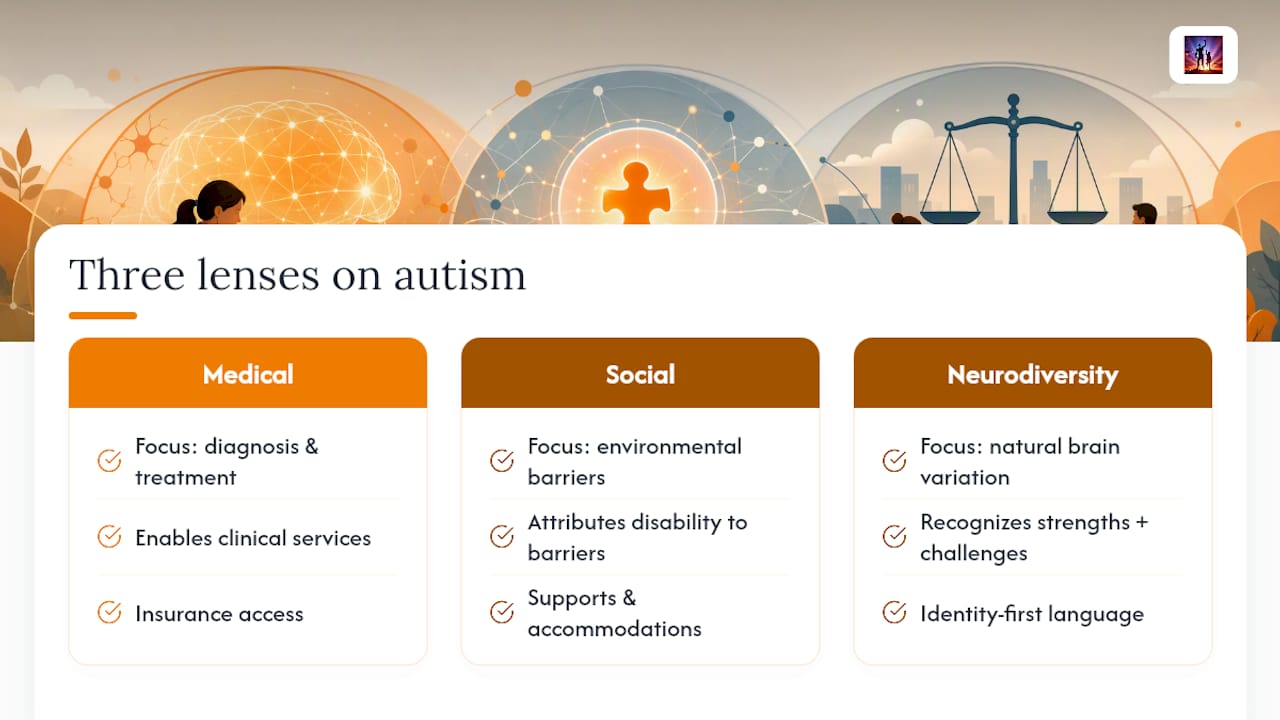
The medical model treats autism as a condition to diagnose and treat, and it's the framework that opens the door to clinical services and insurance coverage. The social model flips the emphasis: it argues that much of the disability autistic people experience comes from inaccessible environments, rigid classrooms, inflexible workplaces, sensory-hostile spaces, rather than from autism itself. The World Health Organization backs this up, noting that societal attitudes and supports strongly shape quality of life across the spectrum.
Neurodiversity adds a third layer, framing autism as a natural variation in how brains process the world, carrying genuine strengths alongside real challenges. That's also why many autistic adults prefer identity-first language ("autistic person" over "person with autism"), a small choice that carries real weight in advocacy spaces.
What Disability Classification Actually Unlocks for Families
Once autism is formally recognized as a disability, it becomes the key to a specific set of doors. Here's what typically opens up:
IEPs or 504 plans for school-based therapy, classroom modifications, and specialized instruction.
Workplace accommodations under the ADA, adjusted schedules, sensory-friendly workspaces, modified communication expectations.
Medicaid waivers that fund in-home therapy, respite care, and long-term support services outside of institutional settings.
Early intervention programs, which the CDC notes can meaningfully improve developmental outcomes when started young.
Before making calls, gather diagnostic reports, school records, and any prior therapy evaluations, that paperwork is what moves applications forward instead of stalling in a queue. Start with the pediatrician for a referral and the school psychologist for an educational evaluation; both can point you toward next steps. If respite care or Medicaid waiver funding feels overwhelming to navigate alone, state-specific financial assistance guides can shorten the learning curve considerably.
What Families Taught Me About Getting the Label Right
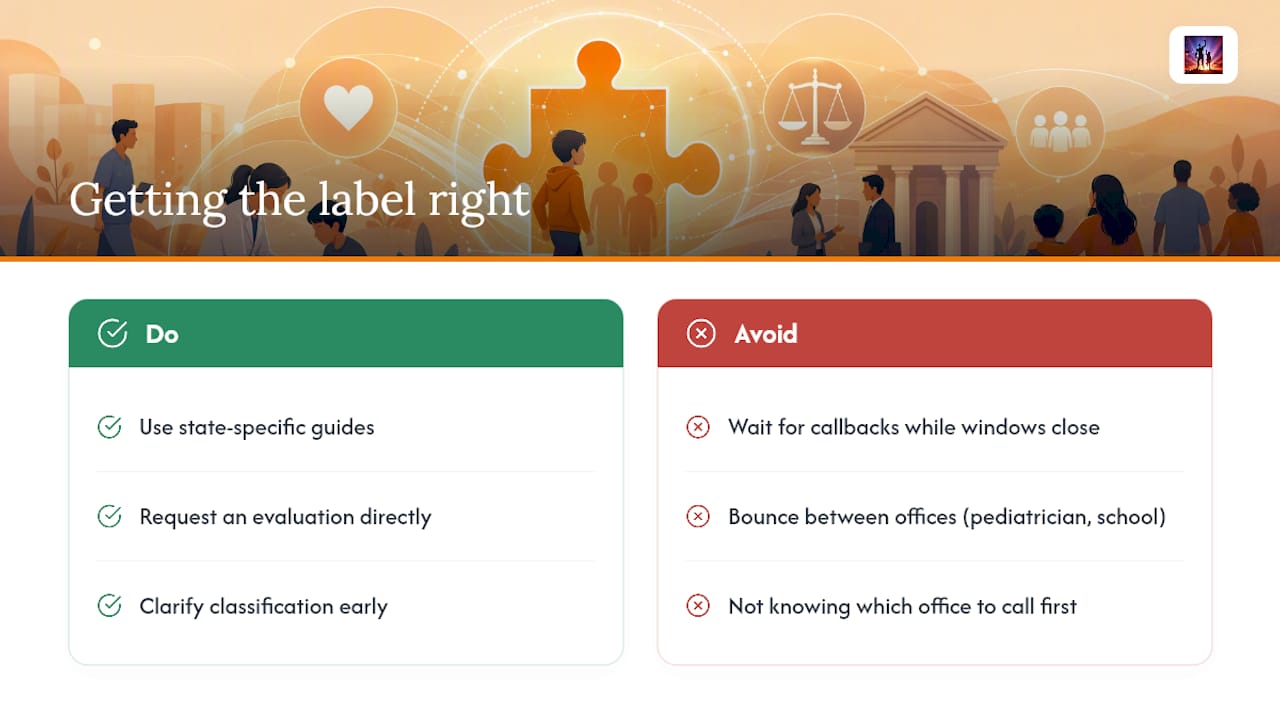
Working alongside families through the diagnosis-to-services pipeline, I've noticed the same pattern over and over: parents don't get stuck on whether their child "seems disabled enough." They get stuck on paperwork, on not knowing which office to call first, on watching early-intervention windows close while they wait for a callback. One mother spent four months bouncing between her pediatrician and her school district before anyone told her she could request an evaluation directly. That's not a medical failure. It's an administrative one.
Autism Victory App's state-specific guides exist because that gap is real and it's fixable. Clear classification isn't about a label for its own sake, it's about removing the guesswork that keeps families stuck at the starting line.
— Ronnie Talent
Turn a Diagnosis Into a Plan With Autism Victory App
Getting the classification is one step. Figuring out which Medicaid waiver your state offers, how long the waitlist runs, and which financial assistance programs you actually qualify for is a separate, much harder problem, and it's the one that burns out caregivers fastest. Autism Victory App exists for exactly this gap: a state-specific resource navigator built specifically for the paperwork maze that comes after diagnosis.
Inside the app, you'll find state-by-state guides to financial assistance and Medicaid waiver waitlists, AI-powered guidance that answers your specific questions instead of generic ones, caregiver-focused books and audiobooks in English and Spanish, and a community of parents who've already walked this path. Instead of piecing together information from a dozen government websites, you get it centralized and organized by your state. Start your free trial at Autism Victory App and see how much faster the next step gets when someone's already mapped the road for you.
Sources
This article is general information, not a substitute for advice from a qualified doctor. Consult a qualified healthcare professional about your own circumstances before acting on anything here.
Recommended