
ASD stands for Autism Spectrum Disorder, a neurodevelopmental condition marked by differences in social communication and by restricted or repetitive patterns of behavior. It's diagnosed using standards set by the American Psychiatric Association's DSM-5, and NIMH treats these criteria as the clinical reference point for evaluation. The word "spectrum" doesn't describe a line from mild to severe. It describes a wide range of strengths, challenges, and support needs that can shift over a person's lifetime.
Key Takeaways
ASD is a lifelong neurodevelopmental condition, diagnosed through DSM-5 criteria, that affects a portion of the global population and responds best to early, coordinated support rather than a search for a cure.
Point | Details |
|---|---|
ASD meaning | Stands for Autism Spectrum Disorder, defined by social communication differences and restricted or repetitive behaviors. |
Spectrum, not severity line | Traits and support needs vary widely between individuals and can change over a lifetime. |
Diagnosis timing | A reliable diagnosis is often possible by age 2, though many people are identified later, especially if they mask traits. |
Global prevalence | WHO estimates that a small percentage of people worldwide have ASD, based on 2021 data. |
No single cause | Genetics, prenatal factors, and gene-environment interactions all play a role; vaccines do not cause autism. |
Treatment goal | Early intervention and therapies build skills and quality of life rather than eliminating autism. |
Table of Contents
What Does the ASD Spectrum Actually Look Like?
Clinicians group ASD traits into three clusters, and you'll see this same structure whether you're reading a diagnostic report or a school evaluation.
Social communication differences: trouble reading tone or facial expression, difficulty with back-and-forth conversation, or a preference for parallel play over shared play.
Restricted or repetitive behaviors: intense focus on specific topics, insistence on routines, repetitive movements (sometimes called stimming), or lining up objects.
Sensory differences: over- or under-reactions to sound, light, texture, or pain, according to the CDC.
How these show up depends heavily on age. An infant might not respond to their name or make limited eye contact. A preschooler might echo phrases from a favorite show instead of using original speech, or melt down over a changed routine. A teenager or adult might have strong verbal skills but struggle to read sarcasm, keep a job interview on track, or manage sudden schedule changes.
Pro Tip: Many autistic girls and adults learn to "mask" their traits, consciously copying social scripts and suppressing repetitive movements in public. This is a major reason ASD often gets missed or diagnosed decades later in women and people who were high-achieving as kids.

How Do Doctors Diagnose ASD?
Screening and diagnosis are two different steps, and mixing them up causes a lot of unnecessary confusion for families. A screening, like the checklist a pediatrician runs at a well-child visit, flags whether a fuller evaluation is worth pursuing. It is not a diagnosis. A formal diagnostic evaluation is a deeper clinical process, and a reliable diagnosis is often possible by age 2, though plenty of people are identified later.
Diagnosis relies on clinical judgment rather than a blood test or brain scan. Evaluators look at developmental history and observed behavior, and caregiver observations are a critical input to that process. Under DSM-5, the pattern needs to include persistent differences in social communication plus restricted or repetitive behaviors, both appearing early in development and both affecting daily functioning in some meaningful way.
Who can actually run this evaluation? Several kinds of clinicians, often working as a team:
Pediatricians and developmental pediatricians
Child neurologists
Child psychologists or psychiatrists
Multidisciplinary teams that may include speech and occupational therapists
Bring specific questions to the appointment: What tools will you use to evaluate my child? What does a diagnosis change about services we can access? Can you refer us to early intervention while we wait on results? A detailed log of milestones and behaviors, kept before the appointment, speeds up and sharpens the evaluation considerably.
When Do Signs of ASD Usually Appear?
Signs often surface within the first 12 months of life and typically become more consistent and noticeable by ages 2 to 3. Some children develop typically until around 18 to 24 months, then plateau or lose skills they'd already gained, a pattern that can push identification later than a newborn screening would ever catch.
How common is ASD? The World Health Organization estimates global prevalence at roughly 1 in 127 people, based on 2021 data. That figure measures how many people in a population have the condition at a given time, not how many are newly diagnosed each year.
Plenty of people, especially those who learned to mask their traits or whose presentation didn't match outdated stereotypes, aren't diagnosed until adolescence or adulthood.
What Causes ASD?
Researchers haven't pinned down a single cause, and that's frustrating for families who want a clean answer. What the evidence does support is a mix of factors working together.
Genetic differences, including both inherited variants and spontaneous mutations
Certain prenatal and perinatal factors, such as complications during pregnancy or birth
Complex interactions between genes and environment that researchers are still mapping out
No credible evidence links vaccines to autism. That myth has been studied extensively and consistently disproven, yet it persists partly because autism traits often become noticeable around the same age children receive routine vaccinations. Timing isn't causation.
It helps to separate a "risk factor" from a "cause." A risk factor raises the statistical odds something happens; it doesn't guarantee it and it doesn't explain the mechanism. Researchers still have real gaps in understanding exactly how genetic and environmental threads combine to produce ASD in any one individual.
What Conditions Commonly Occur Alongside ASD?
Autism rarely travels alone. Several conditions show up often enough that clinicians routinely screen for them alongside ASD itself:
ADHD
Anxiety disorders
Intellectual disability
Epilepsy
Sleep differences
Gastrointestinal issues
Language disorders
These are clinically distinct from autism itself, but they shape what supports actually work. A child with autism and untreated anxiety may need a different classroom plan than a child with autism alone. Raise these possibilities directly with your clinician rather than waiting for them to bring it up. If ADHD traits are part of the picture, our guide to autism and ADHD overlap breaks down how the two get told apart in practice.
What Treatments and Supports Actually Help?
The goal of treatment isn't to eliminate autism. It's to build function, expand quality of life, and open up participation in school, work, and relationships. Early intervention services can meaningfully improve development and daily functioning, though intervention isn't a cure and nobody credible frames it that way.
Common supports include:
Behavioral approaches, including techniques drawn from applied behavior analysis, aimed at building specific skills
Speech and language therapy for communication differences
Occupational therapy for sensory processing and daily living skills, worth pairing with practical strategies like a sensory diet approach
Social skills groups or coaching for navigating peer interaction
Educational accommodations, such as an Individualized Education Program (IEP) or 504 plan in US schools
Medications, used not to treat autism itself but to manage co-occurring conditions like anxiety, ADHD, or sleep disruption
Getting started usually means asking your pediatrician for a referral to a developmental specialist, or contacting your state's early intervention program directly if your child is under three. Ask providers what specific outcomes they're targeting and how progress gets measured. If you're in the first weeks after a diagnosis, our first 30 days guide walks through the practical sequence of next steps.
Funding is often the real bottleneck, not finding a provider. State programs, insurance mandates, and waiver services vary enormously, and navigating them is its own project. The Autism Victory App includes a state-specific funding and support resource navigator built specifically to help caregivers cut through that maze.
What Are the Biggest Misconceptions About ASD?
A few myths keep circulating and they do real damage, so it's worth naming them directly:
"ASD is a mental illness." It isn't. It's a neurodevelopmental difference, distinct from co-occurring mental health conditions like anxiety or depression, which are treated in parallel rather than as part of autism itself.
"Bad parenting causes autism." No. This idea has no scientific basis and it's actively harmful to families.
"All autistic people are the same." Also no. The spectrum spans enormous variation in communication style, support needs, and strengths.
"Early intervention cures autism." It doesn't. It builds skills and improves quality of life. Autism itself is lifelong.
Language matters here too. Many autistic self-advocates prefer identity-first language ("autistic person") over person-first phrasing ("person with autism"). When in doubt, ask the person or family how they describe themselves, and follow their lead.
Why This Explainer Exists
We built Autism Victory App because caregivers deserve clinician-informed answers without wading through jargon or conflicting advice at 2 a.m. Our platform pairs AI-powered guidance with state-specific resource navigation, so you're not starting from zero. If you're newly navigating a diagnosis, the Autism Victory App puts trusted information and practical tools in one place.
Frequently Asked Questions
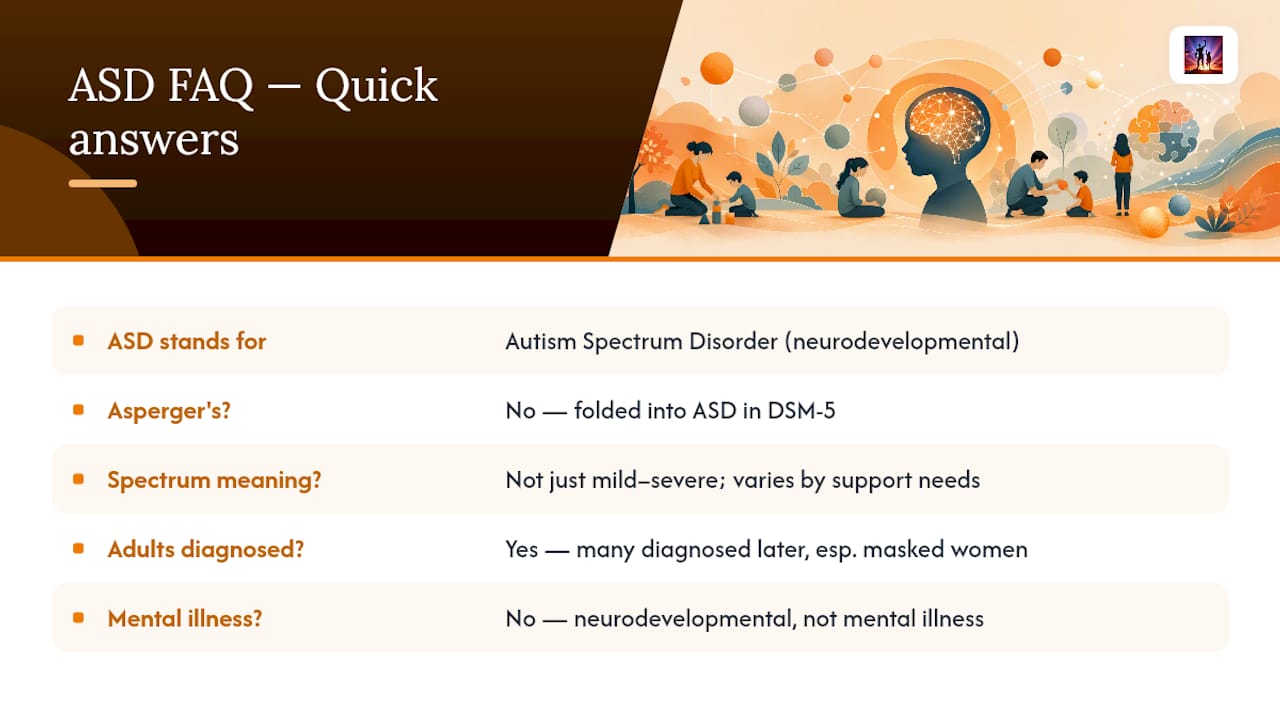
What does ASD stand for? ASD stands for Autism Spectrum Disorder, a neurodevelopmental condition involving differences in social communication and restricted or repetitive behaviors, as defined by the DSM-5.
Is ASD the same thing as Asperger's syndrome? Not anymore in clinical terms. DSM-5 folded Asperger's and several other previously separate diagnoses into one umbrella category, ASD, because they share core neurodevelopmental traits.
Does "spectrum" mean mild to severe? No. It reflects a wide range of strengths, challenges, and support needs rather than a single line from mild to severe, and that mix can shift as a person grows.
Can adults be diagnosed with ASD? Yes. Many adults, particularly women who learned to mask traits early on, are diagnosed later in life after years of misattributed anxiety or social struggles.
Is ASD a mental illness? No. It's a neurodevelopmental difference, not a mental illness, though co-occurring conditions like anxiety or ADHD are common and treated separately.
Where can families find help figuring out funding and services? State programs and insurance rules vary significantly. Guides like our autism financial assistance overview and awareness resources like Hub Security & Investigative Group's autism guide offer starting points, alongside your pediatrician's referral network.
This article is general information, not a substitute for advice from a qualified doctor. Consult a qualified healthcare professional about your own circumstances before acting on anything here.
Sources
Recommended