
A school autism evaluation is a free, education-based assessment run by your public school district. It decides whether your child qualifies for special education under the autism category and what services an IEP should include. You can request it in writing without a doctor's referral or a medical diagnosis, and the school must follow federal and state consent and timeline rules once you do.
This guide walks you through how a school evaluation differs from a clinical one, how to ask for it, what the team looks at, how long it takes, and what to do if you disagree with the result.
TL;DR
A school evaluation answers an educational question (does autism affect learning and require specially designed instruction?). A medical diagnosis answers a clinical one.
You do not need a diagnosis or a doctor's referral to ask for a school evaluation. Put your request in writing to the school or district.
Timelines are set by each state. Colorado and New York use 60 days from consent; Texas uses 45 school days, then a separate eligibility decision.
If you disagree with the results, you can ask for an independent educational evaluation at public expense, and you have further dispute options.
A medical diagnosis can help your case, but it does not by itself guarantee eligibility.
Table of Contents
School evaluation vs. medical diagnosis
These two processes share a name and a lot of overlap, but they do different jobs.
A clinical diagnosis is made by a doctor or clinical psychologist using DSM-5 criteria. The Nebraska Autism Spectrum Disorders Network explains that a school district's educational identification instead determines disability, special education eligibility, and the appropriate services. Understood adds that school identification rests on IDEA eligibility and educational functioning, while a clinical diagnosis need not affect school performance.
Here is the practical comparison:
School evaluation | Medical evaluation | |
|---|---|---|
Who runs it | School district team | Doctor, psychologist, or specialty clinic |
Basis | IDEA eligibility and state rules | DSM-5 criteria |
Main question | Does autism adversely affect education or require specially designed instruction? | Does the person meet criteria for autism spectrum disorder? |
Where | Mostly in school settings | Usually an office or clinic |
Result | Eligibility decision and, if eligible, an IEP | Diagnosis and treatment recommendations |
Michigan's state guide on education-based evaluations notes that clinicians use DSM-5 and clinical tools such as the ADOS, while school teams choose assessment tools based on the educational questions they have to answer. Vanderbilt Kennedy Center makes a similar point: the school asks whether the student meets the special education autism category and whether the disability affects education.
Two things follow from this:
A diagnosis does not automatically mean school services. Colorado's guidelines say a medical diagnosis may be considered but does not by itself guarantee IDEA eligibility.
School services do not require a diagnosis. The CDC says a doctor's referral or medical diagnosis is not required to ask your local school system for an evaluation.
Many families do both: a clinical evaluation for a diagnosis and treatment planning, and a school evaluation for educational supports. They can feed each other. If you are also wondering how autism relates to learning disability categories, our post on why autism is not a learning disability explains how schools think about it.
How to request a school autism evaluation
The process starts with you. Here is how to do it well.
Step 1: Write the request
Contact your local public school system, your child's elementary school, or the board of education and ask how to have your child evaluated. Do it in writing, even if you also call. Illinois Legal Aid Online explains that a parent may request an evaluation at any time by writing to the principal, describing concerns and the areas to be assessed.
A short, clear letter or email should include:
Your child's full name, date of birth, and school (if enrolled)
The date of your request
A plain statement: "I am requesting a full and individual evaluation for special education eligibility"
Your concerns (communication, social interaction, sensory needs, behavior, learning) with a couple of specific examples
Any areas you want assessed, such as speech-language or occupational therapy
A note that you are attaching any outside reports, if you have them
Keep a copy and note who received it and when.
Step 2: Know your child does not need to be in kindergarten yet
The CDC says families can request a Child Find evaluation through the local public school system, including when a child is not yet kindergarten age or is not enrolled in public school. If your child is a toddler, early intervention programs are the usual starting point, and the school district takes over at preschool age in many states.
Step 3: Expect a response with rules attached
States set their own response clocks. In Texas, the state's SPED Support guidance says that after a written parental request the district must provide prior written notice, procedural safeguards, and an opportunity to consent to evaluation, or else a written notice refusing the evaluation. In New York City, official guidance says the principal or Committee on Special Education chair must respond to a written referral within 10 days.
If the school refuses, it should tell you why in writing. Do not accept a verbal "he's fine" as the end of the matter.
Step 4: Don't let interventions delay the request
Schools sometimes suggest trying classroom strategies first. Illinois Legal Aid says interventions such as RTI or MTSS cannot replace or delay an evaluation you have requested. Supports are welcome, but they run alongside your request, not instead of it.
Spanish-speaking families can find the same walk-through in our guide to solicitar una evaluación escolar de autismo paso a paso.
What happens during the evaluation
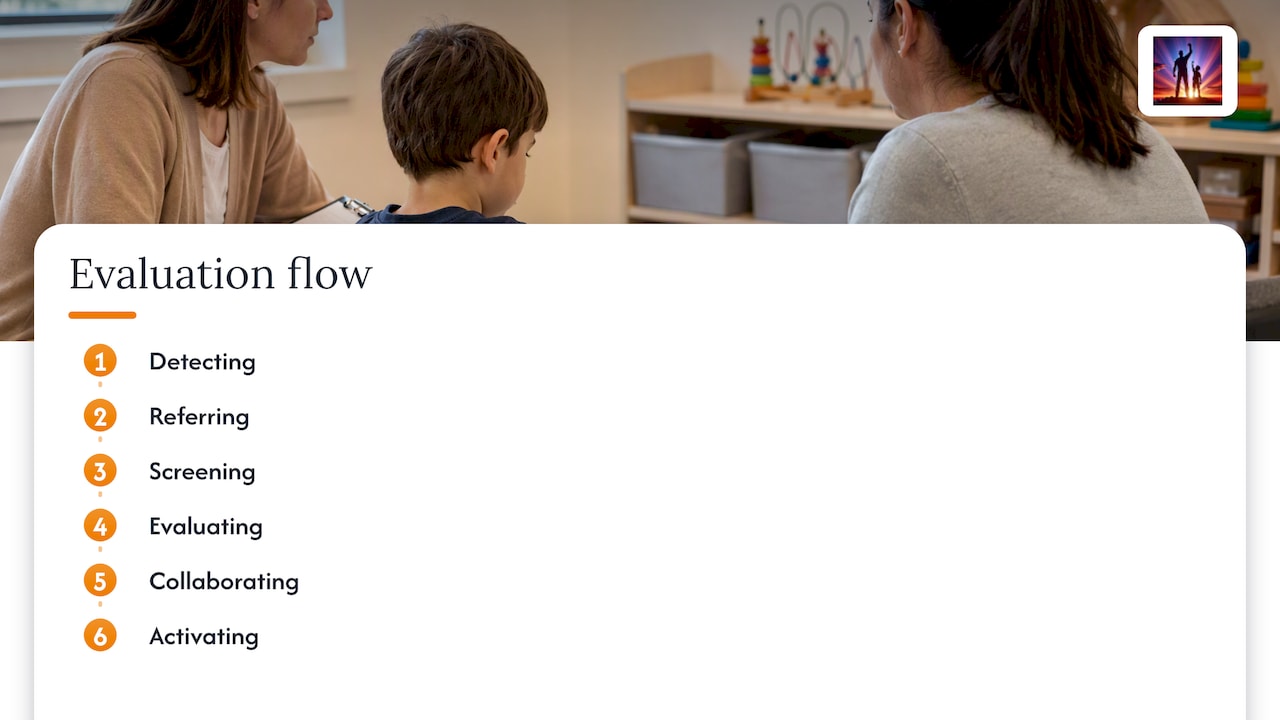
The details differ by state, but the structure is similar. Colorado's guidelines for the educational evaluation of autism describe a flow of detecting, referring, screening, evaluating, collaborating, and activating. Families and school staff both contribute before the team decides eligibility and turns the findings into an IEP.
What the team may look at
According to Colorado's guidelines, information gathered may include:
Academic achievement
School observations
Direct observation of social and communicative behavior
A family interview and developmental history
Assessment of autism characteristics
Teacher and family reports
Michigan says school evaluation generally involves a multidisciplinary team, a review of existing evaluation data, and observations across varied environments over time. That matters: a child may present differently in a quiet testing room, a loud cafeteria, and at home.
New York's 2025 parent guide lists required initial evaluation components: a physical examination, a psychological evaluation when applicable, a social history, an observation in the educational setting, and other appropriate assessments such as speech-language or a functional behavioral assessment. Students age 12 or older also get a vocational assessment. Texas describes its initial evaluation as comprehensive, determining both whether the child meets disability criteria and what the child's educational needs are.
Who is on the team
This varies, but Michigan's rules show what one state requires: a psychologist or psychiatrist, an authorized provider of speech and language services, and a school social worker. Other members may join but are not required. You are a member of the process too. You know your child's history better than anyone in the building.
Making evaluation day easier
Children on the spectrum often do better with preparation. Tell the team about sensory triggers, communication supports, and routines that help. If a child is in pain or overwhelmed by sensory input, results can be harder to read, so it helps to rule out physical sources of distress beforehand. For example, sensory-aware ear care for autistic children is one area some families look at when sound sensitivity or ear discomfort seems to play a part.
Also consider:
Asking whether a familiar person can be present for part of the sessions
Sharing a one-page profile of what calms and what overwhelms your child
Requesting a break schedule
Bringing work samples, videos, or notes showing how your child behaves at home
How long it takes and what consent means
Schools must get your informed written consent before the initial evaluation, and they must give you required notices and procedural safeguards. The clock typically starts when the district receives your consent, not when you first ask.
Timelines are state-specific:
State | Evaluation deadline | Eligibility decision |
|---|---|---|
Colorado | 60-day timeline beginning at consent | Follows the team's review |
New York | 60 calendar days after the district receives consent | Follows the evaluation |
Texas | 45 school days after written consent | Within 30 calendar days of the written report |
Sources: Colorado Department of Education, NYSED, and Texas SPED Support.
There are exceptions. New York's guide says the 60 days can be extended if, for example, a parent repeatedly fails or refuses to make the child available. Texas has summer and end-of-school-year exceptions to its 30-day eligibility window. Check your own state department of education's page for the current rules.
How schools decide eligibility and write the IEP
After the evaluation, the team meets with you. Colorado's guidelines say the team reviews all the data, decides whether the student meets the disability category, and asks whether autism adversely affects educational performance or creates a need for specially designed instruction.
That second question trips up many parents. A child can clearly be autistic and still be found ineligible if the school team concludes that school performance is not affected and no specialized instruction is needed. This is where your input, work samples, and outside reports carry weight, because "educational performance" includes social, communication, and behavior needs, not only grades.
If your child is eligible, the team uses the findings to develop an IEP. If not, ask about other routes. Our comparison of IEP vs. 504 plans for autism shows how accommodations can still be put in place without an IEP, and our complete parent's guide to the IEP covers what comes next when your child qualifies.
If you disagree with the results
You are not stuck with the first answer. Under federal regulations, a parent has the right to an independent educational evaluation (IEE) at public expense if they disagree with an evaluation obtained by the school. The same rule limits you to one IEE at public expense each time the school conducts an evaluation you disagree with.
Practical steps:
Say so in writing. State that you disagree with the evaluation and are requesting an IEE at public expense.
Ask for the school's IEE criteria. Districts usually have rules about evaluator qualifications and location. A private evaluator who meets them is easier to get reimbursed.
Expect one of two responses. The district either pays for the IEE or files for a due process hearing to show its evaluation was appropriate. Under the federal rule, the agency must otherwise ensure the IEE is provided at public expense unless it shows in a hearing that the parent's evaluation did not meet agency criteria.
Know the wider options. Understood's overview of IDEA safeguards says you can negotiate with the school, use mediation, or file a due process complaint, and you can also file a state complaint if the school is violating IDEA.
If the conflict is escalating, consider contacting your state's Parent Training and Information Center or a special education attorney for advice on your state's procedures.
Our perspective
We built Autism Victory because the hardest part of this process is rarely the form. It is the feeling of facing a system with its own language, deadlines, and acronyms, while also parenting a child who needs help now.
We see three patterns again and again. First, families wait for a diagnosis before asking the school for anything, when the school process can run in parallel. Second, families make verbal requests that disappear. Written requests create a timeline and a record. Third, parents walk into eligibility meetings without having written down their child's strengths and needs in their own words.
Our advice: treat the evaluation as a conversation in which you are the expert on your child. Keep a folder. Write things down. Ask what each assessment measures and why. You do not have to agree on the spot.
And be kind to yourself. This process is slow, sometimes frustrating, and entirely survivable. Families get through it every day.
— Ronnie Talent
Keep every step organized with Autism Victory
Between evaluation requests, deadlines, IEP meetings, and state-specific resources, it is easy to lose track. The Autism Victory app brings caregiver-focused books and audiobooks, personalized AI guidance, state-specific financial and support resources, educational videos, and a caregiver community into one mobile app. Content is available in English and Spanish.

Plans are $6.95 per month or $49.95 per year, with a 5-day free trial. You can also explore the Autism Victory homepage to see what is inside.
FAQ
Do I need a medical diagnosis to get a school autism evaluation?
No. The CDC says a doctor's referral or medical diagnosis is not required to request an evaluation from your local public school system. The school evaluates for educational eligibility, which is a different question from a clinical diagnosis. If you already have a diagnosis, share it, since it can inform the team.
Does a school evaluation cost anything?
The evaluation is conducted by the public school district as part of its special education obligations, so you should not be billed for it. If you disagree with the results, you can ask for an independent evaluation at public expense under the federal rule cited above.
Can my child be diagnosed with autism by the school?
Not in the clinical sense. Schools determine whether a student meets the educational autism category and needs specially designed instruction. A doctor or clinical psychologist makes a medical diagnosis using DSM-5 criteria. The two results can differ.
How long does a school evaluation take?
It depends on your state. Colorado and New York describe 60 days from consent, while Texas requires completion within 45 school days after written consent, plus an eligibility decision within 30 calendar days of the report. Check your state department of education for current rules.
What if the school says my child does not qualify?
Ask for the written explanation and the data behind it. You can request an independent educational evaluation at public expense, try mediation, or file a due process complaint. You can also ask about a 504 plan for accommodations.
Sources
Education-Based Evaluations for Autism Spectrum Disorder (Michigan)
For Educators: Understanding the Medical and the Educational Models (Vanderbilt Kennedy Center)
Educational Identification of Autism (Nebraska Autism Spectrum Disorders Network)
Requesting a special education evaluation (Illinois Legal Aid Online)
Guidelines for the Educational Evaluation of Autism (Colorado Department of Education)
Special Education in New York State for Preschool and School-Age Children (NYSED, 2025)
Sec. 300.502(b), Independent educational evaluation (IDEA regulations)
Recommended


