Early intervention is a set of services for babies and young children with developmental delays, and in the US you can start it yourself, without a diagnosis. For children from birth through age 2, you contact your state's early intervention program and ask for an evaluation. For children 3 and older, you contact your local public school district. Both routes are free to request, and the CDC says you do not need a doctor's referral to begin.
This guide walks through the age ranges, the exact steps, the timeline the law sets, what therapy can look like, and how to keep the process moving when it stalls.
TL;DR
Birth to age 2: call your state's early intervention program (called Part C under federal law) and ask for a free evaluation. You can self-refer.
Age 3 and up: contact your local public school district and request an evaluation for preschool special education. Your child does not have to attend that school.
You do not need to wait for an autism diagnosis. Programs look at developmental delays in areas like communication, motor skills and social engagement.
The federal clock is 45 days from referral to the initial evaluation and the family service plan, with limited exceptions.
Parent coaching counts. Research increasingly supports teaching parents to build skills into everyday play and routines.
Table of Contents
What early intervention means (and what it does not)
The CDC uses the term for services and supports for babies and young children with developmental delays and disabilities and their families. It is not one therapy. It is a front door to several: speech-language therapy, occupational therapy, developmental instruction, family training and more, depending on what your child needs.
Two points trip up many families:
Early intervention is not the same as an autism diagnosis. Eligibility is based on developmental delay, not a diagnostic label.
It is not the same as clinic-based ABA. Applied behavior analysis is one approach some families choose. Early intervention is the public system that evaluates your child and writes a plan. We cover the ABA question further down.
Early intervention by age: where to go
The answer to "how old does my child have to be" depends on which door you use. Under the Individuals with Disabilities Education Act (IDEA), there are two main tracks.
Child's age | Where to start | What you request |
|---|---|---|
Birth through age 2 | Your state's Part C early intervention program | A free evaluation and, if eligible, an Individualized Family Service Plan (IFSP) |
Age 3 and older | Your local public school district | An evaluation for preschool special education services |
Per the CDC's guidance on accessing services, services for the youngest group are publicly funded, and preschool special education is available even if your child does not attend the school.
The program name changes by state. It might be called Early Intervention, Early Start, Early Childhood Intervention or something else. Search "[your state] Part C early intervention" and look for the official state agency page, not a private provider.
What if my child is close to turning 3?
Do not wait for the birthday. The move from the birth-to-2 system to the school district system involves paperwork and planning, so start asking your service coordinator about the transition well before your child turns 3. If your child is already past 3, skip straight to the school district request.
Do you need a diagnosis first? No
This is the most expensive misunderstanding in the whole process. Many parents assume they must wait for a specialist to confirm autism before asking for help. In reality, early intervention programs evaluate developmental delays across areas like communication, motor skills and social engagement. Waiting for a formal evaluation can mean losing months of support during a period when children are developing fast.

Pediatricians usually screen for autism at the 18-month and 24-month checkups, or whenever you or others have concerns. A child can be diagnosed at any age. But you do not have to line your appointments up in that order. Request the early intervention evaluation and pursue the diagnostic evaluation in parallel.
The NICHD notes that early diagnosis and interventions are more likely to have major long-term positive effects on symptoms and later skills. That is a reason to move, not a reason to panic. If your child is older than the ages in this guide, services still help.
Some concerns that come up alongside autism signs, such as feeding difficulty, mouth posture or poor sleep, may point to other professionals too. If that sounds like your child, this overview of pediatric myofunctional therapy from a dental airway and sleep practice explains six signs parents may notice and what to do next. Raise those concerns with your pediatrician as well, and keep the early intervention request moving at the same time.
How to get early intervention: step by step
Write down what you see. Note specific moments: no response to name, few gestures, limited babbling or words, loss of skills, trouble with transitions. Dates and short examples help. If you read Spanish or work with Spanish-speaking family, our guide to early signs of autism between 6 and 36 months covers what caregivers can document.
Find your state's Part C program (or, for age 3 and up, the special education office of your school district).
Make the referral yourself. A phone call or an email works. Say plainly: "I am requesting an evaluation for early intervention because I am concerned about my child's development." Put the date and the name of the person you spoke to in your notes.
Follow up in writing. An email creates a record and a date.
Attend the evaluation. A multidisciplinary team looks at your child's development. You are part of that team, so bring your notes, videos and questions.
Review the plan. If your child is eligible, you and the team write an IFSP that names goals, services, how often they happen and where.
Consent and start. Services begin after you consent.
The 45-day timeline
Federal rules set a tight schedule. The CDC explains that the initial evaluation and the IFSP meeting are to be completed within 45 days of referral, unless exceptional family circumstances documented in the child's record require an extension.
What counts as exceptional? The Department of Education's Q&A on the Part C evaluation timeline gives examples such as a parent being unavailable or a natural disaster. The state has to document the reason and finish as soon as the circumstances allow.
Three practical takeaways:
Count from your referral date. That is why your notes and follow-up email matter.
A missed date is not a dead end. If the timeline slips and there is documented communication, the process has not failed. Ask in writing what the reason is and when the next step will happen.
Ask about an interim IFSP. The same guidance describes interim plans that let services, especially those delivered by telehealth, begin after parental consent while the full process is finished. Many parents never hear about this option, so ask for it by name.
What early intervention can look like day to day
Services usually happen in your home, a childcare setting or another place where your child spends time, and they usually include you. The point is to teach you specific ways to meet your child's needs, so progress carries into ordinary routines. The CDC describes the goal of early intervention as helping young children gain skills and helping families learn ways to support them, and treatments can be delivered in education, health, community or home settings.
A typical week might include a speech-language therapist coaching you on how to wait and respond during play, an occupational therapist working on sensory and motor routines, and a developmental specialist helping with joint attention and turn-taking.
Why parent-mediated approaches matter
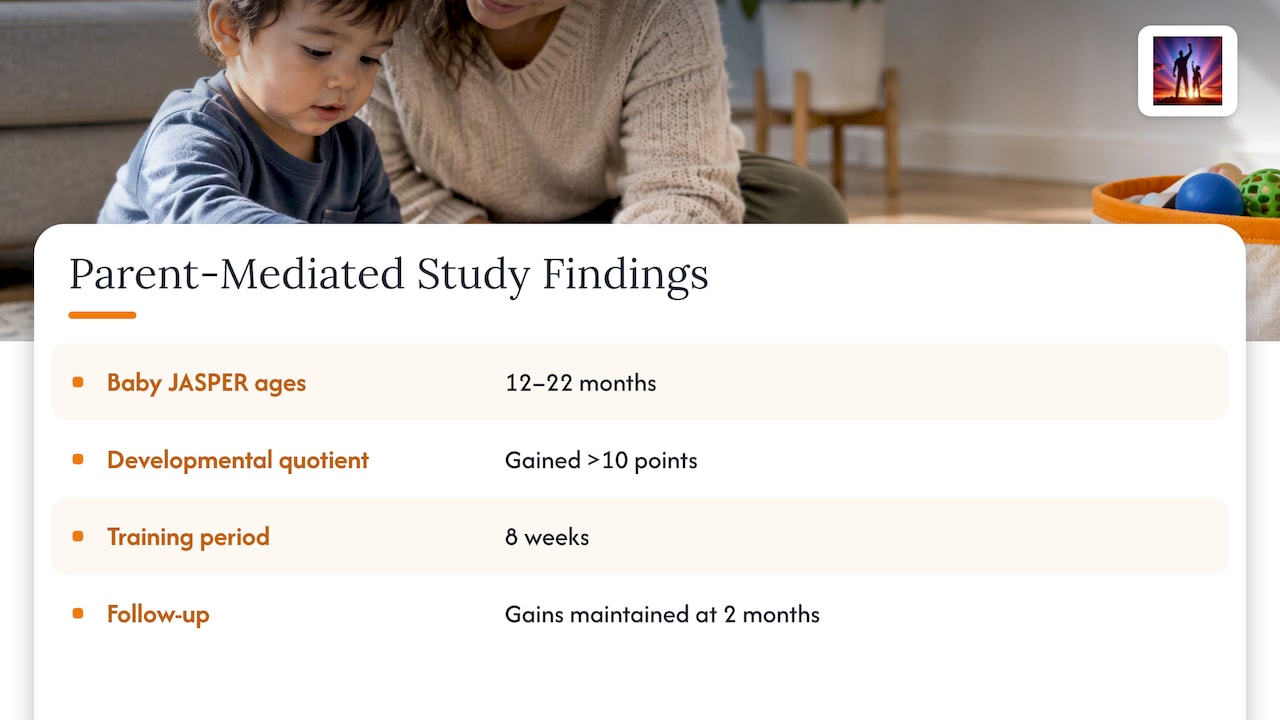
Research is moving toward parent-mediated programs and naturalistic developmental behavioral interventions (NDBIs), which teach skills inside play and daily routines. A 2024 study of the Baby JASPER model reported that infants aged 12 to 22 months gained more than 10 points in developmental quotient over 8 weeks after parent-mediated training, with gains maintained at a 2-month follow-up. The same source also reviews a 2025 trial of a parent-mediated program for uncertainty-related anxiety in children aged 4 to 7.
One caution: these are individual studies, and results for any one child vary. They do support something parents already sense. Coaching you to use play and routines can raise "dosage", meaning how much quality engagement your child gets, without filling the week with clinic appointments. Intensity is about the quality of that engagement, not only the number of therapy hours.
If you want ideas for the daily-routine side, see our guide to building communication at home in 5 to 15 minute routines and our five simple steps for helping autistic preschoolers.
Where ABA fits
You will hear about ABA from nearly everyone, because it is widely recognized in federal and state policy. The evidence is more mixed than the confidence suggests. An AHRQ systematic review of behavioral interventions, covering 65 unique studies, found moderate strength of evidence that early intensive ABA-based interventions improve cognitive and language functioning in some children. It also found the evidence for long-term impact and for social and adaptive skills to be inconsistent.
AHRQ's own topic brief also describes a field shifting toward individualized, strength-based care, where success is judged by meaningful daily-life outcomes and not only clinical scores.
What this means for you: ABA is one option, not the only one, and it is not a requirement for early intervention. If you are weighing it, read about coverage and insurance for ABA and look at ethical, evidence-informed alternatives to ABA. Spanish-speaking families can find the same guides in Spanish. Whatever you pick, ask the provider what the goals are, how progress is measured, and how you will be involved.
When the process stalls
Some common snags and what to do:
"Your child doesn't qualify." Ask for the evaluation results in writing and ask what criteria were used. Eligibility rules differ by state, so check your state agency's policy. You can also continue private evaluations and request a new evaluation later if concerns persist.
"Let's wait and see." If a pediatrician says this and you are still worried, you can still make the referral yourself. Then tell the pediatrician you have done so.
Long waits for a diagnosis. Use the waiting period. Start early intervention, keep a log, and ask the diagnostic clinic about cancellation lists.
Missed paperwork or a missed call. Reply by email the same day and note the dates. That documentation matters if the timeline is extended.
Our perspective: you are the consistent expert
We built Autism Victory for caregivers who are trying to do a hard thing with too little guidance, so here is how we see early intervention.
First, speed matters less than direction. Making the call this week beats researching for three months. You can change course later; you cannot get the early months back.
Second, you will be asked to carry a lot. The research on coaching parents is encouraging, but it also means the system leans on you. That is why we focus on practical tools: step-by-step guidance, a library of books and audiobooks in English and Spanish, short educational videos, a calming sound library, and a community of other caregivers who have already made the same calls. Our app also points you to state-specific funding and support resources, because the name, rules and benefits differ so much from one state to the next.
Third, trust your observations. Therapists are trained, but you see your child at breakfast, at bath time and on the hard days. Notes from those moments are real data, and a good team will want them.
Finally, you do not have to feel ready. Nobody does.
— Ronnie Talent
Getting support while you wait
The weeks around a referral are long. If you want help organizing the process, Autism Victory puts AI-powered guidance, state-specific resource navigation, caregiver-focused books and audiobooks, educational videos and a caregiver community in one mobile app. You can try it with a 5-day free trial. After that, plans are $6.95 per month or $49.95 per year.
The app supports your work with your state program and your care team. It does not replace evaluation or therapy by qualified professionals.
FAQ
Can I ask for early intervention without a doctor's referral?
Yes. The CDC says parents can request a free evaluation themselves for children from birth through age 2, and a doctor's referral is not required. For age 3 and up, you contact your local public school district. Keep a record of the date you asked.
What is the best age to start early intervention for autism?
As early as concerns appear. Early intervention programs serve children from birth through age 2, and the NICHD notes that early diagnosis and interventions are more likely to have major long-term positive effects. If your child is already 3 or older, preschool special education and other therapies are still available, so do not treat age as a closed door.
How long does it take to get started?
Federal rules call for the initial evaluation and IFSP meeting to be completed within 45 days of referral. Exceptional family circumstances, which must be documented, can extend that. Ask about an interim IFSP if you want services to begin sooner.
Does early intervention cost money?
The CDC describes these early intervention services as publicly funded. The exact rules for fees, insurance use and any family cost participation can differ by state, so ask your state program what applies to you before you consent.
Is early intervention the same as ABA therapy?
No. Early intervention is the public system that evaluates your child and builds a service plan. ABA is one therapy approach that may or may not be part of a plan or a private choice. Other options include parent-mediated and naturalistic developmental approaches, speech-language therapy and occupational therapy.
Sources
CDC: Treatment and Intervention for Autism Spectrum Disorder
U.S. Department of Education: Q&A on the Part C evaluation timeline (PDF)
JAMA Pediatrics: What Parents Need to Know About Autism Screening and Early Treatment
PubMed Central: parent-mediated interventions, Baby JASPER and CUES-Junior
NIH RePORTER: project summary on early intervention capacity
AHRQ: Autism update, systematic review of behavioral interventions (PDF)
Recommended