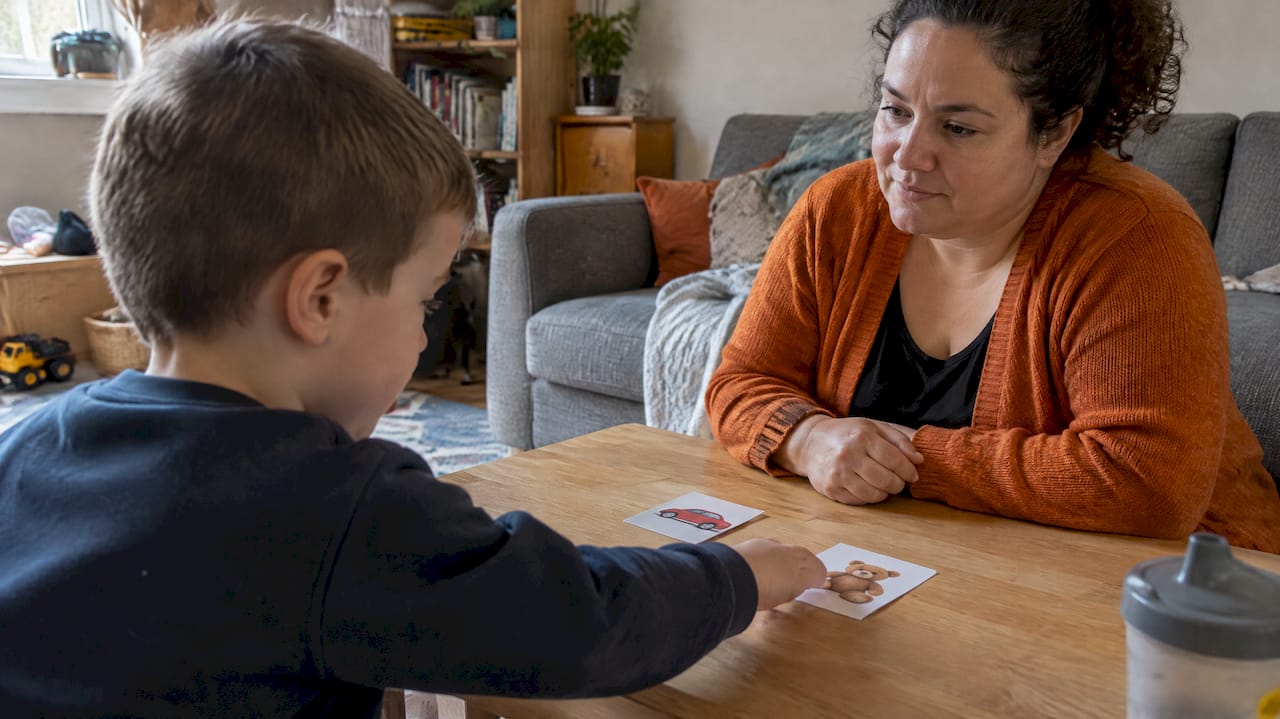
Start by following your child's lead and building short, high-interest communication moments into routines you already share, like meals and bath time. Two supports amplify that habit: visuals or AAC tools that give your child a reliable way to express a need, and coaching from a therapist, including telehealth NDBI programs, that helps you use these strategies with more consistency. The rest of this guide walks through exactly how.
TL;DR:
Repetition of routines and waiting silent for ten seconds after questions enhances a child's processing and communication without requiring long sessions.
Using visuals, AAC tools, and modeling during daily activities increases the likelihood of consistent, functional communication development.
Short, purposeful interactions during familiar routines, like meal times or dressing, support progress more than formal therapy sessions.
Consistent practice, driven by caregiver confidence and coaching, is more influential on growth than the specific communication method used.
Addressing sensory sensitivities and celebrating small communication successes helps maintain motivation and reduces setbacks.
Table of Contents
1. Prioritized strategies that work starting today
Communication growth at home rarely comes from drills at a table. It comes from what you do during ordinary, short daily moments you already spend together, repeated often.
Follow your child's lead. Join whatever has their attention instead of redirecting it, and narrate what they're doing rather than quizzing them with questions.
Use short, clear language. One or two words tied to the moment ("open" while handing over a jar) land better than a full sentence of instructions.
Pair words with something visual. A gesture, a photo, or a choice board gives your child a second way in if speech is hard to access in that moment.
Model and expand, don't correct. If your child says "car," respond with "yes, big car" instead of asking them to repeat it back properly.
Build in real back-and-forth. Pause after you speak and wait, genuinely wait, before jumping in again.
Motivate with real choices. Offer two snacks instead of one, and hold both up so your child has an actual reason to reach, point, or vocalize.
A recent practitioner literature review found that joining a child's focused activity and commenting on it builds communication more reliably than directive questioning, and that treating every gesture, glance, or sound as a legitimate message is central to building two-way exchange.
None of this requires a block of free time. What it needs is repetition.
Pick two or three routines you already do daily (breakfast, getting dressed, a car ride).
Practice one small target in each, for five to ten minutes, rather than one long session once a week.
Notice anything new: a new sound, a new point, a longer pause before you have to prompt.
Wait time matters more than most parents expect. Research on response processing in autism suggests that interrupting a child's pause after a prompt often resets their processing, so the silence that feels awkward to you may be exactly what they need.
Pro Tip: Count silently to ten after you ask a question or offer a choice. It feels long. It usually isn't.
2. Using AAC and visual supports at home
Augmentative and alternative communication, or AAC, covers anything that supplements or replaces speech: picture cards, choice boards, and tablet-based apps. None of these are a last resort, and none of them stop a child from eventually talking.
Low-tech boards (laminated pictures, a simple binder) work well for a small, highly specific vocabulary you can build fast and carry anywhere. High-tech apps make sense once your child needs a bigger, growing vocabulary or when portability and voice output matter. Many families use both at different times of day.
Caregiver comfort with the tool matters as much as the tool itself. Research on caregiver fluency with AAC apps found that a structured, repeatable practice protocol increased how comfortably and fluently parents used AAC apps, which in turn was linked to more consistent use during real interactions.
Start with a small set of symbols tied to your child's immediate needs and favorite items, then expand once they're initiating with those.
Model the device yourself during meals or play instead of only handing it over when your child seems frustrated.
Keep pages simple; an overloaded screen with dozens of icons slows everyone down.
Avoid treating AAC as clinic-only equipment. A family-centered AAC approach works best when it shows up during ordinary, motivating moments like snack time or a favorite game.
If progress stalls or the vocabulary setup feels wrong, a speech-language pathologist can adjust it, and telehealth coaching makes that kind of support available without a clinic visit every week. Our guide to communication boards walks through building a first low-tech board step by step.
3. Turning daily routines into practice without adding pressure
You don't need a special session. You need a few routines you already run, used on purpose.
Meals: offer two foods, hold both up, and wait for a reach, point, or word before handing either over.
Dressing: narrate each step ("socks on, now shoes") and pause before the last item so your child can request it.
Bath time: use a visual schedule showing the sequence, which reduces resistance because the next step isn't a surprise.
Car rides: sing part of a familiar song and stop before the last word, leaving space for your child to fill it in.
Store trips: let your child choose between two items on the shelf instead of just handing them one.
A "first, then" structure (first bath, then book) works across almost all of these, because it makes the routine predictable before it asks anything of your child. Our visual schedules guide shows how to build one.
Keep sessions short, five to fifteen minutes, spread across the day rather than one long block. Watch for small shifts: a new initiation, a gesture that clearly means something, a longer string of sounds or words than usual. Those are the signals that matter more than any formal test.
4. Troubleshooting common challenges and red flags
Some days nothing works, and that's normal. A few fixes cover most sticking points.
If your child turns away or seems overwhelmed, back off the demand and focus on regulation first; communication can't happen on top of distress.
If progress has stalled for weeks, simplify the target, check whether the activity still motivates your child, or review whether the AAC vocabulary still matches their needs.
Respond to what your child is trying to communicate, not how neatly they say it. A grunt toward the door still means something.
If a behavior or outburst seems to escalate quickly and regularly, our meltdown strategies guide and practical guidance on managing meltdowns cover regulation tactics in more depth.
Pro Tip: If you've tried the same strategy for two weeks with no shift at all, change the activity before you change the strategy.
Seek a faster evaluation if your child loses words they once used, stops responding to their name consistently, or shows a sudden drop in eye contact or social interest.
5. Why parent coaching changes outcomes
The strongest evidence here points toward parents, not clinicians alone, as the main driver of gains. A randomized trial of telehealth-delivered Project ImPACT found that therapist-assisted coaching improved how accurately parents used intervention strategies, which was tied to gains in children's intentional communication and expressive language. A separate randomized trial of parent-implemented early social intervention found that individualized, in-home coaching outperformed group or clinic-only models. Caregiver fluency, with language and with AAC, is the lever that makes daily practice count.
— Ronnie Talent
6. Managing sensory sensitivities during communication
Sensory discomfort can shut down communication before it starts. A child who is overwhelmed by noise, light, or texture is working hard just to stay regulated, and asking them to also produce language on top of that is asking for two things at once.
Watch for the signals first: covering ears, squinting, pulling away from touch, or a sudden drop in eye contact. Any of these can mean the environment, not the communication task, is the problem.
A few adjustments help most households:
Lower background noise during practice moments (turn off the TV, close a window) rather than adding your own voice on top of it.
Offer a preferred texture or object to hold during a harder interaction, like a weighted toy during a store trip.
Keep lighting soft where possible, especially during transitions like bath time or bedtime.
Build in short breaks between demands instead of stacking requests back to back.
Sensory needs shift day to day and even hour to hour, so the same routine that worked at breakfast might need adjusting by dinner. Treat regulation as the first step, not an interruption to the real work. Once your child is calm, communication opportunities tend to show up on their own.
7. Spotting and celebrating small communication milestones
Progress in communication rarely looks dramatic. It shows up as a longer pause before a meltdown, a point instead of a cry, or a sound that wasn't there last month.
Keep a simple log, even just a note on your phone, of small moments: a new gesture, an unprompted request, eye contact held a beat longer than usual. Reviewing it weekly makes gradual change visible, since day-to-day it's easy to miss.
Celebrate small wins without turning them into a test. A big smile and "you got it" response is usually better than stopping to ask your child to repeat the new skill, which can make them hesitant to try it again. Consistency in how you react matters more than the size of the moment.
Milestones to watch for including a first intentional point, a new word used in more than one setting, a longer string of sounds, or a child initiating contact instead of only responding. None of these need to look like a textbook example to count. What matters is that your child used it to get something they wanted, which is the whole point of communication in the first place.
8. Nonverbal communication and alternative methods at home
Speech is one route to communication, not the only one, and plenty of meaningful exchange happens without a single spoken word.
Gestures count. Pointing, reaching, pulling your hand toward something, even a change in body posture, are all intentional communication once you learn to read them. Treat them as real messages and respond to them the same way you'd respond to a spoken request.
Picture exchange systems let a child hand over a card to request an item, which gives a clear, physical way to initiate without relying on speech. Choice boards work similarly: holding up two pictures and letting your child select one builds the same back-and-forth as a verbal exchange.

Sign language, even a handful of functional signs like "more," "done," and "help," can bridge gaps for children who aren't yet speaking but can manage the fine motor movement.
Technology-based options, from simple picture-based apps to more complex AAC software, extend all of this and can grow with your child's vocabulary over time. Whatever method you use, consistency across people and settings matters: if a sign or symbol means "more" at home, it should mean the same thing at school or at a grandparent's house. Our short-step strategies for preschoolers cover age-specific ways to introduce these methods early.
9. What matters more than the method you choose
The research on parent-mediated intervention points to a conclusion that gets lost in most advice lists: the specific technique matters less than how consistently and confidently you use it. A coaching program that raises your fluency with a strategy, whether that's wait time, AAC, or expansion, moves the needle more than swapping techniques every few weeks looking for the "right" one.
Conventional advice often treats AAC as a backup plan, something to try once speech "isn't working." That framing costs families time. AAC doesn't compete with spoken language, and starting early tends to support it rather than replace it.
If you take one thing from this guide, let it be this: pick two or three strategies, practice them in routines you already run, and give yourself weeks, not days, to see the shift. Professional coaching, including telehealth NDBI programs, exists to build your confidence with those strategies, not to take the work away from you.
How Autism Victory supports your daily practice
Building these habits is easier with structure, and that's the gap we built our app to fill. Autism Victory gives you personalized, step-by-step guidance for the exact situations covered here, alongside caregiver-written books, audiobooks, and educational videos in English and Spanish.

Personalized AI guidance you can ask about specific routines or challenges, any time of day.
State-specific resources to help you find funding and support programs where you live.
A caregiver community and bilingual content library built around real family situations.
None of this replaces a professional evaluation or therapy, but it gives you a daily companion between appointments. A 5-day free trial is available, and our pricing page lists the Annual plan at $49.95 per year and the Monthly plan at $6.95 per month.
This article is general information, not a substitute for advice from a qualified doctor. Consult a qualified healthcare professional about your own circumstances before acting on anything here.
FAQ
What are the characteristics of high-functioning autism level 1?
Level 1 autism, sometimes called "requiring support," typically involves noticeable difficulty with social communication, such as trouble initiating conversation or reading social cues, alongside inflexible behavior that interferes with daily life in at least one setting. Children at this level usually speak in full sentences but may struggle with back-and-forth conversation or shifting between activities.
What is tunneling in autism?
"Tunneling" generally describes an intense, narrowed focus on one activity, topic, or object, where a child has difficulty shifting attention away from it. It's related to the restricted interests often seen in autism, and recognizing it helps caregivers plan transitions with more warning and visual support.
What is the 6 second rule in autism?
This term isn't a standardized clinical guideline, and definitions vary depending on the source. In general use, it refers to pausing for several seconds after speaking to a child to give them extra processing time before repeating or rephrasing, which aligns with the wait-time guidance covered earlier in this article.
Can level 2 autism live independently?
Independence for a person with level 2 autism ("requiring substantial support") depends heavily on the individual's specific needs, support system, and skill development over time, so there's no single answer that applies to everyone. Many adults with level 2 autism live independently with some ongoing support, while others need more consistent assistance, and this is best assessed through individualized evaluation rather than a label alone.
Sources
Telehealth coaching in Project ImPACT and child expressive language outcomes
Parent-Implemented Social Intervention for Toddlers With Autism: An RCT
Effect of practice protocol on caregiver fluency with AAC applications
Recommended