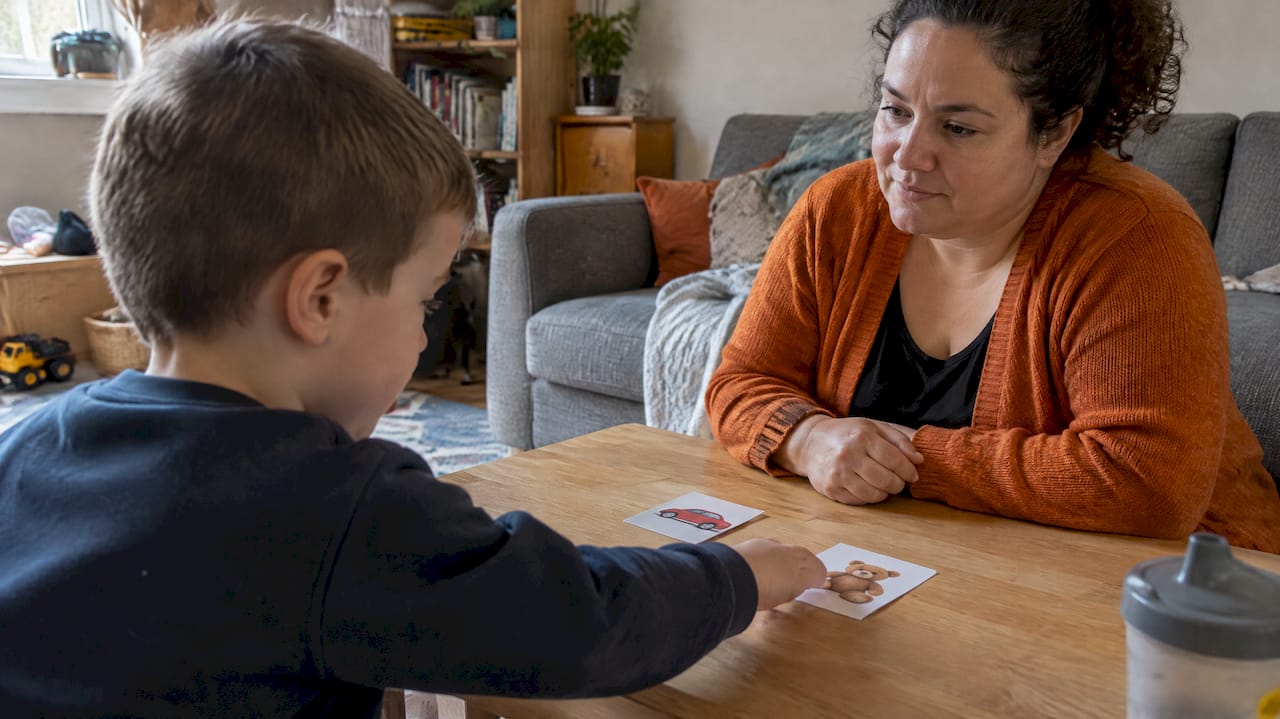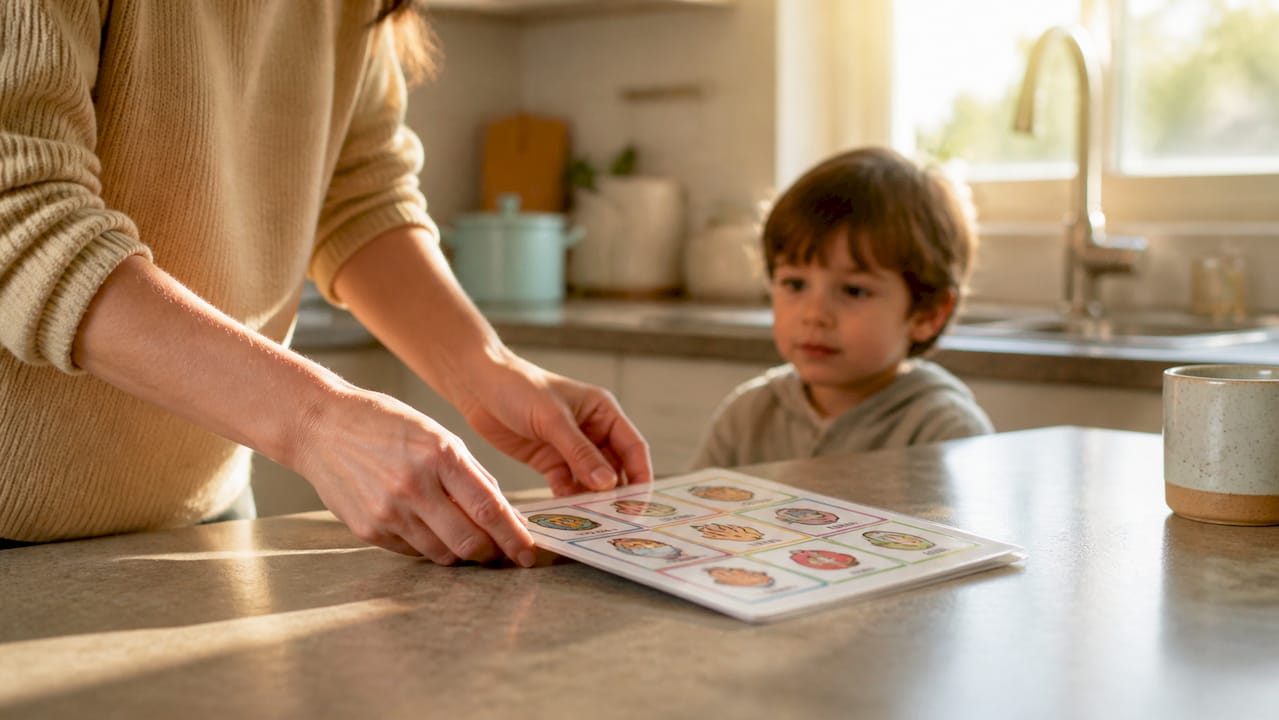
A communication board is a low-tech AAC grid of pictures, symbols, or words that lets a nonspeaking or minimally speaking person point to express needs and choices. Communication boards autism resources exist for exactly this moment: your child has things to say, and no reliable way to say them yet. According to the Organization for Autism Research, these boards are one of the most accessible entry points into augmentative and alternative communication (AAC), and you can build one and start using it the same day.
Here's what a board immediately unlocks for your child:
Requesting food, toys, or activities without a meltdown as the only signal
Making choices between two or more options instead of settling for whatever's offered
Naming feelings like "hurt," "tired," or "mad" before frustration boils over
A bridge to speech, not a replacement for it. Evidence shows AAC use does not delay or block spoken language development.
TL;DR:
Using a simple, laminated six-word core board with constant modeling can lead to more consistent communication than waiting to find the perfect system.
Both PECS and high-tech speech devices are effective, and trying both helps determine which suits individual child's preferences and responses best.
Replacing a high-tech device with a low-tech board when problems arise ensures continuous communication access and avoids delays caused by technical issues.
Most children show reliable independent pointing within a few weeks of consistent daily use, emphasizing the importance of frequent, natural modeling.
Success depends more on consistent aided language input and modeling than on choosing a specific AAC system or waiting for readiness signs.
Table of Contents
Do Communication Boards Actually Help Autistic Kids Communicate?
How Autism Victory App Supports Families Using Communication Boards
What Types of Communication Boards Work Best for Autism?
Not every board looks the same, and that's the point. The right format depends on your child's motor skills, attention span, and how they've responded to symbols so far.
Core-word boards hold the words used most often in daily talk: "want," "more," "stop," "help," "go." A starter grid usually has a small number of cells; expanded versions can include many more as vocabulary builds. Fringe or topic boards cover specific situations, like a bath-time board with "soap," "towel," and "warm," or a lunch board with food choices.
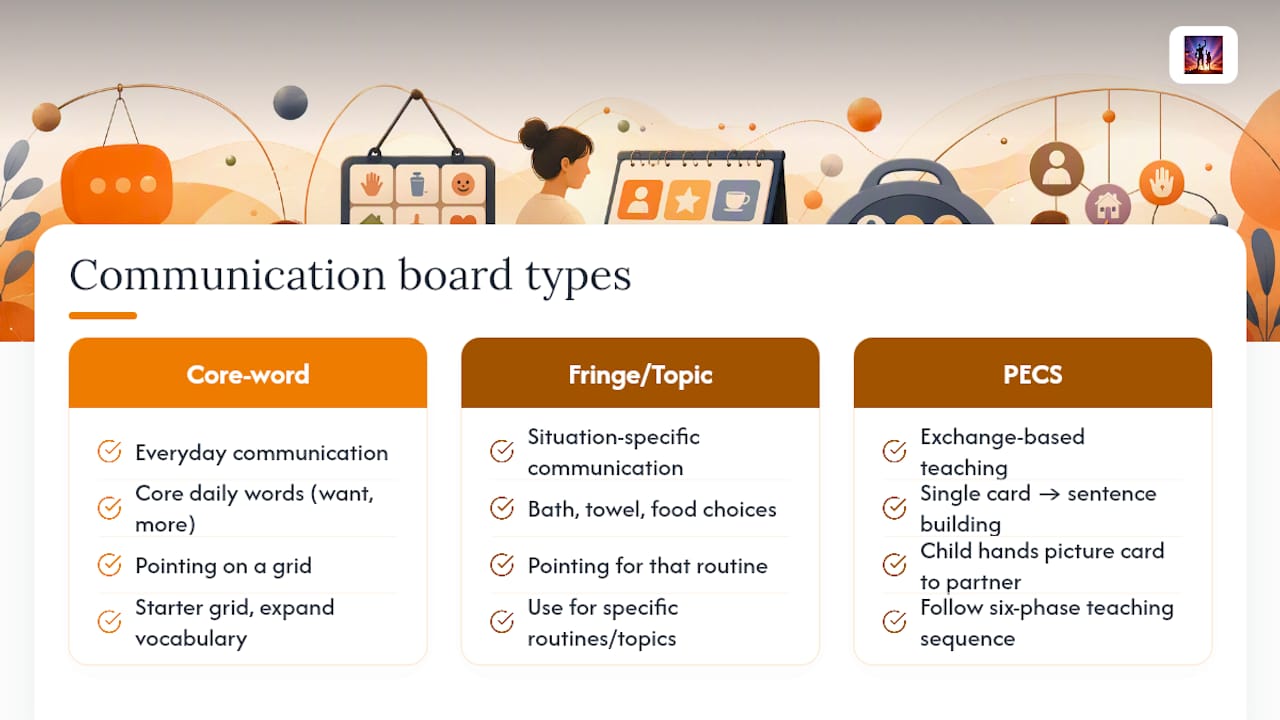
PECS (Picture Exchange Communication System) works differently. Instead of pointing to a fixed board, the child physically hands a picture card to a communication partner in exchange for the item. It follows a six-phase teaching sequence that starts with a single-card exchange and builds toward discrimination between symbols, sentence construction, and eventually commenting.

High-tech speech-generating devices (SGDs) and tablet apps add voice output and much larger vocabularies, but they come with tradeoffs: cost, charging, and the very real risk of a cracked screen mid-tantrum. Cards versus devices each have their strengths. Physical boards never run out of battery.
For setup, laminate every sheet, use photos for younger or newly diagnosed kids and simplified line drawings once symbol recognition is established, and keep cells at least one inch square for small fingers.
Pro Tip: Print three copies of the same board before you laminate anything. One stays in the backpack, one lives by the front door, one sits on the kitchen table. Redundancy beats perfection here.
Do Communication Boards Actually Help Autistic Kids Communicate?
The short answer: yes, and the research is fairly consistent on this. An evidence-based practice review comparing PECS and SGDs found both approaches effective at teaching children with complex communication needs to make requests. Neither method wins outright. Individual preference drives which one sticks.
That same review notes something clinicians see constantly in practice: a child who's initially drawn to a tablet's flashing lights sometimes settles into PECS once the novelty wears off, and vice versa. Trying both before committing long-term isn't indecision. It's standard, sensible practice.
Where boards tend to pay off day to day:
More spontaneous requests, not just responses to "What do you want?"
Fewer meltdowns rooted in communication breakdown rather than defiance
Easier inclusion in classroom routines once teachers know the system
A shared vocabulary between home and school that reduces guesswork
None of this happens instantly. Most families see the first reliable, unprompted point within a few weeks of consistent modeling, not days.
How Do You Actually Use a Communication Board Day to Day?
Buying or printing the board is the easy part. Using it consistently is where families either see progress or watch the board gather dust in a drawer.
Pick a starter grid. Start with 6 to 12 core words your child hears constantly: "more," "help," "stop," "go," "want," "done." Print it, laminate it, and place copies in the backpack, on the kitchen table, and by the front door.
Model constantly, quiz never. This is called aided language input, and it's the single biggest predictor of whether a board gets used functionally. Every time you speak, point to the matching word on the board, even if your child isn't looking. You're not testing comprehension. You're showing them the tool works.
Use a prompting ladder when teaching a new word. Start with a gesture toward the symbol. If that doesn't land, add partial physical guidance, like a light touch on the wrist. Fade the prompt as soon as your child shows independent pointing.
Build practice into transitions. Snack time, getting in the car, bedtime; these repeated daily moments are where new words stick fastest because the context repeats.
Track what's working. Keep a simple log of which words get used and how often. Reinforce every request immediately, even if it's imperfect pointing. Add new vocabulary only once current words are solid.
Pro Tip: Resist the urge to add ten new words at once. Two or three new symbols a week, modeled heavily, beats a crowded board nobody masters.
How Do You Customize a Communication Board for Your Child?
A board that looks great on Pinterest but doesn't match your child's actual needs will sit unused. Personalization isn't optional polish. It's the difference between a tool your child adopts and one they ignore.
Start with vocabulary that reflects real motivation. Core words like "want," "more," "stop," and "help" belong on every board, but add three or four high-value fringe words specific to your child. If your son is obsessed with trains, "train" earns a spot before "cookie" does.
Design choices matter more than most parents expect:
Larger cells (at least 1.5 inches) for kids still developing fine motor control and precise pointing
Real photos for children who respond better to concrete images; simplified line drawings once symbol generalization improves
Color-coding by word category (core words in one color, feelings in another) to speed visual scanning
Alternative access methods like eye gaze or partner-assisted scanning for kids with significant motor challenges
Clinicians at Communication Matters are direct about this: there's no universal best AAC system. Preference varies, and what clicks for one child may frustrate another entirely.
When should you add a high-tech layer? Once your child has mastered a low-tech board and clearly needs more vocabulary or voice output to be understood by unfamiliar listeners, a tablet-based app becomes worth the investment. Keep the laminated board as backup regardless. Batteries die. Paper doesn't.
What Do You Do When the Communication Board Isn't Working?
Every family hits a snag. Here's how to troubleshoot the most common ones fast.
Board gets ignored: Increase your modeling frequency and shrink the grid back down. A 24-cell board can overwhelm a child who's only ready for eight.
Tantrums spike during practice: Check that your child actually has access to the item they're requesting. Never turn the board into a quiz; that kills motivation quickly.
Cards go missing: Keep laminated spares in every bag, and give each set a labeled pocket so nothing walks off with a backpack.
Devices freeze or die: Always keep a low-tech backup within reach, and build charging into your nightly routine like brushing teeth.
How Autism Victory App Supports Families Using Communication Boards
Building a functional AAC system takes more than one printable grid. Autism Victory App gives caregivers a place to keep momentum going:
Personalized AI guidance for troubleshooting specific communication challenges as they come up
Caregiver-focused books and audiobooks, available in English and Spanish
Educational videos that pair well with modeling techniques like video modeling
A caregiver community where parents swap what's actually worked for their kids
State-specific funding and resource navigation for speech therapy support
Ronnie Talent, contributing to Autism Victory App's caregiver resources, has watched families get further with a laminated $2 grid and consistent modeling than with a $500 device and no plan behind it.
Why Most Advice on Communication Boards Misses the Point
Most guidance on this topic obsesses over which system to buy. PECS or SGD, app or laminated paper. That's the wrong first question. The evidence itself says both approaches teach requesting effectively, so agonizing over the "best" system before you've even started modeling is time you don't have to lose.
What actually predicts success is boring, unglamorous, and rarely gets its own headline: how often you point to the board while you talk. Aided language input isn't a footnote in the research. It's the mechanism. Parents who model twenty times a day for six weeks see more progress than parents who bought the fancier tablet and used it twice.
Here's where I'd push back on the typical advice: don't wait for a "sign of readiness" before starting. Print a six-word board tonight. Model it constantly for two weeks before deciding whether to expand vocabulary or switch systems. The board that gets used is always better than the board that gets debated.
— Ronnie Talent
Try This With Your Child This Week
If you take one thing from this guide, make it this: consistent modeling with a simple starter board predicts more communication progress than which specific system you choose.
Print a six-word core board tonight, laminate it tomorrow, and point to it every time you speak to your child for the next two weeks before judging whether it's working. Autism Victory App gives caregivers a structured way to keep that momentum going, with AI guidance, printable resources, and a community of parents troubleshooting the exact same questions you have right now.
Key Takeaways
Aided language input, modeling the board constantly while you speak, predicts more communication progress than which AAC system you pick.
Point | Details |
|---|---|
Start low-tech and fast | Print and laminate a 6 to 12 word core board today rather than waiting for the "right" system. |
Model constantly, don't quiz | Point to symbols every time you speak; this single habit drives whether a board gets used. |
Both PECS and SGDs work | Evidence shows both teach requesting effectively; preference varies, so trying both is standard practice. |
Keep a low-tech backup | Devices break and lose charge; laminated boards never do, so carry spares everywhere. |
Expect gradual, steady gains | Most families see reliable independent pointing within a few weeks of consistent daily modeling. |
This article is general information, not a substitute for advice from a qualified doctor. Consult a qualified healthcare professional about your own circumstances before acting on anything here.
Sources
What Are Communication Boards? | Organization for Autism Research
Communication Board for Autism: Free Printable + How to Use It
Recommended