
If your school denied IEP services, you have three moves to make right now: demand Prior Written Notice explaining the refusal in writing, document every conversation and decision from this point forward, and request an Independent Educational Evaluation if you disagree with the school's data. A denial is not the end of the road. Federal law gives you clear paths to challenge it.
TL;DR:
Schools are legally required to provide a written explanation through Prior Written Notice whenever they deny evaluation or services, including reasons and data relied upon.
Parents can request an independent educational evaluation at public expense if they disagree with the school's assessment, with the district choosing to pay or defend in a hearing.
Immediate actions after a denial include requesting written notice, scheduling evaluation or IEP meetings, documenting all interactions, and exploring interim supports like a 504 plan.
Formal dispute options such as mediation, state complaints, or due process hearings each serve different needs, with mediation and complaints usually moving faster and costing less.
Keeping organized records of requests, deadlines, and meeting notes is essential, and expert guidance tools can help parents prepare and manage documentation efficiently.
Table of Contents
Choosing Between Mediation, State Complaint, and Due Process
How Caregiver Tools and Templates Speed Up the Record-Building Process
Alternative Support Options While You Wait or Instead of an IEP
What the School Must Provide and Your Rights Under IDEA
Once you understand the rules the school has to follow, you can hold them to it. The Individuals with Disabilities Education Act (IDEA) requires school districts to explain themselves in writing whenever they refuse to evaluate, identify, or provide services to your child.
Under Prior Written Notice requirements, the school must give you a written explanation any time it proposes or refuses to start or change an evaluation, identification, or services. That notice has to include:
The action the school is proposing or refusing to take
The reasons behind that decision
A description of the data, tests, or records the school relied on
Any other options the team considered and why they were rejected
Where you can go for help understanding your rights
Your right to an independent evaluation is federally protected. Under IDEA's evaluation rules, if you disagree with the district's evaluation, you can request an Independent Educational Evaluation (IEE) at public expense. The school then has two choices: pay for the IEE, or file a due process complaint to defend its own evaluation in a hearing. If the district loses that hearing, it pays. If it wins, you can still get the IEE done, just not on the district's dime.
You're also entitled to copies of every evaluation report and record the school used to make its decision, at no cost to you.
Immediate Steps to Take Right Now
The first two weeks after a denial matter more than almost any other stretch in this process. What you do now determines how strong your case looks later.
Request Prior Written Notice in writing. Email the special education coordinator and ask specifically for the PWN explaining the refusal, referencing the data used and other options considered.
Ask for an IEP or evaluation meeting. Put the request in writing (email counts) and ask for a date within a reasonable window, typically within a few weeks.
Request an IEE if you disagree with the evaluation. State plainly that you disagree with the district's findings and want an independent evaluation at public expense.
Document every interaction from here forward. After every call or meeting, send a same-day follow-up email summarizing what was said and agreed, even if nothing was agreed.
Explore interim supports while you wait. Ask about a 504 plan, informal classroom accommodations, or outside evaluations your child's pediatrician or a private specialist can provide in the meantime.
Keep a single folder, physical or digital, for every email, report, and note. Chronological order matters when someone unfamiliar with your case has to review it quickly.
Pro Tip: Never accept a verbal "yes" as a final answer. Ask the school to confirm any agreement in writing within 24 hours, or send your own summary and ask them to correct anything inaccurate.
Choosing Between Mediation, State Complaint, and Due Process
When the school won't budge after your written requests, you have three formal paths. Each has different speed, cost, and evidentiary demands, and picking the right one first can save months.
Mediation is voluntary, informal, and led by a neutral third party. It works best when the relationship with the school is still workable and both sides want a quick resolution without a paper trial.
State complaint is a written filing to your state education agency alleging a specific violation of IDEA, such as failing to issue Prior Written Notice or missing evaluation timelines. State complaint procedures typically require a 60-calendar-day investigation and written decision, and the agency must supply forms and filing instructions.
Due process complaint is the most formal option, functioning like a legal hearing. It can produce binding orders, including compensatory services, but it demands more preparation, evidence, and often legal help.
Mediation and state complaints tend to resolve disputes faster and with less strain, so many advocates suggest trying one of those first unless the situation involves serious harm or a pattern of noncompliance that needs a binding order. Due process remains available at any point, and filing it can itself accelerate a resolution: it triggers a mandatory meeting that puts pressure on the district to negotiate before the case ever reaches a hearing.
Timelines and Traps That Can Derail Your Case
Deadlines protect you, but only if you track them. Filing a due process complaint requires the district to hold a resolution meeting within 15 days, followed by a 30-day resolution period before a hearing can proceed, unless both sides agree to waive or mediate instead.
Mark every deadline on a calendar the moment a complaint or request goes in.
Don't rely on a verbal promise that services will "start soon." Get a start date in writing.
Confirm implementation directly with your child's teacher, not just the case manager.
Keep a simple log of when you first noticed the problem, since due process complaints carry a statute of limitations tied to when you knew or should have known about the violation.
Most disputes never reach a hearing at all. Districts often resolve issues once a parent creates a clear paper trail and escalates methodically, starting with a PWN demand, moving to an IEE request, and filing a state complaint only if needed.
When to Bring in an Advocate or Attorney
Not every denial requires a lawyer, but some do. If your case involves a pattern of noncompliance, a potential ADA claim, or a fight over compensatory services owed for months of missed support, it's worth a consultation.
Special education advocates know the process and paperwork but aren't licensed to represent you in court; they're often less expensive and available through Parent Training and Information Centers.
Attorneys handle due process hearings, appeals, and any claim that crosses into disability discrimination law.
Before hiring either, ask about their experience with your specific issue, how they bill, and whether they've handled a case with your district before.
Many states have low-cost or free legal aid programs specifically for special education disputes.
How Caregiver Tools and Templates Speed Up the Record-Building Process
Building a solid record takes structure, not luck. Parents who move fastest tend to use a repeatable system for tracking requests, deadlines, and meeting notes rather than starting from scratch each time.
A saved template for requesting Prior Written Notice or an IEE keeps your language consistent and legally specific every time you write.
A dated log of meetings and calls turns scattered memories into evidence you can hand to an advocate or attorney.
State-specific resource guides help you find your local Parent Training and Information Center and complaint forms without hunting through multiple agency websites.
For deeper background, our guides on special education mediation and IEP for autism walk through these processes in more depth.
Understanding What an IEP Is and Who Qualifies
An Individualized Education Program (IEP) is a legally binding document that spells out the specific services, accommodations, and goals a public school must provide a child with a qualifying disability. It's not a suggestion or a preference list. Once written and signed, it carries the force of federal law behind it.
To qualify, a child must meet two conditions under IDEA. First, they need a diagnosed disability that falls into one of the recognized categories, autism, specific learning disabilities, speech or language impairment, and others. Second, the disability must be shown to adversely affect the child's educational performance to the point that specialized instruction is needed to make progress.
That second condition trips up a lot of families. A diagnosis alone doesn't guarantee an IEP. The school's evaluation team has to document that the disability is actually getting in the way of learning, whether that's academic performance, social functioning at school, or behavior that interferes with instruction.
This is also why grades alone don't settle the question. A child can be passing every class and still qualify, if the disability is affecting them in ways that don't show up on a report card, like sensory regulation, executive functioning, or social communication. Eligibility teams are supposed to look at the whole picture, not just grades.
Alternative Support Options While You Wait or Instead of an IEP
An IEP isn't the only path to support, and it's worth knowing the alternatives while you're fighting for one, or even if you eventually decide it's not the right fit.
A 504 plan provides accommodations, extra time on tests, preferential seating, modified assignments, without the specialized instruction an IEP guarantees. It's often faster to put in place and can serve as a bridge while an IEP dispute plays out. Our comparison of IEPs versus 504 plans breaks down which one fits which situation.
Outside the school system, families often turn to private evaluations, tutoring, speech or occupational therapy through insurance or Medicaid waivers, and community-based programs designed for children with developmental disabilities. None of these replace the legal protections of an IEP, but they can fill gaps while a dispute is unresolved.
Some parents also pursue informal classroom accommodations that a teacher agrees to without any formal plan at all. These carry no legal weight and can disappear the moment a teacher changes, so they should never be treated as a substitute for pursuing formal rights.
Accessing and Reading Your Child's Educational Records
You have the right to see everything the school has on your child, and reading those records carefully often reveals exactly why a request was denied.
Start with a written request to the school's records custodian, usually listed in the student handbook or on the district website, asking for the complete educational file. This includes evaluation reports, teacher observations, disciplinary records, attendance data, and any prior IEPs or 504 plans. Schools generally cannot charge you for this and must provide it within a reasonable timeframe.
When you get the file, look specifically at the evaluation reports the school used to make its eligibility decision. Check the dates, the tests administered, and whether the observations match what you see at home. Inconsistencies here, a report that says your child shows no signs of difficulty in an area where you've documented struggles, are exactly what an Independent Educational Evaluation is meant to challenge.
Progress-monitoring data matters just as much as the initial evaluation. If your child already has a 504 plan or informal supports, ask for the data showing whether those accommodations are actually working. That data becomes part of your evidence if you later argue the school's current approach isn't enough.
What to Do in the First Days After a Denial
The instinct after a denial is often to escalate immediately or to give up. Neither serves your child as well as a measured, written response.
Start by requesting the Prior Written Notice if you haven't already, since everything else builds from that document. While you wait for it, write down your own timeline of what happened: when you requested the evaluation or service, who you spoke with, and what was said. Memory fades fast, and a same-day note is far more reliable than a memory reconstructed weeks later.
If the school has already written an IEP but you disagree with parts of it, you don't have to accept or reject it wholesale. Parents can partially reject an IEP by signing only the sections they agree with and attaching a letter listing specific disagreements. Anything not explicitly rejected still has to be implemented, which means your child keeps receiving the services you did agree to while you dispute the rest.
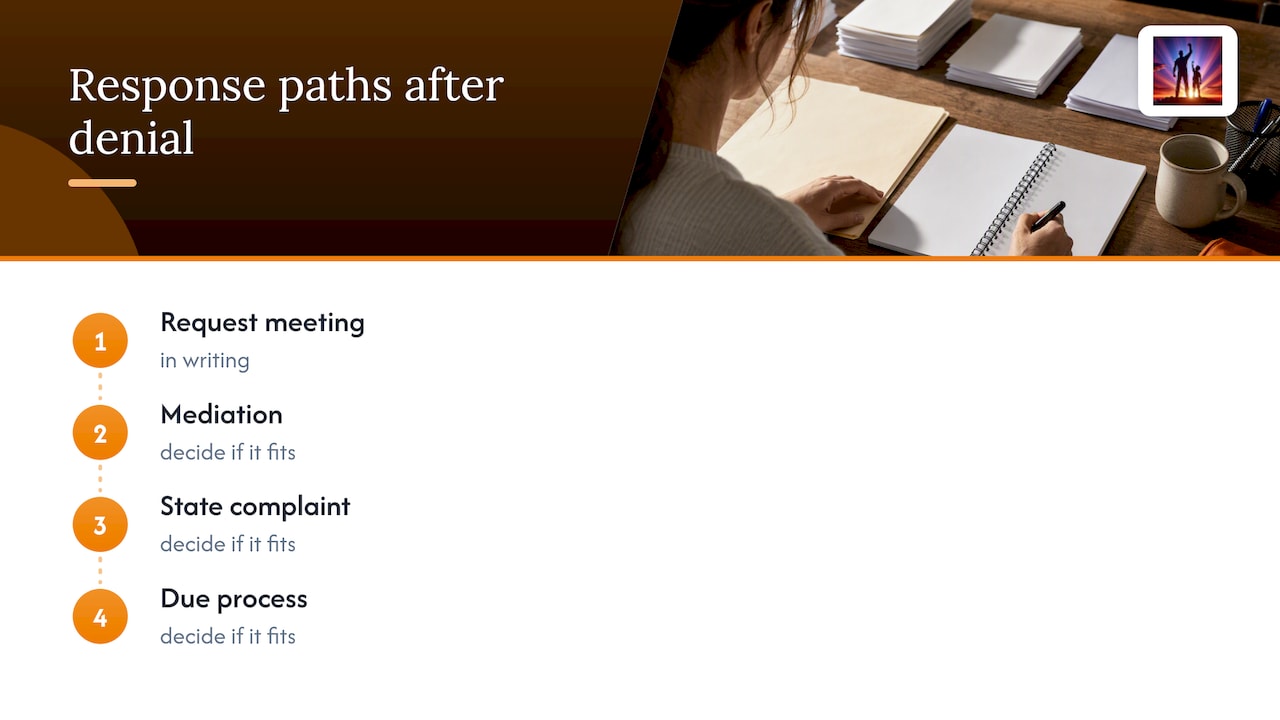
From there, request a follow-up meeting in writing, and start deciding whether mediation, a state complaint, or due process fits your situation best.
Advocating for Your Child in IEP Meetings
Meetings move fast, and schools run dozens of them every year. You run maybe one or two for your own child, which puts you at a real disadvantage unless you prepare.
Bring a written list of concerns and questions rather than trying to remember everything in the moment. Ask for a copy of any draft IEP or evaluation report before the meeting, not during it, so you have time to read it carefully. If English is not your first language or you're not comfortable with the pace of the discussion, request an interpreter or ask for the meeting to slow down: this is your right, not an imposition.
During the meeting, ask the team to explain any decision in plain language, and don't sign anything you haven't had time to review. If you disagree with something, say so out loud and ask that your disagreement be noted in the meeting minutes. Bring a support person if you can, a spouse, family member, or advocate, since a second set of ears catches details you might miss while processing everything in real time.
Afterward, send a written summary of what you understood was agreed to. This single habit does more to protect your child's services than almost anything else you can do.
Staying Firm Without Losing the Working Relationship
Collaboration works until it doesn't. Stay open and cooperative with the school team, but get every denial, promise, and decision in writing from day one.
Formal dispute routes exist to secure the services your child is owed, not to punish anyone. Use them that way, and keep your child's progress as the only measure that matters.
— Ronnie Talent
How Autism Victory Helps You Organize the Paperwork
Autism Victory won't file your complaint or sit in your IEP meeting, but it helps you get organized before either happens.

Caregiver-friendly templates for tracking requests, deadlines, and meeting notes in one place
A state-by-state resource navigator to help you find funding and support programs near you
Bilingual guides and AI-powered guidance to help you prepare questions before every meeting
This is a support tool, not legal representation. For contested cases, pair it with an advocate or attorney. Explore plans starting at $6.95 per month or $49.95 per year on our pricing page.
This article is general information, not a substitute for advice from a qualified lawyer. Consult a qualified legal professional about your own circumstances before acting on anything here.
Sources
FAQ
What to do if IEP is denied?
Request Prior Written Notice explaining the school's reasoning in writing, document every conversation from that point forward, and consider requesting an Independent Educational Evaluation if you disagree with the district's findings. If the school still won't act, mediation, a state complaint, or a due process complaint are the formal paths to escalate.
Why would a school deny an IEP?
Schools deny IEP requests when their own evaluation doesn't show the disability is significantly affecting educational performance, or when they believe existing supports like a 504 plan are sufficient. Whatever the reason, the school must explain it through Prior Written Notice, including the data it relied on and any other options it considered.
Did the federal government cut funding for special needs education?
Federal special education funding levels change with each budget cycle and are set through congressional appropriations, not through this article's sources. Check your state education agency's website or the U.S. Department of Education for the most current funding figures.
Can you be denied an IEP because grades are good?
Good grades alone don't disqualify a child from an IEP, since eligibility depends on whether the disability affects educational performance in ways that go beyond grades, including social skills, behavior, or sensory regulation. If a school denies services based on grades alone, ask for the specific data behind that decision through a written Prior Written Notice request.
Recommended