Caregiver burnout is a state of physical, emotional, and cognitive exhaustion caused by prolonged, unrelenting caregiving stress. If you recognize that description in yourself right now, the burnout is real and it is common among autism parents. The first move isn't a life overhaul. It's arranging one short block of respite this week and telling one trusted person exactly how they can help you.
TL;DR:
Addressing caregiver burnout requires consistent, structural changes like booking regular respite and delegating tasks, not just short-term self-care.
Caregivers of autistic children face unpredictable behavior, sleep disruptions, and financial and social strain that intensify burnout risks.
A self-check of sleep, irritability, and health symptoms helps identify burnout early, especially if three or more signs are present for several weeks.
Professional support such as therapy, medication, and systemic adjustments can prevent worsening burnout and support recovery.
Practical tools like the Autism Victory App aid in finding respite resources, navigating support programs, and connecting with caregiver communities.
Table of Contents
What Caregiver Burnout Looks Like Day to Day
Burnout isn't a bad week. The World Health Organization classifies burnout as a recognized syndrome that develops from chronic stress that hasn't been successfully managed, and that framing matters because it treats exhaustion as a legitimate health issue, not a character flaw. Cleveland Clinic describes caregiver burnout specifically as physical, emotional, and mental exhaustion that builds when caregiving demands outpace a person's capacity to recover.
The symptoms tend to cluster into three categories:
Physical: chronic fatigue that sleep doesn't fix, catching every cold that goes through the house, tension headaches, and stomach issues that show up when stress spikes.
Emotional: irritability with people you love, a flat numbness where joy used to be, guilt for resenting caregiving tasks, and a creeping sense of dread about the next school call or therapy session.
Cognitive: brain fog that makes you reread the same email three times, forgetting appointments you'd normally never miss, and decision fatigue so severe that choosing dinner feels like a chore.
Here's a quick way to tell the difference. A rough week looks like snapping at your spouse once, then apologizing and moving on. Burnout looks like snapping daily, feeling nothing when your child has a good day, and realizing you can't remember the last time you felt rested. Research on caregiver burden confirms that parents of autistic children report significantly higher rates of chronic stress, sleep disruption, and depression than caregivers of neurotypical children, which is why this isn't something you should expect to just push through.
Pro Tip: Keep a one-line daily note (mood, sleep hours, one physical symptom). Patterns are much easier to see written down than remembered under stress.
Why Autism Caregiving Makes Burnout So Common
Autism caregiving carries a different kind of weight than most caregiving roles, and it comes from several directions at once.
Unpredictable intensity. Behavioral support needs don't follow a schedule. A calm morning can turn into a meltdown by lunch, and caregivers stay in a low-grade state of alert most of the day.
A second full-time job in paperwork. Coordinating IEPs, therapy schedules, insurance appeals, and school meetings adds an administrative load most caregivers never signed up for.
Sleep disruption that compounds. Many autistic children have irregular sleep patterns, and a caregiver who loses sleep for years, not weeks, faces a very different recovery curve than someone dealing with a temporary rough patch. Our guide on autism sleep problems breaks down why this cycle is so hard to escape on your own.
Isolation and financial strain. Therapy costs, missed work, and a shrinking social circle (because plans keep getting canceled for behavioral reasons) add pressure that stretches across years, not months.
A 2026 study in the Journal of Autism and Developmental Disorders found that emotional reactivity strengthens the link between caregiving stress and burnout. In plain terms, caregivers who feel emotions more intensely under pressure are more vulnerable to burnout when psychological inflexibility is also high. This is not a character weakness.
How to Screen Yourself for Burnout Right Now
You don't need a clinical evaluation to get a useful read on where you stand. Run through this self-check:
Sleep: Are you sleeping fewer than 6 hours most nights, even when your child sleeps through?
Appetite: Have you noticed skipped meals, overeating, or no appetite at all?
Irritability: Are you short with people over small things more days than not?
Anhedonia: Have things that used to bring you joy started to feel flat or pointless?
Illness frequency: Have you been sick more often in the last few months than usual?
If you answered yes to three or more, you're likely dealing with burnout rather than routine stress. Situational stress fades once the triggering event passes. Burnout persists even during calm stretches and tends to worsen without intervention.
Some signs require action today, not this week. Thoughts of harming yourself or your child, an inability to get out of bed or function for basic tasks, or a pattern of neglecting your child's essential needs are red flags that call for immediate professional contact.
Pro Tip: Bring your written self-check answers to your next doctor's visit. Clinicians triage faster and recommend more targeted help when they see specific patterns instead of a general "I'm tired."
What Actually Reduces Caregiver Burnout
Fixing burnout takes layers, not a single fix. Some tactics help within a day. Others need weeks to build. A few require professional support.
This week, try:
A 15 minute walk alone, even around the block.
Bundling errands into one trip instead of three scattered ones.
Drinking water on a schedule tied to a task you already do (every diaper change, every therapy drop off).
A single "off" hour where your phone goes in another room.
Over the next month, build:
A recurring respite block, even two hours weekly, booked in advance so it can't quietly disappear.
One delegated task handed permanently to a partner, relative, or paid helper.
A caregiver support group, in person or online, where venting doesn't require explaining autism from scratch. Our autism caregiver guide walks through how to find groups that actually fit your situation.
A faith community or neighborhood network you can call on short notice.
Harvard Health frames self-care as a strategic necessity, not an indulgence, and specifically recommends asking for help directly, joining a support group, and setting goals that are realistic rather than aspirational. That reframing matters because guilt is often what keeps exhausted caregivers from taking the break they need.
Clinical support closes gaps that willpower can't. Cognitive behavioral therapy (CBT) helps with the racing thoughts and catastrophizing that come with chronic stress. Acceptance and Commitment Therapy (ACT) targets the psychological inflexibility the 2026 JADD study linked to worse burnout outcomes. Mindfulness-based programs have a track record for lowering baseline stress reactivity. A referral for medication is reasonable if anxiety or depression symptoms are interfering with daily function. None of these are a last resort. They're tools most caregivers reach for too late.
System-level fixes matter just as much:
Ask your child's care team for a single written care plan instead of five verbal ones from five providers.
Consolidate appointments onto fewer days to reduce driving and waiting time.
Look into state-specific funding and respite programs before assuming none exist.
Use a direct script when asking for help: "I need someone to watch my son from 2 to 4 on Saturday so I can rest. Can you do that?" Specific asks get answered more often than vague ones.
What Recovery Actually Requires
Recovery from caregiver burnout is not about squeezing in more self-care around an unchanged schedule. It requires reducing the load itself.
Start with what can be handed off entirely: therapy transportation, insurance paperwork, meal planning, or laundry. Pick one task and give it to someone else this month, permanently, not just when you happen to ask.
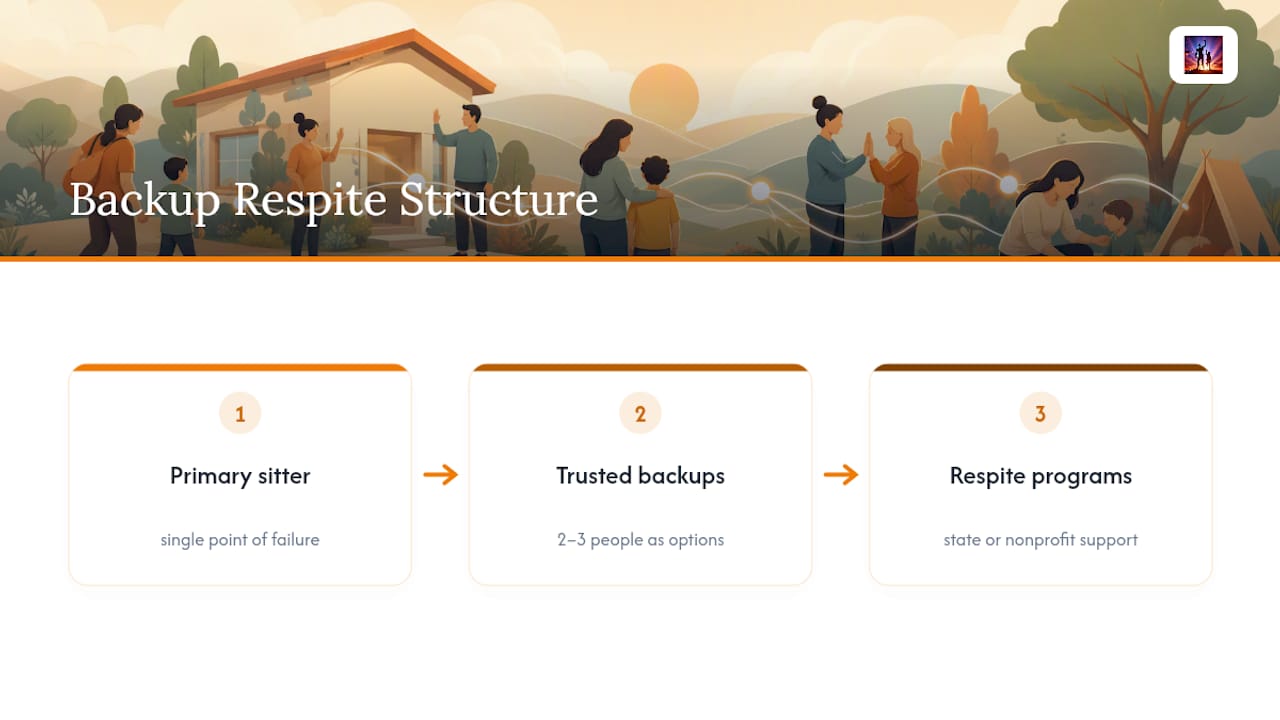
Build backup respite before you need it in a crisis. A single babysitter is a single point of failure. Two or three trusted people, plus a state or nonprofit respite program, give you options when the primary plan falls through. Our guide on finding and funding respite care covers how to line this up.
Reset expectations around therapy and routines too. Not every session needs to be perfect, and not every day needs to follow the ideal schedule. Geisinger's caregiver guidance points out that structural changes, scheduled breaks, predictable routines, and asking for help before you're desperate, do more than motivational self-care advice ever will.
Don't skip your own health care. Book a primary care visit, follow up on any mental health referral, and treat your own sleep problems as seriously as you'd treat your child's. Caregivers of autistic children report measurably poorer physical health than caregivers of neurotypical children, and that gap doesn't close on its own.

Recovery isn't fast. Most caregivers notice a real shift in energy and mood within several weeks of consistent respite and reduced load, with fuller emotional recovery often taking longer. Progress looks like fewer bad days in a row, not the absence of hard days entirely.
When to Get Professional Help Immediately
Some signs mean you shouldn't wait for the next scheduled checkup.
Contact your primary care provider if fatigue, headaches, or illness has persisted for more than a few weeks.
Contact a therapist if irritability, numbness, or dread has become your daily baseline rather than an occasional flare.
Contact a psychiatrist if anxiety or depression symptoms are interfering with your ability to care for your child or yourself.
Call for crisis support immediately if you have thoughts of harming yourself or your child, or if you notice severe neglect of essential needs in your household.
If you or someone you know is in crisis, the 988 Suicide & Crisis Lifeline is available 24/7 by call or text. Reaching out is not a failure. It's the fastest way to get support that actually matches what you're going through.
Before any appointment, write down when symptoms started, how often they occur, and what makes them better or worse. A public health overview of caregiver stress recommends this kind of specificity because it lets providers move straight to treatment options instead of spending the visit trying to define the problem.
Finding Respite, Peer Support, and State Resources
Help exists in more places than most caregivers realize, but finding it usually takes some legwork.
Search your state's developmental disability agency or Medicaid waiver program for respite funding before assuming you'll pay out of pocket.
Contact national caregiver organizations, including the Caregiver Action Network, for practical tools and connections to local groups.
Before calling any provider, gather your child's diagnosis details, insurance information, and a rough description of the support you need, so the call moves quickly.
Ask providers directly how many autism families they've served, what their waitlist looks like, and whether funding assistance is available. Credible programs answer these questions without hesitation.
A pediatric-focused guide to recognizing and recovering from caregiver burnout offers additional practical steps worth reviewing if you're just starting this search.
How Autism Victory App Supports Every Step of This
Every recovery step above needs a practical tool behind it, and that's the gap Autism Victory App was built to close. The app includes a navigator that helps find respite funding and financial support programs by location. The app includes an AI guidance feature that helps answer behavior and advocacy questions. Caregiver books and audiobooks cover topics like sleep and meltdowns. The app features a calming sound library to support users. It also offers a community connecting caregivers with others in similar situations.
Ronnie Talent covers caregiver health and family support resources for Autism Victory App.
The Uncomfortable Truth About "Just Get More Rest"
Most burnout advice tells caregivers to rest more, and most caregivers already know that. The advice fails because it treats burnout as a personal deficit instead of what the research actually shows: a predictable outcome of sustained, unpredictable demand with almost no structural relief built in. The 2026 JADD finding on emotional reactivity backs this up. Some caregivers burn out faster not because they're weaker, but because their nervous system responds to stress more intensely, and no amount of "self-care Sunday" changes that biology.
What actually works is smaller and less inspiring than most advice admits: one task permanently handed off, one respite block that can't be canceled, one honest conversation with a doctor. Structural change beats another article about bubble baths every time.
— Ronnie Talent
A Quick Note From One Caregiver to Another
Some nights, surviving the day is the whole win, and that's enough. You don't need a perfect plan today. Just book two hours of respite this week, or call your child's pediatrician to talk about how you're really doing. That one call moves you forward.
Get Practical Support Between Appointments
Between doctor visits and therapy sessions, most caregivers are on their own at 11 p.m. trying to figure out a meltdown, a school email, or which state program actually covers respite. Autism Victory App is built for exactly those moments, not as a replacement for your child's care team, but as the resource that fills the gaps between visits.

The app gives caregivers three things immediately:
A state-specific navigator that surfaces funding and respite programs by location.
Quick, plain-language coping guides for behavior, sleep, and communication challenges.
A caregiver community where you can ask questions without re-explaining your child's diagnosis from scratch.
If you're reading this because tonight has been hard, start the free trial and see what fits your family. And if you're in crisis right now, call or text 988 first. The app supports the long recovery. Crisis lines handle the emergency.
Sources
For readers who want to go deeper into the research and clinical guidance behind this article:
This article is general information, not a substitute for advice from a qualified doctor. Consult a qualified healthcare professional about your own circumstances before acting on anything here.
Recommended