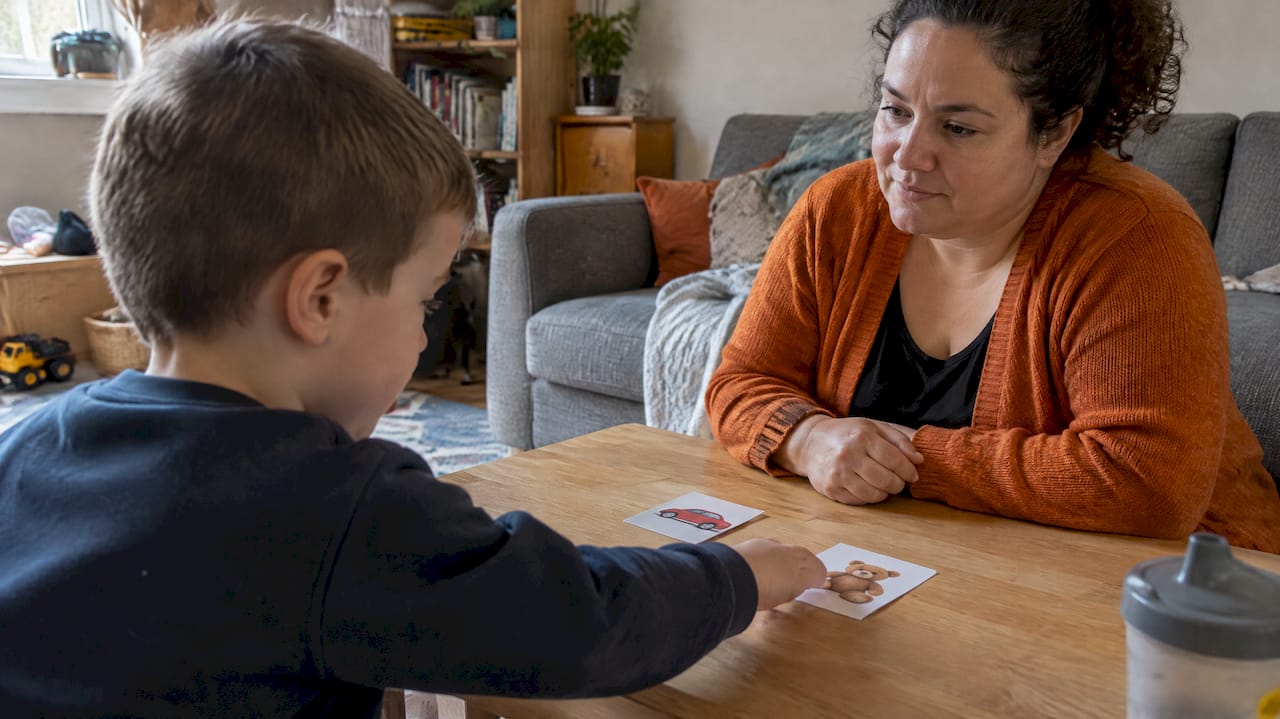
Start with short, evidence-based “How To” and video-modeling clips from university or hospital libraries, not long lecture recordings. Look for a stated evidence base, real demonstrations (not talking heads), supplemental handouts, and a runtime under ten minutes. Autism Victory App curates these formats into guided playlists so you’re not searching from scratch.
TL;DR:
Trust only videos that explicitly reference an evidence base, show the target skill in action, and include supplemental materials like handouts or schedules.
Short demonstration videos are ideal for home use, while longer webinars suit professional development; always prioritize accessibility features like captions and transcripts.
Evaluate videos by checking for a clear practice method, matching the target audience, and confirming the presence of demonstrative content before applying techniques.
Core skills such as video modeling, visual supports, and reinforcement are essential; effective clips show behavior, steps, prompts, and reinforcement in sequence.
Applying video content successfully involves previewing, breaking down steps, rehearsing, and tracking progress, with structured apps like Autism Victory App helping caregivers implement routines.
Table of Contents
Why Structured Video Training Changes What Families Can Do at Home
How Autism Victory App Turns Video Learning Into a Plan You Can Follow
Where to Find Reliable Autism Training Videos
Not all autism training videos are built the same, and the format matters as much as the content. Some are five-minute demonstrations you can watch on a lunch break. Others are ninety-minute workshop recordings meant for staff development. Knowing the difference saves you from wasting an evening on the wrong resource.
Video modeling clips show a person performing a target skill step by step, then leave room for the viewer to practice. Short “How To” demos, typically around five minutes, walk through a single practical task like handwashing or a prompting sequence. Webinar and workshop recordings run longer and usually target a professional audience that needs continuing education credit. Playlists and curricula string several short videos together into a sequence, often organized by skill area or developmental stage.
Where you find these matters just as much as their format. The most trustworthy hosts fall into a few categories:
University-affiliated autism centers, such as VCU’s Autism Center for Education, which produces its How To video series around five-minute, evidence-based demonstrations of classroom and home practices.
Hospital-based autism programs, including Seattle Children’s, whose Introduction to Autism video series explains diagnosis, support levels, and family resources through YouTube playlists.
Nonprofit training networks and regional autism collaboratives, which often produce applied tutorials aimed at both families and frontline staff.
Free structured module libraries like Autism Internet Modules, which pair videos with self-paced coursework for parents, educators, and community members.
Your use case should drive your choice. A parent teaching a child to brush teeth needs a five-minute demo, not a ninety-minute webinar. A special education teacher building a professional development plan needs the opposite. Whichever you pick, prioritize videos that include captions, transcripts, or downloadable handouts. Accessibility features aren’t a nice extra. They’re often the difference between a video you can actually use with a child who has different processing needs and one you watch once and forget.
How to Evaluate a Training Video Before You Trust It
Plenty of autism-related content online looks credible but isn’t. A confident narrator and good lighting don’t make a video evidence-based. You need a faster way to sort the useful from the fluff, especially when you’re short on time and long on responsibilities.
Run any new video through this checklist before you build a lesson or a home routine around it:
Check for a stated evidence basis. Does the video, or the organization hosting it, reference a specific practice, study, or established method? University and hospital centers usually make this explicit.
Look for demonstrative content. A video that only talks about a skill, without showing someone performing it, teaches you very little.
Confirm supplemental materials exist. Handouts, task analyses, or printable schedules signal that the producer expects you to implement, not just watch.
Check the runtime against the purpose. A skill-teaching clip should run short. A staff training or parent workshop can run longer, but it should still be organized into clear segments.
Match the video to its intended audience. A clip built for behavior analysts will use different language and pacing than one built for a parent.
Verify accessibility. Captions and transcripts should be available, particularly for viewers who process written and spoken language differently.
Red flags are just as telling as the good signs. Be cautious of videos that lean on marketing language (“revolutionary breakthrough method”) without ever showing the technique in action, that cite no source or center of origin, or that lack any supplemental material at all. If a video promises results but never demonstrates the process, treat it as entertainment, not instruction.
Your priorities shift depending on your role. Caregivers should look for practical home adaptations, not clinical jargon. Educators need classroom-ready task analyses and simple data collection tips they can use during a school day. Clinicians and behavior professionals should expect citations and a clear description of method, since they’re often responsible for defending their practice choices to families or supervisors.
Pro Tip: Before trying a new technique from a video, watch it twice. The first pass is for understanding the goal. The second is for catching the small details, like hand placement or timing, that make the demonstration actually work.
When a video’s claims don’t match what you’re seeing in your own child or student, that’s your signal to consult a licensed professional rather than keep troubleshooting alone.
The Core Skills Every Video Library Should Teach
A handful of techniques show up across nearly every credible autism training library, because they form the backbone of most classroom and home intervention plans. Understanding what a strong demonstration of each one looks like helps you separate a genuinely useful clip from a vague one.
Video modeling is the foundation. A learner watches someone perform a target behavior, then practices it themselves. Research and practice centers identify video modeling as effective for many autistic learners, in part because visual demonstration often produces faster skill acquisition than verbal instruction alone. A strong modeling clip shows the full behavior at a normal pace, breaks it into repeatable steps, and repeats the sequence more than once.
Visual supports and schedules come next. Effective demonstrations show a real schedule in use, not just a sample image, and they show what happens when a child resists the transition it’s meant to support.
Reinforcement and prompting techniques appear in nearly every applied video. Quality clips demonstrate specific prompting hierarchies, either least-to-most (starting with minimal help and increasing support only as needed) or most-to-least (starting with full support and fading it over time). An effective clip pairs the prompt with a clear moment of reinforcement immediately after the target behavior.
Other core topics you should expect a solid video library to cover:
Routines and transitions, including how to preview an upcoming change before it happens
Functional communication training, which teaches a replacement behavior for meeting a need without frustration or shutdown
Toilet training, usually broken into a task analysis of small observable steps
Sleep interventions, which typically focus on environmental adjustments and consistent bedtime routines
Major university-affiliated centers and nonprofit networks, including WMU’s Autism Center of Excellence, extend these topics further into areas like IEP navigation, mental health, and the transition to adulthood. That breadth matters because a family’s needs change constantly. The video that helped at age four looks nothing like what you need at fourteen.
An effective short clip, regardless of topic, tends to show four things in sequence: the target behavior itself, a stepwise breakdown of how to get there, the prompting method used, and a visible moment of reinforcement. If a video skips straight from “here’s the problem” to “here’s the solution” without showing the steps between, it’s missing the part that actually teaches you anything.
To adapt a demo to your own routine, try reframing it as a short prompt to yourself: “What are the three to seven steps this task breaks into for my child specifically, and where would I add a visual cue?” That single question turns a passive viewing into an active plan.
From Watching to Doing: A Four-Step Workflow
Watching a training video and applying it are two different skills, and most caregivers get stuck between them. A simple four-step workflow closes that gap without requiring a clinical background.
Preview the video with a purpose. Watch once straight through, then note the specific skill and setting it targets. Ask whether it matches your child’s current developmental level.
Extract the task steps. Break the demonstrated skill into three to seven observable steps you can actually see happening. This is the same task analysis structure clinicians use, and it works just as well at your kitchen table.
Rehearse before you implement. Role-play the sequence yourself, or with a partner, before trying it with your child or student. This catches awkward transitions in the plan before they become confusing to the learner.
Run a short data check. After a few attempts, track three to five brief probe trials to see whether the skill is generalizing across settings, not just the one where you first practiced it. A simple frequency count, like how many times a request was made independently today versus yesterday, tells you more than instinct alone.
If those probes show no movement after a couple of weeks, that’s the point to loop in a behavior analyst, speech therapist, or your child’s care team rather than keep adjusting the approach solo.
Autism Victory App’s guided playlists and prompt library are built around this exact workflow. Instead of hunting for the right video and then guessing how to apply it, you get a curated clip paired with a suggested practice plan and a place to log what happened, all inside one caregiver community.
A few practical notes matter here too. Always ask for a demonstrated skill’s consent-friendly framing, particularly with older children and teens who can participate in decisions about their own learning. Use affirming, respectful language when narrating a plan to your child, and adjust the pace of any technique to match developmental level rather than chronological age.
Pro Tip: Keep a single notebook or app note for each skill you’re teaching. Write the date, the video source, and one line about what worked. Three weeks later, that tiny record will tell you more than your memory will.
Why Structured Video Training Changes What Families Can Do at Home
The families who make the fastest progress with autism intervention videos aren’t the ones who watch the most content. They’re the ones who watch less, but apply it with more structure. A single well-chosen five-minute demo, rehearsed and measured, tends to outperform an afternoon of scattered YouTube searching.
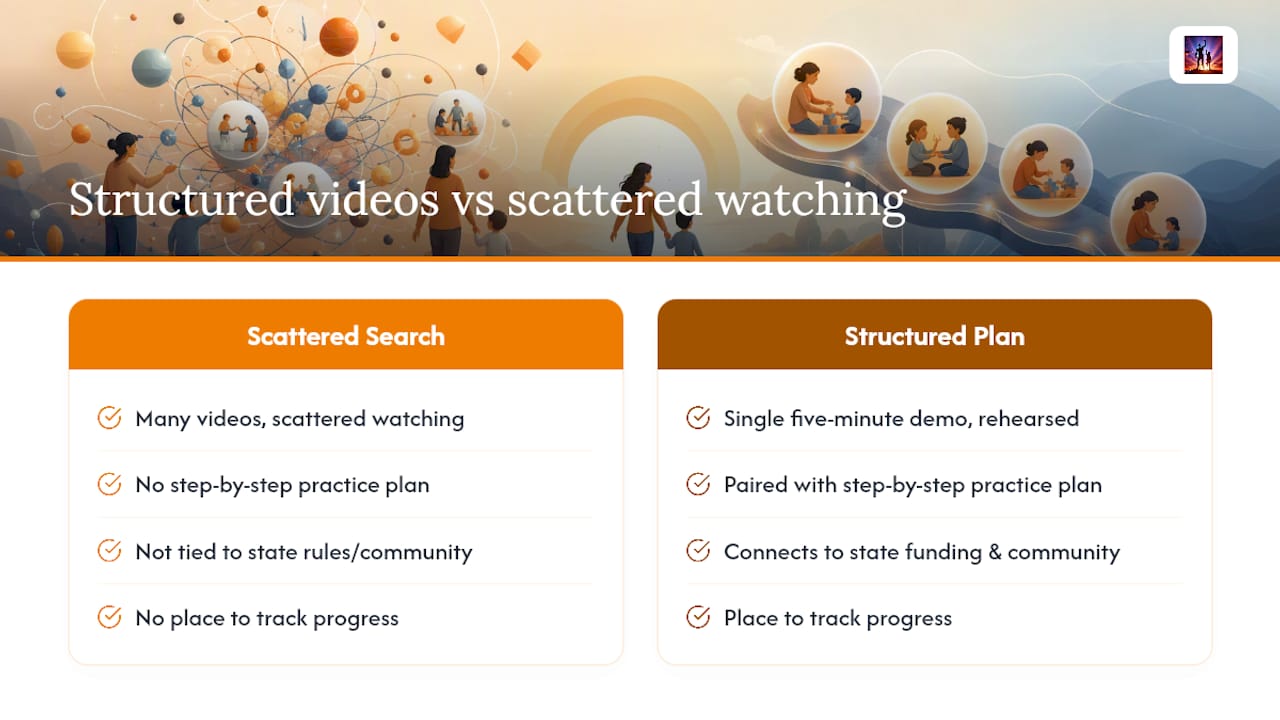
That’s the gap Autism Victory App is built to close. Public video libraries from university and hospital centers are genuinely excellent, but they weren’t designed with a step-by-step practice plan attached, and they weren’t built to connect to your specific state’s funding rules or your particular caregiver community. Pairing strong public resources with a structured plan, a place to track progress, and people who understand your specific situation is what turns information into actual skill-building at home.
None of this replaces a diagnosis, a treatment plan, or the professionals on your child’s care team. It supplements what they’re already doing, and it gives you a way to stay consistent between appointments, which is often where the real progress either happens or stalls out.
— Ronnie Talent
How Autism Victory App Turns Video Learning Into a Plan You Can Follow
Finding a good training video is only half the job. The harder part is turning it into a routine that actually sticks on a Tuesday night when everyone’s tired. That’s the specific gap Autism Victory App fills for caregivers who’ve already found solid public resources but need help applying them consistently.
Inside the app, you get:
Curated video playlists organized by skill area, so you’re not re-searching university archives every week
Guided lesson plans that turn a demonstration into a step-by-step home or classroom routine
AI-powered prompts that help you troubleshoot when a technique isn’t landing the way the video showed
State-specific funding and support resource navigation, so you know what’s available where you live
A caregiver community where you can ask what actually worked for someone else’s kid
A public video library gives you the technique. Autism Victory App gives you the plan, the tracking, and the people to compare notes with, all built specifically for autism caregivers rather than a general audience. You can free for seven days and see whether a guided approach gets you further than a bookmarked playlist ever did.
Trusted Video Libraries Worth Exploring
VCU’s How To series: five-minute evidence-based demos for caregivers and educators.
Seattle Children’s video series: hospital-backed family education playlists.
Autism Internet Modules: free, self-paced training for professionals and parents.
Kennedy Krieger’s Early Signs tutorial: comparative clips for early identification.
This article is general information, not a substitute for advice from a qualified doctor. Consult a qualified healthcare professional about your own circumstances before acting on anything here.
Sources
Recommended