
Autism Spectrum Disorder Is Not a Learning Disability
Autism spectrum disorder (ASD) is classified as a developmental disability, not a learning disability. The NIMH is clear on this: learning disabilities refer to specific impairments in academic skill acquisition — reading, writing, or math — while ASD affects social communication, behavior, and sensory processing in ways that go far beyond the classroom. That distinction matters practically, because the supports your child needs, the evaluations you request, and the labels schools use will all follow from it.
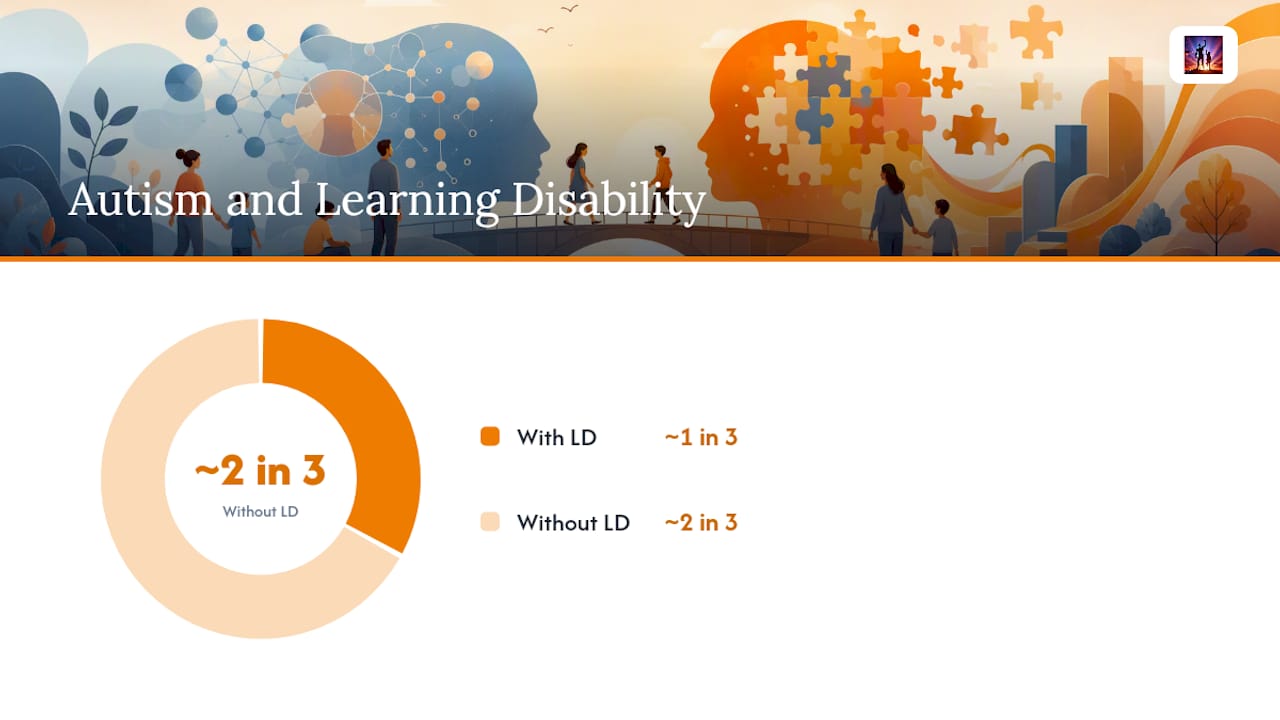
That said, autism absolutely can affect how a child learns. And roughly one in three autistic people also has a co-occurring learning disability — meaning the two can exist together, even though they are separate diagnoses.
Here is where to start if you are a parent or educator:
Monitor learning closely. Track whether struggles are tied to social demands, sensory overload, or specific academic skills — the cause shapes the solution.
Request a comprehensive evaluation. Ask your child’s pediatrician or school for a full developmental and educational assessment, not just one or the other.
Trial classroom accommodations now. Visual schedules, sensory breaks, and flexible response formats can help while a formal evaluation is pending.
Key Takeaways
Autism is a developmental disability, not a learning disability — but it can significantly affect how a child learns, and it frequently co-occurs with specific learning disabilities that require their own evaluation and support.
Point | Details |
|---|---|
ASD is not a learning disability | ASD is a developmental disability; learning disabilities are specific impairments in reading, writing, or math. |
Co-occurrence is common | Around one in three autistic people also has a learning disability — always evaluate for both. |
Learning barriers differ | Autism affects learning through sensory, social, and executive function demands, not academic skill deficits. |
Request a full evaluation | Ask for both developmental and academic assessments; schools are legally required to evaluate under IDEA. |
Start supports early | Early intervention through CDC-recommended programs improves developmental outcomes significantly. |
For practical next steps, caregiver tools, and state-specific resources, visit Autism Victory App.
Table of Contents
Is autism a learning disability? The classification explained
What a learning disability actually is
How autism can affect learning in practice
Can someone have both autism and a learning disability?
How professionals assess ASD vs. learning disabilities
Evidence-based supports, accommodations, and school planning
What the research says about early identification
When to request an evaluation — age-by-age signs
A note from the author on what families actually need
Sources
Is autism a learning disability? The classification explained
Autism spectrum disorder is a neurodevelopmental condition characterized by differences in social communication, restricted or repetitive behaviors, and sensory sensitivities. The CDC describes it as a developmental disability caused by differences in the brain — one that shows up differently in every person and can range from mild to highly significant in terms of daily support needs.
Core features of ASD include:
Social communication differences: Difficulty reading social cues, maintaining back-and-forth conversation, or understanding unspoken rules
Restricted and repetitive behaviors: Strong routines, intense focused interests, repetitive movements (stimming)
Sensory differences: Over- or under-sensitivity to sound, light, touch, taste, or smell
Variability in language and cognition: Some autistic people are highly verbal with strong academic skills; others have limited spoken language or intellectual disabilities
The National Autistic Society describes what they call a “spiky profile” — autistic individuals often show wide variation between their strengths and areas of difficulty, even within the same person. A child might have exceptional memory for facts but struggle to write a paragraph. Another might read fluently but find group work overwhelming. That variability is one reason ASD is so often misunderstood in school settings.
Early signs parents and educators should know include limited eye contact in infancy, delayed speech milestones, not responding to their name by 12 months, and difficulty with pretend play by age 2. These are developmental signals, not academic ones — which is exactly why ASD sits in a different diagnostic category than learning disabilities.
What a learning disability actually is
A learning disability is a specific impairment in the brain’s ability to receive, process, store, or communicate information related to academic skills. According to LD OnLine, learning disabilities affect the acquisition of reading, writing, or math — not social communication or behavior.
Common types include:
Dyslexia: Difficulty decoding written words and connecting letters to sounds; the most common learning disability
Dyscalculia: Trouble understanding number concepts, math facts, and calculations
Dysgraphia: Difficulty with the physical act of writing and organizing written expression
Auditory processing disorder: Trouble interpreting sounds accurately despite normal hearing
Nonverbal learning disorder (NVLD): Difficulty with visual-spatial tasks, math reasoning, and reading social cues — notably, NVLD can look similar to ASD in some presentations
One important clarification: in education, the terms “learning disability” and “learning difficulty” are sometimes used interchangeably, but they carry different legal and clinical weights. In the U.S., the Individuals with Disabilities Education Act (IDEA) uses “specific learning disability” as a formal eligibility category for special education services. A child can qualify under that category without having autism, and an autistic child can qualify for services under a completely different eligibility category.
A person can have a specific learning disability without autism. An autistic person can have no learning disability at all. And some people have both — which is where the overlap gets complicated.
How autism can affect learning in practice
Autism does not impair academic skill acquisition the way dyslexia does. But it can create significant barriers to learning through entirely different mechanisms. The National Autistic Society notes that the main barrier for many autistic students is not cognitive ability — it is the sensory and social demands of the school environment itself.

ASD Feature | How It Shows Up in Class | Practical Accommodation |
|---|---|---|
Sensory sensitivity | Distracted or distressed by fluorescent lights, noise, or crowded hallways | Preferential seating, noise-canceling headphones, reduced sensory load |
Executive function differences | Trouble starting tasks, switching activities, or organizing multi-step work | Visual schedules, step-by-step checklists, transition warnings |
Social communication differences | Difficulty with group work, peer collaboration, or understanding teacher instructions | Clear written instructions, one-on-one check-ins, explicit social rules |
Language processing differences | Slower processing of verbal instructions; literal interpretation of figurative language | Extra processing time, written instructions alongside verbal, avoid idioms |
Anxiety | Avoidance, meltdowns, or school refusal tied to unpredictability | Predictable routines, advance notice of changes, calm-down spaces |
Autistic students also bring real strengths to the classroom. Many show exceptional attention to detail, strong visual memory, deep expertise in areas of special interest, and consistent rule-following once expectations are clear. A teacher who taps into a student’s special interest to teach a concept often sees engagement that looks nothing like the “struggling student” label the child arrived with.
Quick accommodations educators can trial immediately:
Post a visual daily schedule and refer to it explicitly
Give written instructions alongside verbal ones
Offer alternative ways to demonstrate knowledge (oral response, drawing, project-based work)
Build in a sensory break between demanding tasks
Pair a sensory regulation strategy with transitions between subjects
Can someone have both autism and a learning disability?
Yes — and it happens more often than many people realize. Autism and learning disabilities are distinct diagnoses, but they co-occur at a meaningful rate.
According to Autistica, around one in three autistic people may also have a learning disability. That figure varies considerably depending on the age group studied, the diagnostic criteria used, and whether the sample comes from a population-based study or a clinical setting.
A peer-reviewed review on autism comorbidity confirms that co-occurring neurodevelopmental conditions — including specific learning disabilities, ADHD, and anxiety — are common in ASD and add complexity to both diagnosis and support planning. Understanding autism and ADHD together is particularly relevant, since ADHD co-occurs with ASD at high rates and can independently affect academic performance.
Why do prevalence estimates vary so much? A few reasons:
Clinic-based samples tend to include more severely affected individuals, pushing co-occurrence rates higher
Population-based studies (like the CDC’s SEED study) capture a broader range of autistic people, including those with milder profiles
Diagnostic practices have shifted over time, particularly after DSM-5 merged several previous categories into ASD
Population / Study Type | Estimated Co-occurrence with Learning Disability | Notes |
|---|---|---|
General autistic population (Autistica estimate) | ~1 in 3 | Varies by age group and study design |
Clinical/referred samples | Higher than population estimates | Sampling bias toward more complex presentations |
Population-based studies (e.g., SEED-style) | Lower than clinical estimates | Captures full spectrum including milder profiles |
The practical takeaway: never assume an autistic child does or does not have a learning disability without a full evaluation. The two conditions require different supports, and missing one means leaving real needs unaddressed.
How professionals assess ASD vs. learning disabilities
These are two different evaluation processes, often conducted by overlapping but distinct teams.
For an ASD diagnosis, the typical process involves:
A developmental pediatrician or child psychiatrist conducting a clinical interview and behavioral observation
Standardized diagnostic tools (such as the ADOS-2 or ADI-R) administered by a trained psychologist or speech-language pathologist
A developmental history gathered from parents and caregivers
Hearing and vision screening to rule out sensory causes
Input from teachers and school staff via rating scales or reports
For a learning disability evaluation, the process focuses on:
Standardized academic achievement tests (reading fluency, math calculation, written expression)
Cognitive/IQ testing to identify processing strengths and weaknesses
Review of school records, grades, and teacher observations
Ruling out other explanations (vision, hearing, inadequate instruction)
The NIMH’s autism publications note that comprehensive evaluations combine developmental history, standardized assessments, and school input — which is why a single appointment rarely captures the full picture.
Who to contact and what to say:
Talk to your child’s pediatrician first and ask for a developmental screening or referral to a developmental pediatrician
Contact your child’s school in writing and request a “full and individual evaluation” under IDEA — schools are legally required to respond within a set timeframe
Gather samples of your child’s schoolwork, teacher comments, and any prior evaluations before the appointment
Ask specifically whether the evaluation will assess both developmental functioning and academic achievement
Pro Tip: Keep a running log of specific classroom examples — not just “struggles with reading” but “reads words correctly but cannot retell the story” or “shuts down during group work but completes the same task independently.” That level of detail helps evaluators distinguish between ASD-related barriers and a specific learning disability.
Evidence-based supports, accommodations, and school planning
Once you have an evaluation, the next step is translating findings into a formal support plan. In the U.S., two main frameworks apply: the Individualized Education Program (IEP) and the 504 Plan. They are not interchangeable. An IEP provides specialized instruction and is appropriate when a child’s disability requires modifications to what is taught. A 504 plan provides accommodations within the general education setting — changes to how a child learns, not what they learn. For a detailed breakdown of which fits your child’s situation, the IEP vs. 504 guide on Autism Victory’s blog walks through the decision clearly.
Common therapies and services that support autistic learners:
Speech-language therapy: Builds communication skills, both verbal and social
Occupational therapy (OT): Addresses sensory processing, fine motor skills, and daily living tasks
Applied behavior analysis (ABA): Targets specific skill-building and behavior reduction; effectiveness and appropriateness vary by individual
Social skills groups: Structured peer interaction with explicit coaching on social rules
Family and school collaboration is one of the most underused tools in a child’s support plan. A strategy that works at home — a visual countdown timer before transitions, for example — often transfers directly to the classroom if the teacher knows about it. Ask for a shared communication log or a brief weekly check-in with the teacher, especially during the first months of a new plan.
Quick-start checklist for requesting school supports:
Submit a written request for evaluation (email creates a paper trail)
Ask the school to identify which eligibility category they are evaluating under
Request that the evaluation include both developmental and academic components
Ask for interim accommodations while the evaluation is in progress
Attend the IEP or 504 meeting with written questions prepared
What the research says about early identification
The evidence for early intervention in ASD is consistent and strong. The CDC’s “Learn the Signs. Act Early.” program is built on the finding that early intervention services can significantly improve a child’s developmental trajectory — particularly in communication, adaptive behavior, and school readiness.
Key findings worth knowing:
The CDC’s SEED (Study to Explore Early Development) is one of the largest studies of ASD in the U.S., tracking developmental patterns from early childhood to help identify risk factors and improve early detection
A PubMed review on autism and learning disability documents shared and distinct features between the two conditions, underscoring why differential diagnosis matters for treatment planning
Research published in Frontiers in Psychiatry highlights the neurodevelopmental mechanisms underlying ASD and the importance of individualized assessment approaches
What this means for your family: do not wait for a formal diagnosis to start services. In the U.S., children under age 3 can access early intervention through their state’s Part C program without a formal ASD diagnosis. Children ages 3 and older can receive school-based evaluations and services under IDEA. The earlier supports begin, the more developmental ground a child can cover.
When to request an evaluation — age-by-age signs
Knowing when to act is half the challenge. Here is a practical timeline:
Birth to 12 months: Limited eye contact, not babbling by 12 months, not responding to their name, no back-and-forth gestures (pointing, waving)
12–24 months: No single words by 16 months, no two-word phrases by 24 months, loss of previously acquired language or social skills at any age
Ages 2–4 (preschool): Difficulty with pretend play, strong preference for sameness, limited peer interaction, distress at transitions or sensory input
School age (5–12): Academic struggles that seem tied to attention, anxiety, or social demands rather than specific skill gaps; difficulty with group work; meltdowns around schoolwork; teacher reports of “not paying attention” or “seems to be in their own world”
Adolescence: Social isolation, anxiety, school avoidance, or academic decline that does not fit a clear learning disability pattern
Urgent signs that warrant immediate contact with a pediatrician: any loss of language or social skills at any age, significant self-injurious behavior, or a child who seems to regress after a period of typical development. Regression is not a normal developmental variation — it needs prompt evaluation.
Co-occurring conditions like anxiety and ADHD change the picture. A child with both ASD and ADHD may look primarily inattentive in class, and the autism piece gets missed. A child with ASD and anxiety may refuse school entirely, which looks like a behavioral problem rather than a support need. When multiple conditions are present, request that the evaluation explicitly address each one — a single-focus assessment will miss the full picture.
A note from the author on what families actually need
Parents navigating this question are usually not looking for a textbook answer. They are watching their child struggle and trying to figure out what to do next. The classification question — is this autism, a learning disability, or both — matters because it determines which door you knock on first and which supports your child qualifies for.
What I find most important to say here is this: the label is a starting point, not a ceiling. An autistic child who also has dyslexia needs supports for both. An autistic child with no learning disability still needs a school environment that works with their neurology, not against it. And a child who is struggling but has not yet been evaluated needs someone to advocate for that evaluation — now, not after another year of watching them fall behind.
Autism Victory App was built for exactly this moment: when you know something is going on and you need real information, not a generic checklist. The app brings together AI-powered guidance, state-specific resource navigation, caregiver books and audiobooks, and a community of families who have been where you are. It is a practical next step when you are ready to move from understanding the diagnosis to doing something with it.
Sources
This article provides general information only and is not a substitute for professional medical, educational, or psychological advice. Consult a qualified clinician or your child’s school team for guidance specific to your child’s needs.
Recommended