Alternatives to ABA for Parents: Ethical, Evidence-Informed Options
The most practical alternatives to ABA fall into four categories: developmental and relationship-based models (DIR/Floortime, RDI, ESDM, SCERTS, TEACCH), communication and daily-living supports (speech therapy, AAC, occupational therapy), regulation and social supports (CBT, social skills groups), and complementary adjuncts (music therapy, play therapy, animal-assisted therapy). Before you switch or add services, identify your child’s top one or two priorities — communication, emotional regulation, or daily living skills — then confirm what your insurance covers and whether your child has an active IEP or 504 plan. That two-step check will save you weeks of searching.
Both the CDC and ASHA recognize multiple non-ABA intervention categories with meaningful evidence behind them. Community advocates, including resources like Instead of ABA, emphasize that the goal of any good therapy should be your child’s dignity, autonomy, and well-being, not behavioral compliance. Autism Victory App was built around that same principle: giving your family the tools to navigate this system with confidence.
Developmental/relationship models: DIR/Floortime, RDI, ESDM, SCERTS, TEACCH
Communication and daily-living supports: Speech and language therapy, AAC, occupational therapy
Regulation and social supports: CBT, social skills groups, SPACE framework, NEST approach
Complementary adjuncts: Music therapy, play therapy, animal-assisted therapy
Key Takeaways
The most effective path forward is matching your child’s top priority (communication, regulation, or daily living) to a neurodiversity-affirming provider with the right credentials, then confirming IEP and insurance coverage before committing.
Point | Details |
|---|---|
Match therapy to your child’s priority | Identify whether communication, regulation, or daily living is the most urgent need before choosing a therapy type. |
Established vs. emerging evidence | ESDM, TEACCH, SLP, OT, and CBT for anxiety have the strongest evidence; DIR/Floortime, RDI, and music therapy are promising but emerging. |
Ask the right provider questions | Request measurable goals, data-sharing, and a clear explanation of how reinforcement is used before starting any program. |
Check IEP and insurance first | School-based SLP and OT are available at no cost through IDEA; state autism insurance mandates cover many clinic-based therapies. |
Autism Victory App for navigation | The app provides state-specific resources, AI guidance, and caregiver tools to help you evaluate and find neurodiversity-affirming providers. |
Table of Contents
What are the best alternatives to ABA therapy?
Developmental and relationship-based models worth knowing
How speech therapy and occupational therapy support daily life
How CBT and social skills groups build regulation and connection
Play therapy, music therapy, and other adjunct supports
How to choose a provider: questions, credentials, and red flags
What the research actually says about ABA alternatives
U.S. next steps: IEP, insurance, and finding providers
What I’ve learned writing caregiver resources
Autism Victory App helps you navigate therapy options with confidence
Sources
What are the best alternatives to ABA therapy?
Here is a fast-reference shortlist. Each entry includes who it fits best, the current evidence level, and the type of provider who typically delivers it. Use this as your starting filter before reading the detailed sections below.
Therapy | Best For | Evidence Level | Typical Provider |
|---|---|---|---|
DIR/Floortime | Toddlers–school age; emotional connection, play | Emerging | Developmental therapist, trained SLP, parent-coached |
RDI | School age; social referencing, dynamic thinking | Emerging | RDI-certified consultant |
ESDM | Ages 12 months–5 years; early communication, play | Established | Certified ESDM therapist, SLP |
SCERTS | All ages; social communication, emotional regulation | Emerging | SLP, special educator, interdisciplinary team |
TEACCH | All ages; structured independence, daily living | Established | Special educator, trained therapist |
CBT (adapted) | School age and up; anxiety, emotion regulation | Established (anxiety) | Licensed psychologist, LCSW |
Speech and language therapy / AAC | Any age; communication | Established | Licensed SLP (CCC-SLP) |
Occupational therapy | Any age; sensory regulation, daily living | Established | Licensed OT (OTR/L) |
Play therapy | Preschool–school age; emotional expression | Emerging | Licensed play therapist, LCSW |
Music therapy | Any age; communication, regulation, engagement | Emerging | Board-certified music therapist (MT-BC) |
Social skills groups | School age–teen; peer interaction | Emerging | Psychologist, SLP, LCSW |
Sensory/sensory diet supports | Any age; regulation, sensory processing | Emerging | OT with sensory integration training |
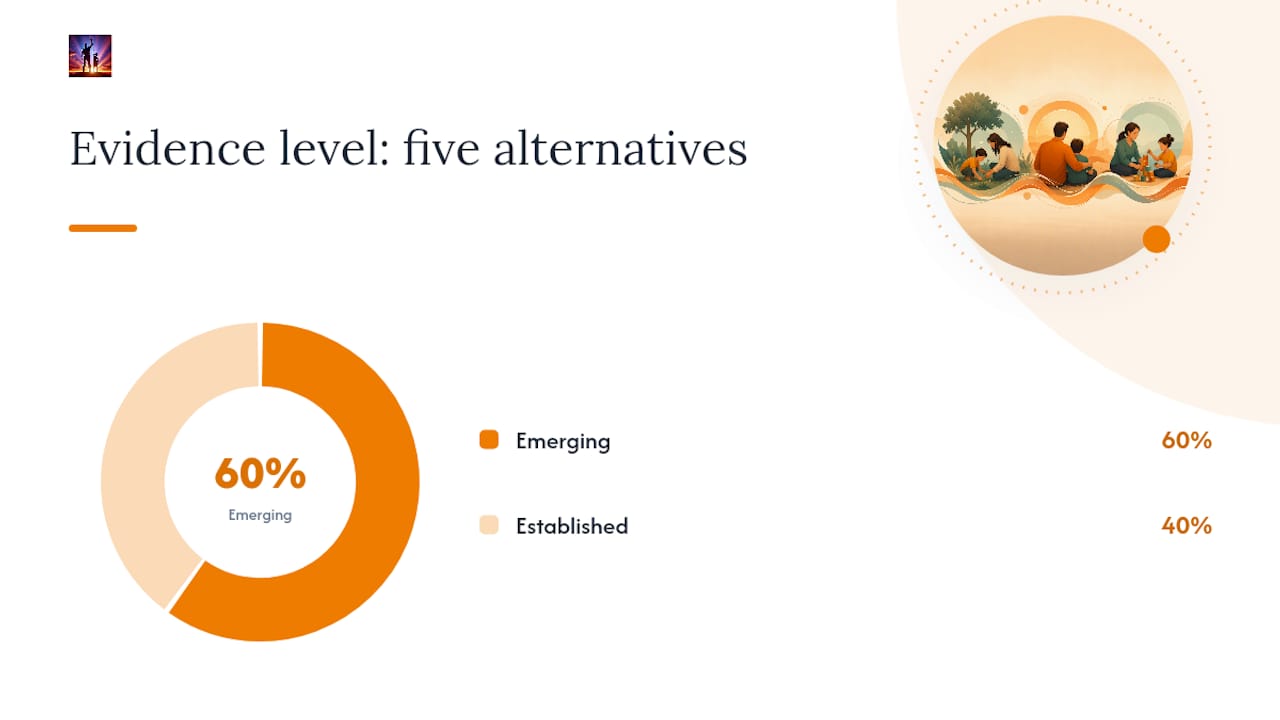
A note on framing: Neurodiversity-affirming approaches treat autism as a difference, not a disorder to be corrected. They prioritize the child’s comfort, communication, and quality of life over behavioral compliance. Behavior-modification-oriented approaches, including some ABA programs, focus on changing observable behavior, which can be helpful for specific skill-building but raises concerns when coercive or masking-focused techniques are used. The therapies above span that spectrum; the sections below help you tell the difference.
Developmental and relationship-based models worth knowing
These models share a core belief: emotional connection and developmental readiness come before skill instruction. Rather than targeting behaviors directly, they build the relational foundation from which communication, social understanding, and daily skills naturally grow. Family involvement is central to all of them. The Royal College of Psychiatrists specifically recommends relationship-based, person-centered, regulation-focused, and trauma-informed approaches as compassionate alternatives to purely behavioral programs.
DIR/Floortime
Developed by Stanley Greenspan, DIR (Developmental, Individual-Difference, Relationship-based) Floortime follows the child’s lead during play to build emotional and relational engagement first. The idea is that complex social and cognitive skills develop from connection, not instruction. Evidence is promising but historically more limited than for behavioral models, so it is typically described as “emerging.” It fits toddlers through school-age children and works best when parents are trained as co-therapists.

RDI (Relationship Development Intervention)
RDI targets social referencing, flexible thinking, and dynamic problem-solving through guided parent-child interactions. A certified RDI consultant coaches the family directly, making it highly parent-led. Evidence is emerging, with a smaller published trial base than ESDM. It tends to suit school-age children and families who want a structured but non-behavioral coaching model.
ESDM (Early Start Denver Model)
ESDM is one of the most rigorously studied early intervention models for children ages 12 months through 5 years. It blends developmental and relationship-based principles with naturalistic teaching strategies, targeting communication, play, and social skills simultaneously. The CDC recognizes ESDM as a treatment category with meaningful evidence. Delivery requires a certified ESDM therapist, often an SLP or developmental specialist, and can be adapted for parent coaching at home.
SCERTS Model
SCERTS stands for Social Communication, Emotional Regulation, and Transactional Support. It is a curriculum framework rather than a discrete therapy, designed to be used by an interdisciplinary team including SLPs, special educators, and OTs. It works across all ages and settings, including school IEP teams. Goals are explicitly child-centered and avoid compliance-based framing. Evidence is emerging, with growing adoption in school districts.
TEACCH (Treatment and Education of Autistic and Related Communication-Handicapped Children)
TEACCH uses structured visual supports, predictable routines, and organized physical environments to help autistic individuals work and learn more independently. It is one of the older, better-studied approaches and is recognized by the CDC as an established intervention category. TEACCH is especially strong for daily living skills and classroom independence across all ages. Special educators and trained therapists typically deliver it, and it integrates well into IEP programming.
SPACE and NEST frameworks
Two newer frameworks worth knowing: the SPACE (Supportive, Predictable, Accepting, Calm, Empowering) framework and the NEST approach both prioritize sensory-friendly environments, predictability, and low-arousal de-escalation. Rather than modifying behavior, they modify the environment so children can engage more naturally. These are often used as organizational principles within schools or residential settings rather than standalone therapies.
Model | Evidence Status | Typical Provider | Best For |
|---|---|---|---|
DIR/Floortime | Emerging | Developmental therapist, trained SLP | Toddlers–school age; emotional connection |
RDI | Emerging | RDI-certified consultant | School age; social referencing |
ESDM | Established | Certified ESDM therapist, SLP | Ages 12 months–5 years; early communication |
SCERTS | Emerging | SLP, special educator, OT team | All ages; social communication, regulation |
TEACCH | Established | Special educator, trained therapist | All ages; structured independence |
SPACE/NEST | Emerging | School teams, residential staff | All ages; environmental regulation |
How speech therapy and occupational therapy support daily life
Communication and daily-living supports are often the first services families add or keep when stepping back from ABA. They address the most immediate functional needs: being able to communicate wants and needs, and managing the sensory and physical demands of everyday life.
Speech and language therapy and AAC
A licensed speech-language pathologist (CCC-SLP credential from ASHA) works on expressive and receptive language, social communication, and, when needed, augmentative and alternative communication (AAC). AAC includes everything from picture exchange systems to high-tech speech-generating devices. Community advocates and neurodiversity-affirming clinicians strongly support AAC for any child whose verbal speech is limited or unreliable, rejecting the outdated idea that AAC “delays” speech development. ASHA’s evidence-based practice framework advises combining research evidence, clinical expertise, and your family’s values when selecting communication interventions — which means your input matters as much as the therapist’s.
Speech therapy is available through school districts (often included in IEPs), early intervention programs (for children under 3), outpatient clinics, and teletherapy platforms. Insurance coverage under the Affordable Care Act and state autism insurance mandates varies; most states now require some level of coverage for SLP services.
Occupational therapy
An occupational therapist (OTR/L) targets the skills your child needs to participate in daily life: self-care, fine motor tasks, handwriting, and sensory regulation. For many autistic children, sensory processing differences are a primary barrier to learning and participation, and OT addresses this directly through a sensory diet — a personalized schedule of sensory activities designed to keep the nervous system regulated throughout the day. OTs with sensory integration training can also address tactile defensiveness and other sensory sensitivities that affect daily routines.
OT is typically covered by insurance and is one of the most commonly included services in school IEPs. Clinic-based and school-based delivery differ in focus: school OT targets educational participation, while clinic OT can address a broader range of daily living goals.
Signs that communication or OT supports should be a priority:
Your child has limited or no functional verbal communication
Your child uses challenging behavior (hitting, biting, fleeing) as a primary communication strategy
Sensory sensitivities significantly disrupt eating, dressing, or sleep
Your child struggles with fine motor tasks needed for school or self-care
Anxiety or meltdowns are triggered by sensory environments (loud spaces, certain textures)
Your child has not received a recent speech or OT evaluation
How CBT and social skills groups build regulation and connection
Emotional regulation and social participation are two of the most common goals families bring to therapy. The approaches in this section target those goals directly, and both can be delivered in neurodiversity-affirming ways when the provider is well-trained.
Cognitive Behavioral Therapy (CBT)
CBT is a structured, evidence-based therapy that helps people recognize connections between thoughts, feelings, and behaviors. For autistic children and teens, it is most commonly used for anxiety and emotion regulation, areas where the evidence base is well-established. Standard CBT protocols are typically adapted for autistic clients: more visual supports, concrete language, explicit teaching of emotional vocabulary, and a slower pace. The key is finding a therapist who understands autistic cognition and does not use CBT to push masking or social performance as goals.
CBT is generally appropriate for school-age children and older, and works best when the child has sufficient verbal and reflective capacity to engage with the cognitive components. A licensed psychologist or licensed clinical social worker (LCSW) with autism-specific training is the right provider.
Social skills groups
Social skills groups bring small numbers of autistic peers together to practice interaction in a structured setting. The best groups use naturalistic, interest-based activities rather than scripted social rules, and they include peer models who share similar communication styles. When evaluating a group, ask whether the goals center on authentic connection or on performing neurotypical social norms. The latter can reinforce masking, which carries real psychological costs.
Pro Tip: When interviewing a CBT therapist or social skills group facilitator, ask directly: “What does success look like for my child?” If the answer centers on appearing more typical, blending in, or reducing autistic traits, that is a signal to keep looking. Neurodiversity-affirming goals sound like: “Your child will have strategies to manage anxiety in loud environments” or “Your child will be able to initiate a conversation about a preferred topic.”
Overlap with relationship-based supports
CBT and social skills work pair well with Floortime and SCERTS when the same team coordinates goals. Co-regulation — where a trusted adult helps a child regulate their nervous system before expecting social engagement — is a principle shared across all three. Families who combine a relationship-based model with targeted CBT for anxiety often report that the two approaches reinforce each other.
Ask whether the provider uses neurodiversity-affirming practices and can describe what that means in their specific program
Confirm that social goals are framed around the child’s quality of life, not neurotypical performance
Check that the group size is small enough for genuine interaction (typically 4–8 participants)
Play therapy, music therapy, and other adjunct supports
These approaches are most useful as complements to core therapies, not replacements. They address engagement, emotional expression, and sensory regulation in ways that feel natural and low-pressure for many autistic children.
Play therapy
Play therapy uses structured and unstructured play to help children process emotions and develop communication. A narrative review of 13 interventions found play therapy among the most frequently cited approaches with reported benefits in the literature. It is typically delivered by a licensed play therapist or LCSW and fits preschool through school-age children well. Evidence is emerging rather than established, meaning it shows consistent promise in smaller studies but lacks the large randomized trial base of ESDM or TEACCH.
Music therapy
Music therapy uses rhythm, melody, and musical interaction to target communication, social engagement, and emotional regulation. The same narrative review identified music therapy as one of the most-cited adjunct interventions with beneficial effects reported in the literature. A board-certified music therapist (MT-BC) delivers it, and sessions can be adapted for any age or communication level. It is particularly useful for children who respond strongly to auditory input or who find verbal interaction difficult.

Animal-assisted therapy
Animal-assisted therapy, including equine-assisted therapy, is frequently requested by families. Evidence is limited and mostly from small studies, but reported benefits include reduced anxiety and increased social engagement. If you pursue this, verify that the provider is a licensed clinician (not just an animal handler) and that the program has clear therapeutic goals.
Dietary changes, supplements, and unproven products
Families frequently ask about gluten-free/casein-free diets, omega-3 supplements, and various other nutritional approaches. The evidence for most of these is thin. More importantly, the FDA has issued clear warnings about potentially dangerous products and therapies that claim to treat autism, including bleach-based “treatments,” chelation, and certain supplements marketed specifically for autism. Before changing your child’s diet or adding any supplement, consult your child’s pediatrician or a registered dietitian. Some dietary changes can affect nutrition, medication absorption, and overall health.
Safety callout: The FDA specifically warns against products marketed as autism “cures” that have no scientific backing and carry real health risks. If a product or therapy promises to eliminate or cure autism, that is a red flag, not a selling point.
Music therapy and play therapy: emerging evidence, useful as adjuncts
Animal-assisted therapy: limited evidence, verify licensed clinician involvement
Dietary changes and supplements: consult a medical provider first, every time
Avoid any product or therapy marketed as an autism “cure”
How to choose a provider: questions, credentials, and red flags
Matching the right provider to your child’s needs is the most practical step you can take. Start by identifying your child’s top priority: communication, emotional regulation, or daily living skills. Then look for a provider whose training, approach, and stated goals align with that priority and with neurodiversity-affirming values.
Credentials to look for by therapy type
Speech-language therapy: CCC-SLP (Certificate of Clinical Competence from ASHA); for AAC, look for additional AAC-specific training
Occupational therapy: OTR/L (Occupational Therapist Registered/Licensed); for sensory work, look for SIPT certification or sensory integration training
CBT and social skills groups: Licensed psychologist (PhD/PsyD) or LCSW with documented autism-specific training
DIR/Floortime: DIR/Floortime-trained therapist (ICDL certification is the recognized standard)
ESDM: Certified ESDM therapist (certification through the UC Davis MIND Institute)
RDI: RDI-certified consultant (RDI Connect certification)
Music therapy: MT-BC (Board-Certified Music Therapist, credentialed through CBMT)
Play therapy: RPT (Registered Play Therapist) or licensed clinician with play therapy training
Questions to ask any provider
What are the specific, measurable goals for my child, and how will you track progress?
How do you involve parents and caregivers in the treatment plan?
Do you use reinforcement for behavior change, and if so, how?
How do you handle distress or refusal during sessions?
Will you share the treatment plan and data with me regularly?
How do you adapt your approach for my child’s sensory and communication needs?
What does success look like for my child in your program?
ASHA’s evidence-based practice framework explicitly includes client and family values as one of the three pillars of good clinical decision-making. A provider who dismisses your questions or your child’s preferences is not following best practice.
Red flags
Goals framed as “normalizing” behavior or reducing autistic traits rather than building skills
Use of aversive, painful, or coercive methods at any intensity
Refusal to share treatment rationale, session data, or progress reports
Pressure for high-hour intensive programs without a clear, individualized rationale
“Play-based” marketing that masks extinction-based or compliance-focused techniques — ask providers to specify exactly how they use reinforcement
Dismissal of AAC because it might “reduce motivation to speak”
No family involvement in goal-setting
A common pitfall: a program labeled “child-led” or “play-based” can still rely on ABA principles if the underlying techniques use extinction or reinforcement for compliance. Advocacy resources recommend asking providers to specify whether reinforcement is used for behavior change or for communication and regulation support. Those are meaningfully different goals.
What the research actually says about ABA alternatives
The evidence landscape for autism interventions is uneven, and being honest about that helps you make better decisions.
Behavioral approaches, including ABA, have the largest published evidence base for treating certain ASD-related symptoms, particularly for early skill acquisition. The CDC and a broad literature review through PubMed Central both confirm that behavioral methods have the strongest overall evidence base, while many developmental and adjunct approaches have emerging or limited high-quality trial data. That does not mean developmental approaches are ineffective; it often reflects that they are harder to study in randomized controlled trials and have received less research funding.
At the same time, families and autistic adults have raised serious concerns about certain ABA applications, particularly older, more intensive programs that used aversive techniques or prioritized behavioral compliance over the child’s well-being. One mixed-method study found that caregivers who chose non-ABA or AAC-focused supports reported lower posttraumatic stress symptoms than some ABA-exposed peers in that sample. The authors caution that these results are context-specific and not necessarily generalizable, but the finding reflects a real pattern in caregiver experience that deserves attention.
Autistic self-advocacy organizations have published ethics guidance urging that interventions respect autistic autonomy and avoid coercive practices. The Autistic Advocacy Project’s ethics framework provides concrete principles for evaluating whether a program meets that standard.
How to weigh the evidence practically:
Established evidence (ESDM, TEACCH, SLP, OT, CBT for anxiety) means multiple well-designed studies support the approach; it is a reasonable first choice for those goals
Emerging evidence (DIR/Floortime, RDI, SCERTS, music therapy, play therapy) means promising results in smaller or less rigorous studies; reasonable to try, especially when the approach aligns with your child’s needs and your family’s values
Limited or no evidence does not automatically mean harmful, but it does mean you should be cautious, ask more questions, and avoid high-cost or high-intensity commitments without clear rationale
Caregiver and autistic adult reports are meaningful data, not just anecdotes; weigh them alongside published research
U.S. next steps: IEP, insurance, and finding providers
Once you know which therapy categories fit your child’s priorities, here is a practical sequence to follow.
Gather current evaluation reports. Pull together your child’s most recent speech, OT, and psychological evaluations. If they are more than two to three years old, request updated assessments through your school district or a private evaluator.
Request an IEP or 504 meeting. Under IDEA (Individuals with Disabilities Education Act), your child is entitled to a free appropriate public education, which can include speech therapy, OT, and other related services. A 504 plan vs. IEP comparison will help you understand which framework fits your child’s needs. Request the meeting in writing and keep a copy.
Check your state’s autism insurance mandate. Every U.S. state now has some form of autism insurance mandate, but coverage specifics vary significantly. Check whether your plan covers the therapies you are considering and whether prior authorization is required. The ABA insurance coverage guide on Autism Victory’s blog walks through the authorization process in detail, and much of that process applies to other therapies as well.
Ask for medical prior authorization when needed. For clinic-based speech therapy, OT, or CBT, your child’s pediatrician may need to write a referral or letter of medical necessity. Get this in writing before the first appointment.
Search for providers through multiple channels. Start with your school district’s related services team, then check your state’s early intervention program (for children under 3), local children’s hospitals, university clinic programs, and teletherapy platforms. ASHA’s ProFind directory is a reliable starting point for SLPs and audiologists.
Typical cost ranges (out-of-pocket, without insurance):
Speech therapy: $100–$250 per session (clinic-based)
Occupational therapy: $100–$200 per session
CBT (adapted): $100–$250 per session
Music therapy: $60–$150 per session
DIR/Floortime parent coaching: $100–$200 per hour
These are broad ranges; costs vary by region, provider experience, and setting. School-based services through an IEP are provided at no cost to families. For financial assistance options including state Medicaid waivers, grants, and nonprofit programs, Autism Victory’s financial guide covers state-specific resources.
Where to look for evidence and official guidance:
CDC autism treatment page for an overview of recognized intervention categories
ASHA’s evidence-based practice resources for communication intervention guidance
FDA consumer update for safety warnings on unproven products
Autistic Advocacy Project ethics framework for evaluating whether a program respects your child’s autonomy
What I’ve learned writing caregiver resources
There is a version of this conversation that gets stuck on “ABA vs. everything else,” and it misses the point. The real question is: what does your child need right now, and does the provider you are considering actually see your child as a whole person?
The families I have seen navigate this well are not the ones who found the “right” therapy. They are the ones who got clear on their child’s priorities, asked hard questions of every provider, and stayed willing to adjust when something was not working. Neurodiversity-affirming care is not a single therapy; it is a standard you hold every provider to, regardless of the modality they use. A speech therapist who dismisses your child’s AAC device is not neurodiversity-affirming, even if the label on their door says nothing about ABA. A social skills group that teaches autistic kids to perform neurotypical behavior is not affirming, even if it calls itself “play-based.”
The evidence landscape is genuinely mixed, and that is okay. You do not need certainty to make a good decision. You need clarity on your child’s needs, a provider who respects your child’s autonomy, and a system for tracking whether things are actually improving. That combination, more than any specific therapy name, is what moves families forward.
Autism Victory App helps you navigate therapy options with confidence
Finding the right non-ABA support for your child is not a one-time decision. It is an ongoing process of evaluating providers, checking coverage, and adjusting as your child grows. That process is exactly what Autism Victory App was built for.
Autism Victory App gives you state-specific funding and resource navigation so you are not starting from scratch every time you look for a new provider or funding source. The app includes caregiver-focused books and audiobooks (in English and Spanish), educational videos on therapy approaches, a calming sound library, personalized AI guidance to help you prioritize your child’s goals, and a community of caregivers who have been through the same decisions you are facing now. It is an honest, practical tool, not a therapy replacement. Think of it as the navigation layer that sits on top of everything else: helping you ask better questions, find the right providers faster, and understand what your insurance and IEP actually cover.
Start your 7-day free trial at Autismvictory and see what resources are available for your state.
Sources
Keep these links handy when meeting with providers, preparing for IEP meetings, or evaluating a new therapy option.
Treatment and Intervention for Autism Spectrum Disorder | CDC
Why caregivers discontinue ABA and choose communication-based autism interventions (Emerald)
This article provides general information for educational purposes only and is not a substitute for professional medical, psychological, or educational advice. Consult qualified clinicians and review your child’s current evaluations before making changes to their therapy program.
Recommended
ABA Insurance Coverage for Autism Families: 2026 Guide | Autism Victory Blog
Best Autism Books for Parents: 2026 Trusted Guide | Autism Victory Blog
Cobertura de Seguro para ABA en Familias con Autismo: Guía 2026 | Autism Victory Blog
Autism Job Training Programs: A Parent’s Guide | Autism Victory Blog