Families pursuing autism housing assistance have several real pathways: HUD's Housing Choice Vouchers, Section 811 supportive housing, Mainstream Vouchers, Medicaid tenancy-sustaining services, and nonprofit grants. The single most useful first move is to contact your local Public Housing Agency and your state's disability or Medicaid waiver coordinator, since both maintain waiting lists and eligibility rules that shape everything else you do next.
TL;DR:
Waiting lists for housing vouchers and supportive housing programs often take months or years, requiring early application and multiple program submissions to improve chances.
Medicaid supports housing stability through tenancy-sustaining services like help with move-in costs, lease applications, and ongoing case management, but does not pay rent directly.
Families must carefully document help with rent or utilities to avoid reductions in SSI benefits due to in-kind support, including written leases and payment proofs.
Connecting with case managers and waiver coordinators early increases access to referrals and helps navigate complex waiting lists and program details.
Housing for autistic individuals often involves modifications such as sensory-friendly adjustments, safety features, and accessible fixtures, which can be small and affordable or part of funded upgrades.
Table of Contents
Practical, step-by-step actions: apply, document, and advocate
Supportive housing options specific to autism spectrum disorder
Community integration and social inclusion in housing settings
Federal housing programs families should know
HUD runs three programs that matter most for autism housing assistance, and each works differently.
Housing Choice Vouchers are tenant-based, meaning the voucher travels with your family to a private rental unit that accepts it.
Section 811 Project-Based Rental Assistance funds supportive housing built specifically for extremely low-income adults with disabilities. According to HUD's Section 811 program, these units target adults between 18 and 61 who qualify for community-based long-term services, and capital projects are designed to remain affordable for decades.
Mainstream Vouchers serve non-elderly people with disabilities and are administered through the same local PHAs. Federal guidance from the Administration for Community Living notes that HUD has pushed PHAs to limit residency preference rules that can otherwise block eligible applicants, and PHAs are expected to grant reasonable accommodations, including extended search time when a family needs it.
None of this moves quickly.
Housing Choice Voucher waiting lists in many areas stay open for months or years at a time.
Section 811 units are limited in number and often require a referral rather than a walk-in application.
Applying to more than one PHA at once, where allowed, improves your odds instead of waiting on a single list.
Medicaid HCBS waivers and tenancy-sustaining services
Medicaid does not generally pay your rent or mortgage. What it can pay for, through Home and Community-Based Services (HCBS) waivers and related state plan options, is the support that helps someone find and keep housing. The Medicaid HCBS overview describes these as housing transition and tenancy-sustaining services, funded under 1915(c) waivers, 1915(i) state plan options, or managed care authorities depending on your state.
Common covered services include:
Help with tenant screening and lease applications
Security deposits and one-time move-in costs
Adaptive aids and home modifications tied to a person's support plan
Ongoing case management and crisis intervention to prevent eviction
Every state runs its waivers differently, so the services on this list may exist under a different name where you live, or not exist at all. Your state's waiver coordinator is the only reliable source for what your Medicaid program actually covers.
Pro Tip: Ask your waiver coordinator specifically about "housing transition services" and "tenancy-sustaining services" by name. Generic questions about "housing help" often get a generic no.
How SSI and living arrangements affect housing budgets
If your family member receives Supplemental Security Income, pay close attention to a rule called In-Kind Support and Maintenance, or ISM. ISM reduces a person's SSI payment when someone else provides food or shelter without full reimbursement, according to Social Security Administration guidance on living arrangements. A relative covering rent, or a household splitting costs informally, can trigger this reduction without anyone realizing it until a benefits letter arrives.
The fix is not to avoid help. It is to document it.
Keep a written lease or roommate agreement, even between family members.
Record every rent or utility payment your family member makes, no matter how small.
Save proof of any in-kind contributions so SSA can verify the actual value if it asks.
Careful records now prevent a confusing benefit cut later.
Practical, step-by-step actions: apply, document, and advocate
Waiting lists are frustrating, but the families who move through the system fastest tend to follow the same basic sequence.
Contact your local PHA to ask about Housing Choice Voucher and Mainstream Voucher waiting lists, and ask specifically whether Section 811 referrals go through a separate process in your area.
Call your state's disability agency or Medicaid waiver coordinator and ask which HCBS waiver covers tenancy-sustaining services where you live.
Gather documentation early: diagnosis and evaluation paperwork, proof of household income, and guardianship or power of attorney documents if your family member is an adult.
Apply to more than one PHA when your area allows it, and keep every application file current so you are not dropped from a list over an old address.
Request reasonable-accommodation extensions in writing if your family needs more time to search for housing once a voucher is issued.
Pro Tip: Ask your case manager for a "targeted referral" to Section 811 or supportive housing programs by name. Case managers often know about openings before they appear on any public list.
Persistence and paperwork matter as much as eligibility here. A complete file moves faster than an incomplete one, every time.
How Autism Victory helps you track the process
There are apps that keep state-specific guidance in one place so you are not starting from scratch with every phone call. The app's state-by-state waiver waitlist tracker and financial assistance guide walk through funding sources alongside the housing programs covered here.
Track application documents and deadlines in one place instead of scattered folders.
Access bilingual (English and Spanish) resources built for caregivers.
See expert writings on SSI, respite care, and financial assistance for related decisions that affect your housing budget.
Accessible housing design features and modifications
Housing that works for someone with autism often looks ordinary from the outside, but the details inside matter. Sensory-friendly design reduces the everyday triggers that make a home stressful rather than restful.
Common modifications include softened lighting (dimmable or natural-light-focused fixtures instead of harsh fluorescent bulbs), sound dampening through carpeting, acoustic panels, or door seals, and a defined quiet room or low-stimulation retreat space. Secure, weatherstripped doors and window locks address wandering risk, which is a safety concern for some autistic individuals and their families. Visual schedules or labeled storage built into a kitchen or bathroom layout can support independence for someone who relies on routine and predictability.

Kitchens and bathrooms sometimes need adaptive fixtures: lever-style faucet handles instead of knobs, non-slip flooring, and clear sightlines that reduce startle triggers. Color choices matter too. Muted, consistent palettes tend to work better than high-contrast or visually busy walls for someone sensitive to visual stimulation.
None of this requires a full renovation to start. Small changes, like swapping harsh bulbs for warmer ones or adding a rug to dampen hallway noise, cost little and can make an immediate difference. When a Section 811 or HCBS-funded unit is involved, ask whether adaptive modifications are already built in or whether a home modification benefit under your state's waiver can cover the cost of adding them.
Supportive housing options specific to autism spectrum disorder
Beyond vouchers and rental subsidies, some families look toward housing models built specifically around ongoing support. Group homes provide shared living with on-site staff, structured routines, and support for daily living tasks, and they vary widely in size, staffing ratios, and the level of independence expected of residents.
Specialized residential programs go further, often combining housing with therapeutic services, vocational training, or day programming under one roof or one campus. Some are run by nonprofit disability organizations, others by private providers, and cost and availability differ enormously by state and by the acuity of support a person needs.
A newer model, sometimes called host-family or shared living arrangements, places an autistic adult with a trained caregiver family rather than in a group setting, which can suit someone who prefers a smaller, more personal environment over an institutional one. Supported apartment programs sit at the other end of the spectrum: a person lives largely independently in their own unit, with a support worker checking in on a set schedule rather than living on-site.
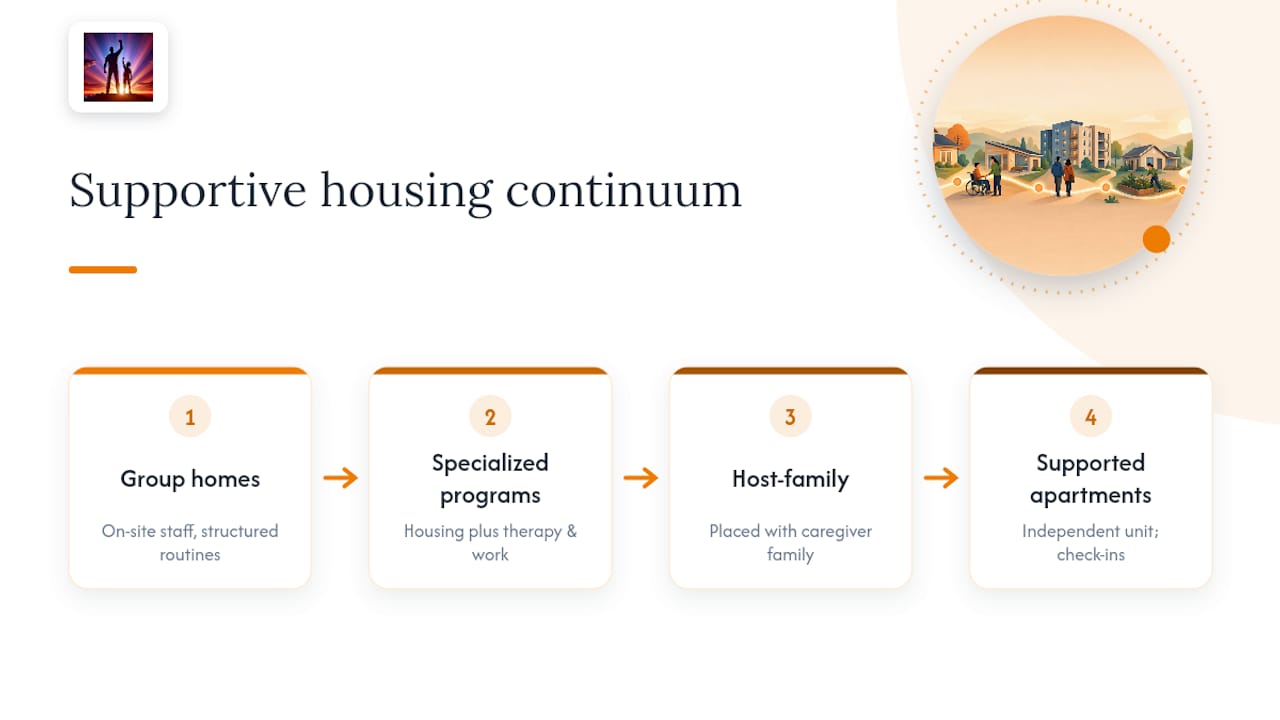
None of these options is inherently better than another. The right fit depends on the person's support needs, their preference for independence versus structure, and, often, on what is actually available and funded in your state. Section 811 PRA units, discussed earlier, are one funding route into this kind of supportive housing, but referrals in many states go through case managers and provider agencies rather than direct application, so building that relationship early matters.
Legal rights and protections for tenants with autism
Tenants with autism are protected under two federal laws that work together. The Fair Housing Act prohibits housing discrimination based on disability, which includes autism, and requires landlords to make reasonable accommodations and allow reasonable modifications to a unit when needed. The Americans with Disabilities Act (ADA) applies more directly to housing operated by state or local government and to programs receiving federal funding, reinforcing the same core protections against discrimination and exclusion.
In practice, this means a landlord generally cannot refuse to rent to a family because a household member has autism, cannot set different lease terms because of a disability, and must consider reasonable requests, such as allowing a support animal even in a building with a no-pets policy, or granting extra time to respond to a lease violation notice tied to a disability-related behavior.
These protections are not automatic in every practical sense. A tenant or family typically needs to request an accommodation or modification directly, sometimes in writing, and be prepared to provide basic documentation connecting the request to the disability. Disputes can be filed with HUD's Office of Fair Housing and Equal Opportunity, and many states have their own fair housing agencies that handle complaints faster than the federal process.
None of this replaces legal advice for a specific dispute. When a landlord denies a reasonable accommodation outright, a local fair housing organization or legal aid office is usually the fastest path to resolution, often at no cost to the family.
The role of case managers and housing coordinators
A good case manager or housing coordinator often matters as much as any single program. These are the people who know which Section 811 properties have referral openings, which PHA waiting lists are actually moving, and which HCBS waiver services your state calls by an unfamiliar name.
Case managers typically help with needs assessments that document the level of support a person requires, which then informs what type of housing or waiver service makes sense. They coordinate referrals to supportive housing programs that are not open to public application, and they can advocate on a family's behalf when a PHA or provider is slow to respond. In many states, a Medicaid waiver coordinator and a housing case manager are different people entirely, so families sometimes need to build two separate relationships rather than one.
Building rapport with these coordinators early, well before you actually need a placement, tends to pay off. Ask direct questions: what waiver services exist in this state, which supportive housing providers take referrals, and what the realistic waiting time looks like for someone with your family member's support needs. A coordinator who knows your family before a crisis is far more useful than one meeting you for the first time during one.
Community integration and social inclusion in housing settings
Where and how someone with autism lives affects more than shelter. Housing near public transportation, community centers, or familiar routines supports independence and reduces isolation, particularly for adults transitioning out of a family home for the first time.
Supported housing programs increasingly build social inclusion into their model rather than treating it as an afterthought. This can look like shared community spaces designed for low-stimulation socializing, staff trained to facilitate peer connections rather than just supervise daily tasks, or partnerships with local employers and day programs that give residents a reason to leave the house and something structured to do once they get there.
Isolation is a real risk in housing models that focus only on safety and supervision. A group home or supported apartment that meets every physical need but leaves someone alone most of the day is not succeeding at its actual goal. Families evaluating a housing option should ask directly about the social and community programming built into daily life there, not just the staffing ratios and physical safety features.
Community integration also depends on transportation. A supportive housing placement in a beautiful but isolated location can undercut everything else the program offers if getting to work, therapy, or friends requires a ride that never comes.
A caregiver's honest note on persistence
Housing assistance rarely arrives on one clean timeline, and mixing funding streams, a voucher here, a waiver service there, is normal rather than a sign you are doing something wrong. Document every contribution someone makes toward your family member's housing, and treat your case manager relationship as something worth maintaining year-round, not just when a crisis hits.
— Ronnie Talent
This article is general information, not a substitute for advice from a qualified financial advisor. Consult a qualified financial professional about your own circumstances before acting on anything here.
Sources
Federal and Medicaid programs rarely cover everything, so many families layer in additional funding. Disability-focused foundations and local charitable programs sometimes offer one-time grants toward deposits, moving costs, or home modifications. Community Development Financial Institutions (CDFIs) occasionally offer favorable loan products for accessible housing projects, and pooled special needs trusts let families set aside money for housing-related expenses without jeopardizing means-tested benefits.
Self-funding or private loans can bridge a gap, but they work best as a supplement to public programs, not a replacement for them.
FAQ
Does autism count as a disability for housing programs?
Yes. Autism qualifies as a disability under the Fair Housing Act and under HUD program rules, which means households with an autistic member can apply for disability-targeted programs like Mainstream Vouchers and Section 811 supportive housing. Documentation from a qualified provider is typically required to confirm eligibility.
Can you get housing assistance with a child with autism?
Yes, families with an autistic child can apply for Housing Choice Vouchers through their local Public Housing Agency, and may also qualify for Medicaid HCBS waiver services that support housing stability. Eligibility depends on household income and your state's specific waiver rules, so contacting a local waiver coordinator is the most direct next step.
What housing supports can you get for free with autism?
Depending on your state and household eligibility, free or low-cost supports can include Housing Choice Vouchers that reduce rent to roughly 30% of adjusted income, Medicaid-funded tenancy-sustaining services such as move-in assistance, and case management through your state's disability agency. What is actually available varies significantly by state and waiting list status.
Is an autism-specific housing grant a real thing?
There is no single federal grant labeled exclusively for autism housing. Instead, families typically combine programs like Section 811, HCBS waiver tenancy services, and nonprofit or foundation grants, since funding tends to be organized around disability broadly rather than autism specifically.
How long does it take to get autism housing assistance?
Timelines vary widely by program and location. Housing Choice Voucher and Section 811 waiting lists in many areas run from several months to a few years, so applying early and to multiple programs at once, where allowed, improves your realistic timeline.
Recommended