
Co-regulation is what happens when a calm, responsive adult helps a child or teen manage big feelings and an overloaded body, until the young person can do more of that work alone. For autistic children, who may need this support for longer and in more individualized ways, it is one of the most useful skills a parent can build. This guide explains what co-regulation is, what it looks like in a real meltdown or shutdown, how to adapt it to sensory and communication needs, and where the research is strong and where it is limited.
TL;DR
Co-regulation means you lend your calm: you stay regulated, validate what your child feels, and help them find a way to settle, rather than demanding they calm down on their own.
Start with yourself. Children settle faster when the adults around them appear calm, so pause and manage your own reaction first.
Adapt to the individual child. Noise, light, textures, and language processing all change what works, so a one-size-fits-all script will fail.
Research supports parent-involved approaches, but much of it is small or early-stage, and co-regulation is not a replacement for professional care when distress is severe or frequent.
Teens still need it. It changes form with age but does not stop at a certain birthday.
Table of Contents
What co-regulation means for an autistic child or teen
A 2017 practice brief from the U.S. Administration for Children and Families defines co-regulation as a supportive process between caring adults and children, youth, or young adults that fosters the development of self-regulation across the lifespan. In plain terms: you help your child regulate now, and that repeated experience builds their ability to regulate later.
Self-regulation is the ability to notice a feeling or a body state (anxious, overstimulated, furious, exhausted) and do something that helps. Nobody is born with it. Every child learns it through a partner who is steady enough to share their calm. Research on parent co-regulation in autistic children notes that a child's later ability to self-regulate is influenced by how caregivers helped them regulate earlier in life.
Co-regulation is not the same as:
Fixing the problem for your child. You are not removing every trigger forever. You are helping them get through this moment and learn from it.
Giving in. Validating a feeling is not the same as agreeing to every demand. You can say "I see how upset you are" and still hold a boundary.
Staying silent and waiting. Sometimes quiet is right. Other times your child needs words, a movement break, or a change of room.
Why autistic children often need co-regulation for longer
Co-regulation is a normal developmental stage. Young children rely on a well-regulated, responsive partner before they can steady themselves. West Sussex County Council's special educational needs guidance explains that this stage may be extended for neurodivergent children. Needing more support at age nine or fourteen is not a failure of parenting or of the child. It is a different timeline.
Several things can make self-regulation harder for autistic kids:
Sensory input that feels louder, brighter, or more painful than it does to others.
Language differences that make it hard to say what is wrong, especially in the middle of distress.
Change and unpredictability. Small changes, like a schedule shift, can land with the weight of a major one.
Difficulty identifying internal signals such as hunger, heat, or rising anxiety.
The good news from the research: a 2019 study in the Journal of Autism and Developmental Disorders found that autistic children show increasing internalization of parental co-regulatory support as they age. What you model out loud today tends to become what your child does silently later.
What co-regulation looks like in the moment
When your child is overwhelmed, the steps below follow the approach described in Harvard Health's guidance on co-regulation. They are not a script to recite. Adjust the order and the words to your child.
1. Pause and check yourself
Before you do anything for your child, manage your own reaction. Harvard's co-regulation guidance for parents describes this as the first move: it creates emotional balance in a high-stress moment. Take a slow breath, drop your shoulders, lower your voice. UK National Health Service guidance for families makes the same point: stay within your own window of tolerance, because children calm more quickly when the people around them appear calm.
2. Share your calm, not the storm
West Sussex's specialists put it this way: with autistic learners the aim is often to share your calm rather than join the storm. If your child is shouting, matching their volume, even with good intentions, adds fuel. Fewer words, a slower pace, and a relaxed body all help.
3. Validate the feeling
Name what you see without arguing with it: "That was too loud. You are really upset." Validation is not agreement that the world is unfair. It tells your child their experience is real and you are on their side. This matters especially for sensory experiences. Discomfort with lights or clothing textures is real, and dismissing it can add to distress.
4. Listen to understand
If your child can communicate, listen for what is bothering them. If they cannot do so in the moment, wait, or offer two simple choices, or use pictures or gestures they already know. Do not interrogate. "Why did you do that?" is rarely answerable mid-meltdown.
5. Choose a way to settle, together
Harvard's guidance suggests deciding together on a way to self-regulate, such as getting fresh air or moving, and then reassessing what your child needs afterward. For some children that means a walk. For others it means a dark room, a weighted blanket, headphones, or a favorite repetitive activity. Our guide to quick meltdown strategies and daily practice lists options to try on calmer days so they are familiar when you need them.
6. Reconnect and reflect later
Once everyone is calm, a short, kind check-in helps: what happened, what helped, what we can try next time. Keep it brief and concrete. Teaching happens after the storm, never in it.
Adapting co-regulation to sensory and communication needs
Researchers Yi-Shan Sung and colleagues, in a 2024 scoping review, explain that because neurodivergent children may process sensory input and emotion differently, co-regulation strategies must respond closely to individual needs rather than follow a one-size-fits-all model. The same review links authoritative parenting, meaning warm but consistent, with better co-regulation outcomes for young autistic children.
A practical way to individualize is to ask two questions: what is my child's body telling me, and how does my child take in information right now?
What you notice | What may be going on | Co-regulation moves to try |
|---|---|---|
Covering ears, flinching, leaving the room | Sound overload | Move somewhere quieter, offer headphones, speak less and more softly |
Squinting, rubbing eyes, avoiding a room | Light or visual overload | Dim lights, offer a hat or sunglasses, change the space |
Pulling at clothes, refusing to be touched | Tactile discomfort | Remove the irritant, offer space, ask before touching |
Pacing, jumping, crashing into things | Body seeking input | Offer heavy work, such as pushing, carrying, or squeezing, or an outdoor break |
Going silent, staring, shutting down | Overwhelm, language unavailable | Reduce demands, wait close by, offer yes/no choices or pictures |
Escalating fast after a change | Unpredictability | Preview what comes next, use a visual schedule, give a warning before transitions |
If sensory input is a frequent driver, these guides go deeper: sensory processing strategies that help your child regulate, our practical sensory diet guide, and strategies for tactile defensiveness. Spanish-speaking families can read regulación sensorial en autismo.
Your words matter, and so do your hands and face
Children who struggle with spoken language may read your tone and body more than your sentences. Keep your face soft, your movements slow, and your phrases short and consistent. Use the same few calming phrases every time, so they become a signal of safety on their own.
Co-regulation for teens
It is easy to assume co-regulation is for toddlers. It is not. The Administration for Children and Families says co-regulation remains a critical resource throughout adolescence as young people continue to develop self-regulation skills.
With teens it often looks different:
Less physical, more respectful of space. Sit nearby rather than hovering. Offer, do not impose.
More collaborative. Ask what helps and agree on a plan during a calm moment: a signal for needing a break, a place to go, a person to text.
Fewer lectures. A short validating sentence and a practical offer ("Want to take the dog out?") works better than a long explanation.
Respectful of autonomy. The goal is a teen who can eventually choose their own tools. Your role moves from doing with to being available.
Looking after your own regulation
You cannot lend calm you do not have. Many caregivers run on empty for months, then wonder why a small incident feels enormous. Build in small resets: a few slow breaths before you open the door, a walk after bedtime, someone else taking a shift. One nightly habit worth considering is a short written check-in, and this 5-item nightly log for spotting burnout early is an easy template for noticing when you are running low.
If you share parenting with a partner, the way the two of you handle tension affects the home atmosphere too. Resources on emotional regulation for couples can help you stay steady with each other, so your child is not absorbing the argument as well as the meltdown. And do not forget siblings, who feel the household's stress; see our piece on supporting siblings of autistic kids.
For a wider look at sustaining yourself over the long haul, our autism caregiver guide covers practical strategies and support.
What the research shows, and where it stops
The evidence is encouraging, but it is worth being clear about its limits.
What looks promising
A 2023 systematic review in PMC identifies parent-implemented interventions as a highest-quality evidence-based strategy for reducing emotion dysregulation in autistic youth.
A 2009 study in the Journal of Autism and Developmental Disorders found that autistic children showed a decrease in negative emotion expression after an intervention that included maternal emotional and motivational scaffolding. Scaffolding means adjusting your support to what the child needs, such as praise and redirection (motivational) or sensitivity and validating feelings (emotional), as described in a 2017 review.
The same 2017 review reports that emotional coaching, a form of co-regulation, is associated with lower physiological stress in autistic children.
A 2022 study of the Regulating Together program, a 5-week caregiver-assisted group intervention, reported improvements in reactivity, flexibility, and emotion-regulation knowledge among 43 autistic youth who completed treatment and assessment. It also found a 16% reduction in inpatient hospitalization rates in the 12 months after treatment compared with the 12 months before.
What to keep in mind
Many of these studies are small, and several compare before and after rather than against a control group, so they cannot prove that co-regulation alone caused the change.
Structured programs with clinicians are different from everyday parenting. The studies support the direction of the approach, not a guaranteed result for your child.
Autistic children vary widely. What works for one may overwhelm another, which is exactly why the individualized approach above matters.
Co-regulation is best understood as a sound, low-risk foundation for daily life, not a cure and not a substitute for evaluation or therapy.
Our perspective
We built Autism Victory for caregivers, and the most common thing we hear is not "I don't know what co-regulation is." It is "I know I should stay calm, and I just can't, because I'm exhausted and nobody gave me a plan." We take that seriously.
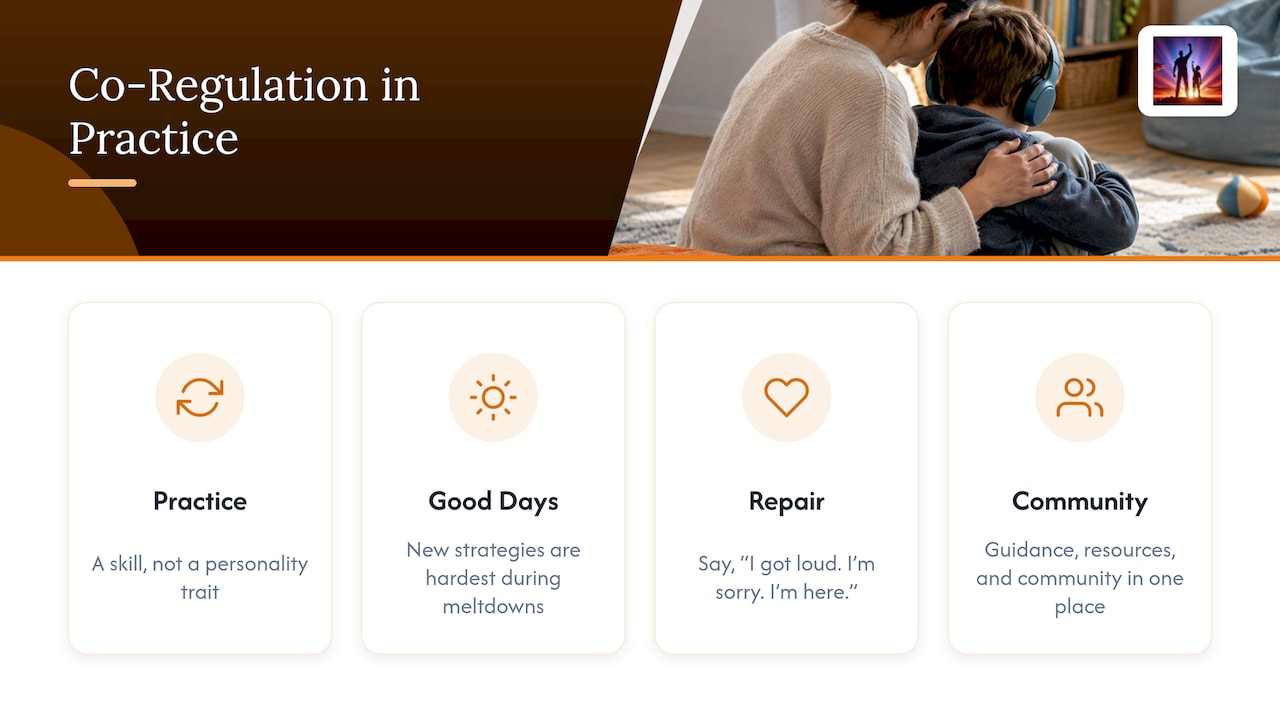
Here is what we believe. First, co-regulation is a skill you practice, not a personality trait. Parents who seem effortlessly calm have usually rehearsed a few phrases and a few moves until they are automatic. Second, practice on good days. Trying a new strategy at the height of a meltdown is the hardest way to learn it. Third, you are allowed to fail. If you raised your voice, repair it: "I got loud. I'm sorry. I'm here." Repair teaches regulation as well as calm does.
Finally, no family should have to work out the next step alone, whether that is a sensory plan, a school meeting, or finding state-specific support. That is why we put guidance, resources, and a community in one place.
— Ronnie Talent
Build co-regulation into your daily routine with Autism Victory
If you want step-by-step help you can open at 9 p.m. when the day went sideways, the Autism Victory app brings together personalized AI guidance, caregiver-focused books and audiobooks, educational videos, a calming sound library, state-specific funding and support resources, and a community of other caregivers and professionals. Content is available in English and Spanish.

Plans cost $6.95 per month or $49.95 per year, and there is a 5-day free trial. You can see the details on our pricing page or explore the Autism Victory app first.
When to bring in more support
Co-regulation helps most with everyday distress. Talk to your child's pediatrician, a psychologist, or a therapist experienced with autism if:
Meltdowns or shutdowns are frequent, long, or getting worse.
Your child or anyone else is getting hurt, or your child talks about harming themself.
Distress is disrupting sleep, eating, school, or most of daily life.
A sudden change in behavior or skills appears, including regression in areas like toileting (see our guide on toilet training regression), since medical or emotional causes should be checked.
You feel unable to cope. Your wellbeing is part of your child's care, and your own doctor or a counselor is a good place to start.
If there is immediate danger, call 911. In the U.S., you can also call or text 988, the Suicide and Crisis Lifeline, for support in a mental health crisis.
FAQ
What is co-regulation in autism?
Co-regulation is a supportive process in which a caring adult helps an autistic child or teen manage emotions and body states, through calm presence, validation, and shared strategies. Over time, children internalize this support and build their own self-regulation. Autistic children often need it for longer, and in more individualized forms.
What is the difference between co-regulation and self-regulation?
Self-regulation is managing your own emotions and arousal independently. Co-regulation comes first: it is the shared process through which that ability develops. Think of co-regulation as the practice and self-regulation as the skill it builds.
Does co-regulation work during a meltdown?
It can help, though the aim in the middle of a meltdown is safety and lowering input, not teaching. Stay calm, reduce noise and demands, keep your child safe, and offer comfort in a form they accept. Save talking things through for afterward.
Can I co-regulate if I'm stressed myself?
Yes, but start by steadying yourself. Even a few slow breaths and a lower voice make a difference, since children calm more quickly when adults around them seem calm. Regular rest and support for you make this easier over time.
Is co-regulation only for young children?
No. It remains useful through adolescence and into young adulthood, though it shifts toward collaboration, shared plans, and respect for the young person's autonomy.
Sources
Co-Regulation from Birth through Young Adulthood, Administration for Children and Families (2017)
Emotion Regulation and Parent Co-Regulation in Children with Autism (2017), PMC
Factors associated with emotion regulation in young autistic children, PMC
Regulating Together: Emotion Dysregulation Group Treatment, PMC (2022)
Systematic Review: Emotion Dysregulation and Challenging Behavior in Autistic Youth, PMC (2023)
Managing emotions and feelings, NHS patient information leaflet
Regulation (including sensory regulation), West Sussex County Council
Recommended


