
The best occupational therapy activities for autism are the ones tied to something your child actually does every day: buttoning a coat, holding a spoon, squeezing toothpaste, getting through a transition. Fine motor play, movement games, and sensory activities all have a place. They work best when they match your child's goals and sensory profile, ideally set with an occupational therapist (OT).
Below you'll find activities by skill area, how to run them at home, and the points where you should check with your child's OT first. A few activities are safe for nearly any child. Others, especially sensory ones, are not.
TL;DR
Choose activities linked to real daily tasks (dressing, eating, writing, play), not isolated drills. That is what AOTA's Practice Smart recommendations call for.
Fine motor activities such as playdough, tweezers, lacing, and tearing paper are low-risk starting points. Sensory tools like weighted blankets or swinging should wait for a professional assessment.
Parents can carry out motor activities at home. A 10-week pilot study found families could do it with instructions and adapted equipment.
Keep sessions short, playful, and predictable. Stop when your child shows distress, and tell your OT what you saw.
Table of Contents
What occupational therapy actually targets in autism
In OT, an "occupation" is any meaningful daily activity. For a child that means dressing, eating, playing, handwriting, and managing school routines. The CDC describes occupational therapy as teaching skills that help a person live as independently as possible, including dressing, eating, bathing, and relating to others. It can also include sensory integration therapy to help with sensitivity to sights, sounds, and touch.
Sensory differences are common, so this matters. A CDC-supported analysis of surveillance data found that about 74% of autistic children studied had documented sensory features, and those features can affect sleeping, eating, and socializing.
So a good OT activity is rarely "just" a craft or a game. It is a small, chosen challenge that builds a skill your child needs.
Before you start: the occupational profile
This is the step most activity lists skip.
AOTA says OT for autism should begin with an occupational profile and collaborative goals. It also advises against sensory-based interventions without documented assessment results showing a child's specific sensory difficulties. In practice, the wrong input can overwhelm a child instead of calming them. The same caution appears in research on a manualized sensory intervention for autistic children, where treatment was individualized after assessment.
Here is how that plays out at home:
Fine motor and play-based activities (playdough, stacking, scooping): generally fine to try. Watch your child's reactions.
Sensory-heavy activities (swings, weighted items, deep pressure, strong textures): ask your OT first. A child who seeks pressure and a child who avoids touch need opposite things.
Anything that causes pain, gagging, panic, or a meltdown: stop, and report it at the next visit.
No OT yet? Ask your pediatrician about a referral, or ask your school district about an evaluation. Our guide to sensory processing strategies explains what to look for in the meantime.
Fine motor activities for autism
Fine motor skills are the small hand and finger movements behind feeding, dressing, playing with toys, and writing. Children's Hospital Los Angeles notes that autistic children may face daily challenges with motor planning and coordination, among other areas. That is why these activities are so common in therapy.
Try these at home:
Playdough or putty. Roll snakes, pinch beads out, press in cookie cutters. Hide small items inside and let your child dig them out.
Tweezers and tongs. Move pom-poms, cotton balls, or pasta from one bowl to another. Make it a game: "feed" a stuffed animal.
Lacing and threading. Start with large beads and a stiff lace or pipe cleaner. Move to smaller beads as control improves.
Tearing and crumpling paper. Great for a collage and good for hand strength.
Clothespins. Clip them on a bowl's edge or a card to match colors.
Building toys and puzzles. Chunky knob puzzles first, then smaller pieces.
Scissors. Begin by snipping playdough or straws, then move to paper strips.
The organization Gympanzees also offers a handy list of fine motor activities for autism if you want more ideas.
How to make a fine motor activity work
Keep it to 5 to 10 minutes at first.
Offer two choices rather than open-ended options.
Let your child lead the pace. If a texture bothers them, use a tool (a spoon, tongs) rather than insisting on bare hands.
Praise effort and specific actions: "You squeezed so hard."
Gross motor and movement activities
Autistic children often benefit from whole-body movement that builds strength, balance, and coordination. Therapy sessions commonly include obstacle courses, climbing, and resistive play. You can borrow the same ideas:
Living room obstacle course. Crawl under a table, step over pillows, walk along a taped line, and finish by pushing a laundry basket.
Animal walks. Bear crawl, crab walk, and frog jumps.
Wall push-ups and carrying games. Carry books to a shelf or groceries to the kitchen. This builds strength and gives the task a real purpose.
Ball games. Rolling, catching, and kicking a large ball.
One randomized feasibility study tested a 10-week, parent-mediated fundamental motor skills program. Retention was 80%, and the researchers concluded parents could help their children learn skills at home when given instructions and adapted equipment. It was a small pilot, so treat it as encouraging, not proof of a specific outcome.
Ask your OT about activities involving swings, trampolines, or heavy resistance. These deliver strong sensory input, so they need to match your child's profile.
Self-care and daily living activities
This is where OT earns its keep, because the goal is independence in daily routines. Break each task into small steps and practice one step at a time.
Daily task | Small practice activity |
|---|---|
Dressing | Zip and button a practice board, then a jacket laid flat on the table |
Brushing teeth | Practice squeezing a toothpaste-sized tube of playdough onto a brush |
Eating | Scoop dry beans with a spoon, then move to yogurt or oatmeal |
Shoes | Practice Velcro first, then lacing with two-colored laces |
Handwashing | Use a picture sequence with steps and a visual timer |
Mornings | Lay out clothes the night before and use a checklist |
A picture schedule often helps. Our autism morning routine guide shows how to prep the night before. If mealtimes are a struggle, picky eating in autism covers gradual exposure.
Backward chaining is a useful trick. You do most of a task and let your child finish the last step, such as pulling the sock over the heel. Then you gradually hand over earlier steps.
Mouth and feeding skills
Some children also have trouble with chewing, mouth posture, or breathing habits that affect eating and sleep. If you notice this, bring it up with your pediatrician and OT. A dental provider can also evaluate whether pediatric myofunctional therapy is worth considering. It is a separate discipline from OT, so tell every professional on your child's team what the others recommend.
Sensory activities, with a caution
Sensory bins, water play, and movement breaks are some of the most popular activities on lists like this. They can help. They can also backfire.
Two children can react to the same activity in opposite ways. One may relax with deep pressure. Another may panic. This is why AOTA advises against using sensory tools without assessment results. Once your OT has a profile, ask:
Which inputs does my child seek, and which does my child avoid?
What activities can we use before tasks that are hard, such as homework?
What signs mean I should stop?
If your child has an assessment, a plan often called a sensory diet spreads these activities across the day. Our practical sensory diet guide explains how families build one with their therapist. Spanish-speaking families can read the guía de dieta sensorial and the guía de terapia ocupacional para familias.
Signs to stop an activity:
Covering ears or eyes, pulling away
Sudden crying, hitting, or running
Gagging or refusing to touch an item
Going quiet and glazed, or very agitated
Skip the drills: make activities purposeful
AOTA's first recommendation warns against non-purposeful activities, such as repetitively using cones, pegs, or an arm bike without a functional goal. The point carries over to home. If your child is stacking cones for twenty minutes with no link to a real task, you are drilling. If your child is stacking cups to build a tower with you, you are playing and practicing.
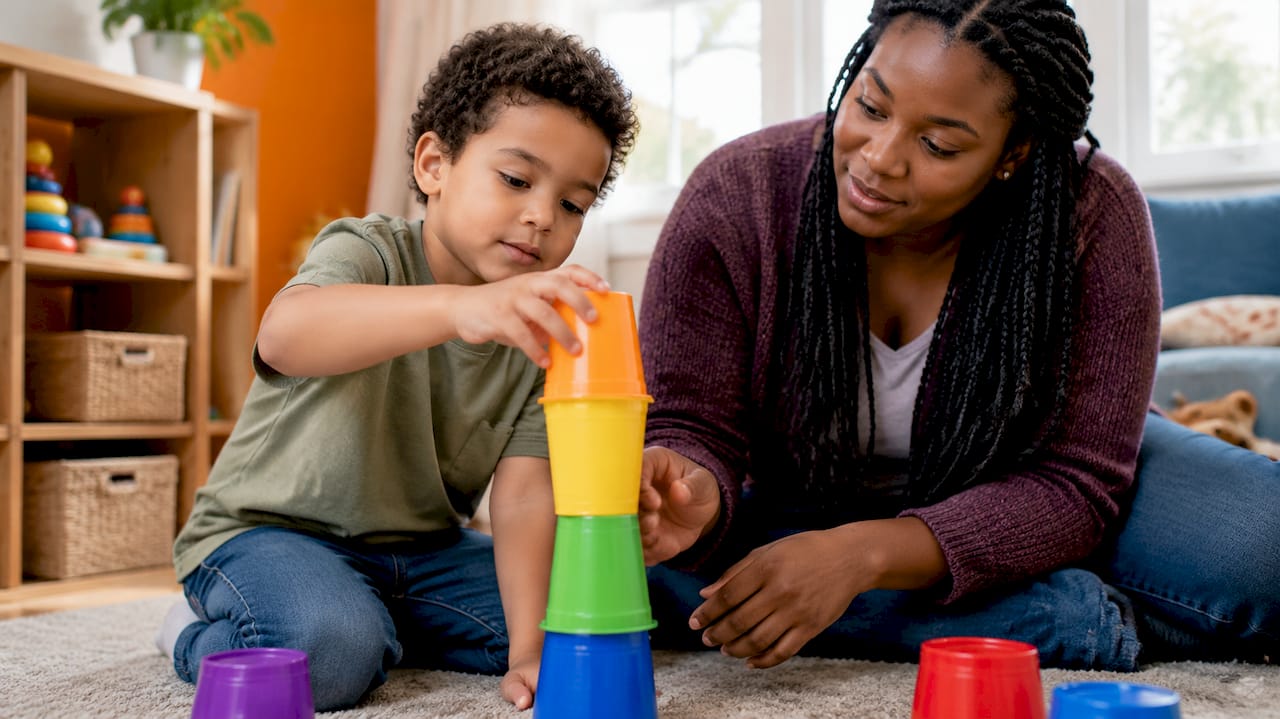
A quick test: can you say which daily task this supports? If the answer is "holding a pencil" or "getting dressed," good. If not, change the activity.
What the research supports
Research on OT for autism is growing, but be realistic about what it shows.
A 2013 randomized trial of a manualized sensory intervention for children ages 4 to 8 reported better results on goal attainment than in the comparison group.
A 2025 randomized controlled trial of OT using sensory integration found it improved occupational performance in children with autism, especially when combined with a structured home program.
The parent-mediated motor skills pilot supports the idea that caregivers can carry out motor activities at home.
These studies used trained therapists and structured programs. A handful of home activities is not the same as therapy. It is a way to extend what your child's OT is already doing. For more on how guidance is structured, see the Ayres Sensory Integration clinician's guide, which describes the child-led, participation-focused approach.
A simple weekly home plan
You do not need an hour a day. Short, consistent sessions work better than one long one.
Pick one goal with your OT, such as buttoning or holding a crayon.
Choose two activities that serve it. For buttoning: a button board and a doll's coat.
Schedule 5 to 10 minutes at a steady time, after a snack or before a favorite show.
Use a visual cue: a picture card or a timer to show when it ends.
Log it. Note what worked, what your child avoided, and any signs of stress.
Bring the log to therapy. Your OT can adjust the plan from real data.
If you also work on speech, you can fold activities into the same routine. See speech therapy activities for autism at home and building communication in 5 to 15 minute routines.
Our perspective
We built Autism Victory for caregivers who are asked to do a lot at home, often without a map. Here is what we hear most often from families, and what we think matters.
First, you do not need to buy a closet of therapy gear. Most good activities start with kitchen items: spoons, bowls, clothespins, dried beans. What matters is the match between the activity and your child.
Second, the assessment comes first. It is tempting to try every sensory idea you see online, especially when your child is struggling. But the professionals' own guidance says to know the profile before using sensory tools. We would rather you wait a week and ask your OT than guess.
Third, you are part of the therapy team. Parents notice what happens at 7 a.m. on a school day, which no clinic can see. Your notes are useful data.
Finally, be kind to yourself. Some days the activity will fail. That is information, not a verdict on your child or on you.
— Ronnie Talent
Keeping it all organized with Autism Victory
OT tips, appointments, and ideas can pile up fast. The Autism Victory app brings caregiver-focused books and audiobooks, educational videos, personalized AI guidance, a calming sound library, and state-specific funding and support resources into one mobile app. You can ask questions at any hour and find what support exists in your state, which can help when you are trying to work out how to pay for therapy.
Plans are $6.95 per month or $49.95 per year, and there is a 5-day free trial. See the plans and pricing or visit Autism Victory to learn more. The app supports your child's care team. It does not replace your OT.
FAQ
What are some simple occupational therapy activities for a child with autism?
Playdough play, picking up small objects with tweezers, lacing beads, tearing paper, and building with blocks are common starting points. Obstacle courses and carrying games cover gross motor skills. Link each one to a daily task, such as dressing or feeding, so it has a purpose.
Can I do OT activities at home without a therapist?
Low-risk fine motor and play activities are usually reasonable to try. A randomized pilot study found parents could deliver a motor skills program at home with guidance and equipment. Sensory-based tools like weighted blankets or swinging should wait for an assessment from a licensed OT.
How long should each activity last?
Start with 5 to 10 minutes and watch your child's cues. A short, successful session is better than a long, stressful one. Increase the time only if your child stays engaged and calm.
What fine motor activities help with handwriting?
Hand-strengthening play comes first: playdough, clothespins, tongs, and tearing paper. Then add lacing, snipping with scissors, and drawing on vertical surfaces like an easel. If your child struggles to hold a pencil, ask your OT about grips and positioning.
How do I find an occupational therapist for my autistic child?
Start with your pediatrician for a referral, or ask your school district about an evaluation. Ask whether the therapist has experience with autism and whether they will set an occupational profile and shared goals first. Your state's funding and support options may help with cost.
Sources
An Intervention for Sensory Difficulties in Children with Autism: A Randomized Trial
Sensory features in autism: findings from a large population-based surveillance system, CDC
A Randomized Feasibility Trial of a Fundamental Motor Skill Parent-Mediated Intervention
Treatment and Intervention for Autism Spectrum Disorder, CDC
Promoting and Developing Fine Motor Skills in Children with Autism, Children's Hospital Los Angeles
Clinician's Guide for Implementing Ayres Sensory Integration, AOTA
Recommended


