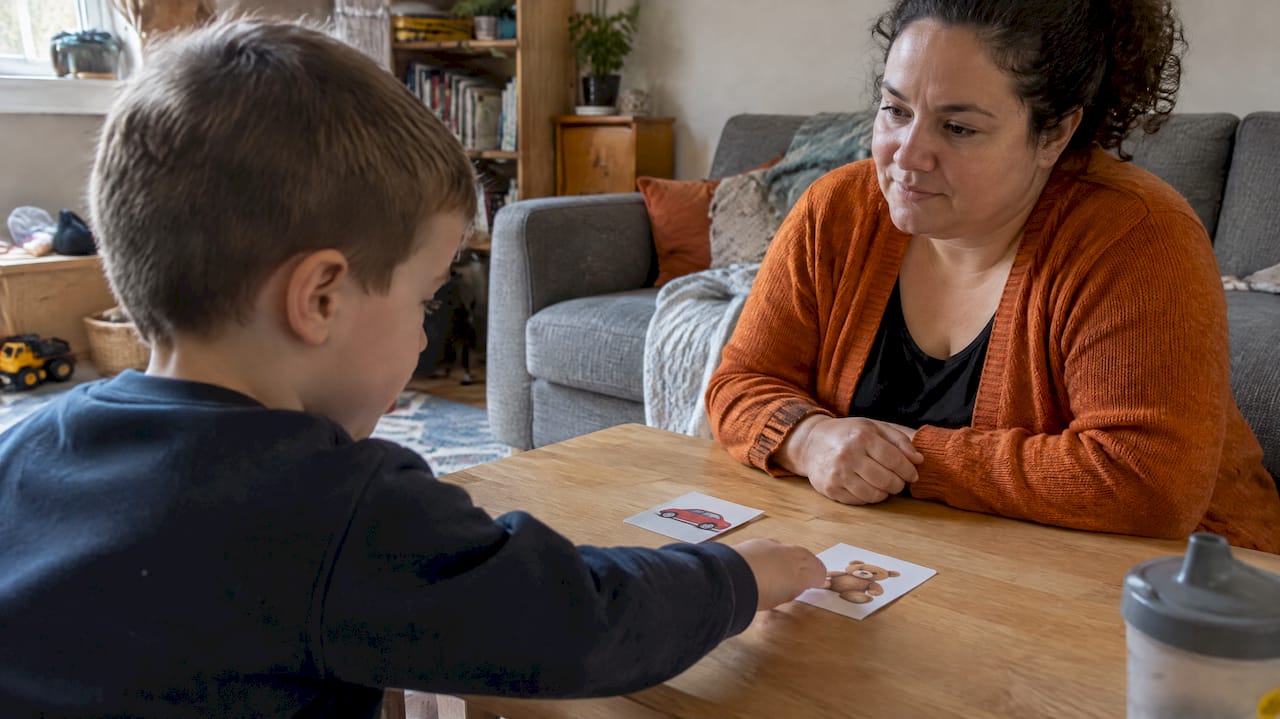
The best speech therapy activities for autism are the ones that fit into your child's day: play, meals, getting dressed, car rides. You do not need special equipment or an hour-long session. You need a few repeatable moves, a way for your child to communicate that works for them (words, pictures, signs or a device), and a speech-language pathologist (SLP) who knows your child.
This guide gives you specific activities, grouped by where your child is right now, plus how to make them stick and when to ask for more help.
TL;DR
Embed practice into routines you already have. Short, frequent, playful moments beat long sit-down drills.
Communication is not only speech. Gestures, picture boards, signs and devices (AAC) all count, and they support language rather than blocking it.
Start where your child is: connect and imitate first, then words, then sentences and conversation.
Children under 3 can be evaluated through state early intervention, and you do not need a doctor's referral to ask.
Activities support your SLP's plan. They do not replace an evaluation or therapy.
Table of Contents
Why home activities matter
The CDC lists speech and language therapy as the most common developmental therapy for autistic people. Its aim is to improve both understanding and use of communication, verbal and non-verbal, including signs, gestures, pictures and electronic devices.
A clinic visit may be 30 to 60 minutes a week. Your child lives the other 160-plus waking hours at home. ASHA's early intervention guidance describes caregivers as the primary partners in therapy, because strategies built into everyday routines help skills carry over in ways that isolated clinic exercises often miss.
There is research behind this too. A study of parents learning to use teaching strategies in daily routines looked at preschool children with autism and how parents generalized those strategies at home. It was small (five children), so treat it as encouraging, not proof. But it matches what most SLPs tell families: the routine is the classroom.
Before you start: three ground rules
Follow your child's lead. Join what they are already doing. A child lining up cars is not "off task." It is your way in.
Keep it short. Five to fifteen minutes, once or twice a day, is plenty. Stop while it is still fun.
Accept every attempt. A look, a reach, a sound, a picture tap: respond right away, then model the next step up. Do not demand a perfect word.
A neurodiversity-affirming approach adds one more. ASHA's Leader describes starting with a strengths-based look at what the person wants and needs, rather than only aiming for neurotypical speech patterns. Ask what your child wants to say, to whom, and about what. A child who wants to tell you about trains will work harder on "train" than on "ball."
Activities for children who are not yet using words
If your child uses few or no words, the goal is connection and intentional communication: "I want that," "I'm done," "look at this."
Songs and games with a pause
Pick a predictable game: peek-a-boo, "Ready, set, go!", tickles, bubbles, a song with actions. Do it a few times, then stop and wait with an expectant face. Wait at least five seconds. If your child reaches, looks, makes a sound or signs "more," you continue immediately.
You have just taught that communicating makes things happen.
Choice-making
Hold up two snacks or toys and let your child pick by reaching, pointing, looking or touching a picture. Say the word as you hand it over: "Crackers!" Offer choices dozens of times a day: which cup, which shirt, which song.

Sound and imitation play
Face your child at their eye level and copy their sounds and movements. Once they notice you copying, change one thing: a new sound, a bigger clap. Imitation is a building block for words. Funny faces, animal noises and vehicle sounds ("vroom," "beep") are easier to start with than real words, because they are visual and repetitive.
Hands-on routines with one word
Pick one word per routine and say it every time. "Open" at the snack bag. "Up" for lifting. "Go" when pushing a swing. Keep your own language short: one or two words, slightly above what your child says.
Activities for children with a few words
When your child has single words or early phrases, you are expanding.
Expand and add one word
If your child says "car," you say "red car" or "car go." No correction, no "say it again." Just model the next step.
Sabotage (a little)
Create small reasons to communicate. Put a favorite toy in a clear container they cannot open. Give them a bowl of cereal without a spoon. Hand over a puzzle with a piece missing. Then wait. Be careful to keep this playful, not frustrating. If your child is getting upset, help right away and model the word.
Treasure hunt with pictures or words
Hide a few familiar objects around a room and use picture cards or spoken clues: "Find the cup." Naming, following directions and turn-taking all come together. Swap roles so your child can give you the clues.

Narrate and comment, don't quiz
Many parents ask questions all day ("What is this? What color?"). Try commenting instead: "You're pushing the truck. Truck goes fast!" Comments give language without pressure to perform.
Books
Choose books with simple, repeating text. Point, pause before a repeated phrase and let your child fill in the gap. Do not insist on reading every page. Spending five minutes on one favorite page is a fine session.
Activities for children building sentences and conversation
Visual routines and scripts
A picture schedule for the morning or bedtime gives your child something to talk about and cuts down on surprises. Add sentence starters: "First ___, then ___." Your child can build the sentence by moving pictures, then say it.
Emotion and "what would you do" cards
Use a few photos or drawings of faces. Talk about how the person feels and what might help. Move on to short scenarios ("Your friend took your toy") and let your child pick a response by pointing or talking.
Pretend play with roles
Restaurant, doctor, store. Each has natural back-and-forth language and gives you a safe place to rehearse real situations. If a medical or dental visit is coming up, our dentist visit prep plan shows how to rehearse it step by step.
Conversation turns with a topic your child loves
If your child loves a movie, a game or an animal, use it. Take turns: one comment from you, one from them. Use a visual cue (a card passed back and forth) if turns are hard to track.
AAC: pictures, boards and devices
Augmentative and alternative communication (AAC) covers every form of communication other than spoken language. ASHA notes it ranges from gestures, signs and picture boards to speech-generating devices.
Parents often worry AAC will stop their child from speaking. A recent review of communication in autistic people frames AAC as a tool for supporting communication in everyday life, not just a substitute for speech. In other words, it is not a last resort.
One well-known picture-based system is PECS (Picture Exchange Communication System). In a 2023 study of a 24-session PECS program for children with non-verbal or minimally verbal autism, 82% of participants reached phase IV, which involves building sentence structure, and families showed 96% adherence. The study was run in a Brazilian public-health school clinic, so results may differ in a US setting, but it shows how much family follow-through matters.
How to get started with AAC at home:
Start low-tech. A few laminated pictures for favorite items on a ring or a simple board is enough to begin. Our communication boards quick start guide walks through it.
Keep it within reach in the kitchen, the car and the bedroom.
Model it yourself. Point to the pictures as you speak, the way you would want your child to use them.
Ask your SLP about trying a speech-generating device if pictures are not giving your child enough ways to say what they want.
Make it part of the day: a sample routine
The ASHA guidance recommends using routines like mealtime or play for practice. Here is how a regular day might look. Nothing here needs extra time.
Moment | Activity | What you model |
|---|---|---|
Waking up | Offer a choice of two shirts | "This one or this one?" then the name |
Breakfast | Hand over food in small amounts | "More," "open," "all done" |
Car ride | Sing a song with pauses | Fill-in-the-blank words |
After school | Water or sand play | "Pour," "splash," "my turn" |
Bath | Name body parts and toys | Short comments: "Wash arm" |
Bedtime | Book with repeated phrase | Child fills the gap |
Pick one or two rows this week. Add more only when those feel automatic. For a fuller plan, see our guide to building communication at home in 5 to 15 minute routines, and our five steps for autistic preschoolers.
For more toddler-specific ideas from a pediatric speech therapy practice, this list of speech therapy activities for toddlers covers everyday routines and caregiver involvement.
When activities are not enough
Home practice supports therapy. It does not replace it. Talk to your child's pediatrician or an SLP if:
Your child is not using gestures, sounds or words that fit their age, or has lost skills they once had.
Frustration around communication is leading to frequent meltdowns or self-injury.
You are unsure whether to use pictures, signs or a device.
If your child is under 3, you can go straight to your state's early intervention program. The CDC explains that children under 3 are eligible for state early intervention services under IDEA, and you do not need a physician's referral to request an evaluation. For Spanish-speaking families, we also have a guide to intervención temprana en autismo.
Older children can often get speech services through the school district. Ask the school in writing for an evaluation. If your child already has therapy, bring your home activities to the next session and ask the SLP which ones to keep, change or drop.
When your child is having a hard moment, skip the drills. Regulation comes first, and language follows. Our meltdown strategies guide covers what to do in the moment.
Our perspective: consistency beats intensity
We built Autism Victory because families told us the same thing again and again: they were handed a diagnosis, a long waiting list and a stack of handouts, then left to work out the rest alone.
Our view on speech activities is simple. Do not try to run a clinic in your kitchen. Choose two or three moments a day, use the same few phrases, and let your child's interests set the topic. Children learn language from people they trust, in moments that matter to them. That is why a parent's five minutes of play at the right time often does more than a perfectly planned worksheet that never gets used.
We also think families should hear this plainly: how your child communicates is less important than that they can communicate. If pictures or a device give your child a way to say "stop," "more" or "I'm sad," you are helping them, not holding them back. And keep your own energy in mind. A tired, guilty caregiver cannot model language well. Smaller, repeatable steps protect you as well as your child.
— Ronnie Talent
Keep guidance, resources and support in one place
If you would like help choosing which activities fit your child, Autism Victory is a mobile app for parents and caregivers with AI-powered guidance, caregiver-focused books and audiobooks in English and Spanish, educational videos, state-specific funding and support resources and a caregiver community. You can try it free for 5 days. After that, plans are $6.95 per month or $49.95 per year.
FAQ
What speech therapy activities work for a non-verbal autistic child?
Start with play routines that have a pause, such as songs, bubbles and peek-a-boo, and with choice-making using objects or pictures. Respond to every attempt to communicate, whether a look, reach, sound or picture. Many families also add a low-tech picture board so the child has a reliable way to communicate while speech develops.
Can I do speech therapy at home without a therapist?
You can support language at home with the activities above, and research and ASHA guidance both describe caregivers as key partners in therapy. But activities do not replace an evaluation. An SLP can identify your child's specific needs and set goals, and then you can practice those goals at home.
How long should a home speech session last?
Five to fifteen minutes is enough for most children, once or twice a day, and short moments inside routines count. End while your child is still engaged. If they are tired, upset or overwhelmed, stop and try again later.
Will using pictures or a device stop my child from talking?
No. AAC is described by ASHA and recent research as a tool that supports everyday communication, not something to try only after everything else fails. Talk to your SLP about which type of AAC fits your child, and model it yourself so your child sees how it works.
Where do I start if my child is under 3?
Contact your state's early intervention program and ask for an evaluation. Under the CDC's guidance on accessing services, you do not need a doctor's referral to request one. Your pediatrician can also help if you want a second opinion.
Sources
Treatment and Intervention for Autism Spectrum Disorder, CDC
Augmentative and Alternative Communication in Early Intervention, ASHA
How Do We Identify Client Needs Through a Neurodiversity-Affirming Lens? ASHA Leader
Communication in Autistic Adults: An Action-Focused Review, PMC
Recommended