Independence for an autistic teen is not one finish line, such as living alone or holding a job. It is a set of skills (daily routines, decision-making, self-advocacy, safety) that you build step by step, in the places your teen will actually use them, while you line up the school and benefits systems that become critical around age 18. Start earlier than feels necessary, practice in real settings, and measure success by whether a skill is sustainable, not whether it looks good for one afternoon.
This guide covers what to teach, how to teach it, how to use the IEP transition process, and what to arrange legally and financially before your teen turns 18.
TL;DR
Under federal law (IDEA), the IEP must include transition planning by age 16, and starting at 14 is recommended. Bring your own vision for adult life to the meeting instead of waiting for the school to write one.
Teach daily living skills with prompting and video modeling, then practice them at home and in the community, not only in therapy rooms.
Watch for masking. A teen who looks independent may be running on exhausted compensation, especially girls.
Explore SSI, ABLE accounts, guardianship alternatives and your state's Centers for Independent Living well before 18.
Build skills in small steps and track them in writing. Progress is rarely a straight line.
Table of Contents
What independence actually means for your teen
Why the "cooking and cleaning checklist" is not enough
Teaching life skills that stick
Masking: when independence is not what it looks like
Technology, safety and boundaries
Using the IEP transition plan
The planning you need before 18
A realistic timeline
Our perspective
Keeping it all in one place
Sources
What independence actually means for your teen
For some families it means living on their own someday. For others it means choosing their own clothes, riding a bus with a plan, or telling a doctor what hurts. All of these count.
It helps to break the goal into four areas:
Daily living: hygiene, meals, laundry, cleaning, medication routines, money handling.
Self-management: planning a day, starting tasks, handling transitions, asking for a break.
Community: transportation, shopping, appointments, using a phone safely.
Self-advocacy: explaining needs, saying no, asking for help, understanding rights.
Research on adolescents with autism points out that adaptive behavior is about more than IQ or social ability, and that daily living skills need targeted attention in their own right. That matches what many parents see: a teen can be academically strong and still struggle to start a shower routine without reminders.
Why the "cooking and cleaning checklist" is not enough
It is tempting to count skills: can make a sandwich, can do laundry. But a checklist misses two things.
Executive function. Knowing how to do laundry is different from noticing the hamper is full, starting the task, finishing it, and putting clothes away. Those steps depend on planning, initiation and working memory. If those are the hard part, teach them directly with visual schedules, timers, and a clear "done" signal.
Generalization. Many teens perform a skill in a structured therapy setting and then cannot repeat it in a noisy kitchen at home. The same research notes that skills need to be practiced in the actual settings where they will be used. If your teen learned to order food in a role-play, go to the real counter with a script and a backup plan.

Teaching life skills that stick
Break each skill into steps
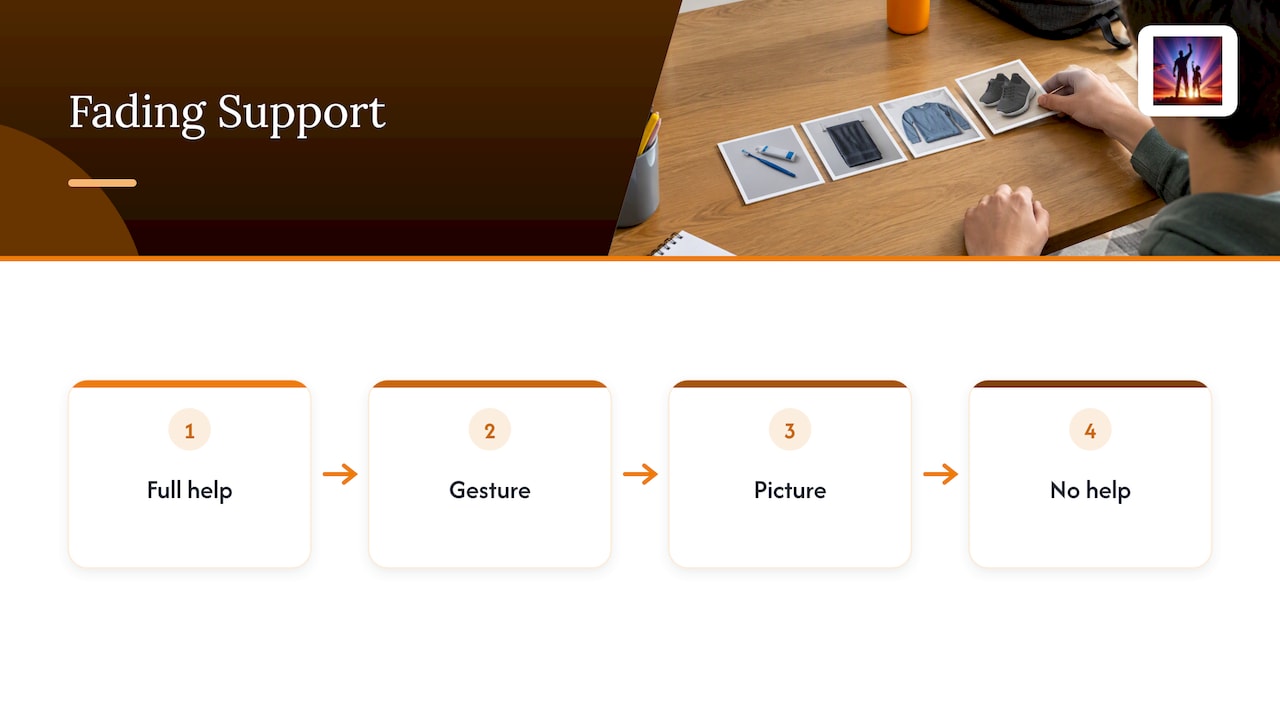
Write out the steps of one task, such as brushing teeth or making a bed. Then decide how much help each step needs: full help, a gesture, a picture, or nothing. Fade support one step at a time, not all at once.
Use prompting and video modeling
A systematic review of interventions for autistic youth ages 13 to 24, summarized in the research we reviewed, found that prompting and technology-based video modeling were among the most effective ways to teach daily living skills. A structured program called Surviving and Thriving in the Real World reported teens gaining roughly two years of daily living proficiency over 12 weeks. That is one program in one study, so treat it as encouraging rather than a promise for every teen.
Video modeling is practical at home: record a short clip of the steps (a peer, a sibling, or your teen's own hands), then let your teen watch it right before the task. Our practical parent's guide to video modeling walks through how to film and use these clips.
Start small and pick one skill at a time
A workable monthly rhythm:
Choose one skill your teen cares about (a snack they love, a game they want to download, a place they want to go).
Write or film the steps.
Practice at the same time each day for two weeks.
Reduce prompts gradually.
Practice it somewhere new before calling it learned.
Motivation matters. Skills tied to your teen's own interests tend to hold longer than skills tied to your preferences.
Sample skills by priority
Area | Starter skill | Next step |
|---|---|---|
Hygiene | Following a morning routine with a visual list | Managing it with no list, adjusting for sensory needs |
Food | Making a simple snack | Planning, shopping for and cooking a basic meal |
Money | Paying at a register | Tracking a weekly budget, understanding scams |
Health | Naming symptoms and medications | Speaking for themselves at an appointment |
Community | Using a bus route with a plan | Handling a delay or missed stop |
Phone | Calling a family member | Making an appointment or asking a store a question |
Masking: when independence is not what it looks like
A teen who gets good grades, follows the rules, and seems to manage everything may be paying a heavy hidden cost. Clinicians describe how many girls in particular adopt high-effort behaviors to appear fine, and how puberty can be the point where those coping strategies stop working. The result can be autistic burnout, anxiety crashes or school refusal.
What to do instead:
Measure sustainability. Ask whether your teen can keep up a habit without needing hours of recovery afterward.
Reduce load before adding demands. Protect sensory recovery time after school. Lower noise, light and social pressure at home.
Teach puberty, body safety and consent explicitly. Do not assume your teen will pick these up by observation.
Give permission to be unfinished. "I need a break" is a self-advocacy skill, not a failure.
If you see a sharp loss of skills, withdrawal or extreme exhaustion, talk to your teen's pediatrician or a clinician experienced with autism. Those signs call for evaluation, not more practice.
Technology, safety and boundaries
Phones are both a route to independence (maps, reminders, texting) and a source of risk (oversharing, scams, sleep loss). Agree on rules together, and teach what to do when something online feels wrong. This note to parents on teens, tech and boundaries offers a counselor's view on setting limits without constant conflict, which is useful when you are loosening supervision gradually.
A simple safety kit for a teen heading out alone:
A card or phone note with name, a caregiver's number and how to communicate needs.
A rehearsed plan for "what if the bus doesn't come" and "what if someone asks for money."
A check-in routine that your teen helps design.
Using the IEP transition plan
For students receiving special education, the law gives you a real lever. Under IDEA, transition services are meant to prepare students for life after high school, and transition planning must be in the IEP no later than age 16. Starting at 14 is recommended, and some states require it earlier, so check yours.
Here is the gap: according to CDC reporting from 2025, more than 90% of adolescents with autism had completed postsecondary education and employment goals in their transition plans, but only 47% had a completed goal for independent living skills. Independent living is the part most likely to be skipped.
How to prepare for the meeting
Write a one-page vision. Where might your teen live, work or study, and spend free time at 22? Include your teen's own words.
Ask for measurable goals. "Will improve independence" is vague. "Will prepare a three-step meal with a visual recipe in four of five trials by May" is measurable.
Request community-based practice. Skills should be taught where they will be used.
Invite your teen. Self-advocacy grows when they attend and speak, even briefly.
Ask who is responsible. Each goal needs a named person and a timeline.
Plans are often generic, so a specific vision from you changes the conversation. Your state's education department or parent training center can explain local rules.
The planning you need before 18
Many families seek adult systems only when a crisis hits, at the point where school services end, between 18 and 22. State guides advise exploring Centers for Independent Living, SSI and SSDI, and ABLE accounts well before your teen turns 18. Here is how the pieces fit.
Decision-making and guardianship
At 18 your teen is legally an adult in most states, and that changes who can see records, sign forms and make medical decisions. Guardianship is one option, but there are lighter alternatives, such as supported decision-making or powers of attorney, depending on your state. Our guide to what changes legally at 18, including guardianship and SSI lays out the choices. Talk to a special needs attorney in your state before deciding.
SSI at 18
At 18 the Social Security Administration looks at your young adult's own income and resources rather than the household's, which can change eligibility. We cover the process in our checklist for parents of autistic teens approaching 18 and the longer runway in the benefits checklist to start two years early. If your child is younger, see our guide to SSI for a child with autism.
ABLE accounts
An ABLE account lets a person with a disability save without necessarily jeopardizing certain benefits. Per The Arc, since January 1, 2026 you may qualify if your disability began before age 46 (previously 26), and the annual contribution limit rose to $20,000. There are no income limits to open one, and each person can have one account. Details of how ABLE interacts with SSI are in our 2026 ABLE guide.
Centers for Independent Living
These community organizations offer advocacy and skills training for living in the community. Find the one near you and ask about waitlists, programs for transition-age youth, and what they offer to families.
Health care transition
Pediatric care ends at some point. A pediatrician writing for the American Academy of Pediatrics describes how his son learned to take part in his own doctor's appointments as a step toward adulthood. Let your teen practice answering questions first, with you adding what is missing.
A realistic timeline
Age | Focus |
|---|---|
12 to 13 | Choice-making, simple chores, visual routines, early self-advocacy phrases |
14 to 15 | Request transition planning in the IEP, start community practice, health self-advocacy |
16 to 17 | Job exploration, travel skills, money skills, research guardianship alternatives, ABLE, SSI |
18 to 21 | Adult benefits in place, decision-making supports, school-based transition services, adult providers |
This is a framework, not a deadline. Some teens need longer on every step, and that is fine.
Our perspective
We built Autism Victory for caregivers because the hardest part of independence is rarely one skill. It is the pile of systems, forms and decisions around it, arriving all at once. Families often tell us they wish they had started the paperwork and the practice years earlier, and that they had been told sooner that small, boring, repeated steps work better than big leaps.
Our view: treat independence as a long project with two tracks. One track is skills your teen builds, with the support that fits them. The other is the legal and financial scaffolding you build around them. Neither replaces the other, and neither should wait for a crisis. Honest expectations are not low expectations. They are what let you pick the next right step.
— Ronnie Talent
Keeping it all in one place
If you want guidance that adapts to your teen and your state, the Autism Victory app brings together caregiver-focused books and audiobooks, educational videos, state-specific funding and support resources, and AI-powered guidance in one place. Plans are $6.95 per month or $49.95 per year, with a 5-day free trial, so you can see whether it fits your family before you commit.
FAQ
At what age should I start working on independence?
Earlier than you think, with age-appropriate steps: choices and small chores in the elementary years, routines in middle school. For formal planning, IDEA requires transition planning in the IEP by age 16, and starting at 14 is recommended. Check your state's rule, since some start earlier.
What life skills matter most for an autistic teen?
Start with what protects health and safety: hygiene, medication awareness, communicating needs, and handling an emergency. Then add food, money, transportation and phone use. Pick skills your teen is motivated to learn and teach one at a time.
How do I know if my teen is truly independent or masking?
Look at the cost. If a skill is followed by exhaustion, meltdowns, shutdowns or school refusal, it is not sustainable yet. Real independence can be repeated without hidden, draining effort. If you are worried, speak with your teen's clinician.
Does my teen lose benefits when saving money?
Not necessarily. ABLE accounts exist so people with disabilities can save without necessarily losing certain means-tested benefits, but rules vary, so confirm details with the program and a benefits counselor before moving money.
What if my teen will never live fully on their own?
Independence is a spectrum. Many autistic adults live with supports, roommates or in supported housing and still make their own choices every day. Plan for the level of support your teen needs, and build decision-making skills within it.
Sources
CDC: Healthcare Needs and Transition Planning for Youth with Autism
Daily living skills in adolescents with autism spectrum disorder (PMC)
Neurodiversity Centre: internalising AuDHD girls and puberty
Massachusetts resource guide for transition-aged youth with autism
AAP: Helping Teens on the Autism Spectrum Transition to Adulthood
Recommended