
Transition services are the results-oriented activities schools and agencies must plan and deliver to move a student from high school into adult life, covering education, employment, independent living, and community participation. The one thing to do right now: pull out your child's IEP and check whether it already contains measurable postsecondary goals, then request a transition meeting if it doesn't. Federal law requires this planning to start no later than the first IEP in effect when your child turns 16, and many families begin the conversation earlier.
TL;DR:
Transition services must include specific activities like work placements and daily living training, linked to measurable postsecondary goals in the IEP.
Schools are required to invite VR agencies to transition planning meetings starting at age 16, with parental consent, to coordinate support effectively.
Families should start informal transition discussions around ages 12 to 14 and ensure the IEP contains concrete, trackable goals for education, employment, and independence.
A complete transition plan must address four areas: education, employment, independent living, and health care, with clear timelines and responsibilities.
Using tools and checklists, and documenting every step and commitment, helps families stay organized and advocate for comprehensive, results-oriented transition planning.
Table of Contents
Who provides transition services and how the system fits together
How to plan: a realistic timeline and what to do at each stage
Finding state-specific resources, benefits, and support programs
How Autism Victory helps you stay organized through the process
What counts as transition services under federal law
The Individuals with Disabilities Education Act defines transition services as a coordinated set of activities designed through a results-oriented process, aimed at improving the academic and functional achievement of a student with a disability to facilitate movement from school to post-school activities. That phrase, "results-oriented," matters. It means the plan cannot just describe good intentions. It has to point toward something specific: a job, a training program, a college enrollment, an independent living arrangement.
In practice, transition services show up in forms parents will recognize once they know to look for them:
Work experience placements, where a student practices job tasks in a real or simulated setting before graduation.
Travel training, teaching a student to navigate public transit, walk a route safely, or use ride-share apps with support.
Daily living instruction, covering cooking, laundry, budgeting, or medication management.
Community experiences, such as visiting a college campus, a vocational program, or a supported living site.
These activities can be delivered as special education, related services, community experiences, or a combination, depending on what the student needs to reach the postsecondary goals written into the IEP.
There's a distinction worth understanding here: special education instruction is designed to meet a student's unique needs directly, while related services (things like speech therapy, occupational therapy, or counseling) exist to help the student benefit from that instruction. Transition planning often calls on both. A student working toward a supported employment goal might need direct instruction in workplace communication, plus occupational therapy input on sensory accommodations for a noisy job site. The IEP Team decides which services apply based on evaluation data and the student's stated goals, not a generic checklist.
This is also where families sometimes get tripped up. A plan that says a student will "explore career interests" is not a transition service by itself, it's a vague intention. A transition service names the activity, who provides it, and how progress gets measured. If your child's IEP reads more like a mission statement than a work plan, that's your cue to ask for specifics at the next meeting.
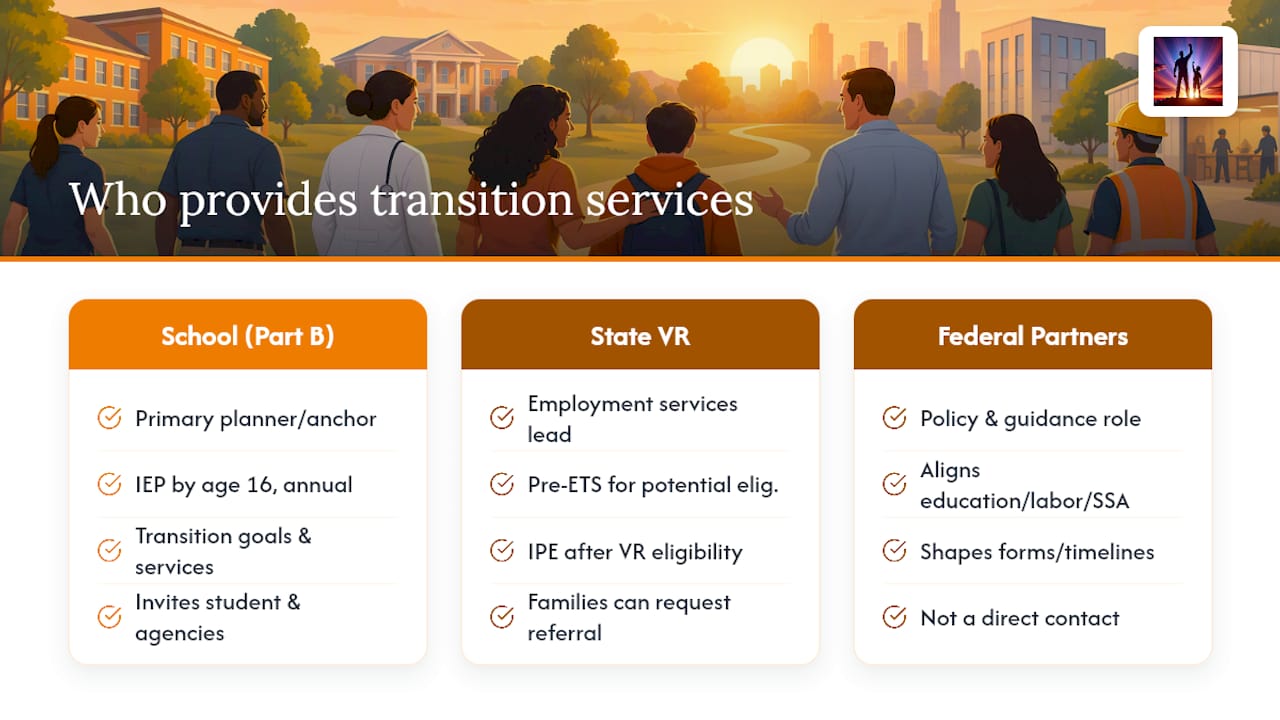
Who provides transition services and how the system fits together
Transition planning involves more than the school district, even though the IEP is where most of the coordination happens. Understanding which agency handles which piece saves families months of confusion.
IDEA and the school's Part B obligations. Under federal transition guidance, transition services must appear in the IEP not later than the first IEP in effect when the student turns 16, and the IEP must be updated annually after that. The regulation behind this, 34 C.F.R. §300.320(b), requires measurable postsecondary goals based on age-appropriate transition assessments, along with the specific transition services needed to reach those goals. A separate provision, §300.321(b), requires the school to invite the student to any IEP meeting where transition is discussed, and to invite a representative of any agency likely to provide or pay for transition services, with parent consent. The school is the anchor for this planning through graduation, but it is not the only agency in the room.
State Vocational Rehabilitation and pre-employment transition services. Under the Rehabilitation Act as amended by the Workforce Innovation and Opportunity Act, state VR agencies are required to coordinate with local schools to deliver pre-employment transition services, often called pre-ETS. These include job exploration counseling, work-based learning experiences, counseling on postsecondary education options, workplace readiness training, and instruction in self-advocacy. Pre-ETS is available to students who are potentially eligible for VR services, which is a lower bar than full VR eligibility. Once a student is found eligible for VR, the agency develops an Individualized Plan for Employment, or IPE, which lays out the specific services and job goal VR will support. Families can request a VR referral directly through the school or by contacting the state VR office.
Federal coordination behind the scenes. The Federal Partners in Transition initiative, which includes the Department of Labor's Office of Disability Employment Policy, works alongside the Department of Education's Rehabilitation Services Administration to align federal resources across education, labor, health, and Social Security. Parents won't interact with this layer directly, but it shapes the guidance your school and VR counselor are following. If you want to understand why a particular form or timeline exists, FPT fact sheets are a reasonable place to look.
A practical step: at your next IEP meeting, ask the school to formally invite a VR representative if your child is approaching age 16 or is already eligible. Written parental consent is required for that invitation, so don't assume it happens automatically.
The four areas every transition plan should cover
Transition plans built around a single goal area, usually just "get a job," tend to leave gaps elsewhere. A complete plan addresses four areas, even if the depth in each varies by student.
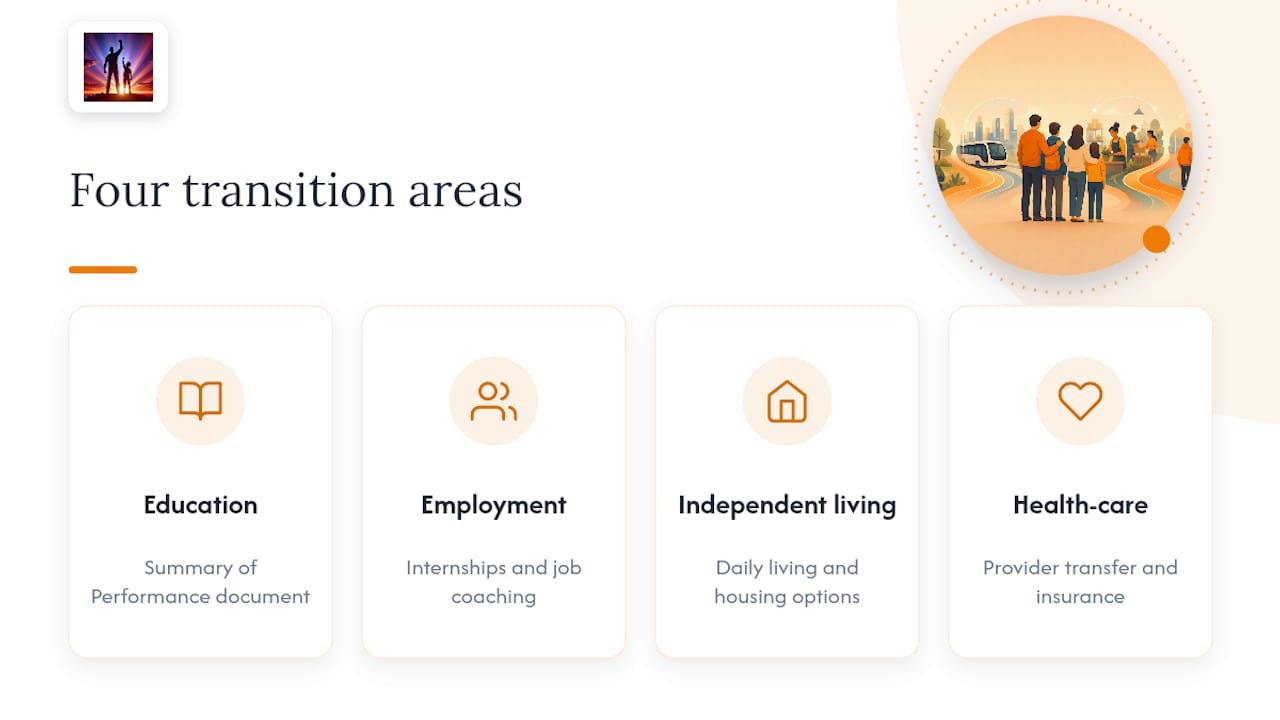
Education. This covers the courses of study a student takes to support their postsecondary goal, whether that's a diploma track, a certificate program, or dual enrollment at a community college while still in high school. It should also address any accommodations that will or won't carry over after graduation, since IDEA protections end at that point. Before a student exits, the school should prepare a Summary of Performance, a document summarizing academic and functional performance along with recommendations for meeting postsecondary goals. VR counselors and college disability offices rely on this summary, so it's worth confirming it will be written and requesting a copy.
Employment. Pre-ETS activities, internships, job shadowing, job coaching, and supported employment all fall under this category. For students who will need ongoing support to maintain a job, supported employment connects them with a job coach who fades support over time. Our guide to job training programs walks through what these vocational supports look like in more detail.
Independent living. This includes daily living skills, transportation training, money management, and exploring housing options, from staying with family to supported or independent living arrangements. This is also the area where documented gaps are widest, which the next section covers directly.
Health-care continuity. Turning 18 changes how medical decisions and insurance work, and transition planning should address transferring from pediatric to adult providers, maintaining mental health support without interruption, and understanding insurance coverage changes. Our guide on turning 18 with autism covers the legal and benefits side of this shift.
How to plan: a realistic timeline and what to do at each stage
Formal transition planning is required by law no later than the first IEP in effect when a student turns 16, but starting earlier gives families more room to build skills gradually rather than scrambling. Expert guidance on early transition planning recommends beginning informal conversations by ages 12 to 14, well before the legal requirement kicks in.
Here's what that looks like in practice:
Ages 12 to 14: Start informal conversations about interests, strengths, and what adult life might look like. Request age-appropriate transition assessments if the school hasn't already offered them.
By age 16 (or the first IEP after turning 16): Ensure the IEP includes measurable postsecondary goals in education, employment, and, when appropriate, independent living, along with the specific services needed to reach them.
Ages 16 to 17: Request VR referral and pre-ETS services if not already in place. Begin discussing guardianship, supported decision-making, or power of attorney options ahead of the student's 18th birthday.
Final year before exit: Confirm the Summary of Performance will be completed, finalize any VR Individualized Plan for Employment, and connect with adult service providers before the student's last day of eligibility.
Writing a measurable goal is different from writing an aspirational one. Instead of "the student will improve independence," a testable goal reads closer to "the student will use public transit with support on three routes by a specific date." That level of detail is what makes a goal something the team can actually track and revise.
Meeting prep checklist:
Bring the most recent evaluation reports and any outside assessments (medical, therapy, or psychological).
Draft two or three measurable postsecondary goals ahead of time so you're proposing, not just reacting.
Request the Summary of Performance be added to the agenda for the student's final year.
Ask the school, in writing, to invite a VR representative if the student is 16 or older.
Bring a notebook or your phone to document who committed to what, and by when.
Our IEP guide for autism covers the broader IEP process if transition is just one piece of what you're navigating this year.
Where transition plans fall short, and how to push back
The data on transition planning is encouraging in one respect and troubling in another. CDC surveillance found that more than 90% of adolescents with autism spectrum disorder had a documented transition plan. Access to school-based mental health services was quite limited among adolescents, and that access was unevenly distributed.
Beyond the disparities the CDC identified, a few administrative patterns show up repeatedly:
Goals written in vague language ("increase independence") instead of measurable, dated outcomes.
No mental health or independent living goal at all, even when the student clearly needs one.
VR referral happening too late, sometimes not until the final semester before graduation.
No documented plan for who follows up after the student exits the school system.
Families who proactively request specific supports, backed by assessment data, tend to get more measurable commitments written into the IEP than families who wait for the school to propose services first. If a request gets brushed aside, your state's Protection and Advocacy agency can help, and the Department of Education's Office of Special Education Programs handles complaints when a district isn't meeting its IDEA obligations.
Pro Tip: Put every verbal commitment from a meeting into a follow-up email the same day, thanking the team and restating what was agreed. It creates a paper trail without requiring a formal complaint.
What to bring and what to ask at every transition meeting
A transition meeting is more productive when you walk in with documents ready and questions that force specifics rather than generalities.
Bring:
Current and past evaluation reports, including outside assessments if you have them.
A one-page summary of your child's strengths, interests, and preferences in their own words when possible.
Draft measurable goals for education, employment, and independent living.
Contact information for any outside providers (therapists, VR counselor, medical team).
Ask:
What specific transition assessments have been completed, and can we see the results?
Who is responsible for each goal, and what is the timeline for the next update?
Has a VR referral been made, and if not, when will it happen?
Will a Summary of Performance be completed before exit, and who prepares it?
What happens if the student doesn't meet a goal by the target date?
A sample goal template worth adapting: "By [date], [student] will [specific skill] in [setting], measured by [specific criteria]." That structure turns almost any objective into something the team can actually check off or revise.
Finding state-specific resources, benefits, and support programs
Every state runs its own Vocational Rehabilitation office, and intake generally starts with an application, an eligibility determination based on documented disability and need, and then development of an Individualized Plan for Employment for those found eligible. Contact information for your state VR office is typically listed through your state's department of labor or education website, and the school's transition coordinator can usually provide a direct referral.
Medicaid Buy-In programs, where they exist at the state level, allow working individuals with disabilities to keep Medicaid coverage while earning income above standard limits, which matters for young adults moving into paid employment. Documentation requirements vary by state, but typically include proof of employment or work capacity and income verification. Our financial assistance guide breaks down what to gather and where state benefits tend to differ most.
The Social Security Administration publishes resources specifically for youth transitioning into adulthood, covering SSI, SSDI, and work incentives designed to let young adults test employment without an abrupt loss of benefits. Families approaching a child's 18th birthday should review these resources well before the birthday itself, since SSI eligibility rules change at that point and are reassessed under adult disability criteria.
How caregiver platforms can support the transition process
Coordinating transition planning means tracking evaluation reports, IEP goals, VR paperwork, and state benefit deadlines, often for years at a stretch. A caregiver-focused tool can help organize that load without replacing the school's or agency's legal obligations.
Autism Victory's app includes a state-specific resource navigator for locating benefits and support programs relevant to your state, printable checklists for meeting prep, and AI-powered guidance for questions that come up between meetings. Caregivers can use it to store evaluation documents in one place, set reminders ahead of annual IEP reviews, and revisit bilingual educational content (English and Spanish) when explaining a process to family members. None of this substitutes for the school's transition planning duties or a VR counselor's role, but it gives families a single place to keep the paperwork straight between meetings.
Three priorities to keep in view
If you take nothing else from this, hold onto three things. First, insist on measurable goals: vague language protects no one and tracks nothing. Second, push for coordination between the school, VR, and health providers early, because waiting until the final year to introduce agencies almost always costs time your child doesn't have. Third, build daily living and self-advocacy skills alongside academic and vocational goals, since independence rarely develops on its own timeline.
Keep copies of every evaluation, every IEP, and every email. Revisit the plan at least once a year, not just when the school schedules a meeting. And whenever possible, let your child's own preferences shape the goals. A plan built around what a young person actually wants tends to hold up better than one built entirely around what looks tidy on paper.
— Ronnie Talent
How Autism Victory helps you stay organized through the process
Transition planning asks a lot of families at once: paperwork from school, referrals from VR, benefit applications tied to state rules that shift depending on where you live, making it helpful to compare life insurance & annuity quotes to support long-term financial planning as part of preparing for adult life. Autism Victory won't sit at the IEP table for you, but it can take some of the administrative weight off your shoulders while you handle the parts that require your voice.

Inside the app, caregivers get:
A state-specific benefits and support navigator to identify programs relevant to your family before a meeting.
Printable, editable checklists to bring to IEP and VR appointments.
AI-powered guidance available anytime a question comes up outside of scheduled meetings.
Bilingual (English and Spanish) books, audiobooks, and educational videos covering the broader autism journey, not just transition.
A 5-day free trial gives you a chance to explore the app before committing. After that, plans run $49.95 per year or $6.95 per month, covering full access to the platform's guidance, resources, and community features. Autism Victory works alongside your child's school and state agencies, not in place of them, giving you a steadier way to track the process while the official planning happens where it needs to.
Sources
This article is general information, not a substitute for advice from a qualified doctor. Consult a qualified healthcare professional about your own circumstances before acting on anything here.
FAQ
What are transition services for a student with autism?
Transition services are a coordinated set of school and agency activities designed to move a student from high school into adult life, covering education, employment, independent living, and health care. Under federal transition guidance, they must be included in the IEP by the first IEP in effect when the student turns 16, with measurable postsecondary goals attached.
How can I help my autistic child handle transitions day to day?
Predictable routines, visual schedules, and advance notice before a change tend to reduce distress during everyday transitions between activities or settings. For the larger transition out of high school, the same principle applies on a bigger scale: starting the conversation early, by ages 12 to 14, gives a young person time to build comfort with new routines gradually rather than all at once.
What free resources are available for parents of children with autism?
Families can access no-cost information and referrals through the Federal Partners in Transition fact sheets, state Vocational Rehabilitation offices, and Social Security Administration resources on work incentives for young adults. School districts are also required under IDEA to provide transition assessments and planning at no cost as part of a student's IEP.
When should transition planning start for a child with autism?
Federal law requires transition planning to be part of the IEP no later than the first IEP in effect when a student turns 16. Many professionals recommend starting informal conversations by ages 12 to 14 so skills and goals develop gradually rather than under time pressure.
Do transition plans actually improve outcomes for autistic students?
Structured, multi-component transition programs have shown measurable benefit in controlled research. A randomized controlled trial of the STEPS program found that structured transition interventions improved post-school outcomes for students with autism, supporting the case for early and well-coordinated planning rather than a single meeting near graduation.
Recommended