
When your child turns 18, the Social Security Administration will re-evaluate their SSI eligibility using adult disability rules, and the outcome is not guaranteed. Some families keep benefits without a hitch. Many others face a cessation notice and must appeal, request Statutory Benefit Continuation within 10 days, or qualify for Section 301 payment continuation. The best protection starts now: updated medical records that describe your child's functional limitations in adult, work-relevant terms under Listing 12.10.
TL;DR:
Families should gather recent, detailed medical, neuropsychological, and functional evidence that explicitly relates their child's autism to adult work capacity.
The medical review will focus on four mental function areas, requiring specific adult-context statements rather than educational or childhood reports.
Starting preparations at least 24 months before the 18th birthday, including evaluations and vocational planning, can improve the chances of a successful redetermination.
If a cessation notice arrives, the 10-day window to request Statutory Benefit Continuation is critical, and timely appeal filing greatly affects eligibility continuation.
About 48% of youth pass the age-18 redetermination without an appeal, highlighting the importance of strong evidence and deadline awareness for improved outcomes.
Table of Contents
What the age-18 redetermination is and how the SSA evaluates it
How autism is judged under adult standards: what evidence matters
Documentation and evidence checklist parents should assemble
Appeals, Statutory Benefit Continuation, and Section 301 payment continuation
Practical timeline and step-by-step plan families can start now
Where to get help: SSA resources, legal aid, and community supports
Autism Victory: how our app helps families prepare for age-18 redetermination
What the age-18 redetermination is and how the SSA evaluates it
The age-18 redetermination is a required review, not a routine renewal. Once your child turns 18, the SSA no longer applies the childhood disability standard that got them approved in the first place. Instead, the agency evaluates them as if they were an adult filing a brand-new disability claim, with one notable exception: the agency skips the Step 1 substantial gainful activity screen that normally applies to adult claims. Everything else, medical severity, functional limitations, and vocational factors, gets a fresh look.
This matters because the child standard asks whether a condition causes "marked and severe functional limitations" compared to other children. The adult standard asks something different: can this person sustain basic work activity? Autism that clearly limited a 10-year-old's functioning in a classroom does not automatically translate into a disabling adult impairment on paper. The evidence has to make that connection explicitly.
The process itself runs through two offices working together:
A local Social Security field office identifies your child's case, usually not long after eligibility began in childhood, and schedules an interview to review non-medical factors like income, resources, and living arrangements.
The field office then sends the case to the Disability Determination Services (DDS) office in your state, which handles the actual medical and functional review.
DDS treats the file largely like a new adult claim, which means it can request current medical evidence rather than relying only on what supported the original childhood approval.
On timing, the SSA must initiate the age-18 redetermination within one year after your child's 18th birthday, though notices about the process typically start arriving well before that, sometimes as early as age 14 as part of broader transition planning. Waiting for SSA to reach out is risky. Families who start assembling adult-focused documentation before the notice arrives tend to be in a stronger position when DDS asks for it.
How autism is judged under adult standards: what evidence matters
Autism is evaluated under Listing 12.10, the adult mental disorders listing for autism spectrum disorder. It has two parts, and your child's file needs to satisfy both.
Part A asks for medical documentation of qualitative deficits in verbal and nonverbal communication and social interaction, along with significantly restricted or repetitive patterns of behavior, interests, or activities, as detailed in this autism social skills activities guide for parents. This is usually the easier part to document since it mirrors much of what already exists in a diagnostic history.
Part B is where most cases are won or lost. It requires an extreme limitation in one, or a marked limitation in two, of four areas of mental functioning:
Understanding, remembering, or applying information, such as following multi-step instructions on a job site.
Interacting with others, including tolerating supervision, reading social cues from coworkers, and managing conflict in adult settings.
Concentrating, persisting, or maintaining pace, especially on sustained, work-like tasks over a full shift.
Adapting or managing oneself, covering things like regulating emotions under stress, maintaining hygiene independently, and adjusting to unexpected changes in routine.
One documentation gap drives more denials than almost anything else: age-18 cases most often fail when the file still reads like a school record instead of an adult functional profile. An IEP goal like "will improve on-task behavior during group work" needs to become something closer to "cannot sustain attention on repetitive tasks for a full shift without redirection every 15 minutes." Ask your child's clinician, therapist, or psychologist to write statements that speak directly to workplace and independent-living scenarios, not classroom accommodations. A letter that says "struggles with transitions" is weaker than one that says "requires advance notice and a structured routine to avoid shutdown or meltdown when tasks change unexpectedly."
Timing, notices, and how long the process typically takes
Transition-related notices from the SSA often begin around age 14, well before the formal redetermination starts, as part of general planning for adulthood. The age-18 redetermination itself must be initiated within one year of your child turning 18, though the exact month varies by case load and state DDS processing times.
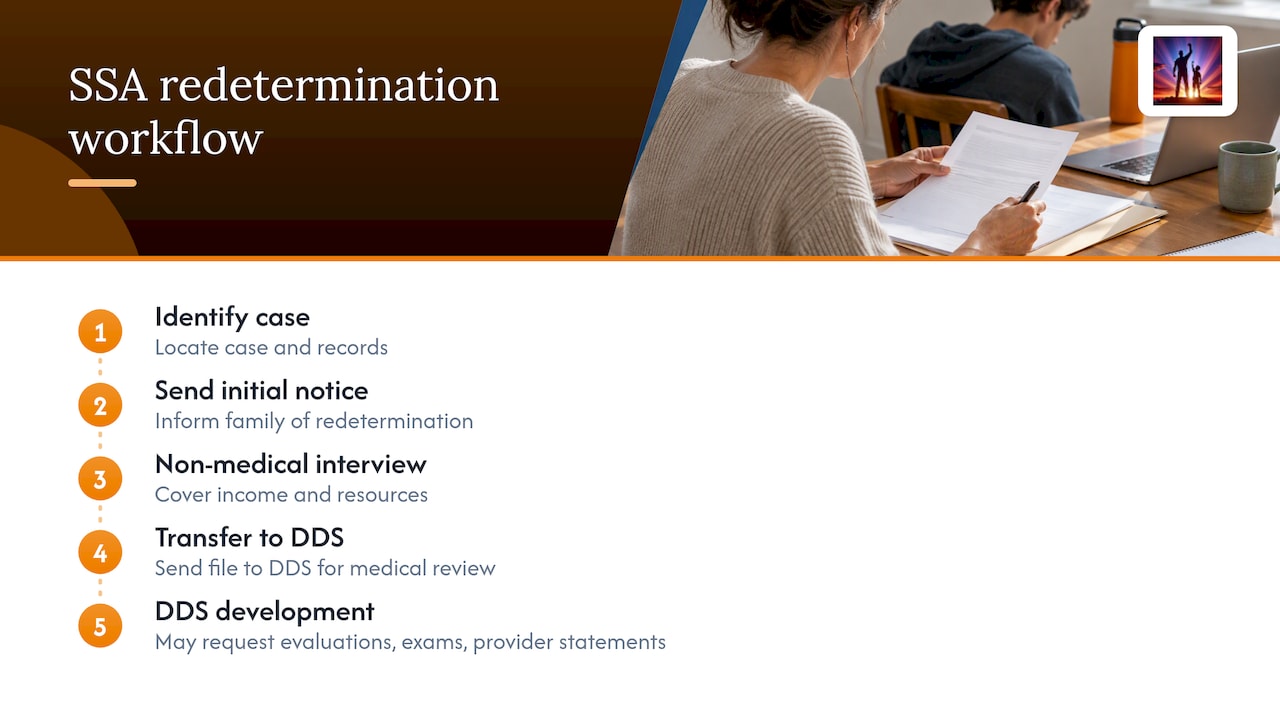
Field offices follow a defined workflow: identify the case, send an initial notice, conduct a non-medical interview covering income and resources, then transfer the file to DDS for the medical review. DDS develops the case largely as a new adult claim, which can mean requesting updated evaluations, consultative exams, or clarifying statements from treating providers. Cases are not typically expedited unless there is a compelling reason, such as a terminal illness designation, which rarely applies to autism redeterminations.
What should families expect in terms of outcome? Recent data from MACPAC found that about 48.0% of youth who went through an age-18 redetermination were found eligible for SSI as adults, meaning a little under half continued without needing to appeal. These numbers are sobering, but they are not a verdict on your child specifically. They reflect an average across a huge range of documentation quality, diagnoses, and support needs. Families who go in with strong, adult-focused medical evidence tend to do better than the baseline.
Documentation and evidence checklist parents should assemble
Strong evidence is the single biggest lever you control in this process. Start building the file well before any notice arrives.
Gather recent medical records, ideally dated within the last 6 to 12 months, including treating-source notes, the original autism spectrum disorder diagnosis report, and any neuropsychological testing on file.
Collect a current medication and treatment history, including any therapies (behavioral, speech, occupational) your child is actively receiving.
Ask caregivers, teachers, or job coaches to write functional statements that describe specific incidents, not general impressions, mapped to the four mental-function areas.
Request a task-analysis or vocational evaluation if one exists, since these documents speak directly to work capacity in language DDS examiners recognize.
Translate IEP transition goals into adult-function language: instead of quoting the IEP verbatim, summarize what the goal reveals about real-world functioning.
Include vocational rehabilitation (VR) intake notes if your child has started that process, since these can double as evidence for both the medical file and a possible Section 301 claim later.
Organize everything into a single packet with a short cover summary, since DDS examiners review many files and a clear structure helps your child's story land.
When you request records, be specific. Ask providers to include language that addresses sustained work activity, independent task completion, and behavior under stress, not just a diagnosis confirmation. A one-line note saying "patient has autism" does almost no work in an adult disability file.
Pro Tip: Ask your clinician directly: "Can you write a letter describing what a full workday would look like for my child, including breaks, supervision needs, and what happens when the routine changes?" That specific framing produces far more useful evidence than a general diagnostic summary.
Appeals, Statutory Benefit Continuation, and Section 301 payment continuation
A cessation notice is not the end of the process. You have 60 days to file a formal appeal, and the evidence gaps that led to the denial can often be addressed on appeal with stronger documentation.
There is a much tighter deadline buried inside that appeal window, and it is the one families most often miss. If you want payments to continue while your appeal is pending, you must request Statutory Benefit Continuation (SBC) within 10 days of the cessation notice. Miss that window and payments stop during the appeal even if you ultimately win.
Section 301 offers a separate path to continued payments, but it has a strict precondition: your child must have been participating in an appropriate vocational rehabilitation program or similar service before the medical cessation decision was made. Enrolling in VR after the fact does not retroactively qualify a case for Section 301. This is one of the clearest reasons to start VR enrollment conversations well ahead of the redetermination, not after a denial letter shows up.
If you receive a cessation notice, mark the 10-day SBC deadline on a calendar immediately and call your local field office the same day if possible.
If your child is in or starting a VR program, keep documentation of enrollment dates and active participation, since this is the evidence Section 301 continuation depends on.
Understand the trade-off: if you request SBC and later lose the appeal, you may be required to repay the benefits paid during the continuation period.
About half of age-18 redeterminations result in continued eligibility without appeal, which means the other half hinge on exactly these deadlines and documentation choices. MACPAC's December 2025 data put the continuance rate at 48.0%, underscoring how much weight the appeal and SBC process carries for the remaining families.
Practical timeline and step-by-step plan families can start now
Waiting for the official notice puts you on the SSA's timeline instead of your own. Here is a sequence that keeps you ahead of it.
24 months before the 18th birthday: schedule updated evaluations (psychological, neuropsychological, or developmental pediatrics) so the file is not relying on outdated childhood assessments. Sign consent forms now so providers can release records quickly later.
18 to 12 months out: begin translating IEP transition goals into adult-function language with help from your child's special education team, and start conversations about vocational rehabilitation enrollment if appropriate.
90 days before the 18th birthday: confirm your contact information is current with the local SSA field office, finalize medical summaries, and make sure any VR enrollment is active and documented.
At the first notice: read it carefully for deadlines, and if the decision is unfavorable, start the appeal and SBC clock immediately rather than waiting to gather more evidence first. You can supplement the file after filing.
Within 10 days of a cessation notice: submit the SBC request in writing if you are appealing and want payments to continue.
Within 60 days of a cessation notice: file the formal appeal, attaching whatever updated evidence is ready and noting what is still in progress.
Two short scripts can save time when you are under deadline pressure. For a clinician: "I need a letter describing my child's ability to sustain a full workday, including behavior under stress and need for supervision or structure, for a Social Security disability review." For the SSA field office: "I received a cessation notice dated [date] and I want to appeal and request Statutory Benefit Continuation under the 10-day rule."
Pro Tip: Keep a single folder, physical or digital, with every record, dated and labeled, from the day your child turns 16. When a deadline hits, you want minutes of searching, not days.
Where to get help: SSA resources, legal aid, and community supports
You do not have to navigate this alone. The SSA's own guide for youth turning 18 explains the redetermination process, work incentives, and related resources in plain language, and is worth reading alongside this article.
Protection and Advocacy for Beneficiaries of Social Security (PABSS) programs operate in every state and can provide free or low-cost help with appeals and SBC requests.
Legal aid organizations in your area often have staff experienced specifically in SSI disability appeals.
State vocational rehabilitation agencies can confirm whether a program qualifies for Section 301 purposes before you enroll.
The Autism Victory app offers document checklists, bilingual resources, and state-specific support navigation to help organize this process, though it is a support tool rather than a substitute for legal representation.
What caregivers often miss and how to avoid common mistakes
The most common mistake I see is treating the redetermination like a formality instead of a new application. Families lean on old school records and childhood diagnostic reports that never speak to adult work capacity, and the file suffers for it. The second mistake is missing the 10-day SBC window entirely, often because the cessation notice arrives during an already overwhelming stretch of life. The third is waiting until after a denial to look into vocational rehabilitation, by which point Section 301 is no longer an option.
Start early, lean on bilingual resources if English is not your first language, and connect with other caregivers who have been through this. Peer knowledge about what actually works in a DDS file is often more current than generic guides.
— Ronnie Talent
Autism Victory: how our app helps families prepare for age-18 redetermination

Preparing for an age-18 redetermination means juggling medical records, state-specific VR programs, and deadlines that do not forgive a missed day. The app brings document checklists, a state-by-state resource navigator, bilingual (English and Spanish) guidance, and a caregiver community into one app, built to support families managing this kind of process. It will not replace a lawyer if you need one for a complex appeal, but it keeps your records organized and your state resources within reach when deadlines are tight. A 5-day free trial lets you try it before committing, with Annual ($49.95 per year) and Monthly ($6.95 per month) plans available afterward.
This article is general information, not a substitute for advice from a qualified lawyer. Consult a qualified legal professional about your own circumstances before acting on anything here.
FAQ
Can an 18-year-old with autism receive SSI benefits?
Yes, an 18-year-old with autism can receive SSI, but eligibility is reassessed using adult disability standards rather than the childhood standard. The review looks at functional limitations under Listing 12.10 and also re-checks income and resources, since parental income deeming ends at 18.
How long does it take to get approved for SSI for a child with autism?
Processing time varies by state DDS workload and how quickly medical evidence is submitted, and there is no single fixed timeframe for a childhood SSI application. For the separate age-18 redetermination process, the SSA must initiate the review within one year after the 18th birthday, though notices often begin earlier.
Can a child with autism receive Social Security benefits?
A child with autism can qualify for Supplemental Security Income (SSI) if the condition meets the childhood disability standard and the family's income and resources fall within program limits. This is evaluated differently from the adult standard applied once the child turns 18.
How long does SSI age-18 redetermination take?
The SSA is required to start the age-18 redetermination within one year of the individual's 18th birthday, though the exact timeline within that window depends on the local field office and state DDS caseload. Families who submit complete, adult-focused medical evidence promptly tend to move through the review faster than those who wait for additional requests.
Sources
Recommended