
Six things need your attention the moment your child turns 18: confirming SSI eligibility or preparing for age-18 redetermination, joining Medicaid HCBS waiver waitlists, locking in HIPAA authorization and a guardianship or power of attorney decision, gathering medical and school records, and opening an ABLE account or talking to an attorney about a special needs trust. Start this at least two years out if you can. The two mistakes that cost families the most: waiting until after the birthday to act, and missing SSI appeal deadlines.
TL;DR:
Families should start planning at least two years before the 18th birthday to avoid missing key SSI, Medicaid, and guardianship deadlines.
Checking and updating documentation, such as evaluations and legal forms, early can prevent coverage gaps during the critical transition period.
The shift at 18 changes SSI rules, with many young adults becoming eligible independently and needing to act quickly during redeterminations to maintain benefits.
Less restrictive guardianship options like supported decision-making or power of attorney are increasingly favored over formal guardianship for capable young adults.
Using a tracking tool simplifies multi-agency coordination and can help prepare all necessary paperwork efficiently before the birthday date.
Table of Contents
Guardianship, Supported Decision-Making, or Power of Attorney?
HCBS Waivers, Housing, and Vocational Rehab: Get on the Lists Now
How Autism Victory App Keeps This Checklist From Falling Apart
Turning 18 Autism Benefits Checklist: What to Do and When
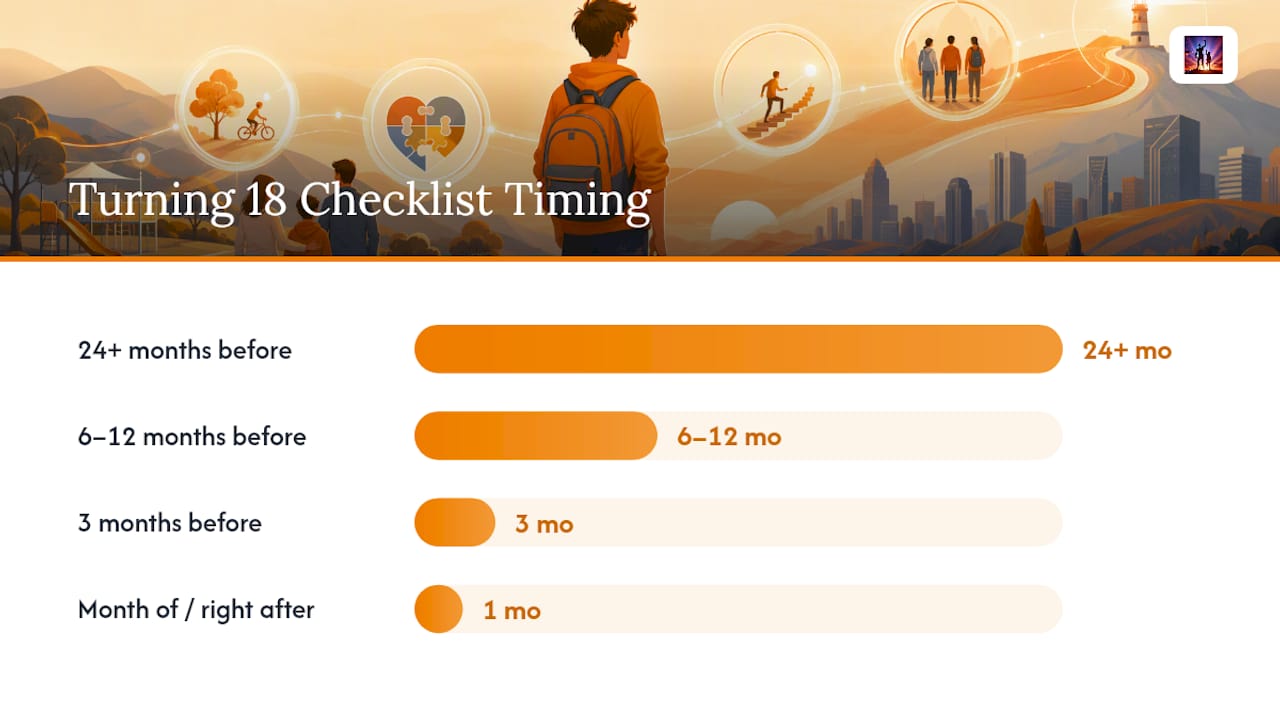
Think of this less as a single deadline and more as a countdown with four checkpoints. Each one has its own paperwork, its own agency, and its own consequences if you skip it.
24+ months before the birthday:
Ask the IEP team to formally document transition goals, including independent living, employment, and post-secondary plans.
Get your child's name on Medicaid HCBS waiver waitlists in your state, even if you're unsure they'll need services right away.
Contact your state's Vocational Rehabilitation (VR) office to start the referral process.
Start a care binder, physical or digital, and begin dropping in every evaluation, IEP, and medical report you can find.
6 to 12 months before:
Request updated psychological and adaptive functioning evaluations. Courts and SSA both want recent documentation, not records from age 10.
Meet with an attorney to talk through guardianship, supported decision-making, or power of attorney. This conversation takes longer than people expect.
Draft HIPAA authorization forms and a medical power of attorney so you don't lose access to your child's health information the day they turn 18.
3 months out:
Apply for SSI if your child hasn't already been receiving it, or prepare documentation for the SSA's age-18 redetermination review.
Open an ABLE account.
Schedule a consultation about a special needs trust if your family has or expects meaningful assets.
The month of, and right after:
Track the SSA redetermination process closely and respond to every request immediately.
Confirm Medicaid coverage carries forward and new insurance cards have arrived.
Set up a representative payee arrangement if your child will need help managing benefit payments.
Follow up in writing on any waiver, housing, or VR applications still pending.
Pro Tip: Call every agency the same week and ask for the direct line and name of a caseworker instead of the general intake number. A named contact who already knows your file will save you weeks the next time you need to follow up.
Missing any single step here rarely causes irreversible damage. Missing several in a row, especially the SSI and Medicaid pieces, can create a coverage gap that takes months to untangle.
How SSI, SSDI, and Medicaid Eligibility Change at 18
Turning 18 rewrites the financial rules almost overnight. Before 18, the SSA counts a portion of parental income and resources against a child's SSI eligibility through a process called "deeming." That stops at 18. Many young adults who never qualified as children because their parents earned too much suddenly become eligible in their own right, based only on their own income and assets.
The federal maximum SSI payment for 2026 is $994 a month, and the countable resource limit for eligibility sits at $2,000 for an individual. That resource ceiling is tighter than most families expect. It's why the ABLE account conversation matters so much before the birthday, not after.
SSA also runs an age-18 redetermination, a fresh disability review using adult standards, separate from any redetermination that happens for children already on SSI. According to LegalClarity's breakdown of what happens at 18, families have 60 days to file an appeal if SSI is denied or reduced, and only 10 days from the denial notice to request that benefits continue during the appeal. Miss that 10 day window and payments can stop while your case is still being reviewed.
A few other mechanics worth knowing:
SSDI is different from SSI. It's based on a worker's own earnings record or, for adult children, a parent's work history, and it has no resource limit.
If your child will need help managing money, SSA can appoint a representative payee, and parents are typically the first choice, with room for backup designees.
Every SSI or Medicaid decision letter has a clock attached to it. Read the date, not just the verdict.
Our step-by-step SSI guide covering 2026 payment amounts and appeals walks through exactly what to submit and when.
Guardianship, Supported Decision-Making, or Power of Attorney?
Legally, 18 makes your child their own decision-maker by default, no matter their diagnosis. That's the part most parents don't see coming until a doctor's office turns them away for wanting to discuss treatment.
Three tools exist to handle this, and none of them is automatically right:
Guardianship transfers legal decision-making authority to you, often used when a person can't reliably weigh the consequences of medical, financial, or safety decisions.
Supported decision-making lets your child keep legal authority while formally naming people who help them understand and communicate choices. Courts and disability advocates increasingly favor this as the least-restrictive option when it fits.
Durable power of attorney lets a capable adult voluntarily authorize someone else to act on specific matters, revocable by them at any time.
Guardianship petitions often need to start around six months before the 18th birthday, sometimes earlier if your court has a backlog. You'll need a current autism evaluation and adaptive functioning report, not something years old. Judges are evaluating actual decision-making capacity, not a diagnosis label.
Pro Tip: File signed HIPAA authorization forms directly with every doctor's office and hospital your child uses, not just with your own records. A form sitting in your care binder does nothing if the front desk has never seen it.
Our guide on guardianship, SSI, and what legally changes at 18 covers the paperwork sequence in more detail.
ABLE Accounts and Special Needs Trusts, Explained Simply
Money sitting in the wrong account can cost your child their SSI. That's the entire reason ABLE accounts and special needs trusts exist.
An ABLE account is a tax-advantaged savings account for disability-related expenses, housing, education, transportation, health care. The first $100,000 in an ABLE account doesn't count against the SSI resource limit at all. Go above that threshold and SSI payments can be suspended, though Medicaid coverage keeps running.
A special needs trust works differently depending on who funds it:
A first-party trust holds the individual's own money, often from a settlement or inheritance, and generally must repay Medicaid from remaining funds after the beneficiary passes.
A third-party trust, funded by parents or relatives, carries no Medicaid payback requirement, making it the more common choice for family estate planning.
Which one fits your family comes down to a short set of questions: how much money is involved, whether an inheritance is coming, and how much ongoing management you're willing to take on. ABLE accounts are simpler to open and manage day to day. Trusts make more sense once real estate, a settlement, or a sizable inheritance enters the picture, and that conversation belongs with an attorney, not a search engine. Our guide to ABLE account rules walks through setup and contribution limits.
HCBS Waivers, Housing, and Vocational Rehab: Get on the Lists Now
This is the section that surprises families most. Federal data shows HCBS waiver waitlists average around 39 months, and some states run over a decade for certain waiver categories. There's no fast-tracking a list you haven't joined yet.
Call your state Medicaid office and your regional center or IDD agency today, not after the birthday, to start or check waiver applications.
Apply to housing authority waitlists directly and any property-specific lists, and update your contact information regularly since inactive files often get purged.
Contact VR early to arrange trial work experiences tied to IEP transition goals, since that documentation strengthens later applications.
Keep dated copies of every application you submit; caseworkers change and files go missing more often than anyone wants to admit.
Our state-by-state breakdown of Medicaid waiver waitlists across all 50 states shows exactly where your state ranks and who to call first.
Why 18 Is a Horizon, Not a Cliff
Families who treat 18 as a single crisis date scramble in the final weeks and often lose ground they didn't have to lose. Families who treat it as a two-year horizon, layering in HIPAA authorization, then supported decision-making or POA, then guardianship only if genuinely needed, tend to walk into the birthday with options intact instead of options lost. Research on transition outcomes backs this up: autistic young adults face real risk of falling short on health, employment, and independence milestones without structured planning.
One family I know of started their care binder at 15, gathering every evaluation as it happened. When the SSI redetermination letter arrived at 18, they had every document ready within a day. No scramble, no lapse in coverage.
— Ronnie Talent
How Autism Victory App Keeps This Checklist From Falling Apart
Autism Victory App is built for exactly this kind of multi-year, multi-agency tracking, so you're not juggling SSA deadlines, waiver applications, and ABLE paperwork across five different notebooks and a dozen browser tabs.
Inside the app, you get a state-specific resource navigator that points you to your own Medicaid office, regional center, and housing authority instead of generic national advice. There are step-by-step guides on SSI redetermination, ABLE accounts, and special needs trusts, plus a document organizer built to hold exactly the records this checklist asks you to gather. Everything is available in English and Spanish, and personalized AI guidance is there when you need a quick answer at 11 p.m. instead of waiting for a caseworker callback. If you want to try it before committing, there's a 5-day free trial, and plans run $6.95 a month or $49.95 a year. Visit the pricing page and start the trial today to get your own checklist organized before the birthday countdown gets tight.
Where to Go for More Reliable Information
Social Security Administration on SSI: official payment amounts and resource rules.
MACPAC on HCBS waiver waitlists: state-level wait time data.
Stanford's adult autism transition checklist: a clinical program's step-by-step guide.
For a family already dealing with earlier developmental concerns, this parent's checklist on speech delays is worth a look.
Talk to an attorney or benefits specialist before finalizing guardianship or trust decisions.
This article is general information, not a substitute for advice from a qualified financial advisor. Consult a qualified financial professional about your own circumstances before acting on anything here.
Sources
FAQ
When Should We Start the Turning 18 Autism Benefits Checklist?
Begin at least two years before the 18th birthday, especially for HCBS waiver waitlists, which can run multiple years in many states. Waiting until the year of the birthday often means missing windows that can't be recovered quickly.
What Happens to SSI When My Child Turns 18?
SSA conducts an age-18 redetermination using adult disability standards, and parental income no longer counts against eligibility. If denied, you have 60 days to appeal, and only 10 days to request continued benefits during that appeal.
Does an ABLE Account Affect SSI Eligibility?
The first $100,000 in an ABLE account doesn't count toward the $2,000 SSI resource limit. Balances above that threshold can suspend SSI payments, though Medicaid coverage continues regardless.
Do We Need Guardianship, or Is There a Less Restrictive Option?
Supported decision-making or a durable power of attorney can work for many young adults, keeping their legal authority intact while adding formal support. Guardianship makes sense when someone genuinely cannot weigh medical, financial, or safety decisions on their own, and courts generally favor the least restrictive option that still protects the person.
How Much Does Autism Victory App Cost?
Autism Victory App offers a monthly plan at $6.95 and an annual plan at $49.95, both preceded by a 5-day free trial. Pricing and current plan details are always listed on the app's pricing page.
Recommended