
Yes, people with autism can use an ABLE account if their disability began before age 46 (a threshold expanded in 2026) and they qualify through SSI, SSDI, or a physician's certification. The account lets savings grow tax-free for disability-related costs, and it protects up to $100,000 from counting against SSI's asset limit. The catch: contributions are capped at $20,000 a year, and balances above that protected threshold can suspend, not end, your SSI payments.
TL;DR:
In 2026, eligibility for an ABLE account expands to anyone with a disability onset before age 46, including many adults diagnosed later in life.
Families should regularly monitor ABLE account balances, especially above $100,000, since amounts over this can suspend SSI payments but usually not affect Medicaid.
The annual contribution limit remains $20,000, with extra contributions possible if the beneficiary is employed and not contributing to a retirement plan.
States accept most ABLE plans nationwide, making it possible to choose based on fees, features, and customer service rather than residency.
An ABLE account complements a special needs trust, serving for routine expenses, while larger assets are better protected within a trust structure.
Table of Contents
What Is an ABLE Account, and What Counts as a Qualified Disability Expense?
Practical Roadmap: Starting and Pacing ABLE Contributions for Autism Families
Does an ABLE Account Affect Housing Assistance or Other Benefits?
How Do You Coordinate an ABLE Account With Broader Family Financial Planning?
What Is an ABLE Account, and What Counts as a Qualified Disability Expense?
An ABLE account is a state-run, tax-advantaged savings account created under Section 529A of the federal tax code, the same legal family as a college 529 plan, but built for disability costs instead of tuition. Money grows tax-free, and withdrawals stay tax-free as long as you spend them on Qualified Disability Expenses, or QDEs, a term borrowed straight from IRS guidance.
QDEs cover more ground than most families expect:
Education, including tuition, tutoring, and specialized curriculum materials
Therapy and health, such as speech, occupational, or behavioral therapy copays
Assistive technology, from communication devices to sensory equipment
Housing, including rent, mortgage payments, and utilities
Transportation, covering vehicle modifications, rideshares, or public transit costs
Employment support, like job coaching or workplace accommodations
Personal care and basic living expenses, including food and daily supports
For a family paying out of pocket for ABA sessions or a communication tablet, that breadth turns an ABLE account into a practical, everyday tool rather than a distant retirement-style fund.
Who Qualifies for an ABLE Account in 2026?
The biggest shift this year is age. Starting January 1, 2026, eligibility now covers anyone whose disability or blindness began before their 46th birthday, up from the previous cutoff of 26, according to the Social Security Administration. That change opens the door to a much larger pool of adults diagnosed with autism later in life, along with parents who missed the old window entirely.
Qualification runs through one of two paths:
You already receive SSI or SSDI based on disability, which automatically satisfies the requirement.
You don't receive those benefits but a licensed physician signs a disability certification, documenting a marked and severe functional limitation consistent with SSA's criteria.
For a minor or an adult who cannot manage financial accounts independently, a parent, legal guardian, representative payee, or another authorized legal representative can open and run the account. The beneficiary, per SSA POMS guidance, stays the legal owner even when someone else holds signature authority. One more rule to know: each person is allowed exactly one ABLE account at a time, no matter how many states offer plans.
How Do ABLE Accounts Affect SSI and Medicaid?
The first $100,000 sitting in an ABLE account doesn't count against the SSI resource limit at all. That protection is the entire point of the program: it lets a family build real savings without triggering the usual $2,000 asset ceiling that governs most SSI recipients.
The $100,000 threshold in plain terms: Balances up to $100,000 are fully disregarded for SSI. Anything above that amount counts as a resource, which can suspend SSI payments, but according to a comprehensive family guide from Cozen O'Connor, it typically leaves Medicaid coverage intact.
That distinction matters because Medicaid, not SSI, usually pays for the therapies and long-term supports autism families rely on most.
A few habits keep this rule from becoming a problem; for example, families often participate in community fundraisers like the Autism Anglers Fundraiser, where you can win a FishNFX Rod and support autism awareness to help grow their ABLE contributions.
Watch the balance regularly, not just once a year, especially as contributions from grandparents or fundraisers add up.
Spend housing distributions in the same month you withdraw them; SSA counts unspent housing funds carried into the next month as a resource.
Keep receipts sorted by QDE category so you can show, if ever asked, that withdrawals matched allowable expenses.
How Much Can You Contribute to an ABLE Account Each Year?
The standard annual contribution limit for 2026 is $20,000 per beneficiary, according to SSA's ABLE spotlight. That ceiling applies to the combined total from everyone who contributes, whether that's parents, grandparents, or a fundraiser, not $20,000 per contributor.
If the beneficiary is employed and not contributing to a retirement plan through that job, they can add extra money on top of the standard limit, up to their earnings or a poverty-line benchmark, whichever is lower. Alaska and Hawaii use higher poverty-line figures, so their maximums for this "ABLE to Work" provision run higher than the rest of the country ($19,950 and $18,360, respectively, based on those state-specific benchmarks).
Two more contribution paths worth knowing:
You can roll over funds from a traditional 529 college savings plan into an ABLE account without a tax penalty.
Contributions may also qualify the beneficiary for the Saver's Credit, per IRS rules.
How Do You Choose the Right State ABLE Plan?
States run their own ABLE programs, and most accept applicants from anywhere in the country, not just their own residents, according to the ABLE National Resource Center. That means you're not locked into your home state's plan if another one offers better terms.
Work through this checklist before enrolling:
Compare fees and expense ratios across the investment options each plan offers.
Check contribution minimums and whether the plan allows automatic monthly deposits.
Confirm debit card and bill-pay features, which make day-to-day QDE spending far easier to track.
Look for gifting tools, such as an Ugift-style link relatives can use for birthdays or holidays.
Ask whether your home state offers a tax deduction for contributions, even to another state's plan.
Test customer service responsiveness before you commit, since you'll be managing this account for years.
Pro Tip: A directory comparing every active state plan side by side lives at the ABLE National Resource Center's compare-states tool. Bookmark it. Rules and fees shift year to year, and the plan that made sense last year might not be the cheapest one this year.
How Do You Open and Manage an ABLE Account?
Opening an account is faster than most families expect, usually 15 to 20 minutes online once you have the right documents ready.
Gather proof of disability, either an SSI/SSDI award letter or a physician's signed certification.
Choose a state plan based on the checklist above.
Complete the online application, listing the beneficiary and, if applicable, the authorized legal representative.
Fund the account with an initial deposit, often as low as $25.
Set up recurring contributions if your budget allows, even a small automatic monthly transfer.
A few management habits matter more than people realize. If a representative payee moves SSA benefits into the account, they still must follow every existing SSA payee rule; opening an ABLE account doesn't loosen those obligations. Review the account quarterly, match every withdrawal to a QDE category in writing, and revisit your contribution pace whenever a benefits redetermination notice arrives.
ABLE Account vs. Special Needs Trust: Do You Need Both?
Neither one replaces the other. An ABLE account works best for flexible, everyday spending, therapy copays, groceries, a new communication device, while a special needs trust is built for protecting larger sums over decades, often inheritances or legal settlements too big for ABLE's contribution limits.
Financial planners generally recommend running both side by side. According to Yahoo Finance's guide for autism families, a common structure looks like this:
Small, steady deposits into the ABLE account for routine, month-to-month costs
A special needs trust holding larger assets meant to last a lifetime
Coordination between both so withdrawals never accidentally push resources over program limits
One rule ties them together at the end: when an ABLE beneficiary dies, the state can file a Medicaid payback claim against remaining funds. Some trust structures avoid that payback requirement entirely, which is exactly why estate planning attorneys often recommend reviewing broader financial assistance and guardianship planning alongside any ABLE decision, not after it.
Practical Roadmap: Starting and Pacing ABLE Contributions for Autism Families
Start smaller than you think you need to. The ABLE National Resource Center advises treating an ABLE account as a landing spot for money left over after essentials like housing and food are already covered, not as another bill competing for the same dollars.
Priorities tend to shift by stage:
Early childhood: fund therapy copays and assistive communication tools first.
School years: build a cushion for tutoring, summer programs, and IEP-related gaps insurance won't cover.
Transition to adulthood: shift focus toward job coaching, vocational training, and eventual housing costs.
Adult independence: prioritize rent, transportation, and long-term personal care funding.
A short action checklist gets most families moving within a week:
Confirm your state's ABLE plan rules or pick an out-of-state plan that fits better.
Gather SSI/SSDI paperwork or request a physician's disability certification.
Open the account with even a modest first deposit.
Explore state-specific support resources to see what else your family may already qualify for.
Pro Tip: Set your monthly ABLE contribution to auto-draft the same week your paycheck lands. Families who automate savings rarely skip a month; families who "get to it later" often don't.
Does an ABLE Account Affect Housing Assistance or Other Benefits?
SSI and Medicaid get the most attention, but ABLE accounts also touch other means-tested programs families depend on, particularly housing assistance. Federal housing programs, including Section 8 vouchers and public housing, generally calculate eligibility using income and asset tests separate from SSI's rules.
The good news: ABLE's federal protections were written broadly enough that funds in the account, and qualified distributions from it, are typically excluded from resource calculations for many federal means-tested programs beyond SSI and Medicaid. That includes SNAP (food assistance) in most circumstances. Housing programs administered by HUD generally follow similar exclusion logic for ABLE balances, though local housing authorities can interpret asset rules slightly differently from one jurisdiction to the next.
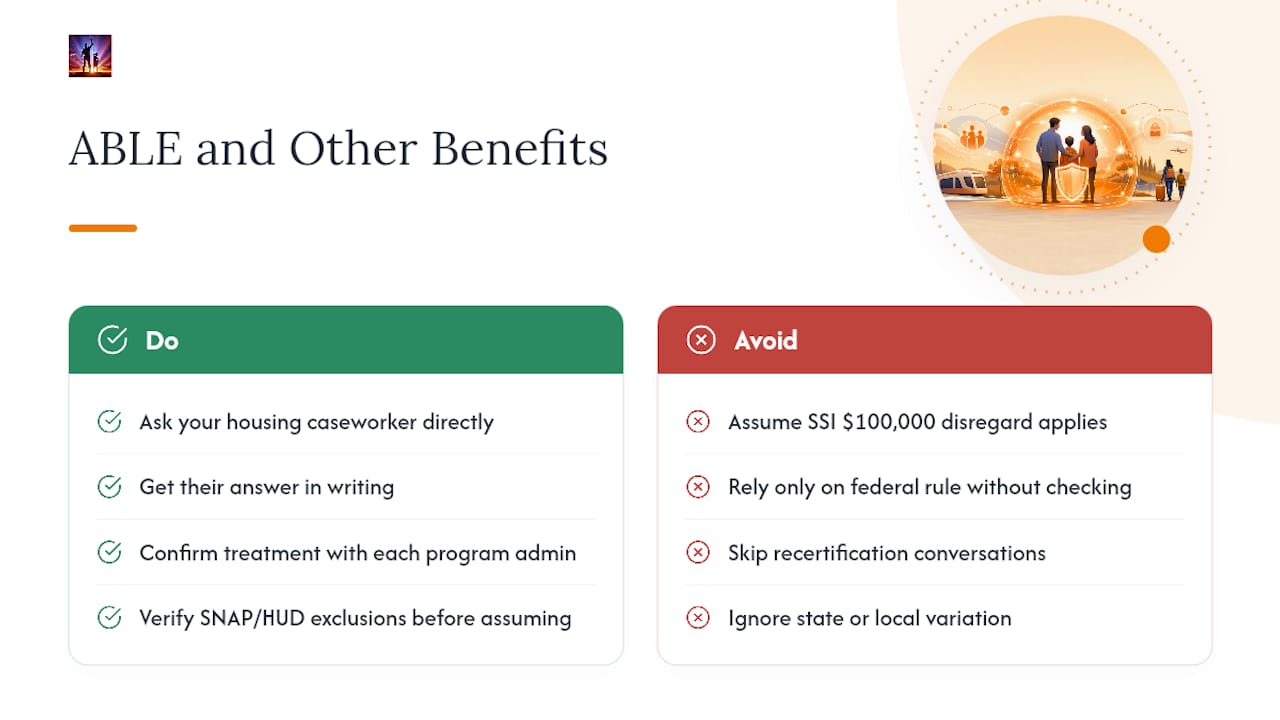
That local variation is the part families overlook. A housing authority in one county might apply ABLE exclusions cleanly, while another asks for additional documentation before recognizing the same protection. If your family receives a housing voucher or lives in subsidized housing, don't assume the SSI-style $100,000 disregard automatically applies in the exact same form. Ask your housing caseworker directly how they treat ABLE account balances during your next recertification, and get the answer in writing if possible.
The same caution applies to other supports layered on top of SSI, like state supplemental payments or utility assistance programs. Rules vary by state and by program administrator. Before you assume an ABLE account is invisible everywhere, confirm it with whoever runs the specific benefit you're worried about protecting.
How Do You Coordinate an ABLE Account With Broader Family Financial Planning?
An ABLE account works best as one piece of a larger financial picture, not a stand-alone fix. Treat it as the "next layer" of savings: keep a regular checking account for month-to-month essentials, then sweep leftover funds into the ABLE account to capture tax-free growth while keeping benefits intact, an approach the ABLE National Resource Center recommends for exactly this reason.
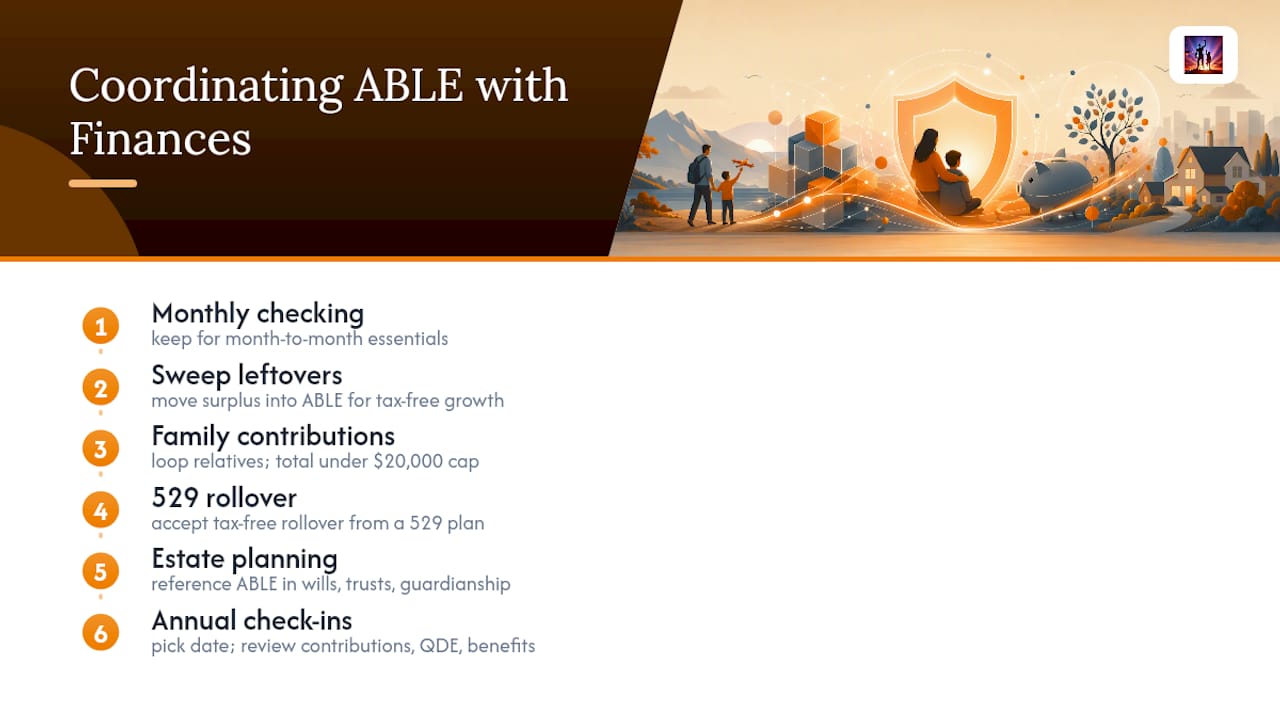
Coordination gets more important as the family grows or circumstances change. If grandparents or other relatives want to contribute, loop them in early so total annual contributions from every source stay under the $20,000 cap. If you're also managing a 529 college savings plan for siblings, remember that ABLE accounts can accept a tax-free rollover from a 529 plan, which matters if a sibling's unused college funds could help their brother or sister instead.
Estate planning deserves a seat at this table too. Wills, guardianship designations, and special needs trusts should reference the ABLE account explicitly, so nothing conflicts when the beneficiary turns 18 or when a parent who serves as authorized legal representative is no longer able to manage the account. Families navigating the legal changes that hit at age 18 often discover that guardianship, representative payee status, and ABLE account management need to be reviewed together, not as separate errands.
Annual check-ins work well. Pick a date, maybe near tax season, and review contribution totals, remaining QDE budget, and whether any benefit redeterminations are coming up in the next twelve months.
Can You Change an ABLE Account's Beneficiary or Owner?
Yes, but the rules are narrower than many families expect. A designated beneficiary can be changed to a sibling only if that sibling also has a qualifying disability and is considered an "eligible individual" under the same age-of-onset and certification rules covering the original beneficiary. You cannot simply redirect an ABLE account to a family member without a disability, even with good intentions.
Changing who manages the account, as opposed to who benefits from it, is more common and more straightforward. If a parent who served as authorized legal representative can no longer manage the account, whether due to relocation, death, or a change in guardianship, a new representative payee, court-appointed guardian, or agent under power of attorney typically steps in. The beneficiary, per SSA's account rules, remains the legal owner throughout that transition; only signature authority changes hands.
Every state plan has its own paperwork for reporting a change in authorized representative, usually a form plus documentation proving the new person's legal standing, such as a guardianship order or power of attorney. Expect this to take longer than opening the account did. Some plans process representative changes within days; others take several weeks if courts or notarized documents are involved.
One detail families frequently miss: if the beneficiary turns 18 and gains legal capacity, or if a guardianship is later terminated, the account's control can shift again. Building a habit of reviewing who holds signature authority every year, alongside your broader financial check-in, catches these transitions before they become a scramble.
A Caregiver's Honest Take on ABLE Accounts
Raising a child with autism means constantly translating bureaucracy into decisions that actually help your family, and ABLE accounts are one of the rare tools where the translation is worth the effort. They won't fix a benefits system that still asks too much of exhausted parents, but they hand you a legal, tax-free way to save without fear of losing SSI over a birthday check from grandma.
Start small. Open the account, deposit what you can, even $25, and let it grow while you handle the rest of your coordination with a special needs trust or estate plan over time. Autism Victory App's state-specific resources and bilingual guides exist to help you take that next step without doing it alone.
— Ronnie Talent
This article is general information, not a substitute for advice from a qualified financial advisor. Consult a qualified financial professional about your own circumstances before acting on anything here.
Sources
POMS SI 01130.740 Achieving a Better Life Experience (ABLE) Accounts | SSA (POMS)
Spotlight on Achieving A Better Life Experience (ABLE) Accounts | SSA
ABLE accounts - Tax benefit for people with disabilities | IRS
Recommended