A Social Story is a short, individualized narrative that describes a social situation and teaches a child what to expect and how to respond. Below, we share copy-ready examples for common situations like dental visits, haircuts, and fire drills, plus editable templates and evidence on where this approach works best.
TL;DR:
A 2026 meta-analysis found a moderate overall effect of 0.743, with the strongest measured benefits among children ages 7 to 12.
Write about one situation, answer who, what, when, where, why, and how, and use mostly descriptive sentences with no more than two gentle coaching lines.
Read the story shortly before and after the event it describes, then repeat it daily or several times weekly and reduce frequency as behavior stabilizes.
A randomized trial found gains toward individualized goals and modest school cost reductions, but no broad improvement in general social responsiveness after six months.
Track one observable behavior, such as tolerating the dentist chair, and note anxiety or cooperation after each reading before revising confusing or upsetting wording.
Table of Contents
What is a social story and when to use one
Key features and Carol Gray's Social Story criteria to watch for
Six copy-ready social stories for common situations
Step-by-step: write and personalize a social story
How often to read social stories and how to track progress
Where to find templates and printable resources
Cultural considerations and adaptations in social stories
Social story examples for different ages
Why we built social story guidance into caregiver support
Try Autism Victory for guided, personalized story-building support
Sources
What is a social story and when to use one
Carol Gray developed the Social Story™ concept to help autistic children understand social situations through calm, literal, and reassuring description rather than direct instruction. The goal is comprehension, not compliance: a well-written story answers a child's unspoken questions about what will happen and why.
We find these stories useful in a wide range of everyday moments:
School transitions, like moving from recess to class or handling a substitute teacher.
Medical and dental visits, haircuts, and other routines that involve unfamiliar sensations.
New social interactions, such as meeting a teacher or joining a group activity.
Fire drills, assemblies, and other schedule disruptions.
Stories can take several formats: plain text, picture-based sequences, audio recordings for auditory learners, or longer "social articles" written for teens and adults who prefer more nuance.
Key features and Carol Gray's Social Story criteria to watch for
A story that follows Gray's original criteria tends to work better than one written on instinct alone. Four markers matter most:
Perspective and tone: Write in first or third person, using positive, literal language rather than sarcasm or vague phrasing.
Sentence balance: Favor descriptive sentences that explain what happens over directive sentences that tell the child what to do.
WH questions: Answer who, what, when, where, why, and how so the child isn't left guessing.
Tailoring: Match the reading level, add visuals, and weave in the child's own interests to hold attention.
Avoid second-person "you" statements when possible. Using "I" or the child's name instead keeps the tone non-accusatory and factually accurate, a pitfall many caregivers run into when they slip into instructional phrasing, according to clinical guidance from Nebraska's Autism Spectrum Disorders Network.
Pro Tip: Draft the descriptive sentences first, then go back and add only one or two gentle coaching lines. It's easier to stay literal when you're not trying to instruct and describe at the same time.
Six copy-ready social stories for common situations
Each story below runs four to eight lines. Swap in the child's name, add a photo where noted, and trim sentences that don't fit the specific routine.
School line. "Sometimes I wait in line before class starts. Other kids wait too. I can look at my shoes or hold my hands together. Waiting means class is about to begin. I can do this." Age 5 to 8. Add a photo of the actual hallway. Edit tip: name the exact spot where the child stands.
Dentist visit. "Today I go to the dentist. The dentist checks my teeth with a small mirror. It might feel a little strange, but it does not hurt for long. I can bring my favorite toy. When it's done, I get a sticker." Age 4 to 10. Add a photo of the dentist's office. Edit tip: name the specific dentist if the child has met them before.
Haircut. "I am going to get a haircut. The hairdresser uses scissors or clippers. I might feel hair falling on my shoulders. I can wear a cape to keep hair off my clothes. My hair will look neat when it's done." Age 3 to 9. Add a photo of the salon chair. Edit tip: mention a favorite show to watch during the cut.
Fire drill. "Sometimes a loud alarm rings at school. This means everyone walks outside calmly. My teacher tells me where to go. I can cover my ears if the sound bothers me. After a few minutes, we go back inside." Age 5 to 12. Add a photo of the drill meeting spot. Edit tip: rehearse the walking route once before the first real drill.
Cafeteria. "At lunchtime, I go to the cafeteria. I find my seat and open my lunch. Other kids are talking and eating too. It can be loud, and that's okay. When I'm done eating, I clean up my space." Age 6 to 11. Add a photo of the lunch table. Edit tip: note a quiet corner the child can request if needed.
Meeting a new teacher. "I have a new teacher this year. My teacher's name is on the board. My teacher wants to help me learn. I can ask questions when I don't understand. It's okay to feel a little unsure at first." Age 5 to 14. Add a photo of the teacher if available. Edit tip: include one shared interest the child and teacher have in common.
A 2026 meta-analysis of single-case studies found a moderate overall effect (Tau-U = 0.743) for Social Story interventions, with the strongest benefits showing up in school-aged children between 7 and 12. That age range lines up closely with several of the examples above.
Step-by-step: write and personalize a social story
Writing a story that actually works takes a bit more than filling in a template. Follow this sequence:
Pick one clear goal. Choose a single situation, then answer who, what, when, where, why, and how before writing a single sentence.
Draft mostly descriptive sentences. Describe what happens and why, then add one or two gentle coaching sentences at most.
Add visuals and personal details. Use the child's name, a favorite character, or a real photo of the setting, and keep the whole story short.
Trial it, then collect simple data. Track one target behavior (like tolerating the dentist chair for two minutes) and note anxiety or cooperation after each reading.
Revise based on what you observe. If a sentence seems confusing or upsetting, rewrite it in simpler, more literal terms.
Pro Tip: Keep a running note of which sentences got a reaction, good or bad. Small edits based on real responses matter more than getting the wording perfect on the first draft.
How often to read social stories and how to track progress
Frequency matters as much as content. Common school-based intervention schedules use repeated reads, often several times over a few weeks, though the exact pace should be adjusted to the child and the goal rather than copied rigidly.
Read the story shortly before the event it describes, then again afterward to reinforce what happened.
Repeat daily or several times a week during the early stage, then fade frequency once the behavior stabilizes.
Track progress simply: count how often the target behavior occurs, jot a quick anxiety rating, or ask a teacher for a short note.
Share the story and any data with school staff or a therapist when a behavior goal spans multiple settings.
A large school-based randomized controlled trial found that Social Stories helped children meet individualized goals and modestly reduced school costs, though it did not produce broad improvements in general social responsiveness after six months. That finding matters for how we set expectations: this tool works best aimed at one specific, measurable goal rather than as a general social skills fix.
Where to find templates and printable resources
Three template types cover most needs. A plain-text Word document works well for quick edits and printing. A picture-story template, built around a simple photo-and-caption layout, suits younger children or those with limited reading skills. An audio script format helps children who process spoken language better than text.
Personalize any template in minutes: swap in the child's name, add one or two real photos, and trim unused sentences.
Pair a new story with a visual schedule so the routine and the explanation reinforce each other.
Store finished stories in a labeled folder or app so they're ready to reuse the next time the same situation comes up.
Cultural considerations and adaptations in social stories
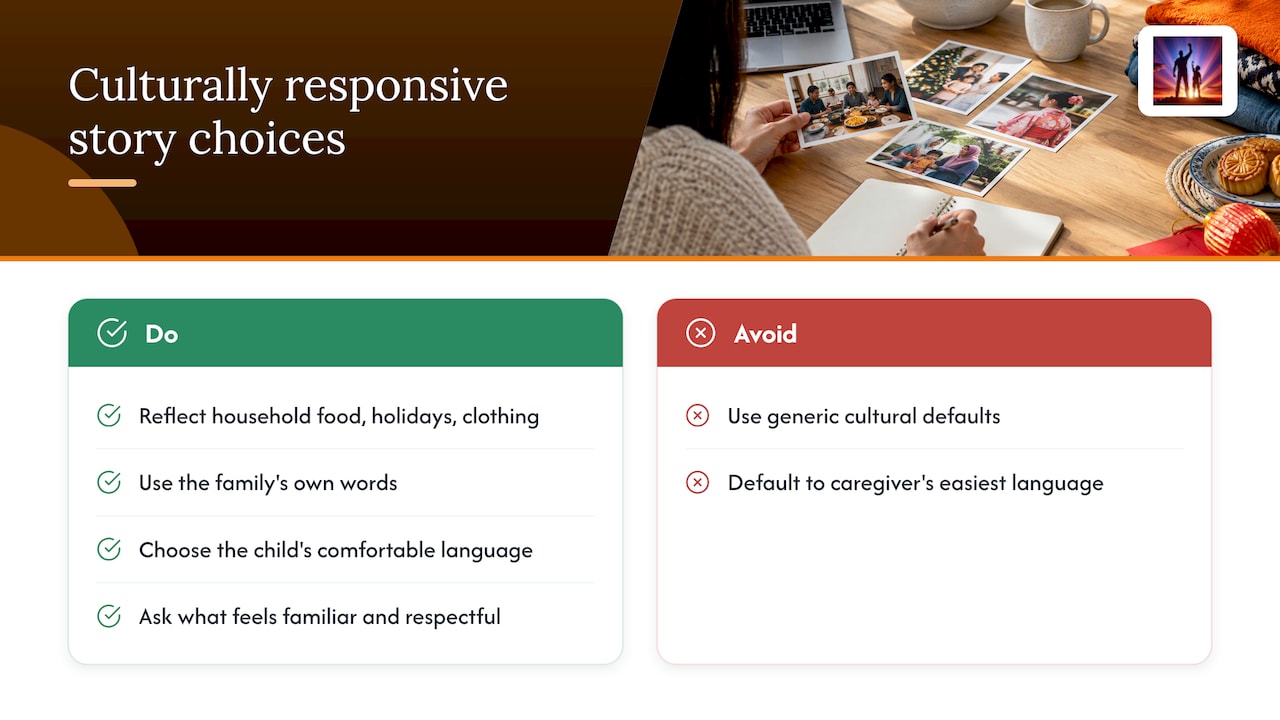
A story only works if the child and family recognize themselves in it. Food references, holiday examples, clothing descriptions, and even the words used for family members should reflect the household's own background rather than a generic default. A story about "going to grandma's house for dinner" means something different depending on who actually sits at that table and what gets served.
Religious and cultural practices around routines like haircuts, medical visits, or holidays can also shape how a story should read. A haircut story written for a family with specific grooming or head-covering customs needs different sentences than a generic version. Language matters too: a bilingual household may benefit from a story written in both languages, or from choosing the language the child processes most comfortably in that context, rather than defaulting to whichever language the caregiver finds easiest to write in.
Individualization tied to the child's own interests and sensory preferences is one of the strongest predictors of how well a story lands, according to adaptation guidance from Sheffield Children's NHS Foundation Trust. Cultural relevance is part of that individualization, not a separate add-on. Asking a child or family what feels familiar, respectful, and accurate before finalizing a story is a small step that meaningfully improves how well it's received.
Social story examples for different ages
A toddler's story stays extremely short, often three or four sentences with one picture per page and large, simple text. "I wash my hands. Water feels warm. Soap makes bubbles. My hands are clean." The goal at this age is recognition and repetition, not detailed explanation.

A school-age story, like most of the examples earlier in this piece, can handle five to eight sentences and a bit more nuance, including a simple coping strategy ("I can cover my ears" or "I can ask for a break"). This is also the age range where the strongest measured benefits appear, which makes consistent use especially worthwhile.
A teen's version, sometimes called a social article, reads more like a short reflective paragraph than a picture book. It can explore why a situation feels uncomfortable, acknowledge mixed feelings honestly, and offer a few options rather than one fixed response. For example: "Group projects can feel stressful because grades depend on other people. Some students work well together right away. Others need more time to figure out roles. It's okay to ask the teacher for a specific role if group work feels unclear." Teens often respond better when they help co-write the story rather than receiving it fully finished.
Why we built social story guidance into caregiver support
We created our resources because caregivers need more than a blank template. Personalized AI guidance, state-specific support navigation, and bilingual books and videos all exist to help families build the kind of individualized tools that actually fit their child, not a one-size version.
— Ronnie Talent
Try Autism Victory for guided, personalized story-building support
Writing a Social Story that truly fits your child takes time, and we built our app to make that process lighter. We offer personalized AI guidance, resources, and caregiver content designed to support individualized story-building alongside tools like the templates above.
Explore everything available on our resources and support page, or see current plans on our pricing page to start a free trial.
This article is general information, not a substitute for advice from a qualified doctor. Consult a qualified healthcare professional about your own circumstances before acting on anything here.
FAQ
What is a social story for a child?
A Social Story is a short, individualized narrative that describes a specific social situation, answers a child's likely questions about it, and uses calm, literal language to reduce uncertainty. It's typically written for one child's exact situation rather than used as a generic script.
What is the 6 second rule in autism?
There isn't an established "6 second rule" tied to autism in clinical or educational guidance, and definitions of this phrase vary widely online. If you've encountered it in a specific program or therapy context, it's worth asking that provider directly what it refers to.
How often should I read a social story to my child?
Many school-based programs read a story repeatedly over several weeks, often shortly before the event it describes and again afterward, then fade frequency as the behavior stabilizes. The right pace depends on the child and the specific goal, so HeadStart guidance recommends pairing repeated use with simple monitoring rather than following a fixed schedule.
Do social stories actually work for autism?
Research shows a moderate overall effect for Social Story interventions, with the strongest benefits in children ages 7 to 12, and a separate randomized trial found they help children meet individualized goals more reliably than they improve broad social skills. They work best aimed at one specific, measurable behavior rather than used as a general social skills fix.
What age groups benefit most from social stories?
School-age children, roughly ages 7 to 12, show the strongest measured benefits in current research, though the format adapts well to toddlers with simplified picture versions and to teens through longer, more reflective social articles. The right format depends more on reading level and personal interest than on age alone.
Sources
Recommended