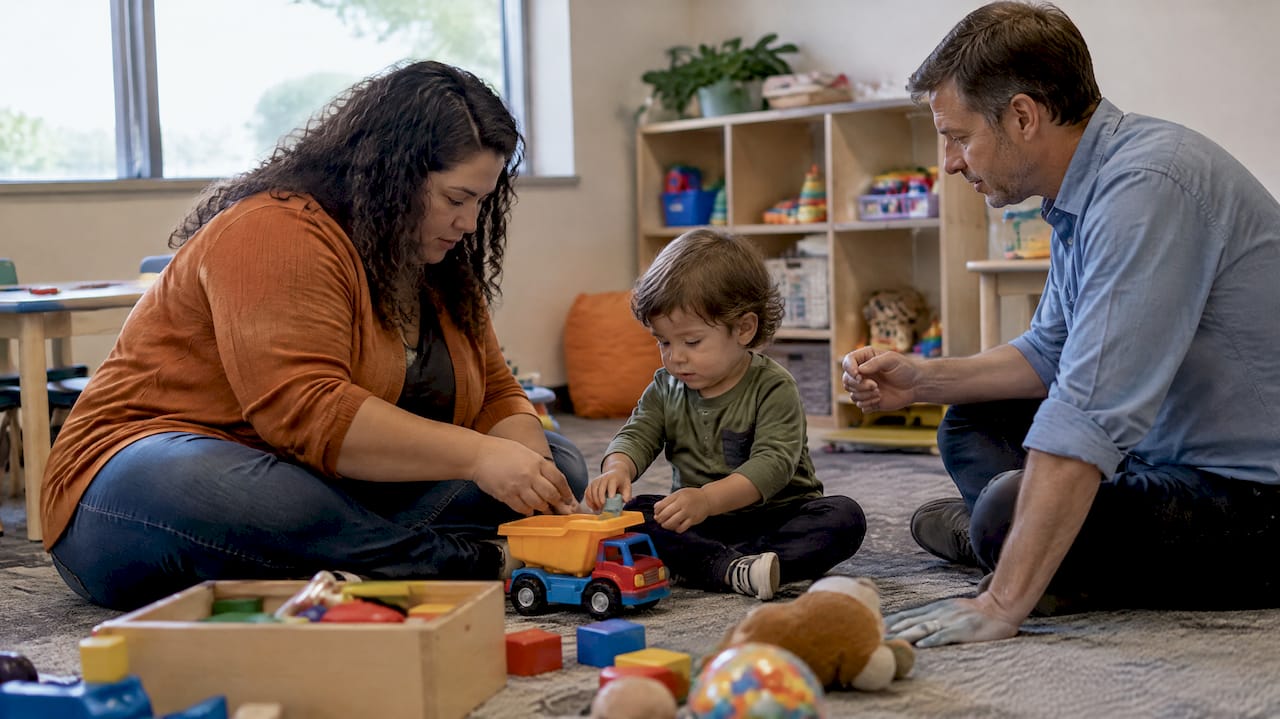
Naturalistic developmental behavioral intervention, or NDBI, blends developmental science with behavioral teaching methods, using everyday play and routines instead of isolated drills. Research supports real gains in early social communication and language for young autistic children when these methods are used consistently and with fidelity. Several well-known, evidence-based models follow NDBI principles, and most lean on caregivers as active partners in delivery, not just observers.
TL;DR:
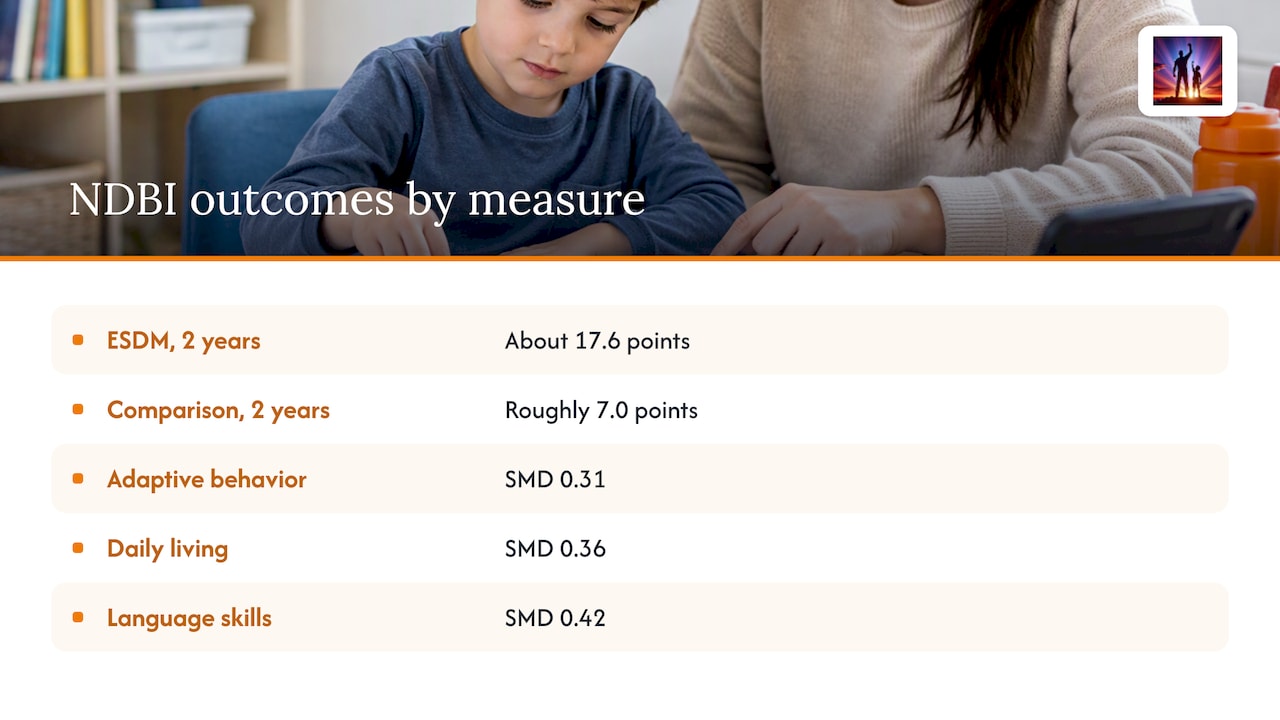
A meta-analysis found standardized mean differences favoring NDBI of 0.31 for adaptive behavior, 0.36 for daily living skills, and 0.42 for language outcomes.
Over two years, toddlers receiving ESDM gained about 17.6 standard score points on cognitive and adaptive measures, versus roughly 7.0 in the comparison group.
When vetting providers, ask whether they measure fidelity, coach caregivers directly, and document goals tied to routines; hours alone are a poor guide.
Choose ESDM for broader developmental coverage, JASPER or RIT for focused skills, or Project ImPACT when parent coaching is the main delivery approach.
Begin with five to ten minutes of play that follows your child's lead, model one or two words, and practice in one routine consistently.
Table of Contents
What NDBI Looks Like in Everyday Practice
What the Research Says About NDBI Outcomes
Common NDBI Models You'll Encounter
How Caregivers Get Coached, and Where to Start at Home
Where and How NDBI Services Are Delivered
How to Check If an NDBI Program Is Delivered With Fidelity
What Actually Matters When Vetting an NDBI Program
Learning NDBI Strategies Alongside Professional Support
Sources
What NDBI Looks Like in Everyday Practice
NDBI is not one program. It is a family of approaches built around a shared set of techniques that show up across different names and settings. The common elements that define NDBI are what separate it from older, more rigid behavioral drills.
In practice, these elements include:
Following the child's lead, using whatever they are already interested in as the starting point for teaching.
Staying face-to-face so the child can see expressions, gestures, and mouth movements during language modeling.
Relying on natural contingencies, where the reward connects logically to the action (reaching for a cup leads to getting a drink, not a token).
Creating communicative temptations, like pausing a favorite activity so the child has a reason to request more.
Using short, paced teaching episodes that keep the child engaged rather than overwhelmed.
A typical moment might look like this: a child reaches for bubbles, and instead of handing them over immediately, we wait, model the word "bubbles," and let the child's attempt (a sound, a gesture, a word) open the bottle. The teaching happens inside the fun, not after it.
What the Research Says About NDBI Outcomes
The evidence base for NDBI has grown substantially, and it points in a consistent direction. A recent meta-analysis found standardized mean differences favoring NDBI approaches across several domains, with effects around 0.31 for adaptive behavior, 0.36 for daily living skills, and 0.42 for language skills.
One of the most cited trials in this field is the Early Start Denver Model randomized controlled trial, which found that toddlers receiving ESDM improved by an average of about 17.6 standard score points on cognitive and adaptive measures over two years, compared to roughly 7.0 points in the comparison group. That gap matters because it reflects functional change, not just statistical movement.
These numbers come with real caveats. Studies vary in quality, sample size, and how closely therapists and parents stuck to the intended model. Several reviews note inconsistent reporting and risk-of-bias concerns across the literature, which is part of why fidelity, how closely a program matches the model as designed, matters as much as hours logged. When you are evaluating a program, ask whether fidelity is tracked at all. If it is not, the research behind the model may not translate to what your child actually receives.
Common NDBI Models You'll Encounter
Different programs use different names, but most share the same backbone. Here is a quick guide to the ones families run into most often:
Early Start Denver Model (ESDM): a comprehensive, play-based program for toddlers and preschoolers, often delivered by trained therapists with caregiver involvement.
Pivotal Response Treatment (PRT): targets pivotal skills like motivation and self-initiation, which can create ripple effects across other areas.
Project ImPACT: built specifically around coaching parents to use NDBI techniques during daily routines.
JASPER: a focused model centered on joint attention, symbolic play, and engagement.
SCERTS: addresses social communication, emotional regulation, and transactional support across settings.
Reciprocal Imitation Training (RIT): a focused approach using imitation to build social engagement.
Enhanced Milieu Teaching (EMT): embeds language teaching into natural interactions and play.
ESDM tends to be comprehensive, covering multiple developmental domains, while JASPER and RIT are more focused, targeting specific skills. ImPACT leans heavily on parent coaching as its delivery method. Despite the different names, all of them draw from the same core NDBI elements covered above.
How Caregivers Get Coached, and Where to Start at Home
Caregiver coaching is central to most NDBI models, not an add-on. A typical coaching relationship includes a therapist modeling a technique, watching the caregiver try it, giving feedback in real time, and sometimes reviewing video afterward to spot small adjustments. Goals are usually tied to routines your family already has, like mealtime or bedtime, rather than abstract milestones.
If you want to start practicing NDBI-informed strategies now, try this:
Set aside 5 to 10 minutes to follow your child's lead completely, letting them choose the activity.
Model simple language tied to what your child is doing, one or two words at a time.
Let natural consequences play out, so the response to a request matches the request itself.
Work with a therapist to set one functional, routine-based goal rather than several abstract ones.
Pro Tip: Pick one routine, like a favorite book or snack time, and practice there consistently before expanding to others. Pacing teaching episodes so your child stays engaged matters more than covering more ground.
For more structured home routines, our guide to building communication at home walks through short daily practices that pair naturally with this kind of coaching.
Where and How NDBI Services Are Delivered
NDBI shows up in several settings, and the right fit depends on your child's needs and what is accessible to your family.
Home-based services, where a therapist or coach works directly in your child's everyday environment.
Clinic or center-based programs, offering more structured, therapist-led sessions.
School-integrated services, blending NDBI techniques into classroom routines.
Telehealth parent coaching, which has expanded access for families without nearby specialists, as noted in implementation reviews.
Intensity ranges widely, from parent coaching modules delivered in weekly sessions to therapist-delivered comprehensive programs running many hours a week. Outcomes track more closely with how faithfully the model is followed than with raw hours alone. NDBI is typically delivered by trained therapists, BCBAs with NDBI-specific training, or speech and occupational therapists working alongside behavioral staff, with caregivers often serving as primary interventionists in parent-mediated formats. For a closer look at one focused model, our piece on Pivotal Response Treatment covers what to ask providers before starting.
How to Check If an NDBI Program Is Delivered With Fidelity
Fidelity, how closely a program sticks to its intended techniques, is measurable, not just a vague quality signal. The NDBI‑Fi observational checklist was developed specifically to rate common elements like following the child's lead and the quality of teaching episodes across different NDBI models.
As a parent or professional, you can watch for signs of fidelity directly:
Are sessions conducted face-to-face, at your child's physical level?
Is the adult genuinely following your child's interest, or redirecting constantly?
Are you, as the caregiver, receiving real coaching and feedback, not just updates?
Is progress tracked with documented goals and reviewed regularly, rather than informally?
What Actually Matters When Vetting an NDBI Program
We think the biggest mistake families make is judging a program by hours instead of fit. Functional goals tied to your daily routines matter more than a packed schedule. Insist on parent coaching, visible progress tracking, and a clear plan for generalizing skills beyond the therapy room.
— Ronnie Talent
Learning NDBI Strategies Alongside Professional Support
We built Autism Victory because caregivers need somewhere to learn these strategies between sessions, not just during them. Inside the app, you'll find caregiver-focused guides, short instructional videos, and AI-powered support for planning routines like the ones described above, alongside a state-specific resource navigator for funding and services.
What you get | Format |
|---|---|
Caregiver guides and books (EN/ES) | In-app library |
Routine and coaching support | AI guidance |
Funding and services lookup | State-specific navigator |
Calming activities for transitions | Audio library |
We see the app as a companion to licensed therapy and parent training, never a replacement for a qualified clinician. If your child benefits from calming routines between NDBI sessions, pairing app resources with activities like children's mindfulness exercises can support attention and regulation. Explore our resources with a 5-day free trial, then choose the Annual plan at $49.95 per year or Monthly at $6.95 per month to keep full access.
This article is general information, not a substitute for advice from a qualified doctor. Consult a qualified healthcare professional about your own circumstances before acting on anything here.
FAQ
What is NDBI in ABA?
NDBI stands for naturalistic developmental behavioral intervention, a family of approaches that blend behavioral teaching principles with developmental science inside natural play and routines. Unlike traditional, table-based ABA drills, NDBI embeds teaching into child-led activities, using common elements like following the child's lead and natural consequences.
Can developmental interventions change behavior patterns in autism?
Research on NDBI-style interventions shows positive effects on social communication, language, and adaptive behavior when delivered with fidelity. A meta-analysis found standardized mean differences around 0.31 to 0.42 favoring these approaches across adaptive behavior, daily living skills, and language outcomes.
Is there a connection between autism and biting?
Biting in young autistic children is often a form of communication or sensory regulation rather than aggression, and it typically responds to the same kind of functional, routine-based strategies used in NDBI. A therapist trained in naturalistic methods can help identify what need the behavior is meeting and teach a replacement skill within daily routines.
What newer approaches are being studied for autism spectrum disorder?
Current research continues to refine NDBI delivery, including parent-mediated formats and telehealth coaching that expand access beyond clinic settings. Studies also continue developing fidelity tools like the NDBI‑Fi checklist to make sure these methods are implemented as intended.
At what age does NDBI work best?
NDBI methods are most studied and most commonly used with toddlers and preschool-age children, generally during a period of rapid language and social development. Some focused models, like JASPER and RIT, are also used with slightly older children depending on their developmental profile.
Sources
Recommended