An FBA figures out why a behavior happens: a BIP is the plan built from those findings. The FBA comes first, the BIP follows, and under federal special education law, both can become part of your child's IEP once the school determines behavior is getting in the way of learning.
TL;DR:
A credible FBA defines observable behavior, records ABC patterns across multiple settings and days, and ties its function hypothesis to raw observation notes.
If the FBA identifies escape as the function, the BIP should teach an appropriate break request while addressing prevention, reinforcement, responses, and data collection.
After a disciplinary manifestation determination, federal rules require the IEP team to conduct or review an FBA and implement or revise a BIP.
The first BIP review commonly occurs four to 12 weeks after implementation; teams should use predefined benchmarks, not general impressions, to judge progress.
When an FBA is part of an initial evaluation or reevaluation, the school needs written consent; classroom intervention assessments may not.
Table of Contents
What an FBA Is and What It Includes
What a BIP Is and What It Must Contain
How FBA and BIP Connect to the IEP and Federal Law
Who Conducts FBAs and BIPs, and How to Request One
How Long It Takes and How Progress Gets Tracked
How to Participate Effectively in FBA and BIP Meetings
How Autism Victory Supports Families Preparing for These Meetings
A Parent's Perspective on Advocating Through This Process
Get Support Preparing for Your Next IEP Meeting
Sources
What an FBA Is and What It Includes
A Functional Behavioral Assessment exists to answer one question: why is this behavior happening? Schools look at four common functions: getting attention, escaping a demand, seeking sensory input, or gaining access to something desired. Without that answer, any intervention the school tries is really just a guess.
A thorough FBA follows a sequence. The team defines the behavior in specific, observable terms (not "acts out," but "leaves seat and throws materials for more than 30 seconds"). Then comes direct observation using an ABC format, antecedent, behavior, consequence, to track what happens right before and right after the behavior shows up. Interviews with teachers and parents, plus rating scales, round out the picture. All of that data gets summarized into a hypothesis about the behavior's function.
In most districts, a school psychologist, a board-certified behavior analyst (BCBA), or a trained behavior specialist conducts the assessment. The U.S. Department of Education's guidance on FBAs frames FBAs as a proactive tool for any student whose behavior interferes with learning, not only a reaction to a crisis or a disciplinary incident.
A few signs the assessment is solid:
The behavior is defined clearly enough that two different observers would agree on what counts.
Observation data comes from more than one setting and more than one day.
The final function statement connects directly to the data collected, not just a guess based on one bad afternoon.
Pro Tip: Ask to see the raw observation notes, not just the summary page. If the notes are thin, the function statement built on them probably is too.
What a BIP Is and What It Must Contain
A Behavior Intervention Plan takes the FBA's answer to "why" and turns it into a daily plan for "what now." A well-built BIP has five working parts: prevention strategies that reduce triggers before they happen, replacement behaviors the child is explicitly taught, a reinforcement plan for using those new skills, a response plan for when the behavior still occurs, and a data collection method so the team can tell if any of it is working.
Each piece should trace back to the function identified in the FBA. If the FBA found the behavior serves an escape function, the BIP should teach the child an appropriate way to ask for a break, not just reward quiet sitting. A plan that does not map to the function is, in effect, untested guesswork rather than evidence-based support.
Peer-reviewed research on school-based FBAs and BIPs has found that many plans show weak technical adequacy, often from vague behavior definitions or a loose connection between the stated function and the strategies chosen. That is worth knowing walking into a meeting: a plan that sounds thorough is not automatically a plan that was built correctly.
The implementation details matter as much as the strategies themselves:
The plan should name who teaches the replacement skill and who tracks the data.
There should be a fidelity check, some way to confirm staff are actually following the plan as written.
Review points should be scheduled in advance, not left open-ended.
A BIP is not a behavior contract listing consequences for infractions. Experts in student behavior management stress that a plan built around punishment rather than skill-building misses the point of the assessment that came before it. If home practice would help reinforce a new skill, strategies like visual schedules can extend what the BIP teaches at school into daily routines at home.
How FBA and BIP Connect to the IEP and Federal Law
Federal regulation 34 C.F.R. § 300.530 requires the IEP team to conduct or review an FBA, and implement or revise a BIP, whenever a student's behavior is determined to be a manifestation of their disability following certain disciplinary removals. That same rule sets specific review steps the team has to follow once that determination is made.
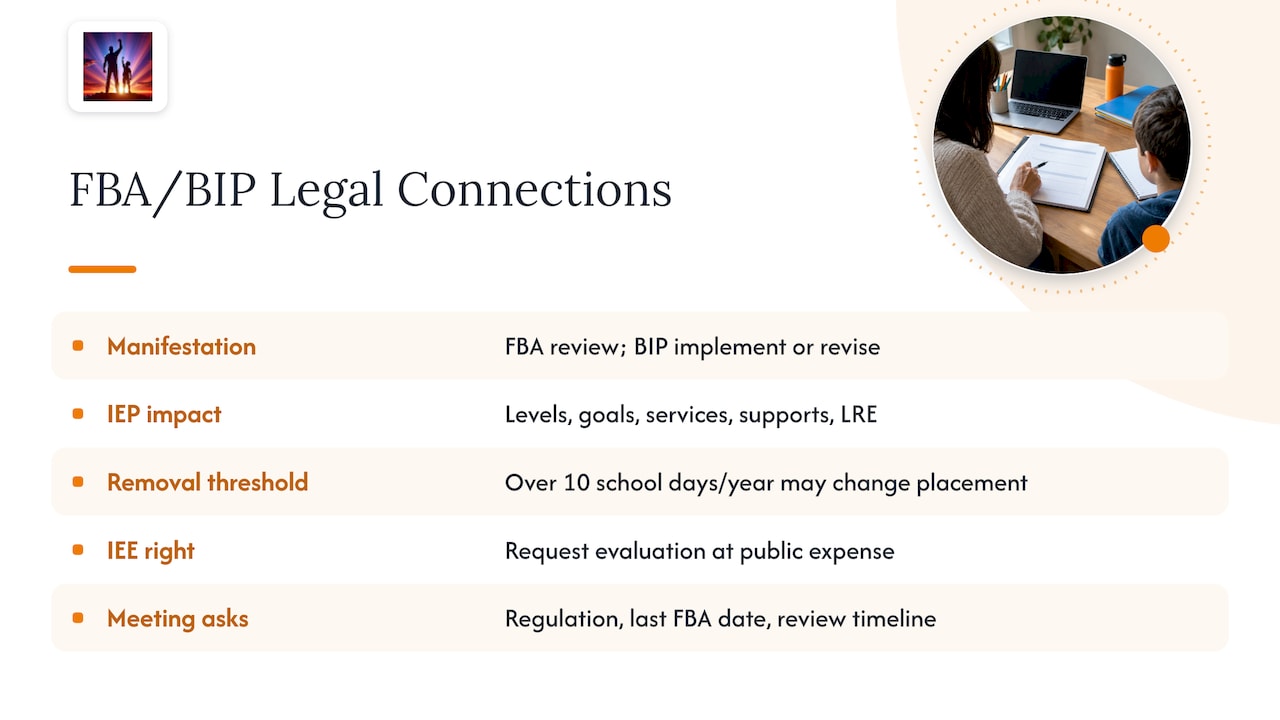
Outside of discipline, FBA and BIP findings feed directly into the IEP itself. They shape the Present Levels of Performance section, help write measurable behavior goals, determine what services and supports the child receives, and factor into decisions about the Least Restrictive Environment, meaning whether behavior supports can be delivered in the general education classroom or require a more restrictive setting.
Discipline timelines matter here too. A string of short disciplinary removals that adds up to more than 10 school days in a year can be treated as a change of placement, which triggers a manifestation determination review and, often, a fresh look at the FBA and BIP. Parents also have procedural rights worth knowing, including the right to request an independent educational evaluation (IEE) at public expense if they disagree with the school's assessment, a safeguard confirmed in IDEA guidance.
When behavior is found to be a manifestation of disability, the IEP team must conduct or review an FBA and BIP, and in many cases return the child to the prior placement or revise the plan.
At the meeting table, ask for the specific regulation the school is applying, the date of the last FBA, and a written timeline for the next BIP review. Those three questions put the conversation on the record.
Who Conducts FBAs and BIPs, and How to Request One
Most FBAs are led by a school psychologist, a BCBA, or a district behavior specialist, often working alongside the special education teacher who knows the child's day-to-day patterns. It is reasonable to ask what credential the lead evaluator holds and how many FBAs they have conducted for students with similar needs.
If you want to request an FBA or BIP, here is how that usually works:
Put the request in writing, by email or letter, addressed to the IEP case manager or special education director.
Describe specifically what you are seeing at home or hearing about from school, with dates if possible.
Ask for a written response and a timeline for the evaluation.
Consent rules differ depending on the purpose. When an FBA is part of an initial evaluation or reevaluation, the school needs your written consent first, under IDEA's evaluation requirements. An FBA used only to guide classroom intervention, without being folded into a formal evaluation, may not require that same consent step, which is a distinction worth clarifying up front so you know which process you are in.
How Long It Takes and How Progress Gets Tracked
FBAs typically take several weeks to complete once consent is given, since the process requires multiple observation sessions across different settings and times of day. A first BIP review commonly happens somewhere between four and 12 weeks after the plan starts, though the exact window depends on how often the behavior occurs and how urgent the concern is.
Expect the team to track more than one kind of data:
Frequency and duration, how often the behavior happens and how long each episode lasts.
ABC sequences, the antecedent and consequence surrounding each incident.
Task engagement, how much instructional time the child is actually participating in.
Progress reviews should be anchored to predefined benchmarks set when the plan was written, not a general impression of "doing better." If the data is not improving by the agreed review date, that is the moment to ask for a revision, not a reason to wait another quarter and see.
How to Participate Effectively in FBA and BIP Meetings
Walking into these meetings prepared changes what you walk out with. Use this sequence:
Before the meeting, ask for the FBA data summary and the proposed function statement in writing, so you can read it before discussing it.
During the meeting, ask how each BIP strategy connects to that specific function, and ask for the measurable goal tied to each one.
After the meeting, request the implementation schedule, who teaches what and when, and a named contact for fidelity checks.
Keep copies of the data summaries, the signed BIP, and any email agreements. If you disagree with the assessment or the plan, you can request an independent educational evaluation, pursue mediation, or file for procedural safeguards, options worth researching further rather than letting disagreement sit unresolved.
Pro Tip: Bring a one-page list of your own observations from home to every meeting. It gives the team real data points they would not otherwise have.
How Autism Victory Supports Families Preparing for These Meetings
We built our state-specific guides, meeting checklists, and bilingual (English and Spanish) resources around exactly this kind of preparation. Inside the app, our AI guidance can help you organize observation notes and draft meeting questions before you sit down with the IEP team, turning the steps above into something you can act on the same week.
A Parent's Perspective on Advocating Through This Process
Walking into an FBA or BIP meeting as a parent can feel like stepping into a language you were never taught. You do not need to master the jargon. You need the data summary, the function statement, and a goal you can measure. Ask for all three, every time, and keep your own notes alongside the school's.
— Ronnie Talent
Get Support Preparing for Your Next IEP Meeting
Reading about FBAs and BIPs is one thing. Walking into a meeting with the right questions and documents ready is another. Our app puts state-specific funding and support guides, meeting checklists, and bilingual educational content in one place, so you are not piecing this together alone the night before.
Inside the app, you get:
State-by-state guides to funding and support programs relevant to your child's services.
Printable-style checklists for FBA and BIP meetings.
Bilingual (English and Spanish) educational videos and audiobooks.
Unlimited AI guidance for drafting questions and tracking progress between meetings.
A 5-day free trial gives you time to try all of it before committing. Plans run $6.95 a month or $49.95 a year on our pricing page.
This article is general information, not a substitute for advice from a qualified lawyer. Consult a qualified legal professional about your own circumstances before acting on anything here.
FAQ
Are an FBA and a BIP the same thing?
No. An FBA is the assessment process that identifies why a behavior is happening, while a BIP is the written plan built from those findings to teach replacement skills and reduce the behavior. One cannot meaningfully exist without the other coming first.
Can a child have a BIP without an IEP?
Yes, a BIP can exist as part of a general education behavior support plan without a full IEP, though it is more commonly tied to one. If you are unsure which document fits your child's situation, our guide comparing 504 plans and IEPs breaks down the differences.
Which comes first, the FBA or the BIP?
The FBA always comes first. A BIP written without a completed FBA is built on assumptions rather than data, which runs against the sequence IDEA guidance describes for developing effective behavior supports.
Is a BIP considered a Tier 3 intervention?
A BIP is often associated with Tier 3 in a multi-tiered system of support, since it targets an individual student with intensive, personalized strategies rather than classroom-wide approaches. That said, the tier label matters less than whether the plan is built from a solid FBA and tracked with real data.
Sources
Using Functional Behavioral Assessments to Create Supportive Learning Environments (IDEA)
34 C.F.R. § 300.530 - Authority of school personnel (LII / Cornell)
Recommended