
A denial is not the end of the road. File a written request for reconsideration right away, mark your calendar with the required appeal deadline (SSA counts it as received several days after the notice date, so allow some extra days), and start gathering the medical and school records that show how autism limits your child's daily functioning. A large share of initial child SSI applications get denied, and most of those denials get overturned once real evidence is on the table.
TL;DR:
Most initial SSI denials for children with autism occur due to insufficient documentation linking diagnosis to functional limits or technical errors like missed exams, not because autism doesn't qualify.
Filing promptly within 65 days of the denial notice is crucial, as missing deadlines often requires starting a new application rather than appealing further.
The reconsideration phase provides an opportunity to submit new evidence, such as updated IEPs, therapy notes, or detailed behavioral logs, which significantly improves chances of approval.
The ALJ hearing stage offers the highest likelihood of overturning a denial, especially when caregivers prepare detailed daily summaries and secure recent medical and school records.
Using organized record-keeping tools, such as caregiver apps, can strengthen appeals by consolidating evidence and tracking deadlines efficiently.
Table of Contents
What Should You Do First After an SSI Denial for Your Autistic Child?
The Appeals Process Explained: Reconsideration, ALJ Hearing, Appeals Council, and Federal Court
How to Strengthen Your Appeal: Documents and Statements That Matter
How a caregiver support app can help you stay organized through the appeal
What Should You Do First After an SSI Denial for Your Autistic Child?
The first two weeks after a denial letter arrives set the tone for everything that follows. Move through this checklist in order, and don't let any single step wait more than a few days.
Read the denial letter fully. It states the specific reason for denial (medical, financial, or procedural) and the exact date SSA mailed it. That date starts your clock.
Confirm your deadline. You have 60 days from the notice date, and SSA assumes you got it 5 days after mailing, so give yourself an effective 65-day window rather than cutting it close.
File your Request for Reconsideration. Use Form SSA-561, file online through your My Social Security account, call your local field office, or visit in person. Attach a short note explaining what's changed or what evidence was missing.
Request the full case file. Ask SSA for the file used to make the decision, including any consultative examination (CE) report, so you know exactly what a reviewer saw and didn't see.
Respond to every SSA request without delay, especially anything about a scheduled CE appointment.
Start pulling records now, not later:
Current Individualized Education Program (IEP) and any recent evaluations
Therapy notes from speech, occupational, or behavioral therapy
A dated log of meltdowns, safety incidents, or missed milestones at home
The Appeals Process Explained: Reconsideration, ALJ Hearing, Appeals Council, and Federal Court
SSA's appeals structure has four levels, and each one has its own rules, timeline, and realistic odds. Understanding what each stage can and can't do saves you from wasted effort and missed opportunities.
Reconsideration: a fresh set of eyes
Reconsideration sends your file to a different examiner at your state's Disability Determination Services (DDS) office, the same agency that reviewed your original application. This isn't a rubber stamp of the first decision. It's a full review, which is exactly why new evidence matters here. If your child's therapist wrote a new report since the initial denial, or the school updated the IEP with fresh behavioral data, this is the moment to submit it. Processing typically takes a few months, though timelines vary by state workload.
The ALJ hearing: your best real shot
If reconsideration also results in denial, the next step is requesting a hearing before an Administrative Law Judge (ALJ) using Form HA-501. This is where cases most often turn around. ALJ hearing-level decisions carry notably higher allowance rates than initial determinations or reconsideration, largely because it's the first stage where a caregiver can testify directly and put the child's daily reality into context that a paper file can't capture on its own.
Prepare for the hearing like it matters, because it does:
Bring a written summary of a typical day, including meltdowns, sensory triggers, and communication struggles.
Ask your child's teacher or therapist if they're willing to submit a letter or testify by phone.
Update medical and school records so the ALJ sees the most current picture, not a snapshot from a year ago.
Rehearse specific, concrete answers ("He cannot follow a two-step instruction without repetition" beats "He struggles sometimes").
Pro Tip: Judges respond to frequency and specificity, not adjectives. "Three or four meltdowns a week lasting 20 minutes" carries far more weight than "frequent meltdowns."
Appeals Council: a narrower door
If the ALJ denies the claim, you can request review from the Appeals Council using Form HA-520. The Council doesn't reweigh evidence like the ALJ did. It checks whether the judge made a legal or procedural error, or whether the decision runs contrary to the weight of the evidence. It can deny review, send the case back to the ALJ for another look, or in rare cases decide it directly. This stage helps a smaller share of families than reconsideration or the hearing.
Federal court: the last resort
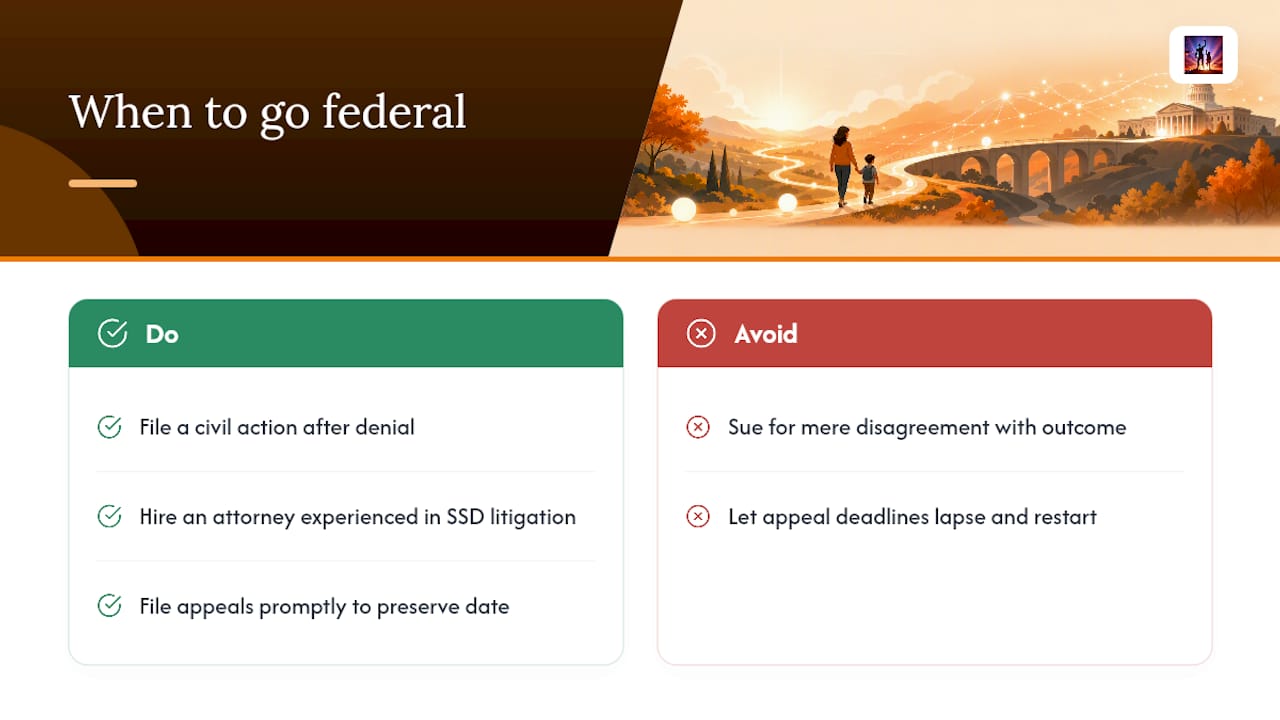
If the Appeals Council denies review or upholds the denial, you can file a civil action in U.S. District Court. This step involves formal legal procedure and almost always requires an attorney experienced in Social Security disability litigation. It's appropriate when there's a genuine legal error in how the case was handled, not simply a disagreement with the outcome.
Filing each appeal promptly, rather than letting the deadline lapse and restarting from scratch, can also preserve your original filing date and any retroactive benefits tied to it.
How to Strengthen Your Appeal: Documents and Statements That Matter
Insufficient documentation linking the autism diagnosis to actual functional limits is one of the most common reasons appeals stall. A diagnosis on paper tells SSA what condition your child has. It doesn't tell them what your child can't do because of it, and that gap is where strong evidence closes the case.
Medical provider statements should connect the diagnosis to specific daily limits: communication, self-care, social interaction, behavior regulation. A statement that says "diagnosed with autism spectrum disorder" does far less work than one that says "unable to communicate needs verbally in unfamiliar settings."
School records carry real weight. Submit the current IEP, any completed Teacher Questionnaire (Form SSA-5665), and attendance or discipline records tied to behavioral episodes.
Therapy notes and standardized assessments, including ADOS or ADI-R results, give reviewers objective measures rather than parental description alone.
Dated behavior logs kept by caregivers add a home-life dimension that clinical and school records sometimes miss.
When asking a therapist or teacher for a statement, ask them to describe frequency and severity in plain terms. "How often" and "under what conditions" matter more to reviewers than clinical labels.
If SSA schedules a consultative examination, attend it. A missed CE without good cause is a frequent, avoidable cause of denial. Bring existing records to the appointment, and bring a short written note describing your child's most difficult days, since a CE is often a single snapshot and won't capture variability on its own.

Pro Tip: If travel to a CE appointment is a hardship, ask about assistance. SSA can help cover some travel costs for scheduled exams under certain circumstances.
Timelines, Odds, and the Technical Reasons Denials Happen
Roughly two out of three initial child SSI applications get denied, according to SSA's own program data. That number alone should tell you something: a denial reflects how the initial paperwork was reviewed, not a verdict on whether your child genuinely qualifies.
By the Numbers: About two-thirds of initial child SSI applications are denied, yet ALJ hearing-level decisions carry meaningfully higher allowance rates than the initial stage or reconsideration.
Reconsideration decisions often take a few months; ALJ hearings can take considerably longer given hearing backlogs in many regions. Watch for technical denials that have nothing to do with medical eligibility: missed deadlines, incomplete income and resource paperwork (SSI has strict financial limits, sometimes affected by parental "deeming"), or a missed CE appointment. These are avoidable, and they're some of the easiest wins on appeal once corrected.
Free and Low-Cost Help: Who Can Represent You
You don't need to pay upfront to get real help. SSA maintains a directory of authorized representatives, and fees for attorneys and non-attorney representatives are capped and typically paid only from back benefits if you win, not out of pocket in advance.
Call SSA at 1-800-772-1213 (TTY 1-800-325-0778) to reach your local field office directly.
Legal aid organizations and disability advocacy nonprofits often take cases for free, especially once you reach the ALJ hearing stage.
Your local field office can help you obtain missing documents needed to support eligibility.
Be cautious of any commercial service demanding payment before your case is even filed. Reputable representatives work on contingency, not upfront fees.
Treat the Appeal as Record-Building
Every appeal is really a paper trail, and the families who do best treat it that way. Keep a physical calendar for every SSA deadline and every piece of mail that arrives. Ask providers for statements that name what your child cannot do and how often, not general descriptions. Coordinate with school staff early so forms like the SSA-5665 come back complete and on time, not rushed the week they're due.
— Ronnie Talent
How a caregiver support app can help you stay organized through the appeal
Winning an appeal often comes down to whether your paperwork is complete and easy to follow, not whether your child qualifies. Some caregiver support apps provide a place to organize records that can make an appeal stronger: medical statements, IEP documents, therapy notes, and dated caregiver logs, all in one spot instead of scattered across folders and email threads.

Some apps also include a state-specific resource navigator to help you see what financial and support programs exist in your state while your SSI appeal moves through the system. For families thinking further ahead, our guide on SSI payment amounts and income limits breaks down what approval actually looks like once benefits start. If you're not sure where to begin organizing your case file tonight, start a free trial at Autismvictory and use the evidence checklist to see exactly what you're missing.
Official SSA Pages and Forms to Bookmark
SSA forms index for SSA-561, HA-501, and HA-520
Call 1-800-772-1213 or use your My Social Security account online
This article is general information, not a substitute for advice from a qualified financial advisor. Consult a qualified financial professional about your own circumstances before acting on anything here.
FAQ
Why Is SSI So Hard to Get for an Autistic Child?
Most denials come down to insufficient documentation connecting the diagnosis to daily functional limits, or technical issues like household income exceeding limits or a missed consultative exam, not a determination that autism itself doesn't qualify.
How Long Does It Take to Get SSI for a Child With Autism After an Appeal?
Reconsideration typically takes a few months, while an ALJ hearing can take considerably longer depending on regional backlogs; filing promptly at each stage helps avoid extra delay.
How Much SSI Can an Autistic Child Receive?
Payment amounts depend on household income, resources, and state supplement rules, so figures vary by family; our detailed guide to SSI amounts and income limits walks through the current federal base and how deeming affects it.
Who Is Eligible for an SSI Emergency or Expedited Payment?
SSA can issue emergency advance payments in limited circumstances involving presumptive disability or urgent financial need; contact your local field office directly to ask whether your situation qualifies.
What Should I Do If I Miss the 60-Day Appeal Deadline?
Missing the window generally means you'll need to file a new application rather than continue the appeal, so treat the 65-day effective deadline (60 days plus SSA's 5-day mailing presumption) as firm.
Recommended
SSI for a Child with Autism: 2026 Payment Amounts, Income Limits, and What to Do If You're Denied
SSI for a Child with Autism: 2026 Payment Amounts, Income Limits, and What to Do If You're Denied
Turning 18 with Autism: Guardianship, SSI, and What Actually Changes Legally
Turning 18 with Autism: Guardianship, SSI, and What Actually Changes Legally