Yes, a properly drafted special needs trust can protect your autistic child's eligibility for SSI and Medicaid while still giving them access to real financial support. There are three main trust structures, each with different funding sources and payback rules. This guide walks through the types, what a trust can and can't pay for, how to set one up in the United States, trustee selection, and how state Medicaid rules affect your plan.
TL;DR:
Most special needs trusts, especially third-party types, can be funded through wills or life insurance without risking Medicaid payback, unlike first-party trusts.
Assets in a correctly drafted trust do not count against SSI or Medicaid resource limits, preventing eligibility loss from windfalls or inheritances.
Trusts can pay for therapies, assistive devices, and activities, while ABLE accounts help manage day-to-day expenses without jeopardizing benefits.
Creating and managing a trust requires careful trustee selection, ongoing recordkeeping, and coordination with state-specific Medicaid rules to avoid unintended benefit reductions.
Families should review their estate plan and trust language at adulthood, especially when their child gains full legal capacity or moves into supported housing, to ensure lifelong support planning.
Table of Contents
What Is a Special Needs Trust for Autism, and What Types Exist?
How Does a Special Needs Trust Protect SSI and Medicaid Benefits?
What Can a Special Needs Trust Pay For, and How Do ABLE Accounts Fit In?
How Do You Create and Fund a Special Needs Trust in the U.S.?
How Does the Trust Cover ABA Therapy and Assistive Technology?
What Should Parents Plan for as Their Child Approaches Adulthood?
How Do State Laws and Benefits Programs Vary for Autism Support?
What Are the Biggest Challenges in Managing a Special Needs Trust?
How Do Guardianship and Conservatorship Work With a Special Needs Trust?
Start Early, Because a Special Needs Trust Autism Plan Is Rarely Final
What Is a Special Needs Trust for Autism, and What Types Exist?
A special needs trust (SNT) holds assets on behalf of a person with a disability without those assets counting against the resource limits for SSI and Medicaid. The trust supplements government benefits. It doesn't replace them, and that distinction is the whole reason these trusts exist.
Families setting up trusts for disabled individuals typically choose from three structures:
Third-party trusts. Funded by parents, grandparents, or other family members, usually through a will or life insurance policy. Because the money never belonged to your child, these trusts generally aren't subject to Medicaid payback after your child's death.
First-party (d)(4)(A) trusts. Funded with your child's own assets, such as a personal injury settlement or an inheritance received directly in their name. These trusts must include a Medicaid payback provision.
Pooled (d)(4)(C) trusts. Run by nonprofit organizations that manage pooled investments while tracking each beneficiary's funds in a separate subaccount, often at lower cost than a private trust.
Most parents fund third-party trusts through a testamentary trust in a will, a life insurance policy naming the trust as beneficiary, or coordinated gifts from relatives who want to contribute without disqualifying your child from benefits.
How Does a Special Needs Trust Protect SSI and Medicaid Benefits?
SSI limits countable resources to a low threshold for an individual. Go even slightly over that line, and benefits stop. A single direct inheritance left in your child's name, with no trust in place, would wipe out their eligibility overnight.
That's the exact problem an SNT solves. When a trust is drafted correctly, its assets don't count as your child's resources for SSI or Medicaid purposes, because the trust, not your child, technically owns the money.
Fast Fact: Even a modest windfall as small as a few thousand dollars, if given directly rather than through a trust, can trigger loss of eligibility under the standard resource limit.
Distributions from the trust still matter, though. A few situations can reduce or interrupt benefits:
Giving your child cash directly from the trust counts as income and can reduce their SSI payment dollar for dollar.
Paying for housing costs (rent, mortgage, utilities) directly from the trust can reduce SSI under what the Social Security Administration calls in-kind support and maintenance rules.
Covering food costs directly from trust funds carries similar risk.
State Medicaid agencies interpret some of these rules differently, so check your state's SSI and income guidelines before assuming a distribution is safe.
What Can a Special Needs Trust Pay For, and How Do ABLE Accounts Fit In?
Think of the trust as covering everything Medicaid and SSI don't. That includes:
Therapies not covered by Medicaid, including private ABA therapy hours or specialized speech and occupational therapy.
Assistive technology, from communication devices to sensory equipment.
Education costs, including tutoring, specialized schools, or vocational training.
Travel, recreation, and personal enrichment activities.
Caregiver respite support, when structured through the trustee rather than paid to a family member as unrestricted cash.
Restrictions matter just as much as the allowances. Direct cash payments to your child are generally off-limits, and unrestricted payments for basic food or shelter need careful planning to avoid reducing SSI.
This is where ABLE accounts come in. An ABLE account lets your child access smaller amounts directly, including for housing, without the same benefit risk that direct trust distributions carry. The trust handles long-term, larger-scale planning; the ABLE account handles day-to-day flexibility.
Pro Tip: For rent, have the trust pay the landlord directly for part of the year and route a monthly ABLE account transfer for the rest. Splitting the payment source lowers the chance that a single large trust disbursement flags an SSI review.
How Do You Create and Fund a Special Needs Trust in the U.S.?
Start by matching the trust type to your situation. Most parents without a settlement or inheritance in their child's name will want a third-party trust, often built as a testamentary trust inside a will rather than a separate document funded immediately.
Steps to take:
Inventory your child's current benefits, income, and any assets already in their name.
Decide between a testamentary trust (activates at your death), an inter vivos trust (active now), or a pooled trust through a nonprofit.
Draft the trust language with an elder-law or special-needs attorney, or add testamentary trust provisions to your existing will.
Update every beneficiary designation, life insurance policy, and retirement account to name the trust, not your child, directly.
Name a trustee and at least one successor trustee.
Fund the trust, commonly through a life insurance policy specifically because it lets you keep using your own assets during your lifetime while guaranteeing funding at death.
Attorney fees for a straightforward testamentary SNT often run into several thousand dollars, with pooled trusts typically costing less to set up since the nonprofit sponsor handles much of the administrative structure. Bring these items to your first attorney meeting:
A list of your child's current benefits and case numbers
Copies of your will, life insurance policies, and retirement account beneficiary forms
Names of potential trustees and successors
A rough estimate of what you expect to leave the trust
How Do You Choose a Trustee and Avoid Common Pitfalls?
Your trustee needs three things: financial competence, staying power, and judgment. This person, or institution, will make discretionary calls for decades, sometimes long after you're gone, so pick someone who can actually stick around and someone comfortable coordinating with your child's support team.
Common mistakes that cause real damage:
Naming your child with autism as their own trustee or co-trustee, which can undermine the entire protective structure.
Writing distribution language so vague that it accidentally creates a "demand right," where your child can compel payments, defeating the trust's purpose.
Forgetting to update beneficiary designations after the trust is created, leaving old forms pointing assets directly to your child.
Skipping recordkeeping, which becomes a serious liability if Medicaid ever audits distributions.
Pro Tip: Set a recurring annual review with your trustee, even if nothing has changed. An unreviewed trust is where outdated beneficiary forms and stale distribution plans quietly pile up.
Naming a successor trustee and building in oversight, whether that's a trust protector or a required accounting to a family member, closes most of the gaps that cause trouble later.
What Are the Medicaid Payback Rules and State Variations?
First-party and pooled trusts carry a mandatory Medicaid payback provision under federal statute 42 USC 1396p(d)(4)(A). When your child passes away, the state gets reimbursed from remaining trust funds for Medicaid costs paid during their lifetime, before any leftover assets pass to other heirs. Third-party trusts avoid this entirely.
States administer Medicaid individually, and recovery procedures and forms differ from state to state.
Check your state's specific financial assistance and Medicaid resources before assuming a rule from one state applies in yours.
Talk to a licensed special-needs or elder-law attorney in your state before funding or changing any beneficiary designation.
How Does the Trust Cover ABA Therapy and Assistive Technology?
Autism-specific supports are exactly the kind of expense an SNT was built to handle, because Medicaid coverage for ABA therapy varies widely by state and by plan, and waiting lists for state-funded services can stretch for months.
A trust can pay a private ABA provider directly when your state's Medicaid plan caps session hours below what your child actually needs, or when you're stuck on a waitlist and want services now rather than later. The same logic applies to speech-generating devices, sensory equipment, and home modifications like secured fencing or specialized flooring that support safety, none of which Medicaid reliably covers in full.

The trustee pays the provider or vendor directly rather than reimbursing you or handing your child cash. That distinction protects benefits and also creates a paper trail if a state Medicaid caseworker ever asks what the trust funds were used for.
One practical tension worth naming: therapy costs can be substantial and recurring, and a trust funded too thinly won't sustain years of supplemental ABA therapy or ongoing assistive technology upgrades. Life insurance funding amounts should reflect realistic, multi-year therapy costs, not just current gaps, because your child's needs at age eight look very different from their needs at eighteen or forty.
What Should Parents Plan for as Their Child Approaches Adulthood?
Turning 18 changes the legal picture even if daily life looks the same. SSI eligibility gets reassessed under adult disability rules, and your child becomes a legal adult regardless of the severity of their autism. That's when many families realize their estate plan and their SNT were built around a minor, not an adult who might need lifelong support.
Review your trust language around this transition to confirm it accounts for adult services, potential job income if your child works part time, and long-term housing. If your child moves into supported housing or a group home as an adult, the trust's role in covering rent gaps or furnishing costs becomes more active, not less.
This is also the moment to revisit your broader estate plan. Wills written when your child was young often name that child as an equal heir alongside neurotypical siblings, which can undo years of careful trust planning if the language wasn't updated. Practitioners regularly see families accidentally leave assets directly to a sibling intending it to informally benefit the child with autism, an arrangement that offers no legal protection and no guarantee the sibling will use the money as intended.
Coordinate the SNT with your will, any other trusts, and your guardianship decisions at the same time, rather than treating them as separate projects.
How Do State Laws and Benefits Programs Vary for Autism Support?
Medicaid is a federal and state partnership, and that partnership plays out differently depending on where you live. Some states offer Medicaid waiver programs specifically for autism services with long waitlists; others have shorter waits but narrower covered services. Some states run their own supplemental income programs on top of SSI, while others don't.
Trust administration rules vary too. A pooled trust option that's well established and affordable in one state might be harder to find, or newer and less tested, in another. Some states have specific court approval requirements for first-party trusts that others don't require.
None of this means the underlying trust concepts change. A third-party trust still avoids Medicaid payback everywhere, and the $2,000 SSI resource limit is a federal standard. What changes is the administrative path: which forms your state's Medicaid office wants, which waiver programs exist locally, and how aggressively your state pursues payback claims after a beneficiary's death. Checking your state's specific financial assistance programs before finalizing trust language saves you from building a plan around assumptions that don't hold where you actually live.
What Are the Biggest Challenges in Managing a Special Needs Trust?
Trustees underestimate how much ongoing work a trust actually demands. It isn't a document you sign once and forget. It's an active financial relationship that needs attention for potentially decades.
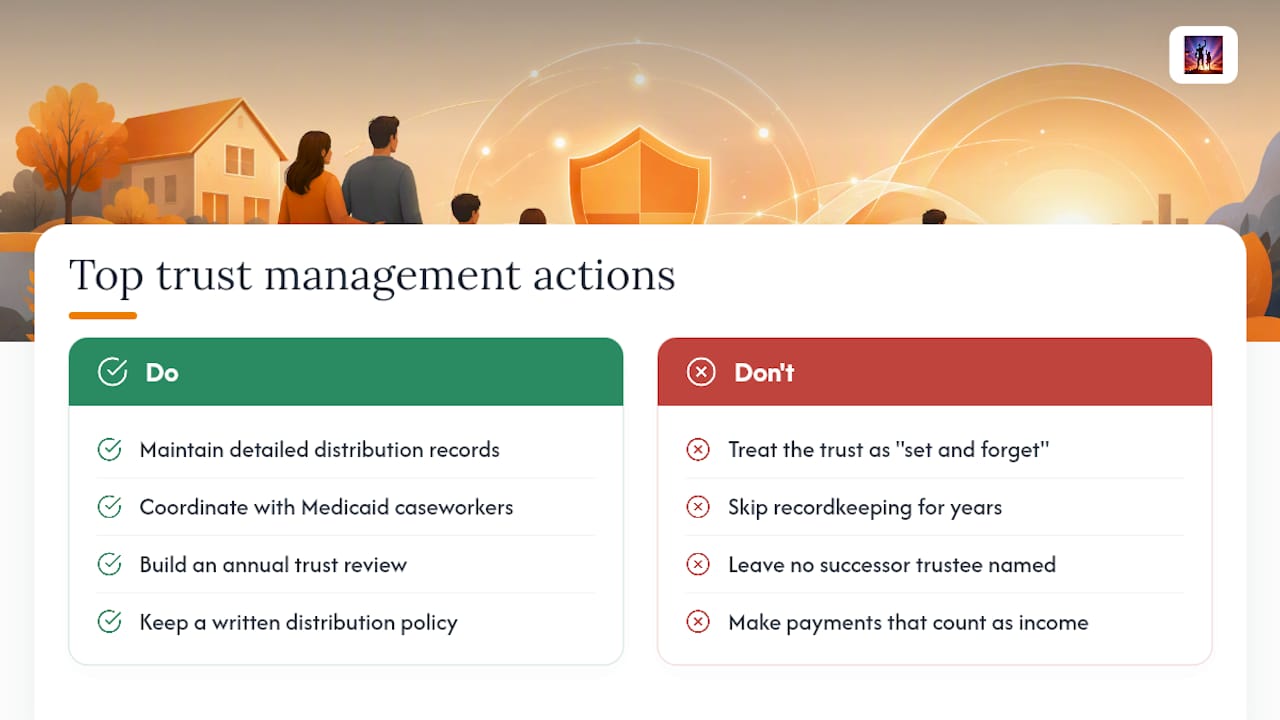
The most common breakdown happens around recordkeeping. Trustees need to document every distribution, avoid payments that could be miscounted as income, and coordinate directly with Medicaid caseworkers when questions come up. Skip that discipline for a few years and you're left reconstructing records under pressure during an audit, exactly when you can least afford confusion.
Trustee turnover is another quiet problem. A sibling or friend named trustee in their thirties might not be available, or might not want the responsibility, twenty years later. Trusts without a clearly named successor trustee can end up in court, with a judge appointing someone who has no relationship with your child.
Coordination gaps between the trust and other benefits create friction too. A trustee who doesn't understand how a housing payment interacts with SSI can accidentally trigger a benefits reduction the family didn't see coming. The fix isn't complicated, but it does require intention: build in an annual review, keep a written distribution policy the trustee actually follows, and make sure at least one backup person understands the trust's rules well enough to step in.
How Do Guardianship and Conservatorship Work With a Special Needs Trust?
A trust manages money. Guardianship, or conservatorship depending on your state's terminology, manages decisions. They're related but separate legal tools, and confusing them is a common planning mistake.
If your child with autism can't manage medical, financial, or personal decisions independently as an adult, a court may need to appoint a guardian, often a parent, to make those decisions. That guardian doesn't automatically become the trustee of the SNT, though many families choose to name the same person for both roles for simplicity.
Some families pursue less restrictive alternatives to full guardianship, such as supported decision making agreements, depending on their child's capabilities and their state's available legal options. Whichever path you choose, coordinate it directly with your trust planning. A guardianship decision made at age 18 affects who can legally instruct the trustee, sign off on major distributions, or advocate for your child in disputes with Medicaid.
What Are the Tax Implications of a Special Needs Trust?
Third-party special needs trusts are typically taxed as complex trusts, meaning the trust itself may owe income tax on earnings it retains, while distributions made for your child's benefit can shift some tax liability depending on how the trust is structured. First-party trusts often qualify for treatment as grantor trusts in certain circumstances, which changes who reports income on a tax return.
None of this is a do-it-yourself calculation. Trust taxation intersects with your own income tax situation, your child's potential income if they work, and the specific trust language your attorney drafts. A tax professional experienced with special needs trusts, ideally one your elder-law attorney already works with, should review the trust structure before you fund it, not after the first tax season surprises you.
Start Early, Because a Special Needs Trust Autism Plan Is Rarely Final
Most testamentary special needs trusts can be revised as your child's needs change, so waiting for a "perfect" plan usually costs you more than an imperfect one drafted now. Simple first moves, like adding empty trust language to your will or updating beneficiary forms, protect your options without locking in every decision today. Autism Victory App can help you gather documents and pull state-specific checklists before that first attorney meeting.
— Ronnie Talent
Where Autism Victory App Fits Into Your Trust Planning
Autism Victory App won't draft your trust, and it won't replace your attorney. What it does is save you from walking into that attorney's office with nothing but questions and a stack of disorganized paperwork.
Inside the app, you'll find state-specific financial assistance guides that point you toward your state's Medicaid waiver programs and support pages, an SSI payment and income limits breakdown so you understand what's actually at stake if a distribution goes wrong, and planning checklists in both English and Spanish that help you organize beneficiary forms, policy numbers, and trustee candidates before your consultation. For broader everyday supports, partner resources like WonderLens's guide to accommodating holidays round out the kind of practical, non-legal planning families juggle alongside a trust.
Start a free trial of Autism Victory App today and pull your state's checklist before your next attorney meeting.
Sources
Check your own state's Medicaid website for procedures, since forms and recovery rules differ by state.
This article is general information, not a substitute for advice from a qualified financial advisor. Consult a qualified financial professional about your own circumstances before acting on anything here.
FAQ
Does Autism Qualify Someone for a Special Needs Trust?
Autism itself qualifies a person for a special needs trust as long as the diagnosis meets the disability standard tied to SSI or Medicaid eligibility; the trust protects benefits regardless of the specific disability involved.
What Is the Downside of a Special Needs Trust?
The main downsides are cost and rigidity: setting one up requires attorney fees, and once funded, distributions must follow strict rules or they risk reducing SSI and Medicaid benefits.
Does a Special Needs Trust Affect Life Expectancy or Care Quality for Someone With Autism?
A trust doesn't change life expectancy, but it directly affects care quality by funding therapies, technology, and supports that Medicaid alone often won't cover over a lifetime.
What State Has the Best Support for Autism?
No single state ranks best for every family, since support depends on Medicaid waiver availability, waitlist length, and state supplemental programs; checking your own state's autism financial assistance resources gives a more accurate picture than any national ranking.
Can Autism Victory App Help Me Set Up a Special Needs Trust?
Autism Victory App provides state-specific checklists, benefit guides, and document organization tools to prepare you for an attorney meeting, but it doesn't draft legal trust documents or replace a licensed elder-law attorney.
Recommended