
Yes, a child with autism can qualify for SSI, but approval hinges on two separate hurdles: SSA's medical standard of marked and severe functional limitations, and strict household income and resource rules. Start today by requesting your child's IEP and recent evaluations, asking therapists for functional letters, and calling SSA to lock in a protective filing date.
TL;DR:
Most children with autism qualify through functional equivalence requiring significant limitations in two or more adaptive domains, supported by detailed school and therapy records.
Household income and resources are heavily scrutinized under deeming rules, often limiting eligibility for middle-class families despite medical approval.
Child SSI payments average around $994 monthly in 2026, but actual benefits depend on household income, with state supplements varying widely.
Preparing documentation like recent IEPs, medical reports, and functional assessments before applying can significantly speed up approval and secure an earlier filing date.
Reporting any household or resource changes promptly within 10 days is crucial to avoid benefit overpayments or recovery actions.
Table of Contents
What Does SSA Look For When Evaluating Autism In Children?
SSA evaluates autism under Listing 112.10 in the Blue Book, but most children get approved through a different route: functional equivalence. That means your child needs a "marked" limitation in two of six functioning domains, or an "extreme" limitation in one. A medically determinable impairment must cause these limitations for at least 12 months, or be expected to.
The six domains are where your paperwork does the heavy lifting:
Acquiring and using information — report cards, IEP goals, standardized test scores.
Attending and completing tasks — teacher notes on focus, task completion rates.
Interacting and relating with others — social skills evaluations, peer interaction logs.
Moving about and manipulating objects — occupational therapy notes, fine motor assessments.
Caring for yourself — daily living skill assessments from therapists or teachers.
Health and physical well-being — medication side effects, seizure logs, sleep disruption records.
SSA's own policy ruling makes clear that functional evidence like school reports carries decisive weight, often as much as the clinical diagnosis itself. A diagnosis alone rarely wins a case. A stack of teacher observations tied to specific domains usually does.
How Do Parental Income And Resources Affect Eligibility?
This is where most families get tripped up. Because a child under 18 has no independent income history, SSA uses a process called deeming: a portion of your household income and resources gets counted as if they belonged to your child. Deeming is why a solidly middle class family can have a severely affected child and still get denied on financial grounds alone, even with medical approval in hand.
A few numbers matter here:
Resource limit: the household generally cannot exceed the SSI countable resource limit, not counting your home and one vehicle.
Excluded income: SSA carves out certain amounts of parental income before deeming the rest, and some items like certain in-kind support are excluded while other benefits reduce SSI dollar for dollar.
The catch: families with high therapy or caregiving costs often assume those expenses offset income for SSI purposes. They usually do not.
Pro Tip: Ask a benefits counselor about ABLE accounts before you assume you're over the resource limit. Money saved in a qualifying ABLE account doesn't count against SSI resource caps the same way a regular savings account does.
How Much SSI Does A Child With Autism Actually Get?
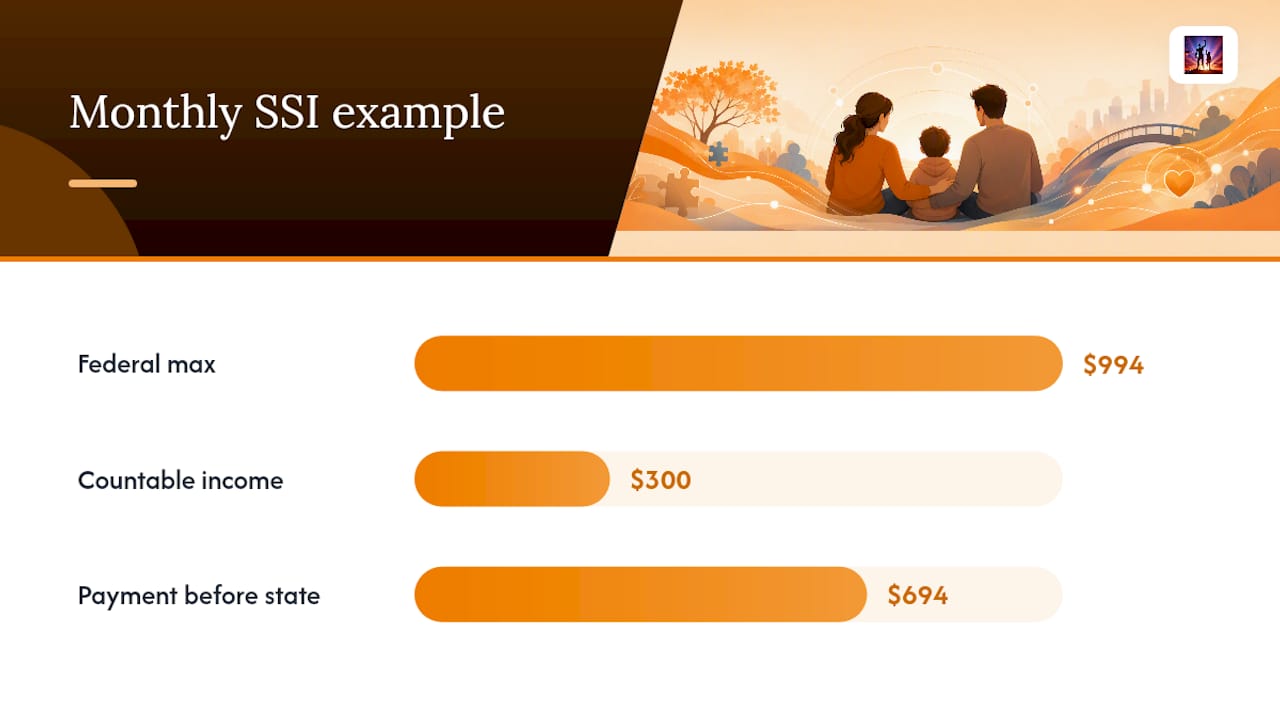
The 2026 federal SSI maximum is $994 a month for an individual, though your child's actual payment shrinks once countable income enters the picture. If your household has $300 in monthly countable income after exclusions, SSA subtracts that from the federal rate, landing your child closer to $694 a month before any state supplement.
Many states add a supplement on top of the federal amount, but the rules and dollar figures vary widely by state, so check with your state's SSI program rather than assuming a flat national number applies to you.
What Forms And Documents Do You Need To Apply?
Getting organized before you call SSA saves weeks. Here's the sequence:
Start the process. Call SSA or visit your local field office. You can begin a Child Disability Report online, but the full application generally requires a phone or in-person interview to finish.
Secure a protective filing date. This locks in the date you first contacted SSA, so back pay isn't lost while you gather documents.
Complete the core forms. You'll need SSA-8001-BK (Application for SSI) and SSA-3820-BK (Child Disability Report), which documents medical history and daily functioning.
Submit supporting evidence as DDS (Disability Determination Services) requests it.
Your document checklist should include:
Full medical records and diagnostic reports
Current IEP and any recent school evaluations
Therapy notes (speech, OT, ABA, behavioral)
A current medication list with dosages
Contact information for every treating provider
Keep copies of everything you send, and use any cover sheet or barcode SSA provides so your file doesn't get separated at DDS.
What Happens After You File For SSI?
Once your local field office confirms nonmedical eligibility (income, resources, citizenship), your file moves to DDS for the medical decision. DDS often reaches back out for more records, so respond quickly.
Consultative exams: if your existing records don't answer every question, DDS may schedule an independent exam, adding several weeks to the timeline.
Typical wait: decisions commonly take a few months, though complex cases with incomplete records take longer.
Presumptive payments: for certain severe conditions, SSA can start payments before the final decision, though autism alone doesn't automatically trigger this.
Back pay: if approved, benefits are calculated back to your protective filing date, not just your approval date.
What If Your Child's SSI Claim Gets Denied?
A denial isn't the end of the road, and most families who eventually win didn't get it right on the first try. The appeals ladder has four stages:
Reconsideration — a full review by a different examiner, typically filed within 60 days of denial.
Hearing before an Administrative Law Judge — where new evidence and testimony carry real weight.
Appeals Council review — a check on whether the judge applied the rules correctly.
Federal court — the final option, rarely needed but available.
Strengthen every appeal with something new: an updated IEP, a fresh therapist letter, or concrete daily-life examples that weren't in the original file.
Pro Tip: Write down three specific things your child struggled with this week, tied to school, self-care, or social interaction. Small, dated examples like these often carry more weight at a hearing than a general diagnosis letter.
Consider representation once you reach the hearing stage. Many disability advocates and attorneys work on contingency, and SSA rules cap what they can charge from your back pay.
What Happens When Your Child Turns 18?
At 18, SSA re-evaluates your child under the adult disability standard, which asks whether the person can perform substantial work, not whether they meet school-based functional domains. This redetermination usually happens automatically around the birthday, and it catches families off guard when it results in a benefits cutoff.
Start preparing at least a year ahead:
Update medical and functional records to reflect current, adult-level limitations.
Gather vocational assessments or job-coaching notes if your child has tried supported employment.
Ask about the Disabled Adult Child (DAC) pathway, which can preserve benefits based on a parent's work record if the disability began before age 22.
Read more about the legal side of this transition in our guide on turning 18 with autism.
Where Can You Find Reliable SSI Help And Resources?
Start with SSA's own pages for child SSI eligibility and the forms library, plus Medicaid and InsureKidsNow for health coverage questions tied to your SSI decision.
Autism Victory App's bilingual SSI guides and state-specific financial assistance resources
A downloadable SSI toolkit with deeming worksheets and document checklists
A milestone tracker for logging daily functional examples over time
How Do You Report Changes To SSA Without Losing Benefits?
Once your child is approved, the paperwork isn't over. SSA requires you to report changes that affect eligibility, and missing this step is one of the most common ways families end up owing money back.
Report these changes within 10 days of the month they happen:
Income changes — a new job, a raise, a change in child support, or a parent's spouse starting work.
Living arrangement changes — moving, a household member moving in or out, or a change in who pays for housing and food.
Resource changes — an inheritance, a settlement, or resources that push the household over the $2,000/$3,000 limit.
School status changes — dropping below full-time enrollment can matter for older teens.
Marriage in the household of an SSI recipient.
You can report changes by phone, in person at your local field office, or in some cases through your online my Social Security account. Keep a written or digital log of what you reported and when, including the name of whoever you spoke with.
Overpayments happen when SSA doesn't learn about a change quickly enough, and they come with a real consequence: SSA can reduce future payments or demand repayment of money already spent on your child's care. Reporting promptly, even when you're not sure a change matters, protects you far more than waiting to find out.
A Parent's Honest Take On The SSI Process
Paperwork like this rewards patience more than perfection. No single form makes or breaks a case. What tips the scale is consistent, specific evidence collected over time. Do one thing today: request your child's most recent IEP or evaluation and call SSA to set a protective filing date. That single step protects your back pay while you build everything else.
— Ronnie Talent
How Autism Victory App Can Help You Stay Organized
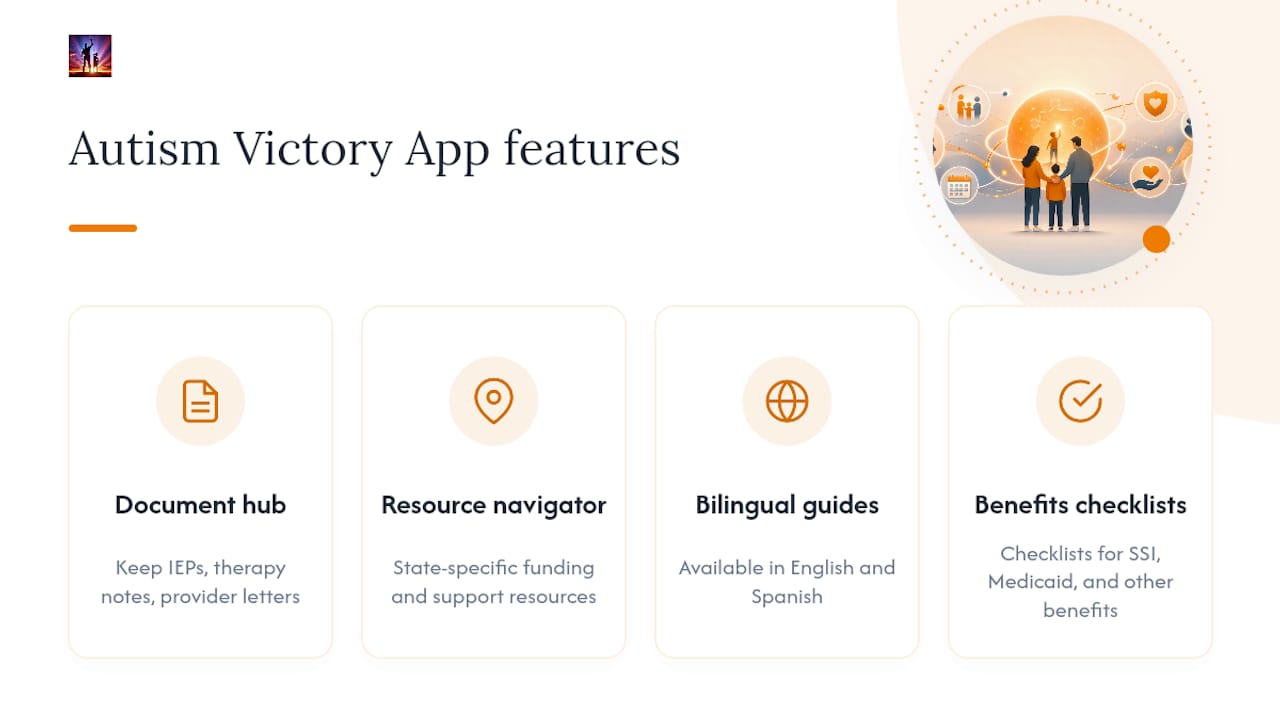
Autism Victory App gives you a place to keep every IEP, therapy note, and provider letter in one spot instead of scattered across email threads and paper folders, so you're never scrambling before a DDS deadline.

Beyond document organization, the app includes a state-specific funding and support resource navigator, bilingual guides in English and Spanish, and checklists built specifically for families working through SSI, Medicaid, and other autism-related benefits. It's not a replacement for SSA's official process. It's a way to walk into that process prepared instead of overwhelmed by loose paperwork.
Subscription plans are available, and new users may have access to a free trial period to test the tools before committing. If you're gathering evidence for an SSI application right now, start your free trial with Autism Victory App and get your child's documents organized before your next SSA deadline.
Where To Go For Official SSI Rules And Forms
Consult the SSA child SSI eligibility page and forms library directly, along with Medicaid or InsureKidsNow for coverage questions, plus the Kennedy Krieger SSI toolkit for a printable checklist.
This article is general information, not a substitute for advice from a qualified financial advisor. Consult a qualified financial professional about your own circumstances before acting on anything here.
Sources
Recommended