
Yes: Illinois law requires covered health plans to pay for autism diagnosis and treatment, subject to a statutory annual cap and your plan's normal cost sharing. That means confirming your plan type, gathering a diagnostic evaluation and physician referral, and contacting The Autism Program of Illinois or the state's prior authorization office are your first moves this week.
TL;DR:
The statutory autism benefit cap in Illinois is approximately $36,000 per year, adjusted for inflation, and applies only to state-regulated health plans, not self-funded ERISA plans.
Families should prepare a comprehensive diagnostic evaluation, physician referral, and behavior plan documentation to speed up approval and avoid delays in obtaining ABA services.
Medicaid HCBS waivers include additional supports like respite, assistive technology, and transportation, but require separate applications and functional assessments, not automatic with an autism diagnosis.
Approvals depend heavily on detailed, dated clinical documentation and a thorough prior authorization process; denials can often be overturned with a well-supported appeal.
Combining multiple support systems, including insurance, Medicaid waivers, SSI, and local grants, is necessary for comprehensive autism care and benefits in Illinois.
Table of Contents
How ABA coverage works in practice: authorization, documents, and cost sharing
Step-by-step checklist to get services approved, and what to do if you're denied
Autism Victory resources that help caregivers navigate benefits and paperwork
What Illinois law requires: the statute in plain language
215 ILCS 5/356z.14 is the law behind most autism coverage in Illinois. It requires state-regulated group and individual health policies to cover diagnosis and treatment of autism spectrum disorder for people under 21, and it sets a statutory maximum benefit that the Director of Insurance adjusts for inflation each year.
"Treatment" under the statute is broader than many families expect. It covers:
Applied behavior analysis (ABA) and other habilitative or rehabilitative care
Speech therapy, occupational therapy, and physical therapy tied to the autism diagnosis
Psychiatric and psychological care related to the condition
Pharmacy care prescribed as part of treatment
The statutory cap has historically been $36,000 per year, adjusted annually for inflation, meaning your actual limit this year may be slightly higher. Coverage up to that cap still runs through your plan's ordinary copays, deductibles, and coinsurance, and insurers can apply medical-necessity review just as they would for any other diagnosis.
One distinction trips up a lot of families: the mandate applies to state-regulated plans. If your employer is self-funded under ERISA, the state cap does not automatically apply, and you will need to check your plan documents directly.
2026 law and policy changes that affect families
A few shifts are worth checking against your own plan summary this year. Waiver budget formulas tied to Public Act 104-0002 changed some appendix limits for the Adults with Developmental Disabilities waiver, with updates tied to January 1, 2026, or CMS approval.
Here is what to look for:
Whether your health plan's summary of benefits reflects the current inflation-adjusted version of the statutory cap
Whether a waiver budget limit that affects your family's services has shifted under the recent amendments
Whether your child's age still falls within the coverage window the insurance mandate specifies
Families with older teens approaching the mandate's age boundary, and those relying on higher-intensity ABA hours, are the ones most likely to feel these changes directly. If nothing on your plan summary has changed, that is useful information too: it means your prior authorization process should run the same as last year.
How ABA coverage works in practice: authorization, documents, and cost sharing
Before you call anyone, know your plan type. State-regulated plans follow the statutory cap and medical-necessity rules under 215 ILCS 5/356z.14. Self-funded ERISA plans set their own autism benefit, which may be more generous, less generous, or structured differently.
Once you know that, the path to approval generally follows this order:
Get a Comprehensive Diagnostic Evaluation (CDE) confirming the autism diagnosis, or current documentation of functional impairment if your CDE is more than 24 months old.
Obtain a physician referral for Adaptive Behavior Support (ABS) services.
Work with your ABA provider to complete a Behavior Analytic Treatment Plan (BATP).
Submit the HFS prior authorization form for ABS services with all required attachments, adding a clinical narrative if your requested hours exceed the standard threshold.
Track the review and keep copies of every document you submitted.
Claims for ABA commonly use service codes like 97153 (direct ABA), 97155 (protocol modification), 97154 (group adaptive behavior treatment), and separate codes for caregiver guidance sessions. Each ticks against your plan's deductible and coinsurance before counting toward the statutory annual cap.
Pro Tip: Keep dated progress notes from every ABA session. Reviewers weigh recent, specific evidence of functional change far more heavily than a general diagnosis, and that same documentation becomes your strongest material if you ever need to appeal.
Medicaid, HCBS waivers, SSI, and other public supports
Insurance coverage solves part of the picture. Many families also need Medicaid home and community-based services (HCBS) waivers, which work differently and are not automatic just because a child has an autism diagnosis.
Illinois HCBS waiver documents show these waivers can include:
Respite care for the caregiver, not just therapy for the child
Assistive technology and home modifications
Transportation, caregiver training, and supported employment for adults
Behavioral intervention services layered on top of insurance-funded ABA
The Children's Support Waiver serves ages 3 through 21, while the Adults with Developmental Disabilities waiver picks up after that. Both require a level-of-care assessment, and eligibility depends on meeting that functional threshold, not the diagnosis alone.
Separately, the SSA's Illinois Family Assistance Program can provide a stipend for qualifying households with children under 18 who have severe autism or another severe disability, based on income and requiring annual reapplication. SSI is its own program with separate income rules. Our guide to SSI for a child with autism breaks down payment amounts and documentation. Expect to file a separate application for each program: insurance, Medicaid waiver, SSI, and Family Assistance do not share one intake process.
Where to find providers, referrals, and navigation help
You do not have to map this system alone. The Autism Program of Illinois (TAP) runs a statewide referral network of roughly 20 centers through university and community partners, offering diagnosis referrals, training, and case navigation.
A practical order of operations:
Contact TAP's referral portal and ask which local center covers your county.
Ask a prospective ABA provider three things: whether they accept your insurance, how often their prior authorizations get approved on the first submission, and their current waitlist length.
Email HFS directly for ABS prior authorization questions if your provider cannot answer a procedural question.
Check our state-by-state waiver waitlist guide if you are weighing how long a waiver application might take.
Local advocacy groups and school districts often know about enrollment windows and grant cycles that do not show up on state web pages, so ask providers and TAP staff what else is open this year.
Step-by-step checklist to get services approved, and what to do if you're denied
Approval moves faster when the paperwork is organized before you make the first call. Our ABA insurance coverage guide walks through this process in more depth, but here is the short version:
Collect your CDE, noting which assessment tools were used and the completion date.
Get a physician referral and ask your ABA provider to begin the BATP immediately.
Submit the prior authorization form with every required attachment, and log the submission date and confirmation number.
Track your authorization period on a calendar. Request progress reports from your provider before the period ends, not after.
If you are denied, appeal promptly with a medical-necessity argument and ask whether a reviewer with autism-treatment expertise can evaluate your case, as the statute requires for appeals.
Keep one folder, digital and physical, with every document, date, and contact name.
Pro Tip: A denial is not final. It is a request for more or clearer evidence, and a focused appeal built on dated clinical documentation succeeds far more often than a general restatement of need.
Autism Victory resources that help caregivers navigate benefits and paperwork
None of this paperwork disappears once you understand it, it just becomes manageable. A mobile app can include a state-by-state benefits navigator designed to help track documents and deadlines for situations like the one above.
The app may also provide caregiver-focused books and audiobooks in English and Spanish, AI-powered guidance for working through forms like the HFS ABS prior authorization packet, and a caregiver community where parents share support and experiences. It is designed to support the administrative challenges that come with navigating autism benefits, not as a replacement for TAP, HFS, or legal advice.
If you want an organized way to hold all of this, from statute citations to your own appeal notes, the Annual plan runs $49.95 per year or $6.95 per month, with a free trial to see whether it fits your family's process.
What families get wrong about autism benefits in Illinois
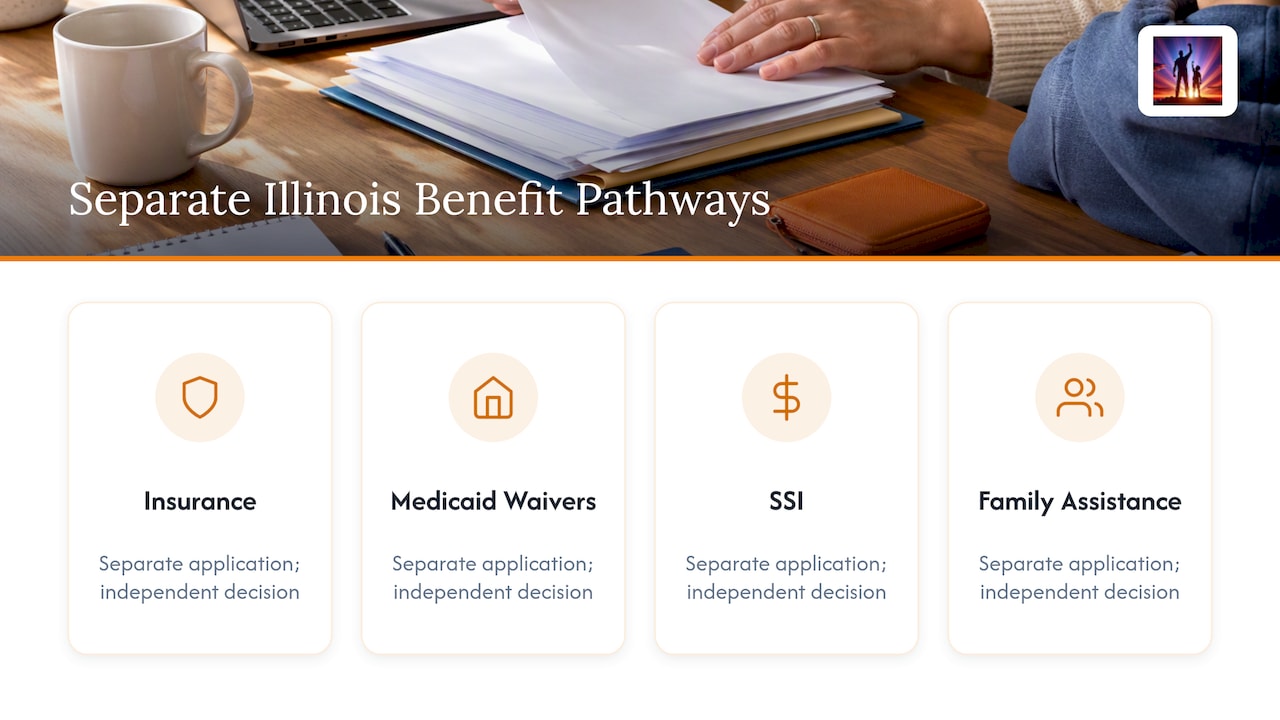
The biggest misconception is that a diagnosis unlocks a fixed set of benefits automatically. It does not. The insurance statute, the Medicaid waivers, SSI, and Family Assistance are four separate systems with four separate applications, and a denial from one has no bearing on your eligibility for another.
The second misconception is treating the prior authorization form as a formality. It is the single most important document in this process, and the families who get approved fastest are the ones who treat it as a clinical case file: dated evaluations, a specific BATP, and progress notes that show change over time, not just a diagnosis on a letterhead.
If you take one thing from this guide, make it this: start the CDE and physician referral before you need them urgently. Waiver waitlists and insurance reviews both run on their own clocks, and the families who struggle most are usually the ones who started the paperwork only after a crisis made it unavoidable.
— Ronnie Talent
This article is general information, not a substitute for advice from a qualified doctor. Consult a qualified healthcare professional about your own circumstances before acting on anything here.
Sources
FAQ
Is autism a disability?
Autism spectrum disorder is recognized as a disability under federal law, which is why it can qualify a person for SSI, Medicaid waivers, and protections like an IEP or similar educational accommodations at school. Whether a specific benefit program accepts that diagnosis still depends on that program's own eligibility rules, not the diagnosis alone.
What grants are available for autistic children in Illinois?
Illinois does not run one single "autism grant," but families often combine several funding sources: the state's HCBS waivers, the SSA's Illinois Family Assistance stipend for qualifying households, and insurance coverage under the state's autism mandate. TAP centers and local advocacy groups can point families toward smaller regional grants as they open.
What benefits can I claim if I'm autistic?
Adults with autism may qualify for SSI or SSDI depending on work history and income, along with the Adults with Developmental Disabilities HCBS waiver if they meet the level-of-care assessment. Eligibility for each program is assessed separately, so a diagnosis alone does not guarantee enrollment in any of them.
What can I get for free for my autistic child?
Public schools must provide services through an IEP or similar educational accommodations at no cost when a child's autism affects their education, and early intervention programs are available for young children regardless of insurance status. TAP centers also offer free referral and navigation help to point families toward no-cost or low-cost local services.
Recommended