Yes, families in New York can get respite care for autistic children and adults, and the fastest way to start is by contacting the OPWDD Front Door or your Care Manager today. From there, eligibility review, funding routes like the HCBS Waiver, Family Support Services, and Family Reimbursed Respite (FRR) all become options worth asking about. The system moves slowly, but there are steps you can take this week.
TL;DR:
Most families can access respite care through OPWDD, but wait times vary significantly by region and paperwork completeness.
In-home and site-based respite are readily available for occasional relief, while camp and intensive options serve longer or more complex needs.
Funding options include Medicaid-linked HCBS Waiver, Family Support Services, and Family Reimbursed Respite, with FRR offering the quickest access and flexible reimbursement.
Starting the process involves initial contact with OPWDD, connecting with a Care Manager, and building a personalized Life Plan, which guides authorization.
Language, cultural compatibility, and coordination with other services are crucial for effective respite, and peer support groups can help mitigate caregiver exhaustion.
Table of Contents
What respite care is and who qualifies
Respite care gives you a break from the daily work of caregiving while someone else looks after your child or family member, as explained in Autism support and therapy approaches. It's temporary relief, not permanent placement, and it can happen in several settings depending on what your family needs and what's authorized in your loved one's plan.
According to OPWDD, respite can be delivered:
In-home, where a trained worker comes to your house for a few hours or overnight.
Site-based, at a day program or respite facility.
Camp respite, often during school breaks or summer.
Overnight or weekend respite, for longer stretches of relief.
To qualify, your child or family member generally needs a developmental disability diagnosis, including autism spectrum disorder, and must be connected to OPWDD services. Children age seven or younger who don't yet have a full diagnostic workup may still access services under provisional eligibility, a policy meant to prevent long waits during evaluation. Once approved, respite gets written into a Life Plan, the document your care team uses to track and authorize services.
How to get OPWDD respite: from Front Door to authorization
Getting respite through OPWDD follows a fairly predictable sequence, even though the pace varies by region and caseload.
Contact OPWDD Front Door. This is the intake point for anyone new to the system. Have diagnostic reports, school evaluations, and contact information ready, since the intake team will ask about current supports and urgent needs.
Get connected to a Care Coordination Organization (CCO). A CCO assigns a Care Manager who becomes your main point of contact for planning and authorizations.
Build a Life Plan. Your Care Manager works with you to document goals, needs, and requested services, including respite, in this master planning document.
Request provisional or limited-exception services while waiting. If your child is under seven or you're not yet enrolled in the HCBS Waiver, ask specifically about interim options so you're not stuck waiting months with zero support.
Wait for authorization, then schedule service. Once respite is approved in the Life Plan, your Care Manager helps match you with a provider or agency.
Timelines vary widely by county and by how complete your paperwork is at intake. Asking your Care Manager directly, "what can we access right now, and what requires full waiver enrollment," often uncovers faster paths than waiting for the standard track to clear.
Matching the type of respite to your family's needs
Not every family needs the same kind of break, and New York's respite categories reflect that. OPWDD's administrative guidance defines several categories, each suited to different situations.
In-home respite works well for short, frequent breaks, like a few hours after school or an evening out.
Site-based respite suits families who want their child in a structured, supervised setting outside the home.
Camp respite offers longer stretches during school breaks, often with peer groups.
Group planned respite now includes new billing codes for groups of two or three individuals, following a 2024 rate update, which can lower per-family cost for shared care.
Intensive respite is reserved for individuals with significant behavioral or medical needs and requires a documented plan overseen by a licensed professional, along with staff trained specifically to implement it.
For most families needing occasional relief, in-home or site-based respite covers the need. Intensive respite exists for the harder cases, where safety and clinical oversight matter as much as the break itself.
Paying for respite: waivers, family support, and FRR
Funding is usually the part that trips families up, mostly because there are several overlapping programs with different rules.
The HCBS 1915(c) Waiver is the backbone funding source for most OPWDD respite. It requires Medicaid eligibility, a documented level-of-care need, and enrollment through your Care Manager. Waiver enrollment takes time, so it's worth starting the application even while pursuing shorter-term help.
Family Support Services offer another route, sometimes including reimbursement for respite costs outside the waiver structure, depending on regional funding availability through your DDRO.
Family Reimbursed Respite (FRR) tends to be the most flexible option for families who want to hire someone they already trust.
FRR is 100% state-funded and reimburses families directly for respite expenses under Self-Direction budgets.
The program caps reimbursement at $3,000 per year, according to OPWDD's Self-Direction guidance, which matters when planning how far your budget stretches across the year.
FRR does not require prior authorization for the provider, which speeds things up considerably compared to agency staffing.
Reimbursement runs through invoices submitted to your Fiscal Intermediary, so keeping clean records from day one avoids denied claims later.
Some invoices now reflect the group-of-2 billing codes and rural rate adjustments rolled out for certain counties, so don't be surprised if your provider's paperwork looks different from what a neighbor in another county sees. Our guide to funding autism respite care walks through these routes in more depth if you want a side-by-side comparison.
Finding and vetting respite providers
Your Care Manager is the obvious first call, but they're rarely the only useful one. Autism specialty programs at hospitals, therapists who already know your child, and school-based teams often have working relationships with respite providers and can point you toward someone who fits.
Community organizations and local nonprofits sometimes maintain their own respite worker networks, particularly useful in regions where CCO caseloads run high and referrals move slowly.
Before hiring or accepting a match, ask about:
Background check status and any required OPWDD certifications.
Training in behavior plans, especially if your child has a formal Behavior Intervention Plan.
Transportation policy, if the respite includes outings.
Insurance and liability coverage, and whether the provider has reviewed relevant OPWDD liability notices.
Write a one-page summary of your child's routines, triggers, and communication style before the first visit. A new worker who reads this in five minutes will do a better job than one improvising on day one.
Pro Tip: Keep a laminated "quick reference" card by the door with emergency contacts, medication notes, and one sentence on how your child communicates distress. It saves precious minutes if something goes wrong.

Self-direction: hiring and getting reimbursed under FRR
Families who want more control over who provides care often turn to self-direction, and FRR is the funding mechanism that makes it work.
Recruit someone you trust. This might be an extended family member, a former aide, or someone referred by your school or therapist network.
Complete a basic training checklist. Cover your child's communication style, any behavior plan steps, medication needs, and emergency contacts.
Track every session. Note dates, times, hours worked, and cost immediately after each visit rather than trying to reconstruct it weeks later.
Submit invoices to your Fiscal Intermediary promptly. OPWDD guidance notes that delays in vouchering can cause reimbursement denial, so treat this like a monthly bill rather than year-end paperwork.
Keep copies of everything, invoices, training notes, and correspondence with your Fiscal Intermediary, in one folder or app. When reimbursement questions come up months later, having a paper trail saves you from starting over.
How respite fits with your child's other services
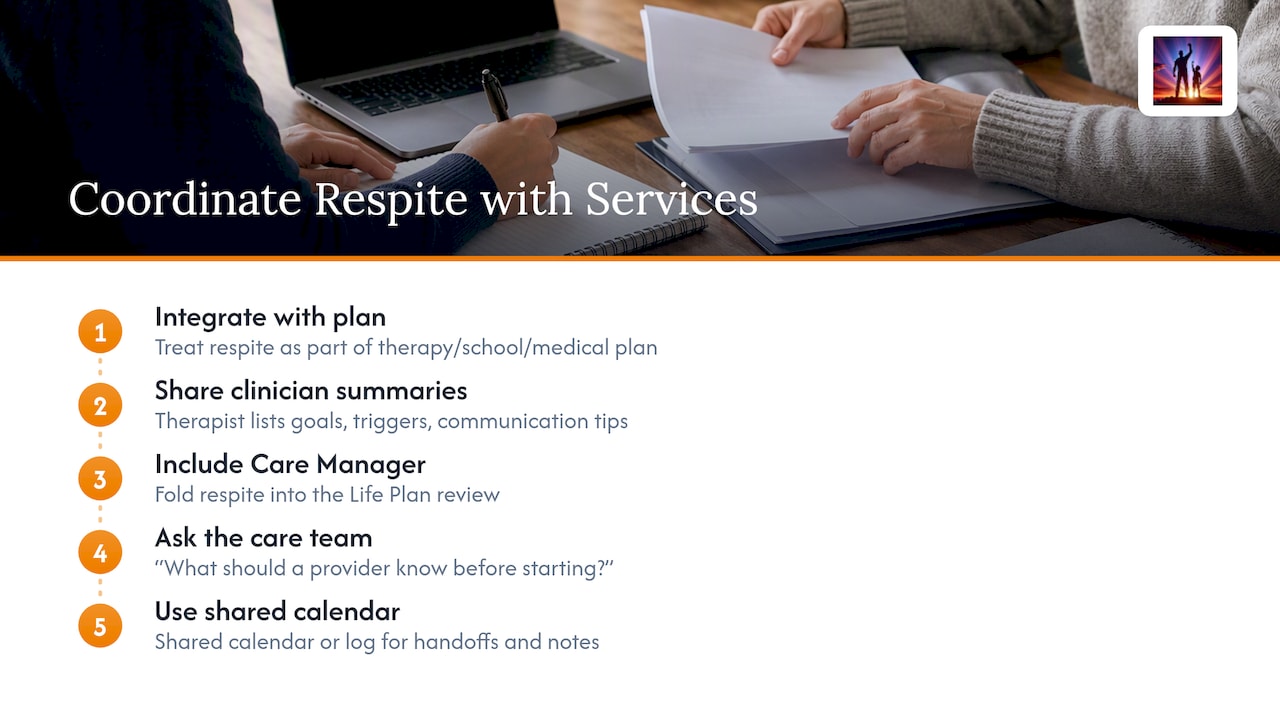
Respite works best when it's not an isolated errand, but a piece of the same plan that covers therapy, school supports, and medical care. A respite worker who understands your child's communication style or sensory needs can reinforce, rather than undo, the progress made in speech therapy or ABA sessions.
Bringing your child's clinicians into the loop, even briefly, helps. A therapist can share a short summary of current goals or triggers that a respite provider should know. Your Care Manager can also fold respite requests into the same Life Plan review that covers other services, which keeps everything documented in one place instead of scattered across separate applications.
This coordination matters most for children with medical complexity or intensive behavioral support needs, where a respite worker acting without context could unintentionally reinforce a problem behavior or miss a safety concern. Asking your child's care team, "what should a respite provider know before they start," is a simple question that often surfaces details nobody thought to write down.
For families juggling multiple providers, a shared calendar or communication log between the respite worker, therapists, and school staff cuts down on repeated explanations and missed handoffs. It's a small habit that pays off over months, not just during the first visit.
Getting respite that fits your family's language and culture
New York is home to families speaking dozens of languages, and finding a respite worker who communicates comfortably with your child and household matters as much as their training does.
Ask your Care Manager directly whether bilingual respite workers are available in your area, and don't hesitate to request one if your child communicates best in a language other than English. Some CCOs and community organizations maintain rosters specifically built around language and cultural background, particularly in New York City boroughs with dense immigrant populations.
Cultural fit goes beyond language. A worker familiar with your family's traditions around food, religious observance, or gender roles in caregiving can settle into your household faster and with less friction. If your community has a cultural or religious center that also runs family support programs, it's worth asking whether they maintain contacts with respite providers who already understand those norms.
Materials from OPWDD and many CCOs are available in Spanish and other languages, and it's reasonable to ask for translated versions of your Life Plan or intake paperwork if that helps you participate fully in decisions about your child's care. Families building support networks in Spanish may find our Spanish-language autism resources a useful starting point alongside official OPWDD materials.
Support beyond the paperwork
Respite care solves a logistical problem, but the exhaustion of caregiving doesn't disappear the moment a worker walks through the door. Peer support groups, whether through local autism nonprofits, hospital-based family programs, or informal parent networks, give you somewhere to trade notes on what's actually working in your county.
Many CCOs host family support events or connect caregivers with parent mentors who've navigated the same Front Door process you're going through now. These informal contacts often know things the official paperwork doesn't mention, like which providers in your area have actual availability versus long waitlists.
If you're feeling isolated, ask your Care Manager about local family support groups tied to your DDRO region. Community organizations focused on autism, including hospital-affiliated centers, sometimes run caregiver respite programs of their own, worth checking even if they're outside the formal OPWDD system.
What to ask any respite provider before saying yes
A few direct questions before your child's first respite visit prevent most of the problems families run into later.
Ask about specific training: has this worker handled a child with a similar communication style or behavior plan before, or is this their first placement with someone on the spectrum? Ask how they'd respond to a specific scenario your child actually experiences, like a meltdown in a public place, rather than accepting a general "I'm trained for that."
Confirm background check status and whether the provider or agency carries liability coverage, referencing OPWDD's liability guidance if you're unsure what's standard. Ask what happens if the worker needs to cancel last minute, since backup planning matters as much as the primary arrangement.
Finally, ask how they document the visit. A simple written note on what happened, how your child responded, and anything unusual gives you a record and helps the next provider, if there is one, pick up where the last one left off.
What caregivers should realistically expect
Delays happen. Waitlists happen. The system rewards persistence more than patience.
Provisional eligibility and FRR exist precisely because full enrollment takes time, so use them. A clinician referral in hand often moves things faster than starting from scratch. And the parents who navigate this well rarely do it alone, lean on community and peer networks early.
— Ronnie Talent
Getting state-specific guidance without the guesswork
Autism Victory was built by caregivers who've sat through the same Front Door calls and Life Plan meetings described above. The app provides state-specific funding guides, bilingual content, and AI-powered guidance available anytime.

Ready-made call scripts for OPWDD intake and Care Manager conversations.
Checklists for FRR paperwork and reimbursement tracking.
A resource navigator that maps funding routes to your situation.
If you're ready to move past the confusion and get organized, our state-specific playbooks show exactly how this works in practice. Start your 5-day free trial and see what fits your family, with plans at $6.95 per month or $49.95 per year.
Sources
For forms and regional contacts, start with the OPWDD respite overview, then reach out to your local DDRO or Care Manager for county-specific paperwork.
Respite Services | Office for People With Developmental Disabilities
Self-Direction guidance (OPWDD) — Family Reimbursed Respite details
Waiver enrollment and eligibility (OPWDD administrative guidance)
FAQ
Can autistic children get respite care in New York?
Yes, autistic children can access respite care through OPWDD once connected to a Care Manager and Life Plan. Children age seven or younger may qualify under provisional eligibility even before a full diagnostic workup is complete.
Is respite care available for autistic adults too?
Yes, respite care extends to autistic adults, not just children, as long as they're connected to OPWDD services and have a documented need in their Life Plan. The same Front Door intake process applies regardless of age.
Can I get paid to stay home with my autistic child in New York?
Family Reimbursed Respite (FRR) reimburses families for respite expenses rather than paying a parent to stay home, and it's capped at $3,000 per year under Self-Direction budgets. Some families explore separate paid caregiver programs through Medicaid, covered in our guide to getting paid for autism care.
Will insurance pay for respite care?
Standard private health insurance typically does not cover respite care, since it's considered a support service rather than medical treatment. Most families fund it through the HCBS Waiver, Family Support Services, or Family Reimbursed Respite instead.
How long does it take to get approved for respite care?
Timelines vary by county and by how complete your intake paperwork is, with full waiver enrollment often taking longer than provisional or FRR options. Asking your Care Manager about interim services while waiting can get you some relief sooner.
Recommended