Parent-Mediated Interventions: Evidence and What to Try
Parent-mediated interventions (PMIs) are evidence-based programs that train caregivers to deliver therapy strategies directly with their children during everyday routines. They work. A systematic review of 30 randomized controlled trials covering 1,934 participants found PMIs produced a clinically relevant effect on disruptive behavior, with a standardized mean difference (SMD) of 0.55. A 2025 meta-analysis confirmed moderate effects for social interaction skills, with smaller but real effects for language and parental stress.
Three things to know right now:
PMIs are most effective for reducing disruptive behavior and improving social engagement in children ages 2–12, with the strongest trial evidence in the preschool years.
Named programs with solid trial backing include PACT, Project ImPACT, PLAY Project, TEACCH, and the NDBI family (which includes ESDM, JASPER, and PRT). You will hear these names from clinicians and school teams.
If your child shows regression, safety concerns, or significant medical complexity, a specialist assessment should come before or alongside any parent-led program. PMIs complement clinician-led services; they rarely replace them for high-need situations.
If your child’s main challenges are social communication, joint attention, or mild-to-moderate disruptive behavior, a coached PMI program is a practical, evidence-supported place to start.
Key Takeaways
Parent-mediated interventions produce clinically meaningful effects on disruptive behavior (SMD 0.55 across 30 RCTs) and moderate effects on social interaction, with the strongest outcomes when coaching is consistent and fidelity is monitored.
Point | Details |
|---|---|
Start with a coached program | Choose a named, evidence-tested model (PACT, Project ImPACT, ESDM) and work with a trained coach from the start. |
Use video for feedback | Record a 5-minute routine weekly; review with your coach to catch fidelity issues early. |
Watch for red flags | Regression, safety concerns, or medical complexity signal the need for specialist assessment alongside PMI. |
Prioritize your own wellbeing | Caregiver self-regulation directly supports intervention consistency and child outcomes. |
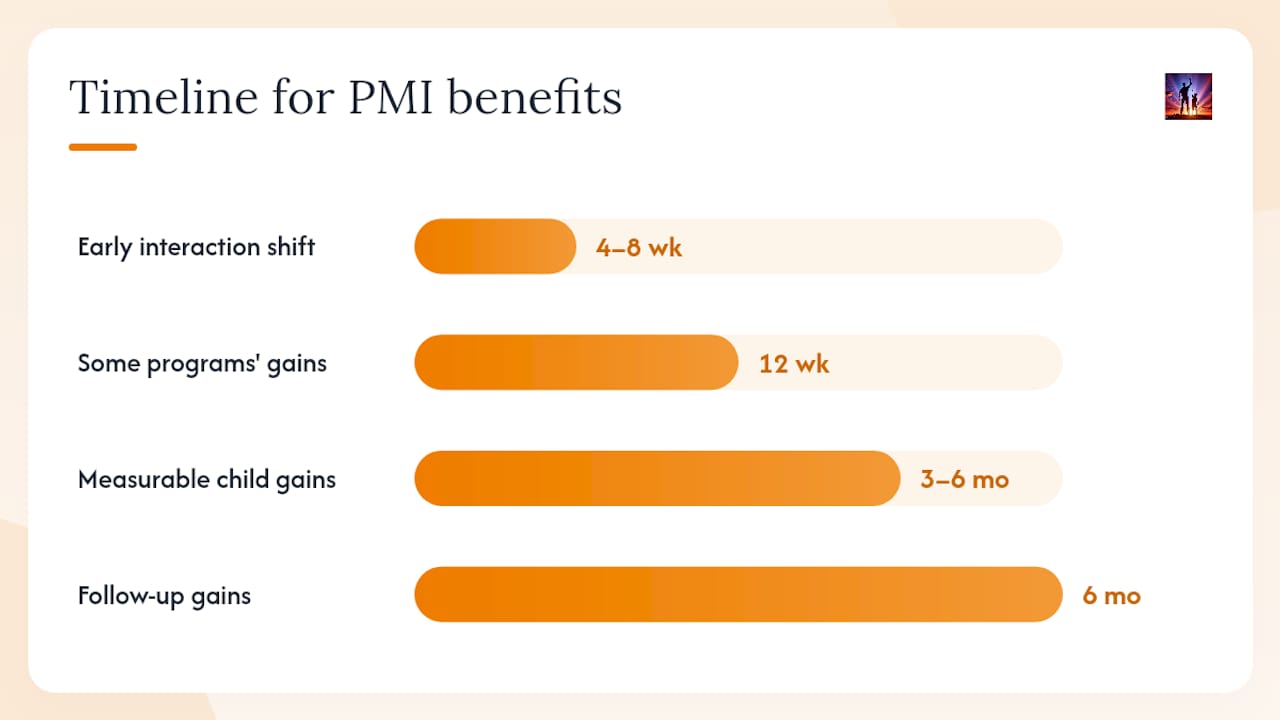
Expect gradual progress | Early interaction shifts appear within 4–8 weeks; measurable child gains typically emerge over 3–6 months. |
Table of Contents
What parent-mediated intervention actually looks like
What the research actually shows
Which children and families benefit most
How to run a PMI practice session at home
How to find and evaluate a PMI program in the United States
Why your own wellbeing is part of the intervention
An honest perspective on what makes PMI work
Sources
What parent-mediated intervention actually looks like
A parent-mediated intervention is not a workbook you read and then try to remember. It is a structured coaching model where a trained clinician teaches you specific strategies, watches you practice them with your child, gives you feedback, and then sends you home to use those strategies during real daily routines. You are the co-therapist. The clinician’s job is to make you effective.

The rationale is straightforward: children with autism spend far more waking hours with their caregivers than with any therapist. When parents learn to embed therapeutic strategies into bath time, meals, and play, the total dose of intervention increases dramatically without adding clinic hours.
The programs you will hear about
NCAEP’s evidence pages and the IntechOpen PMI review both document the following models with trial support:
PACT (Pre-school Autism Communication Therapy): A social communication program where parents learn to follow their child’s lead, synchronize their own communication style, and build reciprocal interaction. Strong RCT evidence, particularly for social communication outcomes.
Project ImPACT: Combines naturalistic ABA and developmental approaches. Parents learn to increase social engagement and communication through play and daily activities. Designed for children ages 18 months to 8 years.
PLAY Project: A home-based, relationship-focused model built on the DIR/Floortime framework. A consultant coaches parents monthly; parents practice daily. Targets emotional connection and developmental growth.
TEACCH (Treatment and Education of Autistic and related Communication-handicapped Children): A structured teaching approach that organizes the environment and visual supports to reduce anxiety and build independence. Parents learn to set up predictable, visually clear routines at home.
NDBI approaches (Naturalistic Developmental Behavioral Interventions): A family of programs that blend behavioral principles with developmental science. Key members include ESDM (Early Start Denver Model), JASPER (Joint Attention, Symbolic Play, Engagement, and Regulation), and PRT (Pivotal Response Treatment). All three have parent-implemented versions with published trial data.
Delivery formats vary. You might attend a parent-only group, work one-to-one with a coach, join telehealth sessions, or use a hybrid model. Core coaching elements across programs typically include live modeling by the coach, video feedback review, in-session practice with your child present, and structured home practice between sessions.
What the research actually shows
The evidence base for PMIs has grown substantially over the past decade, and the picture is encouraging but not uniform across every outcome.
Behavior outcomes carry the strongest pooled evidence. The systematic review of 30 RCTs (1,934 participants, ages 2–17) found an SMD of 0.55 for disruptive behavior reduction, rated moderate certainty. That is a clinically meaningful effect, roughly comparable to what you see with many clinician-delivered behavioral programs.
Social interaction and communication show moderate effects in the 2025 meta-analysis, with generally low heterogeneity across included studies. Language outcomes and parental stress showed smaller, more mixed effects.
Early intervention evidence is promising. ASAT’s synopsis on PMIs for infants at high risk reports improvements in infant attentiveness to parents for some programs, including VIPP (Video-feedback Intervention to Promote Positive Parenting). A randomized early-intervention study published in the Journal of the American Academy of Child and Adolescent Psychiatry also documented measurable developmental outcomes tied to early, structured parent-implemented approaches.
Outcome | Evidence strength | Notes |
|---|---|---|
Disruptive behavior | Moderate-high (30 RCTs, SMD 0.55) | Most consistent finding across reviews |
Social interaction | Moderate (2025 meta-analysis) | Low heterogeneity; good signal |
Social communication | Moderate (PACT RCTs) | Strongest in preschool age group |
Language | Small/mixed | Varies by program and child age |
Parental stress | Small/mixed | Some programs show promise; not universal |
Parent–child engagement | Moderate | Consistent across NDBI-family programs |
Limitations to keep in mind:
Many individual RCTs have small samples. Pooled reviews help, but program-level evidence varies.
Follow-up periods differ widely across studies, so long-term maintenance data is limited for some models.
Program heterogeneity makes direct comparisons difficult. “PMI” covers a wide range of approaches.
For children with severe behavioral challenges, medical complexity, or significant regression, clinician-led services remain the primary recommendation.
Which children and families benefit most
PMIs are not a one-size-fits-all solution, but they fit a wide range of families well when the match is right.
Children most likely to benefit:
Ages 18 months to 8 years, with the strongest evidence in the preschool window (ages 2–5).
Children whose primary goals involve social communication, joint attention, play skills, or reducing mild-to-moderate disruptive behavior.
Children who are responsive to caregiver interaction, even if that responsiveness is inconsistent.
Family circumstances that support success:
A caregiver who can commit 30–60 minutes of structured practice per day, embedded in existing routines.
Access to a trained coach or program, whether in-person or via telehealth.
Willingness to be observed, recorded, and coached. Video review is a core tool in most programs.
When to combine PMI with clinician-led services or seek specialist assessment first:
Significant regression in skills, especially language or self-care.
Self-injurious behavior or aggression that poses a safety risk.
Co-occurring medical conditions that have not been evaluated.
A child who has not yet had a formal diagnostic assessment.
Situations where co-occurring ADHD affects pacing or attention during practice sessions. (Families navigating both diagnoses will find autism and ADHD guidance useful for adjusting strategies.)
Timeline expectations: Most families notice early shifts in parent–child interaction within 4–8 weeks of consistent coached practice. Measurable gains in child behavior or communication typically emerge over 3–6 months. Some programs report meaningful outcomes at 12 weeks; others show continued gains at 6-month follow-up. Progress is rarely linear.
How to run a PMI practice session at home
The techniques parents learn across programs share a common core. Here is what that looks like in practice, followed by a reproducible 6-step script you can use during any 10–15 minute play routine.
Core techniques:
Follow the child’s lead. Let your child choose the activity. Your job is to join, not direct.
Model language at or just above your child’s level. If your child uses single words, model two-word phrases.
Prompt and wait. Offer a natural opportunity, then pause for 3–5 seconds. Silence is a prompt.
Reinforce attempts, not just successes. Any communicative effort gets a warm, immediate response.
Use naturalistic routines. Snack time, bath time, and outdoor play are all intervention opportunities.
Build joint attention. Follow your child’s gaze, comment on what they are looking at, and share the moment before adding language.
A 6-step practice script
Set a goal. Pick one specific target: “I will wait for eye contact before handing over the toy.”
Set up the environment. Remove distractions. Have preferred items ready. Keep it simple.
Prompt naturally. Create an expectant pause or a gentle environmental cue (hold up the toy, look expectant).
Wait. Count silently to five. Resist filling the silence.
Respond immediately. When your child communicates in any way, respond warmly and give them what they were reaching for.
Record. After the session, note how many opportunities you created and how many your child responded to. Two minutes of logging is enough.
Pro Tip: Record a 5-minute clip of yourself during a routine once a week. Watch it back before your next coaching session. You will notice things you missed in the moment, and your coach can give targeted feedback on exactly what you are doing rather than what you remember doing.
Common fidelity slip-ups to watch for:
Prompting too quickly before the child has time to initiate.
Inconsistent prompts (sometimes waiting, sometimes not) that make it harder for your child to predict what to expect.
Shifting goals mid-session, which dilutes practice intensity.
Fidelity tools do not need to be complex. A short checklist of 5–7 strategies, a frequency tally, and a weekly video clip are enough to keep practice on track and give a coach something concrete to review.
How to find and evaluate a PMI program in the United States
Finding a reputable program takes more than a Google search. Here is what to look for and what to ask.
Selection criteria:
The program is tied to a named, evidence-tested model (PACT, Project ImPACT, PLAY Project, ESDM, JASPER, PRT, or TEACCH).
The coach has formal training in that model, not just general “autism experience.”
Fidelity monitoring is built in: the program tracks whether you are using strategies correctly, not just whether your child is improving.
The approach is family-centered, meaning it adapts to your schedule, culture, and home environment.
Telehealth delivery is available if you are in a rural area or have limited transportation.
Questions to ask any program before you commit:
How is coaching delivered (live observation, video review, group, individual)?
How is my fidelity measured, and will I get feedback on it?
What outcomes does your program target, and do you have published data or outcome summaries I can review?
How many sessions are included, and what happens if my child needs more time?
What does the program cost, and does it accept insurance or Medicaid?
Access and cost in the U.S.:
Many PMI programs are delivered through university clinics, early intervention systems (Part C of IDEA for children under 3), and autism specialty centers. Medicaid often covers parent training when it is part of a broader ABA or behavioral health plan. Private insurance coverage varies by state and plan. Some programs offer sliding-scale fees or are available through federally funded early intervention at no cost for eligible families. Telehealth has expanded access significantly; published trials document coaching models delivered entirely remotely with comparable outcomes to in-person delivery.
For families coordinating PMI with school-based services, aligning home strategies with your child’s IEP goals is worth the effort. A practical starting point is the IEP guide for autism parents to understand how home and school goals can reinforce each other.
Understanding how allied health roles (speech-language pathology, occupational therapy, behavior analysis) support PMI delivery can also help you build the right team. Autism allied health pathways offers a clear overview of how these roles work together.
What to expect in early sessions: The first one or two sessions are typically assessment and goal-setting. You will not be thrown into practice immediately. A reasonable trial period is 6–8 weeks of consistent coaching before evaluating fit.
Why your own wellbeing is part of the intervention
This is not a soft add-on. Caregiver self-regulation is a functional component of PMI effectiveness. When you are less stressed, you maintain consistency and responsiveness during practice sessions, and both of those qualities directly affect your child’s outcomes.
A 2025 proof-of-concept trial of the Two Hearts Mindful Parenting programme for parents of autistic children reported reductions in parenting stress for some participants and improvements in mindful parenting measures, with some outcomes maintained at follow-up. The evidence is preliminary, but the signal is coherent: parent-only mindfulness programs show promise as a complement to skill-based PMI coaching.
Practical supports you can use right now:
3-minute breathing reset before a practice session. Not to relax completely, but to shift from reactive mode to present mode.
Brief self-check mid-routine. Ask yourself: “Am I waiting long enough? Am I responding warmly?” One question is enough.
Micro-breaks between routines. A 2-minute pause between activities protects your capacity for the next one.
Parent-only programs. Look for mindful-parenting groups through your regional autism center, university clinic, or telehealth provider.
Psychology Today’s guidance on mindfulness for autism parents frames it well: the goal is not to eliminate stress but to increase your capacity to respond rather than react. That shift, practiced consistently, shows up in how you run a practice session.
Spanish-speaking families can find culturally relevant caregiver support through autism resources in Spanish, including materials that address family-centered approaches in a bilingual context.
An honest perspective on what makes PMI work
The research on parent-mediated interventions is genuinely encouraging, but there is a gap between what the trials measure and what parents actually experience week to week. Most RCTs measure outcomes at 12 or 24 weeks under conditions where coaching is consistent, fidelity is monitored, and families have support. Real life is messier.
What the evidence does not always capture is the cumulative effect of small, consistent moments. A parent who learns to wait three extra seconds before prompting, practiced across dozens of daily interactions, creates hundreds of additional learning opportunities over a month. That is the real mechanism. No single session is transformative. The gains come from repetition embedded in ordinary life.
The programs that work best are not necessarily the most complex. They are the ones families can actually sustain. A 10-minute daily practice with clear goals and a monthly coaching check-in will outperform a sophisticated protocol used inconsistently. If you are choosing between a highly structured program you will struggle to maintain and a simpler one you will actually do, choose the one you will do.
One more thing worth saying directly: parent-mediated does not mean parent-responsible-for-everything. You are not the therapist. You are a trained partner in your child’s development, supported by a coach and a clinical team. The burden of outcomes does not rest on you alone. When something is not working, that is information for the team, not a verdict on your effort.
Sources
These are the sources worth bookmarking if you want to verify program claims or explore the evidence further.
Parent-mediated interventions systematic review (PMC8632873)
Parent-mediated intervention versus no intervention for infants at high risk of autism — ASAT
This article is general information, not a substitute for advice from a qualified doctor. Consult a qualified healthcare professional about your own circumstances before acting on anything here.
Recommended