IEP for Autism: A Parent’s Complete Guide
An IEP for autism is a legally binding education plan created under the Individuals with Disabilities Education Act (IDEA) that documents your child’s present performance levels, measurable annual goals, special education services, accommodations, and placement to guarantee a free appropriate public education (FAPE) tailored to their unique needs. Once you and the school sign it, the services written in that document must be delivered. That is not a courtesy; it is federal law.
If you are just starting out, here are three things you can do today:
Request a school evaluation in writing. Email or hand-deliver a written request to your child’s principal or special education coordinator. The clock on the district’s response window starts when they receive it.
Gather baseline examples. Collect recent teacher notes, work samples, behavior logs, and any therapy reports you have. Concrete examples make the evaluation more accurate and your proposals harder to dismiss.
Confirm the IEP meeting date in writing. Once an evaluation is complete, ask for the meeting date in an email so there is a paper trail.
Before your first IEP meeting, bring:
Your child’s diagnostic reports and any private evaluations
Recent report cards and teacher progress notes
Samples of schoolwork that show both strengths and areas of difficulty
Behavior logs or notes from home (even informal ones)
A written list of your questions and the goals you want to propose
If your child was recently diagnosed, the first 30 days after diagnosis guide from Autism Victory App walks through exactly this kind of preparation in plain language.
Table of Contents
What does an IEP for autism actually guarantee your child?
Who qualifies for an IEP when a child has autism?
What are the key components inside an IEP for autism?
What does the IEP process look like from start to finish?
How do you write measurable IEP goals for autism?
What services and accommodations belong in an IEP for autism?
How can you prepare for an IEP meeting and advocate effectively?
What are your legal rights if you disagree with the school?
When does transition planning start in an IEP for autism?
What tools and tracking methods make an IEP actually work?
Key Takeaways
The part of the IEP process nobody prepares you for
Autism Victory App helps you stay organized through every IEP cycle
Useful sources and where to verify your state’s rules
What does an IEP for autism actually guarantee your child?
An Individualized Education Program (IEP) is a written document created by a school team that specifies the educational program designed to meet your child’s individual needs. It comes directly from IDEA, the federal law that requires public schools to provide FAPE to every eligible child with a disability. For a child with autism, FAPE typically means individualized instruction, related services like speech or occupational therapy, and classroom accommodations, all documented in a single enforceable plan.
The legally binding status matters in a practical way. If the IEP says your child receives 30 minutes of speech-language therapy three times per week, the school must provide exactly that. If services are missed or changed without your written consent, the school is out of compliance. Parents who understand this tend to read the document much more carefully before signing.
A note on FAPE: “Appropriate” does not mean the absolute best possible education. Federal courts have interpreted FAPE to mean an education reasonably calculated to enable a child to make meaningful progress. That is a lower bar than many parents expect, which is why the specific language inside the IEP matters so much.
Autism Speaks publishes a free IEP guide and toolkit that walks families through each section of the document. Autism Victory App also provides state-specific resource navigation and coaching content to help you understand what your district is required to offer before you walk into the meeting.

Who qualifies for an IEP when a child has autism?
A medical diagnosis of autism does not automatically qualify a student for an IEP. Eligibility is an educational decision based on whether the disability adversely affects the student’s educational performance and whether specially designed instruction is required. A child with autism who is performing at grade level without support may not qualify, even with a formal diagnosis. That distinction surprises many families.
How the evaluation process works
When you submit a written evaluation request, the district typically has a set window to respond and, once consent is given, to complete the evaluation. Exact timelines vary by state, so check your state education agency’s procedural safeguards notice for the specific numbers in your state. The evaluation itself covers multiple areas: academic achievement, communication, social and emotional functioning, adaptive behavior, and, for autism specifically, autism-specific screenings.
Documents and observations to collect before the evaluation:
Teacher progress reports and report cards from the past two years
Samples of schoolwork that show patterns (not just one bad day)
Behavior logs from home and school
Notes from private therapists (speech, OT, ABA)
Any prior psychological or developmental assessments
If you disagree with the school’s evaluation results, you have the right to request an Independent Educational Evaluation (IEE) at the district’s expense. Submit that request in writing and ask the district to explain in writing why they believe their evaluation was appropriate. That written explanation is called Prior Written Notice, and it becomes part of your documentation record.
For families weighing whether an IEP or a different plan is the right fit, the IEP vs. 504 plan comparison on the Autism Victory App blog breaks down the differences clearly.
What are the key components inside an IEP for autism?
Every IEP must contain specific sections required by IDEA. Knowing what each section should say, and what a red flag looks like, puts you in a much stronger position at the meeting.
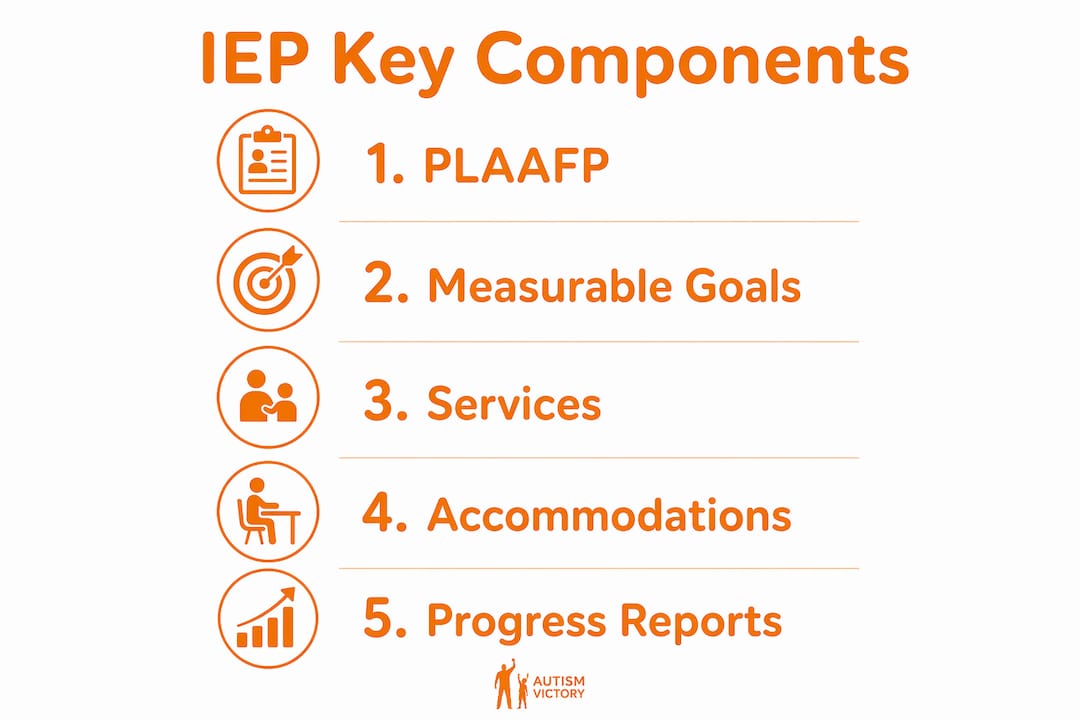
The required IEP sections
Present Levels of Academic and Functional Performance (PLAAFP) is the foundation of the entire document. It describes how your child is currently performing and how the disability affects their participation in the general curriculum. Every annual goal must connect directly to a baseline stated in the PLAAFP. A goal without a baseline in the PLAAFP is a red flag because progress cannot be meaningfully measured without it.
The table below maps each required component to its plain-language purpose and gives you a quick signal for quality versus concern.
IEP Component | Plain-Language Purpose | Strong Example | Red Flag |
|---|---|---|---|
PLAAFP | Describes current skills and how autism affects learning | “Jaylen reads at a 2nd-grade level; difficulty with multi-step directions affects task completion” | “Student has autism and needs support” |
Annual Goals | Measurable targets to reach within 12 months | “Given a visual schedule, student will complete 3-step tasks with 80% accuracy in 4 of 5 trials” | “Student will improve reading skills” |
Special Education Services | Specially designed instruction provided by a qualified teacher | “Resource room: 45 min/day, 5x/week, special education teacher” | No frequency, provider, or location listed |
Related Services | Therapies that support access to education | “Speech-language therapy: 30 min, 3x/week, SLP, pull-out” | “As needed” with no schedule |
Accommodations/Modifications | Supports that change how content is accessed or assessed | “Extended time (1.5x) on all written assessments; preferential seating near teacher” | Generic list copied from a template |
Placement/LRE | How much time in general education and why | “80% of day in general education with paraprofessional support” | No explanation for time outside general ed |
Progress Reporting | How and how often parents receive updates | “Written progress reports sent with report cards quarterly” | “Progress will be monitored” |
Behavioral Intervention Plan (BIP) | Specific plan to address behaviors that interfere with learning | Function-based strategies with antecedents, replacement behaviors, and reinforcers listed | “Redirect student when off-task” |
Transition Plan (age 14–16+) | Post-school goals and the steps to reach them | Employment goal with vocational assessment data and agency contacts | No measurable post-school outcome stated |
A note on neurodiversity-affirming goals
Watch for goal language that targets harmless autistic traits, such as eliminating stimming or requiring eye contact. Neurodiversity-affirming IEPs focus on functional skills, communication, independence, and dignity. If a proposed goal centers compliance rather than skill-building, ask the team to reframe it around a functional outcome.
What does the IEP process look like from start to finish?
The IEP process follows a predictable sequence. Knowing the stages in advance means you are never caught off guard by a deadline or a meeting you were not prepared for.
Submit a written evaluation request. Address it to the principal or special education coordinator. Keep a copy and note the date you sent it.
District responds and obtains consent. The school must respond within its state-mandated window. Once you sign the consent form, the evaluation clock starts.
Evaluation is completed. The school assesses your child across all relevant areas. You have the right to provide input and to receive a copy of all evaluation reports before any meeting.
Eligibility meeting. The team reviews evaluation results and determines whether your child qualifies under IDEA. You are a required member of this team.
IEP development meeting. If eligible, the team meets to write the IEP. Ask for a draft at least a few days before the meeting so you can review it and come prepared with questions or proposed changes.
You provide written consent for initial placement. Before services begin, the school must have your signed consent. Read the document carefully before signing.
Services begin and progress monitoring starts. The school delivers services as written. Progress toward goals should be tracked and reported to you on the schedule stated in the IEP.
Annual review. At least once per year, the team meets to review progress and rewrite the IEP for the coming year. You can request a meeting at any time if data shows the plan is not working.
Three-year re-evaluation (triennial). Every three years, the school must re-evaluate your child to confirm continued eligibility and update the picture of their current needs.
Timing note: Federal law sets some baseline windows, but states add their own requirements. Check your state education agency’s website for exact timelines. When in doubt, ask the special education coordinator for a copy of your state’s procedural safeguards notice.
Documents to bring to every IEP meeting:
Copies of all evaluation reports
Your written list of proposed goals
Recent teacher notes and work samples
A notebook for recording agreements and action items
Consent forms (blank copies in case you need to sign something)
After every meeting, send a brief follow-up email to the case manager summarizing what was agreed. That email becomes part of your documentation record.

How do you write measurable IEP goals for autism?
Measurable goals are a legal requirement under IDEA, not just best practice. They are also the most effective enforcement tool parents have. If a goal cannot be measured, it cannot be tracked, and it cannot be disputed if progress stalls.
The four-part goal formula
Every well-written IEP goal contains four components, sometimes called the C-B-C-T framework:
Condition: The support or context provided (“Given a visual schedule…”)
Behavior: The observable action the student will perform (“…student will independently initiate a greeting…”)
Criterion: The standard that defines success (“…in 4 out of 5 opportunities…”)
Timeframe: When the goal will be achieved (“…by the end of the IEP year”)
A goal missing any of these parts is difficult to implement and nearly impossible to track objectively. When you review a draft IEP, run each goal through this checklist before the meeting.
Pro Tip: Bring baseline data to the meeting. A short log showing that your child currently initiates greetings in 1 out of 5 opportunities makes a goal targeting 4 out of 5 both defensible and trackable. Without a baseline, the team has no starting point.
Sample goals across common autism domains
Domain | Sample Goal | Measurement Method |
|---|---|---|
Communication | Given a picture exchange system, student will request a preferred item using a 2-word phrase in 4 of 5 trials across 3 consecutive sessions by end of IEP year | Frequency count per session, SLP data sheet |
Social interaction | Given a structured peer activity, student will initiate a play-related comment to a peer in 3 of 5 observed opportunities by end of IEP year | Observation tally, teacher or paraprofessional data log |
Behavior/self-regulation | Given a visual calm-down menu, student will independently select and use a coping strategy when frustrated in 4 of 5 documented incidents by end of IEP year | Incident log with antecedent and strategy noted |
Adaptive/daily living | Given verbal prompting, student will independently complete a 5-step morning routine (unpack bag, hang coat, retrieve materials, sit, begin work) with no more than 1 prompt in 4 of 5 school days by end of IEP year | Daily checklist, teacher probe |
Reading/academics | Given a grade-level passage, student will identify the main idea and supporting details in writing across multiple opportunities by end of IEP year | Written probe scored with rubric |
Math | Given manipulatives, student will solve single-digit addition problems with accuracy across consecutive probes by end of IEP year | Timed probe, accuracy percentage |
Quality IEPs focus on a small number of meaningful goals in core areas rather than a long list of loosely written targets. Five well-written, measurable goals will do more for your child than fifteen vague ones.
What services and accommodations belong in an IEP for autism?
Related services are therapies and supports that help a child benefit from special education. They are not extras. When a service is educationally necessary, the school is responsible for providing and funding it.
Common related services written into IEPs for autism:
Speech-language therapy: Addresses communication, language processing, pragmatic (social) language, and augmentative communication systems
Occupational therapy (OT): Targets fine motor skills, sensory processing, handwriting, and daily living tasks that affect school participation
Physical therapy (PT): Supports gross motor development and physical access to the school environment when needed
Counseling/psychological services: Provides emotional regulation support, social skill coaching, and mental health support within the school setting
Behavioral support/ABA as a related service: Applied Behavior Analysis can be written as a related service when it is educationally necessary; document the frequency, provider credentials, and setting clearly
Sample accommodation language you can request
These are specific enough to be enforceable. Generic language like “provide support as needed” is not.
“Student will use a visual daily schedule posted at their workstation and reviewed at the start of each class period.”
“Student will be provided preferential seating near the teacher and away from high-traffic areas.”
“Student will receive extended time (1.5x) on all written assignments and assessments.”
“Student will be permitted to use noise-cancelling headphones during independent work time.”
“Student will have access to a designated quiet space for sensory breaks, available upon self-request or teacher prompt.”
“Assessments will be administered in a small-group or individual setting.”
Strength-based planning means adjustments should be tailored to the individual child and updated over time as needs change. An accommodation that helped in second grade may not be the right fit in fifth grade.
School services vs. private therapy
The school is responsible for services that are educationally necessary. Private therapy your family arranges independently is separate. However, you can ask the IEP team to document coordination between school-based and private providers, and in some cases, the school may be responsible for funding a service your child is not currently receiving. If you believe a service is educationally necessary and the school disagrees, request Prior Written Notice explaining their reasoning.
For families exploring in-home support to complement school services, understanding special needs caregiver qualifications can help you find the right fit for your child outside of school hours.
How can you prepare for an IEP meeting and advocate effectively?
Parents are legally mandated members of the IEP team. Your observations and documentation are not just welcome; they are required input. Coming prepared is the single most effective thing you can do to influence the outcome.
Meeting-prep checklist
Request the draft IEP at least three days before the meeting. Read every section and mark anything you want to discuss or change.
Write your proposed goals using the C-B-C-T formula and bring printed copies to hand to the team.
Organize your documentation: evaluation reports, work samples, behavior logs, and your own observation notes.
Decide whether to bring a support person. You are allowed to bring an advocate, a trusted friend, or a private therapist to the meeting.
Write down your top three priorities before you walk in. Meetings can move fast, and knowing your non-negotiables keeps you focused.
Sample language to use at the meeting
These phrases are collaborative but clear:
“I’d like to propose a goal in the area of communication. Here is the language I’m suggesting.” (Hand over the printed goal.)
“Can you show me the baseline data that supports this goal? I want to understand where we’re starting from.”
“I’m not comfortable signing today. I’d like to take the document home and review it before I consent.”
“If the team is declining this service, I’d like to receive Prior Written Notice explaining why.”
Pro Tip: Take notes during the meeting in real time. Write down who said what and what was agreed. Within 24 hours, send a brief email to the case manager: “Following up on today’s meeting, I want to confirm that we agreed to X, Y, and Z.” That email creates a written record that is very difficult to dispute later.
Bringing written sample goals and requesting written responses for any items the team declines significantly increases the chance that parent-proposed goals are accepted or revised collaboratively. Prior Written Notice is your paper trail if a dispute escalates.
What are your legal rights if you disagree with the school?
IDEA gives parents a set of procedural safeguards that are enforceable. Knowing them before a dispute arises puts you in a much stronger position.
Core procedural safeguards under IDEA:
Informed consent: You must give written consent before the initial evaluation, before the initial placement, and before any significant change to services.
Prior Written Notice (PWN): The school must give you written notice before it proposes or refuses to change your child’s identification, evaluation, or placement.
Access to records: You have the right to review all educational records related to your child.
Right to participate: You are a required member of the IEP team and must be given meaningful opportunity to participate.
Independent Educational Evaluation (IEE): If you disagree with the school’s evaluation, you can request an IEE at the district’s expense.
Dispute resolution options, in order
Start with the least adversarial option and escalate only if needed.
Informal conversation. Request a meeting with the case manager or special education director to discuss your concern directly.
Written request for a meeting. Put your concern in writing and request a formal IEP team meeting to address it.
State complaint. File a written complaint with your state education agency if you believe the school has violated IDEA. The state must investigate and respond within 60 calendar days.
Mediation. A neutral mediator helps both parties reach a voluntary agreement. It is faster and less expensive than due process.
Due process complaint. A formal legal proceeding before an impartial hearing officer. This is the most adversarial option and can take months.
When to bring in an advocate or attorney: consider a special education advocate for IEP disputes that have not resolved after two or three meetings. An attorney becomes worth the cost when you are heading toward due process or when the school has denied a significant service and issued PWN. Keep every email, every meeting note, and every piece of PWN. That documentation is your case.
When does transition planning start in an IEP for autism?
Transition planning addresses what happens after high school: employment, postsecondary education, and independent living. Federal rules require that transition planning be included in the IEP by the time a student turns 16, and many states start earlier, often at age 14. Check your state’s rules because the earlier you start, the more time you have to build the skills and connections that make adult life workable.
What transition goals look like:
Employment: “By graduation, student will complete a 10-hour-per-week supported work experience in a community setting with job coach support, as documented by employer and job coach logs.”
Postsecondary education: “By end of 11th grade, student will independently schedule and attend a campus visit at two community colleges with disability services offices, documented by visit confirmation.”
Independent living: “By end of 12th grade, student will independently manage a weekly budget of $50 using a budgeting app with no more than one error per month, measured by monthly review.”
Agencies commonly involved in transition planning:
Vocational Rehabilitation (VR): State-funded agency that provides job training, supported employment, and career counseling. Connect with VR at least two years before your child’s expected graduation date.
Community college disability services offices
Medicaid waiver caseworkers (waitlists can be long; apply early)
Independent living centers
The Medicaid waiver waitlist guide on Autism Victory App covers all 50 states and is worth reading well before your child approaches high school exit. For families thinking about what changes legally at age 18, the turning 18 with autism guide covers guardianship, SSI, and other legal shifts in plain language.
Practical steps to take early:
Document your child’s functional skills now, even informally. What can they do independently? What do they enjoy?
Build work experience before high school ends: volunteer roles, school-based jobs, community internships.
Connect with your state’s VR office before senior year. Many VR programs require an open case before they can fund services.
Ask the IEP team to include a vocational assessment in the transition evaluation.
What tools and tracking methods make an IEP actually work?
An IEP is only as strong as the data behind it. When progress is tracked consistently, you can see whether goals are being met, identify when a goal needs to be adjusted, and bring concrete evidence to the next meeting instead of relying on memory.
Simple tracking tools parents can use at home:
Goal-probe sheets: A one-page form for each goal that records the date, the prompt level used, and whether the student met the criterion. Teachers use these too; ask for copies.
Weekly behavior logs: A simple tally of target behaviors (frequency, duration, or intensity) tracked across settings. Even a basic notes app on your phone works.
Progress grids: A visual chart showing accuracy or frequency over time. A trend line going up is evidence the goal is working; a flat line is evidence it is not.
Organized data in the form of frequency counts, accuracy percentages, or duration records makes goals measurable and enforceable. When you bring a graph to an IEP meeting showing that your child has been stuck at 40% accuracy for three months, the conversation changes.
A minimum monthly tracking routine:
Review the progress reports the school sends and compare them to your own observations.
Note any discrepancies between school data and what you see at home.
If progress has stalled for six to eight weeks, request an interim IEP meeting in writing. You do not have to wait for the annual review.
Autism Victory App includes a state-specific resource navigator, document storage for evaluation reports and IEP copies, educational videos on IEP topics, and a caregiver community where parents share tracking strategies and meeting scripts. Having everything in one place means you are not hunting through email folders the night before a meeting.
Key Takeaways
An IEP for autism is a legally enforceable document, and parents who treat it that way, by documenting everything, proposing measurable goals, and requesting Prior Written Notice when the team declines a request, get better outcomes for their children.
Point | Details |
|---|---|
IEP is legally binding | Once signed, services must be delivered as written; missed services are a compliance violation. |
Measurable goals are required by law | Every goal must include a Condition, Behavior, Criterion, and Timeframe to be enforceable under IDEA. |
Parents are required team members | Your observations and proposed goals carry legal weight; document everything across settings. |
Diagnosis does not equal eligibility | Educational eligibility requires proof that autism adversely affects educational performance, not just a clinical diagnosis. |
Autism Victory App supports IEP management | The app provides state-specific resources, document storage, goal-tracking tools, and a caregiver community to keep you organized year-round. |
The part of the IEP process nobody prepares you for
Most guides walk you through the legal mechanics of an IEP, and that knowledge matters. But the part that catches parents off guard is the emotional weight of sitting in a room where professionals are describing your child’s deficits in clinical language, often quickly, often without pausing to check whether you understood or agreed.
Here is what I think parents underestimate: the IEP meeting is not a presentation you attend. It is a negotiation you participate in as an equal. Federal law says so. The school team may have more experience with the paperwork, but you have something they cannot replicate: years of daily observation of your child across every setting that matters. That knowledge is not soft data. It is the most relevant data in the room.
The conventional wisdom says to be collaborative and avoid conflict. That is mostly right. But “collaborative” does not mean passive. The parents who get the best outcomes are the ones who come in with written proposals, ask for baselines before agreeing to goals, and request Prior Written Notice the moment the team declines something. They are not adversarial. They are prepared. There is a real difference.
One more thing: do not let the length of the document intimidate you into signing before you are ready. You are allowed to take the draft home. You are allowed to consult an advocate. You are allowed to say, “I need more time.” The school cannot begin services without your consent, which means your signature has leverage. Use it thoughtfully.
Autism Victory App helps you stay organized through every IEP cycle
Keeping up with IEP documents, tracking goal progress, and knowing which state resources apply to your child is a year-round job, not just a once-a-year meeting. Autism Victory App puts the tools for that job in one place.
The app includes a state-specific resource navigator that surfaces funding programs, support services, and agency contacts relevant to your state, so you are not starting from scratch every time a new need comes up. Document storage lets you keep evaluation reports, IEP copies, and meeting notes organized and accessible from your phone. Educational videos and caregiver-focused books (available in English and Spanish) cover IEP topics, goal writing, and advocacy strategies in plain language. The caregiver community connects you with other parents who have navigated the same process and can share what worked.
A practical example: before your next annual review, use the app to pull up your child’s current goals, review the progress data you have collected, and generate a printed goal sheet to bring to the meeting. That kind of preparation takes 20 minutes instead of two hours of searching through old emails.
Autism Victory App is a paid subscription with a 7-day free trial. Start your free trial and see whether it fits how your family works before committing.
Useful sources and where to verify your state’s rules
Federal rules set the floor; states add their own requirements on top. Always check your state education agency for exact timelines, procedural safeguards, and local forms.
Federal guidance and legal foundation:
IDEA.ed.gov: The official federal IDEA website. Start here for the text of the law, regulations, and policy letters.
Autism Speaks IEP Guide and Toolkit: Free downloadable guide covering each IEP section with parent-friendly explanations.
Practical toolkits and goal resources:
IEP Toolkit from the Autism Society of NC / Duke Autism Center: Detailed parent toolkit covering the IEP process, team roles, and meeting preparation.
IEP Considerations for Students with Autism (University of New Mexico CDD): Covers the 11 evidence-based IEP considerations for students with ASD, including communication, behavior, and transition.
Wrightslaw (wrightslaw.com): Plain-language legal guides on special education law, procedural safeguards, and dispute resolution.
Research and peer-reviewed background:
Examining the Quality of IEPs for Young Children with Autism (PMC): Peer-reviewed study on IEP quality indicators for young children with autism.
State-specific rules:
Search “[your state] department of education special education procedural safeguards” to find your state’s exact timelines, complaint procedures, and IEP forms. Every state posts these publicly.
Recommended
IEP vs. 504 Plan for Autism: Which One Does Your Child Need? | Autism Victory Blog
Your Child Was Just Diagnosed with Autism: What to Do in the First 30 Days | Autism Victory Blog
Autism Victory | Resources, Support & Tools for Autism Families
Turning 18 with Autism: Guardianship, SSI, and What Actually Changes Legally | Autism Victory Blog