
Start with three categories: legal and rights tools, established advocacy organizations, and evidence-based family centers. Run a free rights assessment or request your child’s full school records today. From there, resources like Wrightslaw, COPAA, EducationAdvocate, and Autism Victory App fill in the gaps between what the law promises and what your district actually delivers.
TL;DR:
Most state evaluation timelines vary, with some states processing assessments faster than the federal 60-day requirement, affecting case strategies.
Documenting every communication with the school in a detailed, dated log is critical because it holds the most weight in disputes over service gaps.
Confirming whether your child qualifies for an IEP or Section 504 plan shapes the appropriate legal approach and dictates the advocacy pathway.
Using tailored state-specific resources and district contacts early prevents delays caused by generic or unclear district policies.
Combining national tools like Wrightslaw and COPAA with local advocacy groups and bilingual resources increases effectiveness for diverse or multilingual families.
Table of Contents
Best School Advocacy Resources: A Vetted List for Autism Families
Making Advocacy Equitable for Multilingual and Diverse Families
Best School Advocacy Resources: A Vetted List for Autism Families
You don’t need forty tabs open to advocate well. You need a handful of resources that actually do something for you: explain the law in plain terms, generate the paperwork, or connect you to people who’ve fought this fight before.
Wrightslaw advocacy resources — The closest thing to a law library built for parents, not lawyers. Use it when you need to understand IDEA’s evaluation timelines, behavior provisions, or how to document a case before an IEP negotiation gets contentious.
Council of Parent Attorneys and Advocates (COPAA) — A membership organization offering webinars, technical assistance, and legal advocacy training. This is where you go once your case moves past basic questions into systemic advocacy or a dispute that might require an attorney.
EducationAdvocate — Free tools built on federal and state law, including a rights assessment, ready-to-send letter templates, and a directory covering thousands of district special education contacts. This is often the fastest way to figure out what to do next and who to send it to.
Public Counsel’s special education manual — A plain-language guide covering IDEA rights, the child find mandate, IEP contents, and how to document meetings. Use it as your reference when you need the “why” behind a school’s obligation, not just the “what.”
PBIS and the National Center on Improving Literacy — The Center on Positive Behavioral Interventions & Supports is funded by the U.S. Department of Education and offers family-facing, evidence-based behavior strategies. The Evidence Advocacy Center does similar work for literacy interventions. Bring these when you need research behind a specific request for supports.
Autism Victory App — Built specifically for autism caregivers, with state-specific funding and support navigators, plain-language guides, and a caregiver community where you can ask questions in real time. It won’t replace the legal library work Wrightslaw does, but it organizes your state’s resources and your own documentation in one place, which matters when you’re juggling five agencies at once.
Each of these fits a different moment, and when planning classroom supports, you can also use a working template for inclusive activities for students with disabilities. Wrightslaw and Public Counsel teach you the law. COPAA trains you for escalation. EducationAdvocate turns knowledge into action items. PBIS and the literacy center supply the evidence. Autism Victory App keeps it all organized around your specific state and your specific kid.
How to Use These Tools for IEP or 504 Advocacy
Having the right resources means nothing if you don’t know the order to use them in. Here’s the sequence that actually moves a case forward.
Confirm which law applies. Run a rights assessment through EducationAdvocate or read a plain-language guide to determine whether your child needs an IEP under IDEA or accommodations under Section 504. These are different legal frameworks with different protections.
Request records and build a binder. Ask the district in writing for your child’s complete educational file. Start a communication log that dates every email, call, and meeting from this point forward.
Draft your agenda and letter before the meeting. Use a template from EducationAdvocate or Autism Victory App’s IEP guide to write a rights-based request letter, and bring specific evidence, not just concerns, to the table.
Track service minutes and escalate only after documenting. Follow up on unmet commitments with short, dated written requests. If nothing changes, mediation or a state complaint comes next, not before.
Pro Tip: Advocates consistently point to a maintained communication log and a clear timeline as the two pieces of evidence that carry the most weight when a service gap turns into a formal dispute. Start yours before you think you need it.
Finding Your State’s Rules and the Right District Contact
Federal law sets the floor, but states build their own rules on top of it. Evaluation timelines, independent evaluation policies, and complaint windows all vary by state, so a strategy that worked for a friend in another state might not apply to you.
Check your state department of education’s special education page, which EducationAdvocate’s tools can help you locate, for your state’s specific timelines and forms.
Use a district contact directory to find your child’s special education director directly instead of getting stuck in a general office queue.
Send your first request by email so you have a timestamp, then follow up with a phone call a few days later if you haven’t heard back.
Watch for state-specific quirks: some states shorten evaluation windows below the federal 60 school days, and complaint filing deadlines can range from one to three years depending on where you live.
Knowing your state’s version of the rules before a meeting keeps you from accepting a “that’s just how we do it here” answer that isn’t actually true.
Building Your Advocacy Toolkit: What to Keep on Hand
A folder of documents beats a folder of memories every time a disagreement happens six months later.
Communication log: Track the date, the person you spoke with, a summary of what was said, and the outcome. This single habit is what turns “they told me” into evidence a hearing officer can actually use.
IEP prep checklist: Present levels of performance, measurable goals, specific accommodations, exact service minutes, and the data sources behind each recommendation.
Template library: Keep a records request letter, a meeting agenda template, a sample rights-assertion letter, and a progress-monitoring form ready to adapt, not rewrite, every time you need one.
Fill these out consistently and you’ll walk into every meeting with a paper trail that speaks for itself.
Who’s Behind This Guide
Autism Victory App brings together state-specific funding navigators, caregiver-focused books and audiobooks, educational videos, AI-guided support, and a community of parents facing the same fights. This piece was written with input from Ronnie Talent, a contributing editorial voice focused on translating special education law into steps families can actually take. For deeper reading, see Autism Victory App’s guides on IEP preparation and special education mediation.
Making Advocacy Equitable for Multilingual and Diverse Families
Every parent has the right to understand what’s happening in their child’s IEP meeting, regardless of what language they speak at home. Schools are required to provide interpreters and translated documents under IDEA, but that requirement doesn’t always translate into practice. If your district isn’t offering an interpreter without you asking, ask in writing, and keep a copy of the request in your communication log.

Language access is only part of the equity gap. Cultural expectations around authority, disability, and asking questions in a formal setting can make advocacy feel harder for families who didn’t grow up navigating American school bureaucracy. That’s not a personal failing. It’s a system built around one cultural default.
Autism Victory App’s Spanish-language resources exist specifically to close that gap for U.S. families who communicate more comfortably in Spanish, with guides and audiobooks that don’t require a translated afterthought bolted onto English materials. Community-based organizations serving specific immigrant and cultural communities often know local school politics better than any national resource can, so pairing a national legal guide like Wrightslaw with a local cultural liaison or bilingual parent advocate tends to work better than either alone.
Finding Local Autism Advocacy Groups Near You
National resources teach you the law. Local groups teach you what actually happens in your district’s IEP meetings, which is a different kind of knowledge entirely.
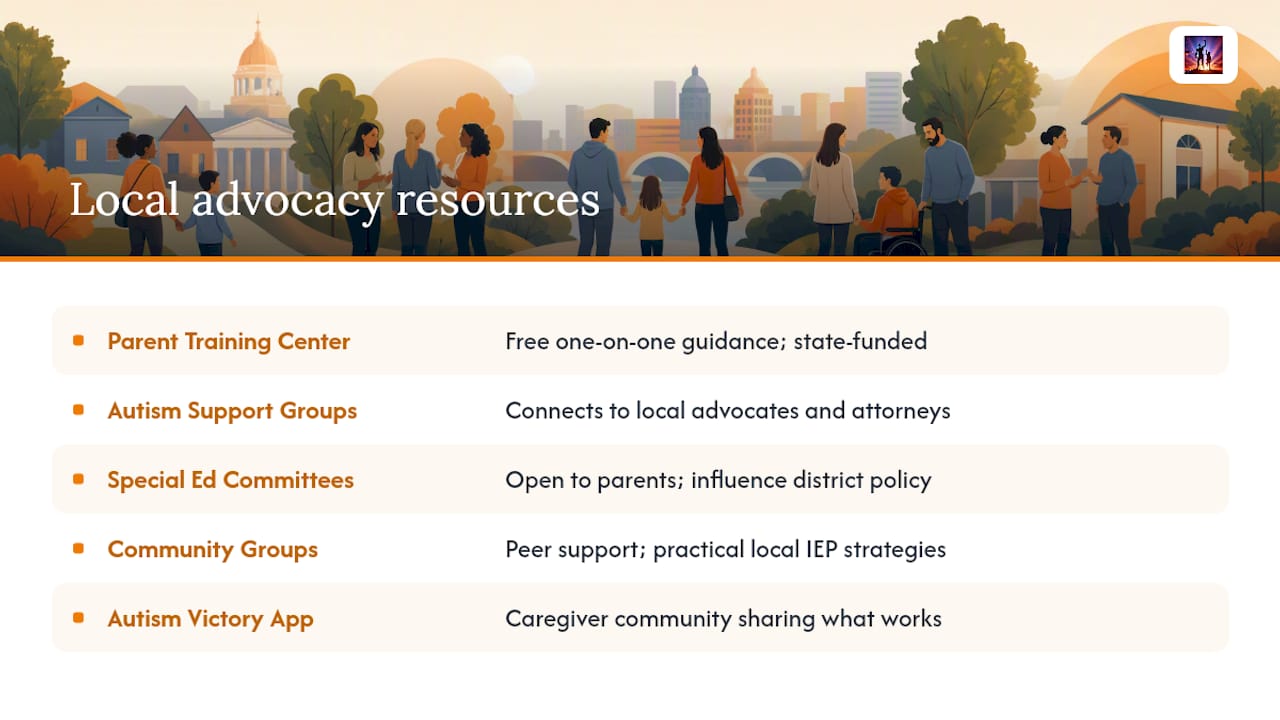
Start with your state’s Parent Training and Information Center, funded federally in every state to offer free, one-on-one guidance and often direct knowledge of how your specific district behaves. Autism-specific parent support groups, frequently organized through local chapters of national autism organizations or independent nonprofits, can point you toward advocates and attorneys with a track record in your area. School district Special Education Advisory Committees are open to parents and offer a direct line to policy conversations most families never see.
Community-based groups also matter for something harder to quantify: knowing you’re not the only parent who’s hard to fight for a one-on-one aide or push back on a district’s boilerplate IEP language. The PTA’s advocacy toolkit offers a useful framework for parents who want to move beyond their own child’s case into broader school and district-level change, including how to contact decisionmakers and organize site visits. Autism Victory App’s caregiver community connects you with families further along in the same process, which is often the fastest way to learn what actually works in practice rather than what’s supposed to work on paper.
What Actually Moves the Needle
Most advocacy advice treats confrontation as the goal, as if the parent who argues hardest wins. That’s backwards. The families who get results are the ones who show up with dated records and a specific ask, not the ones who show up angriest. Start a communication log today, even before you think you need one. Small, consistent documentation beats a perfect argument delivered too late.
— Ronnie Talent
Where Autism Victory App Fits Into Your Toolkit
Once you’ve pulled records, run a rights assessment, and started your communication log, you still need somewhere to keep it all organized around your child, not just your district. That’s the gap Autism Victory App fills.
The app centers on a state-specific resource finder that pulls together funding and support programs for your exact state, so you’re not sifting through fifty states’ worth of policy pages to find the three that apply to you. It layers in AI-guided support for quick questions between meetings, caregiver-focused books and audiobooks in English and Spanish, educational videos, and a community of other autism parents who’ve already been through the IEP table you’re about to sit at. None of that replaces the free legal tools from Wrightslaw or EducationAdvocate. It’s built to sit alongside them, organizing the parts of this process that are specific to your family and your state.
Autism Victory App runs on a monthly or annual subscription with a 7 day free trial, so you can see whether it fits your routine before committing. Start your free trial and see how the state resource finder maps to your own district’s requirements.
Sources
Save these five, and you’ll have most of what you need without hunting for it again mid-crisis.
Special Education & Related Services: Advocating for Students with Disabilities (Public Counsel)
Evidence Advocacy Center — parents and family advocates resources menu
Recommended