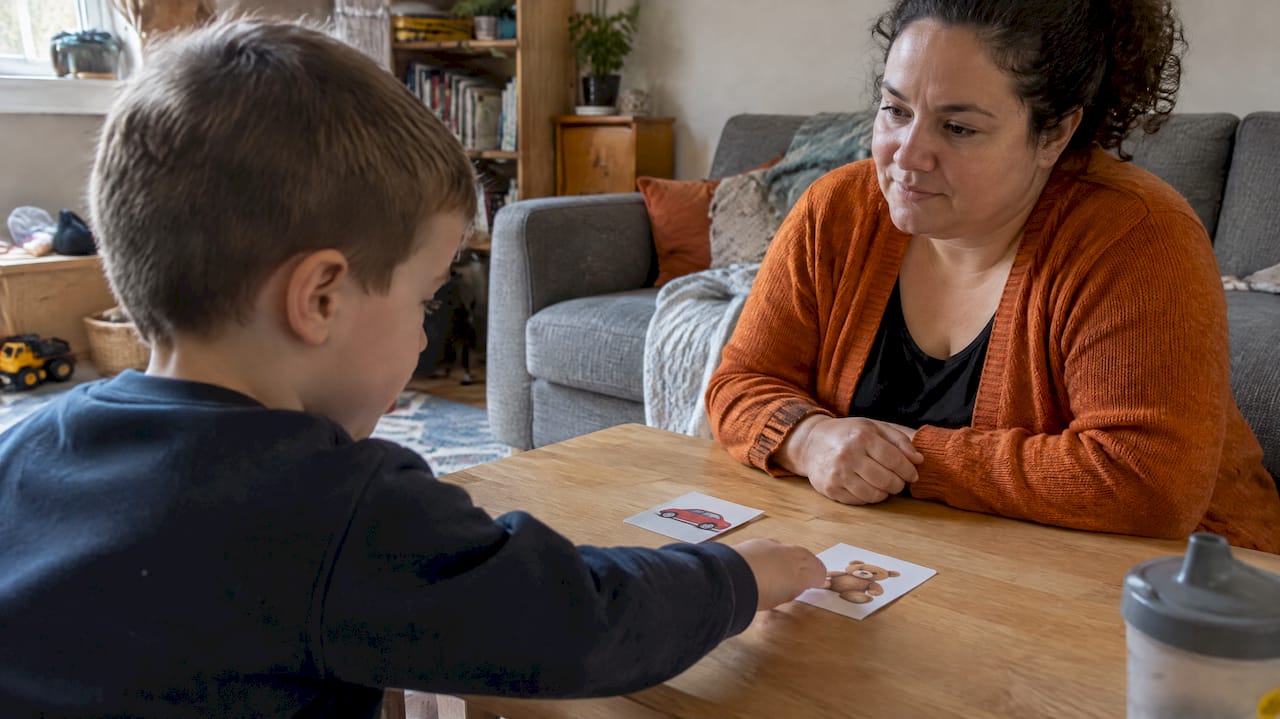
Autistic inertia is a real, well-documented difficulty with starting, stopping, or switching between activities, and it shows up even when someone genuinely wants to move. It is not laziness, defiance, or poor time management.
TL;DR:
External cues that trigger a single physical action are the most effective way to overcome start, stop, or switch inertia in autistic individuals.
Breaking tasks into micro-steps and using visual schedules significantly reduce the mental load that makes initiating or switching activities difficult.
Inertia often cycles with mood disorders such as depression or anxiety, and sudden changes in inertia patterns should prompt professional evaluation.
Co-creating routines and using predictable transitions with support tools like video modeling or heavy work activities can strengthen independence.
Professional intervention may be needed if inertia is accompanied by new motor symptoms, regression, or signs of catatonia, self-harm risk, or severe mood decline.
Table of Contents
What Autistic Inertia Means and Its Three Forms
How Autistic Inertia Feels Day to Day
Why Autistic Inertia Happens
Telling Autistic Inertia Apart From Procrastination, ADHD Paralysis, Burnout, and Catatonia
Practical Ways to Reduce the Grip of Autistic Inertia
When Autistic Inertia Needs Professional Attention
How Autism Victory Supports Families Working Through Inertia
Inertia Deserves Respect, Not Correction
Start Building Your Family's Scaffolding Toolkit
Sources
What Autistic Inertia Means and Its Three Forms
Think of inertia the way a physicist would: an object at rest stays at rest, and an object in motion stays in motion, until something acts on it. Autistic inertia works the same way in daily life. Once you are sitting still, staying still takes no effort at all, but getting up can feel almost physically impossible. Once you are absorbed in something, stopping can feel just as hard.
A 2021 qualitative focus group study led by autistic researchers gathered 32 autistic adults to talk about this exact pattern, and the researchers organized what they heard into three recognizable types:
Start inertia: difficulty initiating a task, even a wanted or necessary one, like getting out of bed, replying to a text, or beginning a work assignment you already have open on your screen.
Stop inertia: difficulty ending an activity once it begins, even past the point of hunger, exhaustion, or a hard deadline, such as staying up for hours past an intended bedtime because closing the laptop feels unreachable.
Switch inertia: difficulty moving from one task or state to another, such as pausing a video game to answer the door or shifting from focused work to a scheduled meeting.
The same focus group study found four overarching themes across these accounts: how people describe inertia, what scaffolding helps them act, how wellbeing shapes the severity, and how much it affects daily life. This was not a fringe experience among the participants. It came up consistently enough that the researchers treated it as a core, shared part of autistic functioning rather than an individual quirk.
How Autistic Inertia Feels Day to Day
People describe it less like reluctance and more like a disconnect between intention and movement. Participants in the first-hand accounts study used words like "frozen," "stuck," and a sense that the brain had decided to act but the body had not received the message. That gap is confusing and often frightening the first few times it happens, especially for someone who has no name for it yet.

The experience tends to split into two extremes rather than sitting in the middle. One extreme is inertial rest: being still, often scrolling, lying down, or staring at a wall, and finding it almost impossible to generate the first movement toward anything else, even something pleasant. The other is inertial motion: being locked into an activity, sometimes a productive one, and finding it just as hard to stop as it was to start the resting state. A large-scale analysis of Reddit discourse found this same rest-motion pattern across a huge body of community writing, which suggests it is not a one-off clinical description but a widely shared experience.
That same research described a vicious cycle: inertia makes it harder to complete tasks, missed tasks create shame and anxiety, and that anxiety feeds back into making the next task even harder to start. Caregivers and autistic adults alike recognize this in ordinary moments:
Knowing you need to shower, wanting to shower, and still sitting on the bed for forty minutes before your body moves.
Staying at a desk long after a shift ends because closing out of an email feels like it requires a kind of effort you do not have.
A parent watching their child freeze at the classroom door, clearly wanting to go in, unable to take the first step without a hand to hold or a verbal cue.
A 2026 analysis of 501 Reddit posts and 9,955 comments spanning 2005 to 2022 found consistent evidence of this inertial rest and motion pattern, along with a cycle linking inertia to co-occurring conditions like depression. The sheer scale of that dataset matters: it means the pattern holds up across thousands of independent, unprompted descriptions, not just a single interview room.
Why Autistic Inertia Happens
No single mechanism fully explains autistic inertia, and that is worth saying plainly rather than papering over. Several overlapping factors show up across the research and clinical literature, and most autistic people probably experience some combination of them.
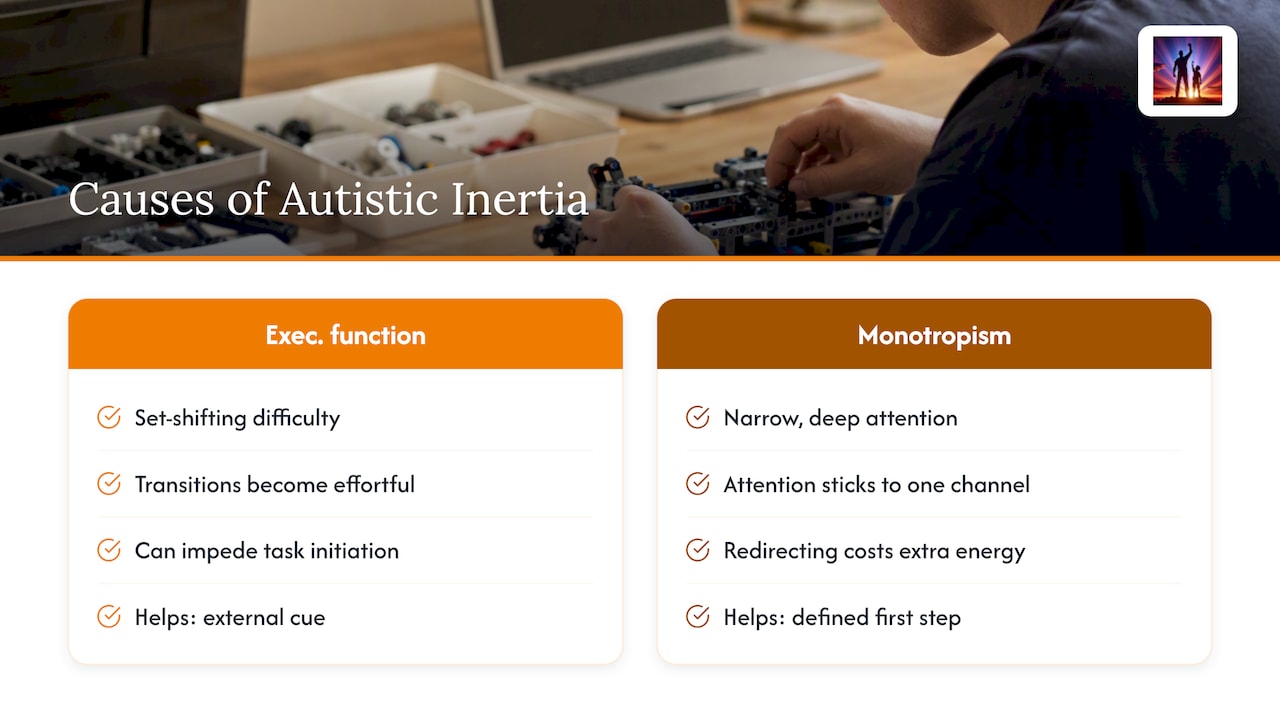
Executive function differences are the most commonly cited factor. Set-shifting, the mental process of disengaging from one task and engaging with another, can take more deliberate effort for autistic people, which turns an ordinary transition into a real cognitive task rather than an automatic one.
Monotropism offers a different and complementary explanation. This is the tendency toward a single, deeply absorbing channel of attention rather than several channels running at once. It is often a genuine strength, producing focus and depth that many autistic people value, but it also means pulling attention away from that channel, or redirecting it toward a new one, takes disproportionate energy. A resource on monotropism and flow states frames this directly as a double-edged trait: the same narrow, deep attention that produces flow also produces stop and switch inertia.
Motor initiation differences are a more cautious piece of the picture. Some autistic people describe the sense that their body will not execute a movement their mind has already decided on, which researchers have linked to possible differences in motor planning and execution rather than simple avoidance. This is an area where more research is needed, and it is one reason occupational therapy assessment can be worth pursuing when inertia shows up alongside other motor or coordination concerns.
Stress, anxiety, and depression reliably make inertia worse. A summary reviewing literature on autistic inertia points to executive dysfunction, monotropism, impaired prospective memory, and motor control differences as overlapping contributors, and notes that an external cue or a defined first step can reduce the initiation gap regardless of which mechanism is driving it for a given person.
Inertia is not a character flaw to correct. It is a measurable interaction between attention, executive function, and sometimes motor planning, and it responds to structure far more reliably than it responds to pressure.
Mental health plays a reinforcing role rather than a separate one. Ongoing parenting stress and anxiety in a household can tighten this loop for both the autistic person and the people supporting them, since chronic stress narrows the cognitive bandwidth available for the very executive processes inertia already strains.
Telling Autistic Inertia Apart From Procrastination, ADHD Paralysis, Burnout, and Catatonia
Getting the label right matters because the right response depends on what is actually happening underneath the stillness.
Procrastination usually involves some choice, however uncomfortable. There is often an internal narrative of "I'll do it later," and the task eventually gets done under enough external pressure. Autistic inertia frequently persists even when the person desperately wants to act and the deadline has already passed.
ADHD task paralysis shares surface similarities, including difficulty starting tasks, but tends to center on working memory overload, distractibility, and difficulty prioritizing among competing demands rather than a start-stop-switch pattern specifically. Many autistic people are also diagnosed with ADHD (sometimes called AuDHD), and when both are present, support usually needs to address both the attention-switching demands of ADHD and the transition-specific stuckness of autistic inertia.
Autistic burnout is a state of chronic exhaustion from prolonged masking or overload, and it tends to build over weeks or months, affecting nearly every domain of functioning at once. Inertia can appear during burnout, but burnout also involves skill regression, increased sensory sensitivity, and a depleted baseline that does not resolve with a single good night's sleep.
Catatonia, a recognized motor and behavioral condition that can co-occur with autism, involves more pronounced and sustained motor symptoms, such as prolonged immobility, unusual posturing, or repetitive movements, and it is a clinical diagnosis that requires a trained professional to identify.
The clearest distinguishing question is usually this: does the person want to act, and does a small prompt reliably unlock movement? If yes, inertia is the likely explanation. If the stillness is accompanied by declining skills, new motor symptoms, or a flattened affect that does not lift with cues, it is worth raising with a clinician rather than assuming it is inertia alone.
Practical Ways to Reduce the Grip of Autistic Inertia
The research is consistent on one point: pressure and reminders to "just start" rarely work, but a concrete external cue frequently does. The first-hand accounts study found that prompting an initial physical action, or offering a compatible activity that bridges into the needed one, was the most reliably effective intervention participants described.
A few principles sit underneath most effective tactics:
Anticipate transitions before they happen. A warning that a change is coming, delivered a few minutes ahead, gives the brain time to disengage from the current state rather than being yanked out of it.
Cue the first physical action, not the whole task. "Put one hand on the doorknob" works better than "go to school," because it removes the decision-making load from the hardest part: the first movement.
Reduce the number of decisions required to begin. Laying out clothes the night before, or pre-opening the document you need to work on, removes small choices that would otherwise stall the start.
Respect flow states instead of fighting them. Interrupting deep focus abruptly tends to backfire; a scheduled, predictable stopping cue works better than a surprise one.
Break tasks into micro-steps small enough that the first one feels almost trivial. "Open the laundry basket" is a complete, achievable unit in a way that "do the laundry" is not.
Use visual schedules so the next step is visible rather than something that has to be recalled from memory. Our practical guide to building visual schedules walks through how to set one up for a child or an adult.
Try video modeling for tasks that are hard to picture from a verbal instruction alone. Watching the sequence performed, rather than hearing it described, can close the gap between intention and action.
Build in heavy work activities, like carrying, pushing, or pulling something with resistance, before a task that requires initiation; some autistic people find this kind of proprioceptive input makes the first movement easier to generate. Our guide to heavy work activities covers age-appropriate options.
Chain tasks to existing habits so the next action is triggered automatically by the one before it, rather than requiring a fresh decision each time.
Occupational therapy offers a more structured version of this same approach. Cognitive Orientation to daily Occupational Performance (CO-OP), a task-specific intervention, has shown measurable improvement in motor-based goal attainment among autistic children with coordination difficulties in clinical studies. It will not eliminate inertia, and no current intervention promises that, but it gives families a structured way to build and test strategies with professional support rather than guessing alone.
Pro Tip: Introduce a new prompt as a predictable part of the routine, not a surprise correction. Say what the cue will be and when it will happen, then use it consistently so it becomes expected rather than intrusive.
How a scaffold is introduced matters as much as the scaffold itself. A timer that appears without warning can feel like pressure; the same timer, agreed on in advance as "our signal to start packing up," feels like support. Co-creating the system with the autistic person, asking what kind of cue feels helpful rather than irritating, and treating a declined suggestion as useful information rather than resistance all preserve dignity while still building structure. Communication tools like visual communication boards can also lower the friction of expressing "I'm stuck" in the moment, which is often the fastest route to getting the right kind of help.
When Autistic Inertia Needs Professional Attention
Most inertia can be managed with the scaffolds above, but some patterns deserve a closer look from a professional.
A sudden or significant change in how often or how severely inertia occurs, especially without an obvious trigger, is worth discussing with a doctor rather than assuming it will pass.
New motor symptoms, such as unusual posturing, repetitive movements, or prolonged immobility that does not respond to any cue, should be evaluated promptly since these can point toward catatonia, which requires specific clinical management.
Any sign of self-harm risk or a steep drop in mood alongside increased inertia warrants an urgent conversation with a mental health professional, since the inertia-depression cycle described in the community discourse research can deepen quickly without support.
Occupational therapists can assess motor planning and coordination and introduce structured approaches like CO-OP when movement initiation itself seems to be part of the picture.
Psychiatrists or psychologists can help when anxiety, depression, or another co-occurring condition appears to be driving or worsening the inertia, and can assess for ADHD when the pattern suggests AuDHD rather than autism alone.
Neurologists become relevant mainly when motor symptoms raise questions about movement disorders separate from, or alongside, autism.
A Cambridge-led summary of community discussion data found that structured routines help some autistic people but fail others, and that when supports fail, some people turn to recreational substances to manage the resulting distress. That finding is a reason to treat persistent, unresponsive inertia as worth a clinical conversation rather than something to push through indefinitely.
How Autism Victory Supports Families Working Through Inertia
We built Autism Victory around the same idea the research points to: structure and the right cue, delivered consistently, make the biggest practical difference. Inside the app, visual schedule tools and bilingual educational videos give families a ready-made way to turn the scaffolding strategies above into a daily routine instead of a one-time effort. AI-powered guidance is there when you need to think through a specific transition or meltdown pattern at 11 PM, and a state-specific resource navigator helps find local occupational therapy and support options when a tool like CO-OP seems worth pursuing.
I write and review much of this content as part of our caregiver-focused library, drawing on what the research says and what actually holds up in daily family life. The goal is not to replace professional assessment but to give you a practical starting point while you figure out next steps.
Inertia Deserves Respect, Not Correction
Autistic inertia sits at an uncomfortable intersection: the same narrowed attention that produces stuckness also produces some of the deepest, most satisfying focus an autistic person can experience. Treating inertia purely as a problem to eliminate risks flattening that strength along with the difficulty.
The more useful frame is adaptation, not correction. A good scaffold does not override someone's way of processing the world; it works with it, giving the brain the specific input it needs to move while leaving the underlying wiring alone. That is a collaborative project between the autistic person and the people around them, not something imposed from outside.
Start small. Try one cue, one visual schedule, one predictable transition warning, and notice what shifts. When inertia still feels unmanageable after that, a professional conversation is a reasonable next step, not a sign that the earlier effort failed.
— Ronnie Talent
Start Building Your Family's Scaffolding Toolkit
Figuring out the right cue, schedule, or transition routine for your specific child or situation usually takes some trial and error, and having guidance on hand speeds that process up considerably.

Our app puts visual schedule builders, bilingual educational videos, AI-powered guidance, and a state-specific resource navigator in one place, so you are not piecing together strategies from a dozen tabs while your child is mid-transition. A 5-day free trial lets you test whether these tools fit your family's routine before you commit. Full access runs $49.95 per year or $6.95 per month, both available on our pricing page. If you are ready to put real structure around inertia instead of just reacting to it day by day, that pricing page is the place to start.
This article is general information, not a substitute for advice from a qualified doctor. Consult a qualified healthcare professional about your own circumstances before acting on anything here.
FAQ
What does autistic inertia feel like?
Many autistic people describe it as a disconnect between wanting to move and the body actually moving, sometimes using words like "frozen" or "stuck" even when the intention to act is clear. It can happen when starting a task, stopping one, or switching between activities, and it often brings frustration or shame when others assume it reflects a lack of effort.
What is the difference between ADHD inertia and autistic inertia?
ADHD-related task paralysis tends to stem from working memory overload and difficulty prioritizing among competing demands, while autistic inertia centers specifically on starting, stopping, and switching activities, often tied to monotropism and executive function differences. The two frequently co-occur in AuDHD, and support usually needs to address both patterns rather than treating them as the same thing.
How to break out of autistic inertia?
The most consistently reported strategy is an external cue aimed at the very first physical action, such as "put your hand on the door" rather than "get ready to leave," according to first-hand accounts from autistic adults. Visual schedules, advance transition warnings, and breaking tasks into small, concrete steps also help reduce the decision load that makes starting hard.
What do autistic meltdowns look like in adults?
A meltdown is an involuntary response to overwhelm, distinct from a tantrum, and it is not something the person can simply choose to stop through willpower or discipline. According to clinical guidance on meltdowns versus tantrums, the right response usually involves reducing sensory or environmental demands rather than applying consequences, since meltdowns are not goal-directed behavior.
Sources
“No Way Out Except From External Intervention”: First‑Hand Accounts of Autistic Inertia
CO‑OP intervention effectiveness for autistic children with DCD
Recommended