Autism Therapy Costs in 2026: What Families Actually Pay
Most U.S. families pay far less than the private-pay sticker price once insurance or Medicaid applies. With all 50 states mandating ABA insurance coverage and Medicaid’s EPSDT provision covering medically necessary therapy for children under 21, your real out-of-pocket cost often lands in the low thousands per year rather than the six-figure totals you see on provider websites. That said, families on high-deductible plans or pursuing intensive therapy (25–40 hours per week) can still face $5,000–$15,000 or more annually before hitting their out-of-pocket maximum.
Three actions you can take today:
Verify your plan benefits in writing. Call the member services number on your insurance card and ask specifically whether ABA (CPT codes 97151–97158) is covered, what your deductible is, and what your out-of-pocket maximum is.
Check Medicaid and EPSDT eligibility. If your child is under 21 and your household income qualifies, Medicaid may cover therapy at little to no cost to you.
Request an itemized estimate from any provider you are considering. Ask for weekly hours by staff type, the CPT codes they bill, and whether they will verify your benefits before your first session.
Pro Tip: Track your out-of-pocket maximum from January 1. Families in intensive ABA programs often hit their annual maximum within the first few months of the year, which means therapy becomes effectively free for the rest of the year. Knowing your reset date changes your cash-flow planning entirely. The Autism Victory App can help you organize benefit details and track spending in one place.
Table of Contents
What do autism therapy costs actually look like by therapy type?
How insurance mechanics determine what you actually pay
How do public programs and private insurance reduce therapy costs?
How to estimate your family’s monthly out-of-pocket therapy costs
What funding options can reduce what your family pays?
What should you ask providers and insurers before starting therapy?
What are realistic timelines for authorization, waitlists, and appeals?
How Autism Victory App helps you manage therapy costs and find funding
Key Takeaways
What families navigating therapy costs need to hear
Authoritative sources and state resources worth checking
What do autism therapy costs actually look like by therapy type?
Private-pay rates vary significantly by therapy type and provider credential. ABA therapy drives the largest bills, but speech, occupational, and social skills therapies add up quickly too.

Provider credential and hourly rate ranges (2026)
Provider Role | Typical Hourly Rate | What They Do |
|---|---|---|
Registered Behavior Technician (RBT) | $50–$100/hr | Delivers direct ABA sessions under supervision |
Board Certified Assistant Behavior Analyst (BCaBA) | moderate hourly rate | Provides direct and some supervisory services |
Board Certified Behavior Analyst (BCBA) | $120–$250+/hr | Designs programs, supervises RBTs, conducts assessments |
BCBA-D (doctoral level) | advanced-level hourly rate | Same as BCBA with advanced clinical or research focus |
Speech-Language Pathologist | variable hourly rate | Addresses communication and language goals |
Occupational Therapist | moderate hourly rate | Targets sensory processing, fine motor, daily living skills |
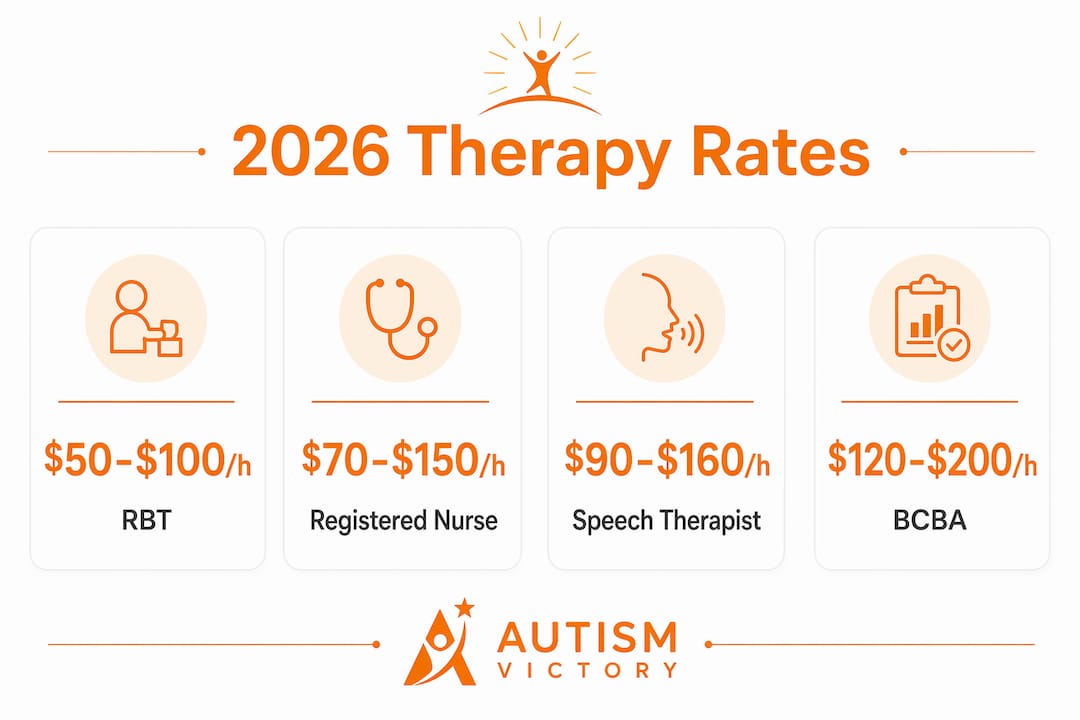
Geographic variation is substantial. High-cost states like California, New York, and Massachusetts push BCBA rates toward the top of those ranges ($150–$250+/hr), while lower-cost states in the South and Midwest often start around $75–$135/hr.
Monthly cost examples suggest that therapy intensity and rates combine to produce variable monthly costs.
Weekly Hours | Blended Rate | Estimated Monthly Cost (Private Pay) |
|---|---|---|
10 hrs/wk | $120/hr | $5,160 |
20 hrs/wk | $120/hr | $10,320 |
30 hrs/wk | $120/hr | $15,480 |
40 hrs/wk | $120/hr | $20,640 |
Healthcare inflation and provider shortages are pushing those figures higher in 2026. The monthly totals above assume private-pay rates. Insurance and Medicaid change the math dramatically, which is why understanding your plan mechanics matters more than memorizing hourly rates.
How insurance mechanics determine what you actually pay
The sticker price matters far less than four numbers on your insurance card: deductible, coinsurance, copay, and out-of-pocket maximum.
Deductible: The amount you pay before insurance starts sharing costs. A $3,000 deductible means you pay the first $3,000 of covered services each year.
Coinsurance: Your share after the deductible. At 20% coinsurance, you pay $200 on a $1,000 covered bill; insurance pays $800.
Copay: A flat fee per visit (often $25–$50 for therapy sessions) that may apply instead of or alongside coinsurance.
Out-of-pocket maximum: The most you will pay in a calendar year. Once you hit it, covered services cost you nothing for the rest of the year.
Blended billing adds another layer. Most ABA clinics staff the majority of direct hours with RBTs (billing at $50–$100/hr) while BCBAs handle assessments and supervision (billing at $120–$250+/hr). A clinic that uses a high RBT-to-BCBA ratio will produce a lower blended monthly bill than one where BCBAs deliver most direct hours.
Worked example: Your child receives 20 hours per week of ABA. The provider’s blended rate is $120/hr, producing a gross monthly bill of roughly $10,400. Your plan has a $3,000 deductible (not yet met), then 20% coinsurance, and a $6,000 out-of-pocket maximum. Month one: you pay $3,000 toward the deductible, then 20% of the remaining $7,400, which is $1,480. Total month one: $4,480. Month two onward: 20% of $10,400 is $2,080 per month until you hit the $6,000 cap. You reach your maximum partway through month two. After that, covered ABA costs you nothing until January 1.
Pro Tip: When reviewing an Explanation of Benefits (EOB), check the “amount applied to deductible” and “patient responsibility” columns. If those numbers do not match your expectations, call your insurer before paying the provider’s bill.
Checklist for reading your EOB:
Confirm the CPT codes match what the provider said they would bill
Check whether the service was processed as in-network
Verify the amount applied to your deductible matches your running total
Note the remaining out-of-pocket balance so you can project when you will hit the cap
How do public programs and private insurance reduce therapy costs?
Coverage programs fall into four main categories, and most families benefit from combining more than one.
State insurance mandates: All 50 states require private insurers to cover ABA therapy. The catch: self-funded employer plans (governed by ERISA) are not bound by state mandates, so coverage varies. Always ask HR whether your plan is “fully insured” or “self-funded.”
Medicaid and EPSDT: Medicaid covers medically necessary ABA for children under 21 through EPSDT. Eligibility is income-based, but the coverage can be comprehensive. Check your state Medicaid agency’s website or call 1-800-MEDICARE for a referral.
Medicaid waiver programs: These extend services beyond standard Medicaid, often with little to no family cost. The downside: waitlists can stretch years in many states. Apply the day you know your child qualifies. The Autism Victory App blog covers waiver waitlists for all 50 states with 2026 data.
School services under IDEA: An Individualized Education Program (IEP) can include speech, occupational, and behavioral services at no cost to the family. IEP hours do not replace clinical ABA, but they reduce the total private-pay hours you need. Understanding the difference between an IEP and a 504 plan matters for maximizing what the school funds.
Pro Tip: Document every phone call with your insurer. Write down the date, the representative’s name, and the reference number. If coverage is later denied, that documentation is your first line of defense in an appeal.
Key stat: Children with treated ASD covered by public insurance had average total health expenditures of $15,544 annually, compared to $23,858 for those on private insurance, according to AHRQ’s Medical Expenditure Panel Survey (2018–2022).
How to estimate your family’s monthly out-of-pocket therapy costs
Use this four-step method to build a realistic budget before therapy starts.
Collect your inputs. Get the recommended weekly hours and staff mix from the provider, the provider’s private-pay hourly rates by staff type, and your insurer’s deductible, coinsurance percentage, copay, and out-of-pocket maximum.
Calculate gross monthly cost. Multiply weekly hours by the blended hourly rate, then multiply by 4.3 (average weeks per month).
Apply insurance mechanics. Subtract your remaining deductible from the gross bill. Apply your coinsurance percentage to the remainder. Add any per-visit copays. Stop when the running total hits your out-of-pocket maximum.
Project the full year. Estimate which month you will hit your out-of-pocket max, then treat remaining months as $0 for covered services.
Sample budget scenarios
Scenario | Weekly Hours | Blended Rate | Gross Monthly | Est. Annual Out-of-Pocket* |
|---|---|---|---|---|
Moderate (10–15 hrs/wk) | — | — | — | ~$4,000–$6,000 |
Intensive (25–30 hrs/wk) | — | — | $15,544 | ~$6,000–$10,000 |
*Assumes a $3,000 deductible and 20% coinsurance with a $6,000–$8,000 out-of-pocket maximum. Actual costs vary by plan.
Assumption callout: Three variables change these numbers most: your deductible amount, your coinsurance percentage, and whether Medicaid applies. If Medicaid is your primary payer, your out-of-pocket cost may be near zero.
Diagnostic evaluations and initial ABA assessments often arrive before insurance authorization completes, so budget for those separately as early-year expenses.
What funding options can reduce what your family pays?
Combining multiple funding sources is the most common strategy families use to make therapy affordable.
Medicaid waivers: Potentially the most valuable option, but apply immediately given multi-year waitlists in many states.
SSI/SSDI: Monthly cash assistance for qualifying children and adults. See the Autism Victory App SSI guide for 2026 payment amounts and income limits.
State grant programs: Many states fund therapy grants through developmental disability agencies. Eligibility and amounts vary widely.
National non-profits: Organizations like the Autism Society of America and the ACT Today! charity offer scholarships and grants for therapy expenses.
FSAs and HSAs: ABA qualifies as an IRS-eligible medical expense, so contributions to a Flexible Spending Account or Health Savings Account reduce your effective cost through pre-tax dollars.
Sliding-scale clinics: Many university-affiliated and non-profit clinics offer reduced rates based on income. Ask directly; not all providers advertise this.
IEP school funding: Maximizing IEP hours reduces the clinical hours you pay for privately.
Pro Tip: Front-load your FSA or HSA contributions in January if you know intensive therapy is starting. Because ABA bills are front-loaded (deductible hits early), having those pre-tax dollars available in Q1 prevents cash-flow gaps.
Funding Source | Typical Benefit | Where to Apply |
|---|---|---|
Medicaid/EPSDT | Full or near-full coverage | State Medicaid agency |
Medicaid waiver | Comprehensive, low/no cost | State developmental disability office |
FSA/HSA | Pre-tax savings on out-of-pocket | Employer benefits portal or HSA bank |
State grants | Varies by state | State health or education department |
Non-profit scholarships | Partial therapy costs | Organization websites directly |
What should you ask providers and insurers before starting therapy?
Getting a reliable cost estimate requires specific questions. Generic answers lead to surprise bills.
Ask your provider:
Which CPT codes will you bill for my child’s services?
How many hours per week will be delivered by RBTs versus BCBAs?
What is your private-pay hourly rate for each staff type?
Will you verify my insurance benefits before the first session?
Do you offer sliding-scale rates or payment plans?
What is your cancellation and no-show policy, and are those sessions billed?
Ask your insurer:
Is ABA therapy covered under my plan, and which CPT codes are included?
Is my plan fully insured or self-funded (ERISA)?
What is my current deductible balance and out-of-pocket maximum remaining?
What is the prior authorization process, and how long does it typically take?
What is the in-network reimbursement rate for CPT code 97153?
Are there annual visit limits or hour caps on ABA coverage?
Sample email to a provider:
Pro Tip: Request a “verification of benefits” (VOB) confirmation in writing from the provider, not just verbally. A written VOB protects you if the insurer later disputes coverage.
What are realistic timelines for authorization, waitlists, and appeals?
Prior authorization for ABA typically takes 2–6 weeks after a completed assessment is submitted.
Initial diagnostic evaluations can take 1–3 months to schedule at many clinics.
Medicaid waiver waitlists range from months to several years depending on your state.
Families in intensive programs often hit their annual out-of-pocket maximum within the first 2–3 months of the calendar year.
If coverage is denied, act quickly. Most plans give you 30–60 days to file an internal appeal.
Appeal steps:
Request the denial letter and the specific reason code in writing.
Obtain a letter of medical necessity from your child’s diagnosing physician or BCBA.
Gather supporting documentation: assessment reports, treatment plans, and progress notes.
Submit an internal appeal with all documentation attached.
If the internal appeal fails, request an external independent review (required under the ACA for most plans).
Contact your state insurance commissioner if the external review is also denied.
Documents to attach to every appeal: denial letter, letter of medical necessity, diagnostic report, treatment plan, and any prior authorization correspondence.
How Autism Victory App helps you manage therapy costs and find funding

Autism Victory App is built specifically for families navigating the financial and logistical complexity of autism care. The app’s state-specific funding navigator pulls together Medicaid waiver information, grant programs, and benefit resources organized by your state, so you are not searching dozens of government websites on your own.
Key features relevant to cost management:
State funding navigator: Locate Medicaid waiver applications, state grant programs, and local resources specific to your state.
Benefit-verification guidance: Step-by-step prompts to help you ask the right questions when calling your insurer.
Caregiver community: Connect with other parents who have navigated the same insurance and funding challenges.
Books, audiobooks, and educational videos: Resources in both English and Spanish covering financial planning, IEP advocacy, and benefit applications.
AI-powered guidance: Personalized answers to your specific questions about coverage, appeals, and funding options.
Use the app in the workflow above: store your benefit summary after the VOB call, save your appeal documentation, and use the state navigator to locate waiver applications the same day your child is diagnosed.
Pro Tip: Start your 7-day free trial on the same day you request your first provider estimate. Use day one to locate your state’s Medicaid waiver page inside the app, day two to review the benefit-verification checklist, and day three to explore grant options. By day five, you will have a clearer financial picture than most families get in months.
Key Takeaways
Most families pay far less than private-pay sticker rates once insurance mechanics, Medicaid, and tax-advantaged accounts are applied correctly.
Point | Details |
|---|---|
Verify benefits in writing | Always get a written VOB from your provider and confirm CPT code coverage with your insurer before therapy starts. |
Calculate real out-of-pocket | Use your deductible, coinsurance %, and out-of-pocket max to project monthly costs, not the provider’s hourly rate alone. |
Apply for waivers immediately | Medicaid waiver waitlists can span years; apply the day your child qualifies to preserve your place in line. |
Combine funding sources | Layering Medicaid, FSA/HSA pre-tax savings, IEP school hours, and grants is the most effective way to reduce out-of-pocket costs. |
Intensive therapy hits the cap fast | Families in 25–40 hr/wk programs often reach their annual out-of-pocket maximum within the first 2–3 months, making the rest of the year effectively free for covered services. |
What families navigating therapy costs need to hear
The number that stops most parents cold is the private-pay sticker price. A $22,000-per-month figure for intensive ABA is real, but it is not what most families actually pay. The gap between that headline number and a family’s true out-of-pocket cost is where the real work happens, and it is almost entirely determined by plan mechanics, not the therapy itself.
What gets overlooked most often is the out-of-pocket maximum as a planning tool rather than just a ceiling. Families who understand their reset date, front-load their FSA contributions, and apply for waivers early are operating with a fundamentally different financial picture than families who react to bills as they arrive. The difference is not income. It is information and timing.
The appeals process is also underused. Denials are not final verdicts. With a strong letter of medical necessity and complete documentation, many families successfully overturn initial denials. The process is not fast or easy, but it works often enough that skipping it is a costly mistake.
If you are at the beginning of this process, the most valuable thing you can do today is not find the cheapest provider. It is to understand your plan’s cost-sharing structure, get your waiver application submitted, and build a realistic monthly budget before the first bill arrives.
Authoritative sources and state resources worth checking
AHRQ Medical Expenditure Panel Survey: Federal data on average health expenditures for children with treated ASD by insurance type and income level. Use this to understand population-level cost benchmarks.
ABA Navigator 2026 Cost Guide: Detailed breakdown of insurance mechanics, out-of-pocket dynamics, and family cost scenarios.
Alpaca Health ABA Cost Guide: Hourly rate ranges by credential, monthly cost examples, and FSA/HSA guidance for 2026.
Special Needs USA State-by-State Guide: State-level ABA pricing tiers and insurance mandate summaries.
Autism Victory App: State-specific funding navigator, benefit-verification tools, caregiver community, and AI-powered guidance for families managing therapy costs and applications.
Autism Victory Funding and Benefits Blog: Ongoing updates on grants, waiver policy changes, and funding program news organized by state.
Your state Medicaid agency website: Search “[your state] Medicaid waiver autism” to find your state’s specific waiver program, eligibility rules, and application portal.
This article is general information for educational purposes. Confirm your specific coverage, eligibility, and benefit details with your insurer, your state Medicaid agency, or a qualified benefits counselor before making financial decisions.
Recommended