Autism and ADHD: What Every Caregiver Needs to Know
Between 50% and 70% of autistic people also carry an ADHD diagnosis. That overlap is not a coincidence or a diagnostic trend. It reflects something real about how these two neurodevelopmental conditions share biological roots, even as they remain distinct in meaningful ways. Autism spectrum disorder (ASD) is defined by persistent differences in social communication, restricted interests, and repetitive behaviors. Attention-deficit/hyperactivity disorder (ADHD) centers on inattention, hyperactivity, and impulsivity across multiple settings. When both are present, the neurodiversity community often uses the term AuDHD to describe the unique interplay that creates.
Key distinctions at a glance:
Social communication: Autism involves fundamental differences in processing and interpreting social cues; ADHD-related social struggles typically stem from impulsivity or inattention rather than a core processing difference.
Routine and flexibility: Autistic individuals often rely on predictable routines for regulation; people with ADHD tend to seek novelty and resist repetition.
Attention profile: ADHD produces inconsistent, scattered attention; autism can produce intense, narrow hyperfocus on specific interests.
Repetitive behaviors: Restricted and repetitive behaviors are a diagnostic criterion for autism; they are not a core feature of ADHD.
Co-occurrence direction: Most autistic people do not have ADHD, but research estimates that 40–70% of children with ASD also meet criteria for ADHD.
How common is co-occurring autism and ADHD in the United States?
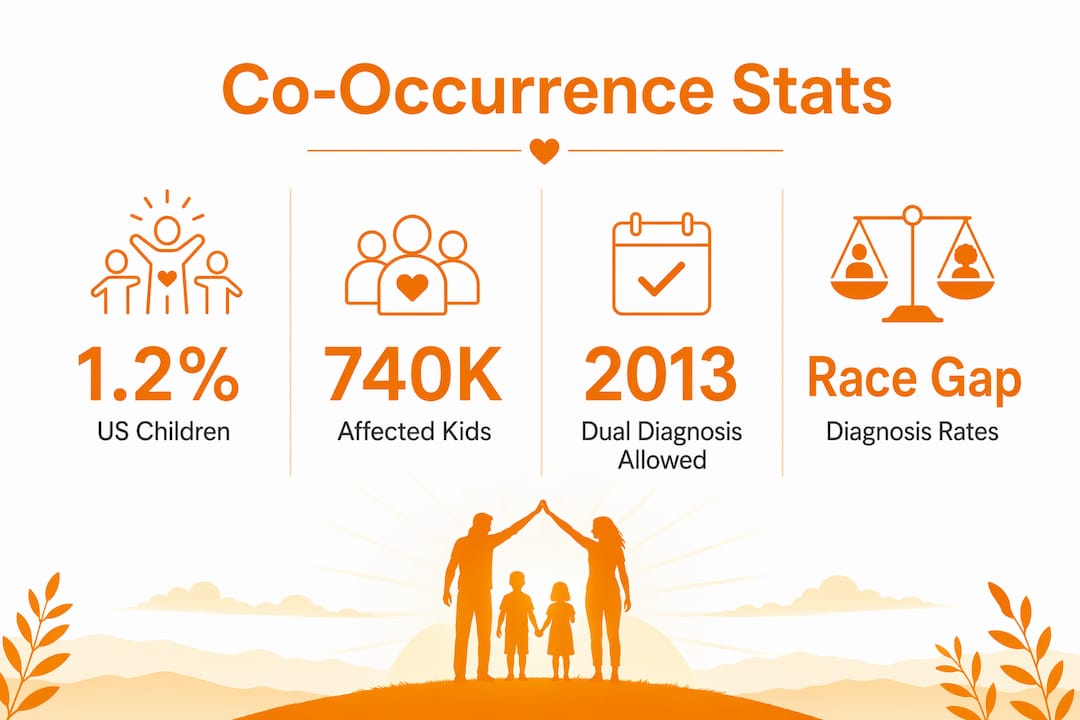
The numbers are striking. The 2016–2018 National Survey of Children’s Health found that approximately 1.2% of US children aged 3–17, roughly 740,816 children, had both ASD and ADHD diagnosed concurrently. That figure almost certainly undercounts the true rate, since many children receive one diagnosis years before clinicians look for the second.
Co-occurrence does not fade with age. Research from Children’s Hospital of Philadelphia and the AJ Drexel Autism Institute confirms that ADHD rates remain high into adulthood among patients with autism, meaning families are not simply managing a childhood phase.
Population | Co-occurrence estimate | Source basis |
|---|---|---|
US children aged 3–17 | 1.2% (740,816 children) | 2016–2018 National Survey of Children’s Health |
Children with ASD | 40%–70% also meet ADHD criteria | Peer-reviewed meta-analyses |
Children with ADHD | — | Frontiers in Psychiatry |
Race and ethnicity shape diagnosis rates, too. The National Survey data showed that Black, non-Hispanic children and multiracial, non-Hispanic children had significantly lower odds of a co-occurring diagnosis compared to White, non-Hispanic children, pointing to persistent gaps in screening access and referral patterns rather than true differences in prevalence.
What the neurobiology of autism and ADHD actually looks like
Both conditions involve differences in executive function, but the specific deficits diverge. ADHD primarily disrupts inhibition and sustained attention. Autism is more associated with deficits in cognitive flexibility, which drives the rigid thinking and resistance to routine changes that caregivers often see. When both conditions are present, executive function impairments tend to be worse than either condition produces alone.
Core autism symptoms:
Persistent differences in social communication and interaction
Restricted, repetitive behaviors and interests
Sensory sensitivities (over- or under-responsiveness to stimuli)
Preference for sameness and predictable routines
Difficulty with cognitive flexibility and transitions
Core ADHD characteristics:
Inattention across multiple settings
Hyperactivity and physical restlessness
Impulsivity affecting decisions and social interactions
Difficulty sustaining effort on low-stimulation tasks
Tendency to seek novelty
Shared features that complicate the picture:
Executive dysfunction
Sensory processing difficulties
Emotional dysregulation
Masking behaviors (suppressing neurodivergent traits in public)
Hyperfocus on preferred topics
Pro Tip: If your child’s sensory meltdowns seem tied to transitions rather than specific sensory inputs, that pattern points more toward autism’s cognitive rigidity than ADHD’s restlessness. Tracking the trigger context in a simple log helps clinicians distinguish the two.
Why diagnosing both conditions at the same time is harder than it sounds
Before 2013, clinicians could not diagnose autism and ADHD simultaneously. The DSM-4 treated them as mutually exclusive, so any inattentive or hyperactive symptoms in an autistic child were attributed to autism by default. The DSM-5 changed that, allowing dual diagnosis and opening the door to more complete care plans.

The problem is that overlapping symptoms still create real diagnostic risk. When a child’s most visible struggles involve attention and behavior, ADHD often gets diagnosed first. The autism diagnosis can then lag by years, delaying access to the specific supports that actually address the underlying differences in social communication and sensory processing.
Diagnostic overshadowing works in both directions. Comprehensive assessment tools and clinical expertise are necessary to prevent one diagnosis from masking the other. Females and high-masking individuals face particular risk because compensatory strategies can suppress visible symptoms long enough to pass standard screening thresholds.
Key assessment considerations:
Use standardized tools designed for neurodevelopmental evaluation, not general behavioral checklists.
Gather information from multiple settings (home, school, therapy) and multiple informants.
Assess symptom history across developmental stages, not just current presentation.
Explicitly evaluate for autism even when ADHD symptoms are prominent, and vice versa.
Pro Tip: When advocating for your child’s evaluation, ask the clinician directly: “Have you ruled out co-occurring ASD?” and “Have you ruled out co-occurring ADHD?” Getting both questions on the record shifts the clinical conversation toward a complete picture.
How to manage co-occurring autism and ADHD effectively
ADHD has approved medication treatments; autism does not. No medication currently addresses autism’s core symptoms, but medications can target co-occurring conditions including ADHD. When ADHD medications stabilize attention, they can make it easier for autistic individuals to engage with behavioral therapies that address social skills, sensory regulation, and daily living skills. The sequencing and coordination of these approaches matters.
A “start low and go slow” titration approach is recommended for individuals with both conditions, given heightened sensitivity to medication effects. Close monitoring of both efficacy and side effects is non-optional in this population.
Effective management strategies include:
Applied Behavior Analysis (ABA) adapted to address both attention regulation and social communication goals.
Cognitive Behavioral Therapy (CBT) modified for autistic cognitive styles, targeting emotional regulation and coping skills.
Occupational therapy addressing sensory processing, interoception, and daily living skills.
Social skills groups designed for neurodiverse participants, not neurotypical social norms.
School-based accommodations including extended time, reduced sensory load, and flexible seating.
Parent-mediated interventions that build caregiver capacity to support regulation at home.
For children, IEP vs. 504 plan decisions hinge on whether the child needs specialized instruction (IEP) or primarily environmental accommodations (504). Both conditions together often justify an IEP.
Trusted US-based resources for autism and ADHD support
Several established organizations and clinics across the United States specialize in the assessment and support of co-occurring autism and ADHD.
Organization | Location | Key services | Telehealth |
|---|---|---|---|
Sachs Center | New York, NY | Autism and ADHD testing, treatment plans, high-masking adult evaluations | Yes |
ATTN Center ADHD Testing | United States (virtual) | Virtual ADHD and autism diagnostic testing, reports | Yes |
ADHD Management and Wellness Clinic | United States | ADHD-focused therapy, wellness coaching, management support | Yes |
The Center for ADHD | United States (virtual) | Adult neurodiversity evaluations, teletherapy, coaching | Yes |
Pathfinders For Autism | Maryland | Community education, family support, lifespan services | Limited |
AJ Drexel Autism Institute | Philadelphia, PA | Autism research, educational resources, volunteer research programs | No |
Sachs Center and ATTN Center ADHD Testing both offer virtual diagnostic services, which matters for families in areas without local specialists. The Center for ADHD focuses specifically on adult neurodiversity, filling a gap that pediatric-focused services leave open. Pathfinders For Autism is Maryland’s largest autism organization, providing workshops, recreational events, and family support across the lifespan. The AJ Drexel Autism Institute at Drexel University contributes research and educational resources that inform clinical practice nationally.
Practical guidance for caregivers managing both conditions
The daily reality of raising a child with both autism and ADHD involves competing demands. Autism often calls for predictable structure and low sensory load. ADHD pulls toward novelty, movement, and frequent transitions. Those needs do not always point in the same direction, and that tension is one of the hardest parts of caregiving for AuDHD children.

Interoception difficulties are common in this population. When a child cannot reliably sense hunger, fatigue, or physical discomfort, emotional dysregulation and meltdowns follow. Treating these as a neurological issue rather than a behavioral choice changes how you respond and what therapies you seek.
Caregiver strategies that hold up in practice:
Build predictable daily routines with built-in movement breaks to address both autism’s need for structure and ADHD’s need for activity.
Use visual schedules to reduce transition anxiety while keeping the day’s flow clear.
Work with the child’s occupational therapist on interoception exercises to build body awareness.
Communicate with teachers in writing before school transitions, not after problems emerge.
Connect with other caregivers navigating the same dual diagnosis through community groups.
Prioritize your own rest and support. Caregiver burnout directly affects the quality of care you can provide.
Pro Tip: When a meltdown happens, resist the urge to problem-solve in the moment. Regulate first, reflect later. A calm co-regulation approach, where you stay physically present and emotionally steady, does more in that moment than any verbal strategy.
If your family is still finding its footing after a new autism diagnosis, the first 30 days are about gathering information, not having all the answers. Autism Victory App brings together AI-powered guidance, state-specific resources, caregiver books and audiobooks, and a community of families who understand exactly what you are navigating. Start your free trial and get the support your family deserves.
Key Takeaways
Co-occurring autism and ADHD affects an estimated 1.2% of US children aged 3–17, and the DSM-5’s 2013 allowance of dual diagnosis was the turning point that made complete, accurate care plans possible.
Point | Details |
|---|---|
High co-occurrence rate | Between 40% and 70% of children with ASD also meet criteria for ADHD. |
US prevalence | Approximately 1.2% of US children aged 3–17 (740,816 children) carry both diagnoses. |
DSM-5 was the turning point | Before 2013, dual diagnosis was not permitted; the DSM-5 changed that and enabled complete care. |
Diagnosis requires both directions | Clinicians must actively screen for ADHD in autistic patients and for autism in those with ADHD. |
Management must be coordinated | ADHD medications can support engagement in autism-specific therapies when carefully sequenced. |
Recommended