Yes, childhood apraxia of speech (CAS) can co-occur with autism, and identifying CAS changes therapy priorities because it calls for motor-based speech practice plus multimodal supports like AAC. Findings on how often this overlap happens vary widely depending on how studies define and sample their groups. If your child has autism and speech that seems inconsistent or hard to understand, an evaluation with a speech-language pathologist is the clearest next step, and the signs and strategies below will help you prepare for that conversation.
TL;DR:
Ask an SLP trained in motor speech for an exam, connected speech samples, and standardized CAS markers; home videos may reveal patterns missed in clinic.
Reported overlap rates vary by sample: studies of minimally verbal children find more suspected CAS than studies limited to children with largely intelligible speech.
Treatment should pair repetitive motor speech practice with autism focused communication support; AAC can reduce speaking pressure and support, rather than replace, spoken language.
Different attempts at the same word, visible mouth searching, or worsening errors in longer words warrant evaluation, especially with limited speech or rising frustration.
Table of Contents
Understanding apraxia vs. autism communication differences
How common is co-occurring apraxia, and how is it diagnosed?
Signs that point toward apraxia in an autistic child
How apraxia shapes daily communication and learning
Therapies that address both apraxia and autism
Coordinating care with therapists and schools
Practical strategies you can use at home
What the research says, and why it still feels unsettled
A parent's honest take on finding answers
How Autism Victory supports your next step
Sources
Understanding apraxia vs. autism communication differences
These two conditions get confused constantly, and we understand why: both can leave a child with limited or unclear speech. But they come from different places, and that difference drives everything about treatment.
Childhood Apraxia of Speech is a motor speech disorder. The brain struggles to plan and coordinate the precise, sequential movements needed for clear speech, even when the muscles themselves work fine. According to the ASHA practice portal on CAS, hallmark signs include inconsistent sound errors, difficulty moving smoothly between sounds, and prosodic abnormalities, meaning speech that sounds flat, overly even, or oddly stressed.
Autism's communication profile is different. It centers on social-pragmatic language: using words to connect, reading nonverbal cues, following conversational back-and-forth. A child with autism alone might speak clearly but struggle to use that speech for social purposes. A child with CAS might understand language perfectly and want desperately to talk, but the words come out garbled or won't come out at all.
Here's a simple way to picture the contrast:
A child with autism may say a word fluently in one context (labeling a toy) but not use it to request or comment socially.
A child with CAS may "know" the word, attempt it repeatedly, and produce a different error each time, like reaching for something just out of grasp.
A child with both may show social communication differences and motor speech inconsistency at once, which complicates assessment because each piece can mask or mimic the other.
The ASHA practice portal on autism stresses that separating these two threads matters because the treatment focus differs. CAS needs repetitive, motor-based practice. Autism-focused approaches address engagement, social use of language, and flexibility. A child with both needs a plan that does both jobs at once, not one or the other.
How common is co-occurring apraxia, and how is it diagnosed?
Parents often ask us for a single number, and we wish we had one. The honest answer is that prevalence estimates swing widely because studies sample different groups. A study drawing from minimally verbal children with autism will find much higher rates of suspected CAS than one limited to children with intelligible speech.
One widely cited clinical sample found suspected apraxia in a large share of autistic children evaluated, a figure reported by a 2015 ASHA Leader summary of research that included Tierney and colleagues' work at Penn State. Other research, including Shriberg's 2011 work, found no clear increase in CAS when samples were restricted to children with largely intelligible speech. The takeaway isn't a clean percentage you can apply to your child. It's that co-occurrence is common enough to warrant real screening, especially for children with limited verbal output.
A thorough evaluation typically involves more than one professional:
A speech-language pathologist (SLP) trained in motor speech disorders to assess sound sequencing and consistency.
A developmental pediatrician to rule out or confirm other contributing factors.
A multidisciplinary team evaluation when autism and speech concerns appear together, so specialists compare notes instead of working in isolation.
When you schedule that evaluation, ask specifically for a speech motor exam, connected speech samples (not just single words), and assessment against standardized CAS markers like inconsistent errors and groping behaviors. Bring a video of your child talking at home if you can. Clinics see a narrow slice of behavior in a 45-minute visit, and your footage often reveals patterns a single appointment misses.
Signs that point toward apraxia in an autistic child
Some signs are subtle at first and easy to write off as "just how my child talks." Watching for a pattern, rather than a single moment, is what helps you build a case worth bringing to an SLP.
Inconsistent errors on the same word. Your child says "ball" three different ways in one sitting, sometimes close, sometimes unrecognizable.
Visible groping for sound placement. You might see the mouth, jaw, or tongue searching for position before (or during) an attempted word.
Trouble imitating sounds on request, even when the child clearly understands what's being asked.
Difficulty sequencing longer words or phrases, with errors increasing as word length grows.
Prosody differences, including flat intonation, equal stress on every syllable, or speech that sounds choppy rather than connected.
Vowel distortions alongside consonant errors, which is less typical in other speech sound disorders.
Reduced overall intelligibility, especially to unfamiliar listeners.
Oral-motor or feeding difficulties, such as trouble coordinating chewing and swallowing, which sometimes travel alongside motor speech issues.
Act sooner rather than later if you notice a true regression in speech, if your child remains minimally verbal past the age you'd expect single words and phrases, or if frustration around communication is escalating into meltdowns. Early referral costs you nothing but a phone call, and waiting rarely makes an evaluation easier.
Pro Tip: Keep a simple log on your phone, just the date and the word your child attempted, for two weeks before your evaluation. Patterns that feel invisible day to day often jump out once they're written down.

How apraxia shapes daily communication and learning
When speech is inconsistent, the ripple effects reach further than the words themselves. Peers and even familiar adults may struggle to understand a child, which shrinks opportunities for back-and-forth interaction exactly when that practice matters most.
That gap between what a child wants to say and what comes out often fuels frustration. For a child who is also navigating autism-related sensory or social differences, limited speech can tip an already hard moment into a behavioral escalation, not because the child is being difficult, but because communication itself has failed.
The long-term stakes extend into literacy. Speech sound awareness underpins early reading skills, so a child whose speech remains inconsistent into the early school years may need additional support connecting sounds to letters. This is one reason multimodal supports matter so much early on. Gestures, picture systems, and AAC devices give a child a reliable way to be understood while motor speech skills are still developing, which keeps language growth and social inclusion moving even when spoken words lag behind.
Therapies that address both apraxia and autism
There is no single therapy that checks every box, and we'd be skeptical of anyone who told you otherwise. What works is a combination, built around your child's specific profile.
Motor-based CAS therapy sits at the core. These approaches use high-repetition practice of speech movements, often through an approach like PROMPT or Dynamic Temporal and Tactile Cueing, with the therapist physically or verbally cueing jaw, lip, and tongue movement. A 2021 review in the American Journal of Speech-Language Pathology describes this kind of intensive, repetitive practice, often embedded in play rather than drilled at a table, as central to effective CAS treatment.
AAC plays a facilitating role, not a last resort. A common parent fear is that introducing a communication device will stop a child from talking. The evidence points the other way: ASHA's guidance notes that multimodal communication, including AAC, reduces the pressure to speak perfectly and often supports rather than replaces verbal language development. Giving a child a reliable way to communicate now tends to make the harder work of motor speech practice less emotionally loaded for everyone.
Use AAC to lower pressure, not as a reward withheld until speech improves.
Pair autism-informed strategies like ABA or NDBI approaches (including Floortime) with CAS motor work rather than choosing one exclusively.
Expect individualized goals, since a narrative review and clinical recommendations paper on CAS and autism stresses there is no one-size program; treatment needs adapting for each child's verbal level and social profile.
Combining approaches usually means your SLP handles motor speech goals while an ABA therapist or developmental specialist works on social communication and flexibility, ideally with regular communication between providers so strategies reinforce each other instead of competing.
An active clinical trial is directly testing this question. Clinicaltrials is evaluating a CAS-specific treatment adapted for minimally verbal children with autism, measuring both perceptual intelligibility and objective acoustic and kinematic outcomes after a defined course of treatment sessions. That dual measurement approach, by-ear judgments plus objective movement tracking, reflects where the field is heading: verifying not just whether a child sounds clearer, but whether the underlying motor planning has actually changed.
Progress with combined CAS and autism intervention tends to be slow and incremental. Expect to measure wins in increased sound inventory, more consistent word attempts, or expanded AAC use rather than sudden fluent speech.
Coordinating care with therapists and schools
Getting the right support usually means pulling together a team rather than relying on one provider to catch everything.
Start with an SLP who has CAS-specific training, since not every speech therapist has deep experience distinguishing motor planning disorders from other speech delays.
Add an occupational therapist if oral-motor coordination or sensory processing is also a concern.
Loop in a developmental pediatrician to coordinate the broader picture, especially when feeding difficulties appear alongside speech concerns, a pattern linked in research on ASD and feeding challenges.
Request specific, measurable IEP or 504 goals, such as "will produce three-syllable words with 80% accuracy across two consecutive sessions," rather than vague language like "will improve speech."
Ask for data at every review meeting, including session notes and progress graphs, so adjustments are based on evidence rather than guesswork.
Bring documentation to every meeting: your observation log, any outside evaluation reports, and a running list of questions. Schools move faster and more accurately when parents arrive organized, and you are allowed to ask for clarification until a goal actually makes sense to you.
Practical strategies you can use at home
Professional therapy matters, but what happens between sessions shapes progress just as much. None of this requires special training, only consistency.
Use multimodal communication constantly, not just during tough moments: sign, gesture, picture cards, or a simple AAC app alongside spoken attempts. Our guide to communication boards walks through low-tech options that work well for beginners.
Fold motor practice into routines your child already enjoys: songs with repeated syllable sequences, turn-taking games, or silly sound play during bath time.
Coordinate feeding and oral-motor activities with a specialist if chewing, swallowing, or texture aversions are part of the picture; don't guess at exercises on your own.
Keep practice short and frequent rather than long and occasional. Five playful minutes, several times a day, beats one twenty-minute session nobody enjoys.
Track small wins deliberately. A new sound attempted, a longer AAC sentence, a word used spontaneously outside therapy, these count, even when they feel minor in the moment.
Many families also find that structured physical activities support motor planning more broadly. Programs built for coordination and body awareness, including adaptive martial arts classes designed for autistic kids, can reinforce the same sequencing skills speech therapy targets, just through the body instead of the mouth.
Pro Tip: Narrate your child's day in short, simple phrases as you go, even if they can't yet repeat them back. Repeated exposure to the rhythm and sequence of everyday language gives the brain more raw material to practice with.
For more structured ideas on building these habits into early routines, our preschool strategies guide breaks down five simple steps you can start tonight.
What the research says, and why it still feels unsettled
The honest state of the research is this: estimates of how often CAS and autism co-occur vary dramatically depending on who gets studied. Samples drawn from minimally verbal children show much higher suspected rates than samples limited to children with clear speech, which is why you'll see numbers that seem to contradict each other in different articles.
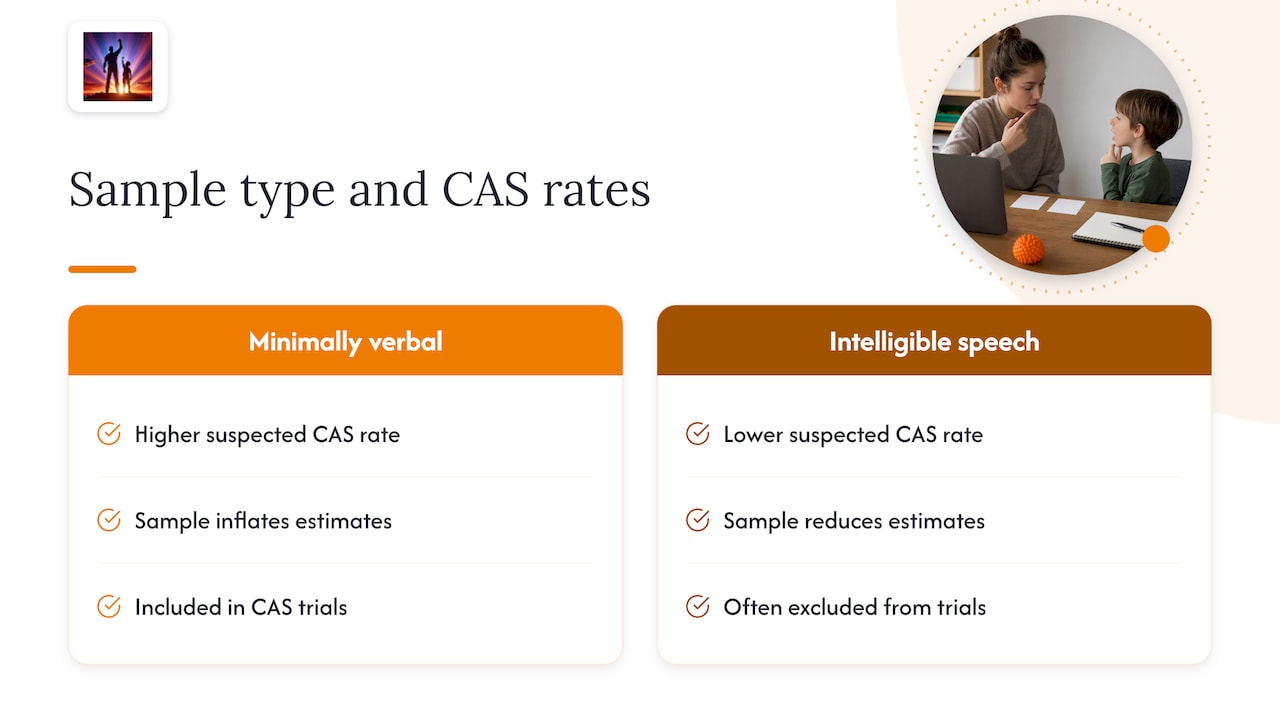
What clinical guidance agrees on is more useful than any single percentage. Differential diagnosis matters because the two conditions need different treatment emphases. Combined therapy, motor-based CAS work alongside autism-informed communication support, has the strongest backing in current clinical recommendations. And ongoing trials like NCT05066178 are actively refining how we measure whether CAS-specific treatment actually helps minimally verbal autistic children, using both listener judgments and objective speech movement data.
This is exactly the kind of landscape where having a steady, organized resource matters. Alongside personalized support, guidance can help you track symptoms, prepare for evaluations, and understand which questions to bring to your child's team.
A parent's honest take on finding answers
We know what it feels like to sit in a waiting room with a list of symptoms and no clear label yet. The uncertainty is its own kind of exhausting, especially when well-meaning people tell you to "just wait and see."
Here's our honest stance: waiting rarely helps, and asking for an evaluation never hurts. Families who introduce AAC early, even when speech eventually blossoms, often tell us their child communicated sooner and with less frustration, not later and with more. Progress in CAS is rarely dramatic. It's a new consonant, a clearer vowel, a sentence typed into a device unprompted. Those moments are real wins, and they add up.
— Ronnie Talent
How Autism Victory supports your next step
Finding clear, trustworthy guidance while juggling evaluations, therapy schedules, and school meetings takes real energy, and an app can help carry some of that weight with you. Personalized guidance, funding resources, and bilingual content can help you move from confusion to a concrete plan without digging through a dozen separate websites.
If you want a single place to organize what comes next, start a free trial or explore our plans and pricing to see what fits your family.
This article is general information, not a substitute for advice from a qualified doctor. Consult a qualified healthcare professional about your own circumstances before acting on anything here.
FAQ
What is the difference between apraxia and autism speech delays?
Apraxia of speech is a motor planning disorder affecting the ability to coordinate sounds and words consistently, while autism-related speech delays usually stem from differences in social communication rather than motor control. A child can have one, the other, or both, which is why a proper SLP evaluation is important before assuming one explanation.
Can a child be diagnosed with both apraxia and autism?
Yes, a child can receive both diagnoses, and clinical guidance from ASHA's autism practice portal stresses that distinguishing the two is essential because each requires a different treatment focus. Research summarized in an ASHA Leader report found suspected apraxia in a large share of one clinical sample of autistic children, though estimates vary by study.
Will using AAC stop my child from developing speech?
No, current guidance indicates AAC tends to support rather than replace verbal language development by reducing the pressure to speak perfectly. Multimodal communication, including gestures, pictures, and devices, is considered a helpful complement to motor-based speech therapy rather than a last resort.
What therapy works best for a child with both conditions?
There is no single best therapy; clinical recommendations favor individualized programs that combine motor-based CAS practice with autism-informed communication supports. A narrative review of CAS and autism treatment emphasizes adapting standard CAS methods to fit a child's verbal level and social communication needs.
How do I know if my child needs a speech evaluation?
Watch for inconsistent errors on the same word, visible difficulty positioning the mouth for sounds, and speech that becomes harder to understand as words get longer. If you notice these patterns, especially alongside limited verbal output, requesting an SLP evaluation that includes a speech motor exam is a reasonable next step.
Sources
Recommended