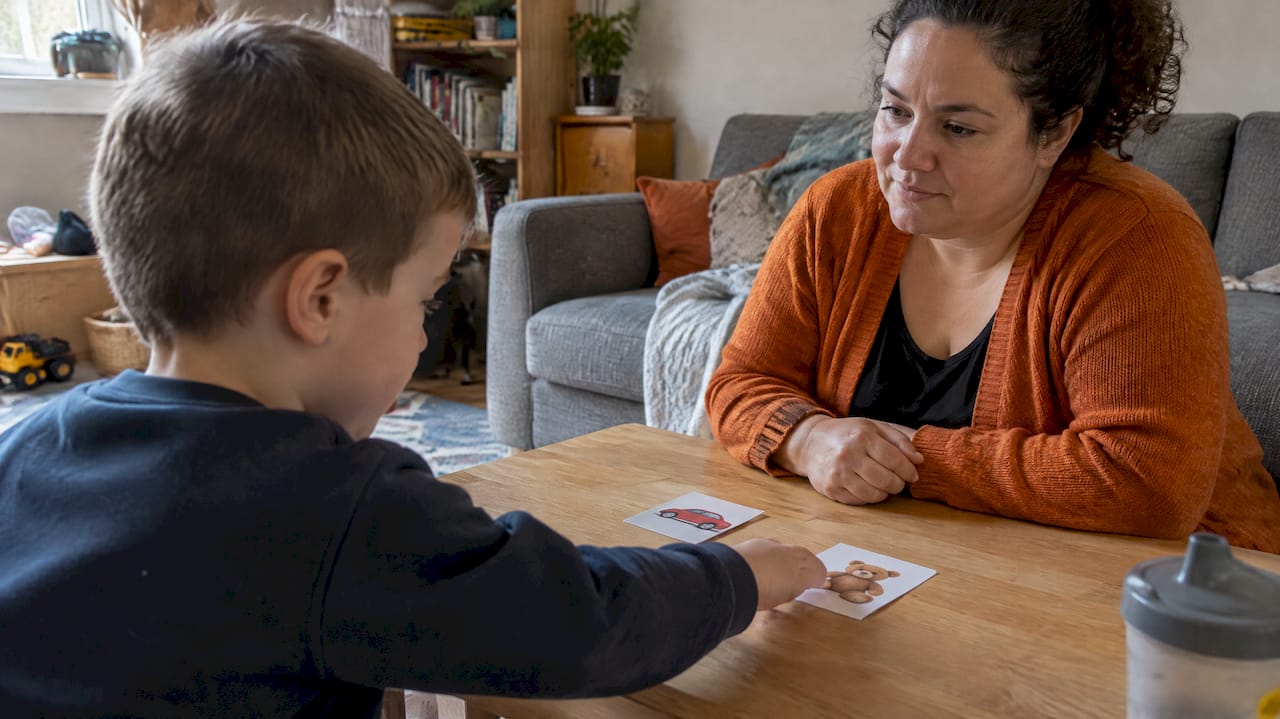
AI can help with screening, social practice, and communication supports, but only as a supervised assistant, not a replacement for clinical evaluation. The strongest tools pair machine learning with human review from a clinician or trained caregiver, and cite their sources rather than improvising advice. The CDC and NIMH still anchor formal diagnosis in standardized assessment, and Autism Victory App builds its guidance around that same principle.
TL;DR:
AI tools for autism support should be used under human supervision, with clinician review and source citation to ensure safety and accuracy.
Screening apps are best as referral triggers and do not provide definitive diagnoses, requiring further assessment by a licensed professional.
Social coaching tools work better for rehearsing scripted scenarios but can reinforce stereotypes or produce unsafe advice without safeguards.
AAC systems with AI features support communication but depend on caregiver oversight and privacy controls to protect sensitive data.
Future developments aim for integrated, transparent platforms that combine screening, learning, and coaching with explainable AI and clinical alignment.
Table of Contents
AI and AAC: Augmenting Communication, Not Replacing the Partner
Building AI Into Daily Practice Without Losing the Human Touch
The Machine Learning Behind the Curtain: ML, NLP, and Computer Vision
Get Supervised AI Guidance Built for Caregivers, Not Just Users
How AI Is Actually Being Used for Autism Right Now
AI for autism support breaks into four working categories today: screening aids, social coaching, AAC enhancement, and personalized learning. None of them operate independently of a human. That's not a limitation caregivers should apologize for. It's the design feature that makes these tools trustworthy.
Screening tools use machine learning to flag developmental patterns worth a closer look, often by analyzing video of a child's movement, eye gaze, or vocal patterns, then scoring the likelihood that a formal evaluation is warranted. They are pre-screening instruments, similar in spirit to a home blood pressure cuff. Useful for flagging something worth investigating, not a substitute for the doctor's office.
Social coaching tools are conversational, often chat-based, and let a person rehearse tricky interactions such as ordering at a restaurant or asking a coworker a question. Stanford's Human-Centered AI institute documented one of the more closely watched examples: Noora, an AI social coach built to let autistic users practice social exchanges on demand, at whatever pace and repetition they need. Early reporting on the pilot describes real enthusiasm from users who wanted a low-stakes way to rehearse before a high-stakes conversation.
AAC (augmentative and alternative communication) tools now often include AI layers, predictive phrasing that speeds up message construction, or tagging that helps a communication partner catch emotional tone in a typed message. These sit on top of established AAC devices rather than replacing the communication partner's role.
Personalized learning platforms use pattern recognition to adjust pacing, difficulty, or presentation style based on how a learner responds, theoretically letting a single app serve a wider range of abilities than a fixed curriculum could.
A narrative review covering the intersection of AI and assistive technology in autism care found real integration happening across communication, learning, and participation domains, alongside consistent evidence gaps that keep most of these tools in the "promising but unproven at scale" category. The review is a useful gut check against marketing copy that implies otherwise.
Where the evidence is strongest:
Rehearsal-style social coaching for scripted, predictable scenarios
AAC prediction and vocabulary personalization built on top of clinician-approved systems
Screening tools used strictly as referral triggers, not diagnoses
Where the evidence is still preliminary:
Fully personalized adaptive learning that claims to replace individualized education plans
Unstructured, freeform social advice generated without clinical oversight
Any tool claiming diagnostic accuracy without a peer-reviewed validation study behind it
What the Research Actually Says About AI Screening Accuracy
Vendor claims about AI autism diagnosis tend to compress a complicated research picture into one impressive-sounding number. Reading the underlying studies gives a more useful, and more humbling, picture.
The reality check: Most published autism-screening AI studies work with modest, non-representative samples, often drawn from a single clinic or research site, and validated against one diagnostic instrument rather than the full range clinicians actually use. That's not disqualifying. It's a reason to treat any accuracy figure as a starting point, not a verdict.
The methodological issues worth understanding before trusting any screening tool:
Modality dependence. A model trained on video of toddlers making eye contact performs very differently on a model trained on parent questionnaire responses, and results from one modality rarely transfer cleanly to another.
Dataset bias. Training data skewed toward one age range, one gender ratio, or one cultural background produces a tool that underperforms for anyone outside that band, a common and under-disclosed limitation.
Lack of longitudinal validation. A tool that flags risk at 18 months needs years of follow-up to prove that flag was meaningful. Very few AI screening studies have run that long yet.
Cohort makeup. Studies recruiting from developmental clinics already skew toward children whose caregivers sought evaluation, which is a different population than the general public a screening app might reach.
A recent technical paper proposing unified, interpretable AI frameworks for autism diagnosis makes the point explicitly: the most promising research directions combine screening, severity-aware classification, and personalized learning into a single pipeline, but the authors stress transparency and clinical alignment as prerequisites, not afterthoughts. That's an admission, buried in the technical language, that the field isn't there yet for unsupervised clinical use.
The practical takeaway for caregivers: a diagnostic-aid app can reliably do one thing well, tell you whether a fuller evaluation is worth pursuing. It cannot reliably tell you whether your child has autism, what severity level applies, or what services they qualify for. Those determinations still require a licensed clinician using standardized instruments, the pathway both the CDC and NIMH describe as the clinical standard. If a screening app's marketing language sounds like it's replacing that pathway rather than feeding into it, that's a signal to look elsewhere.
AI Social Coaching: What Works, What to Watch For
Most AI social coaches follow a similar workflow. The user picks a scenario, ordering coffee, greeting a new coworker, responding to teasing, and the tool runs a scripted role-play, offering feedback on tone, pacing, or word choice after each exchange. Some loop in repetition, letting a user redo the same exchange with slight variations until the pattern feels automatic.
That repetition is the actual value proposition, and it's a real one. Stanford's coverage of the Noora pilot noted that the appeal wasn't novelty. It was the ability to rehearse a specific, anxiety-inducing interaction as many times as needed, at 11 p.m. if that's when the anxiety strikes, without a therapist's calendar in the way. A companion insight from that reporting is worth sitting with: improvement on a scripted rehearsal task doesn't automatically generalize to a messy, unstructured social situation. Practicing the coffee-order script multiple times helps with coffee orders. It doesn't guarantee the skill transfers to a chaotic lunchroom conversation with three people talking at once.
The risks are documented, not hypothetical. A 2026 study found that AI models often lean on autism stereotypes when generating social advice, sometimes discouraging socializing altogether rather than coaching through it. That's a real failure mode: a tool meant to build confidence instead reinforcing the idea that social effort isn't worth the risk. Beyond stereotyping, watch for:
Hallucinated advice presented with false confidence, especially on topics like workplace disclosure or dating
Tone mismatch, upbeat, generic responses to a user describing real distress
Scripts that sound natural to a neurotypical writer but read as stilted or patronizing to the person using them
Safer tools build in specific countermeasures. Research on one purpose-built system, AutismCarebot, found that an emotion-first, source-aware design grounded in retrieval-augmented generation, meaning the model pulls from a curated library of vetted autism resources instead of freewheeling, produced fewer unsafe outputs than an unmodified general-purpose chatbot baseline. That's the technical difference between a tool citing where its advice comes from and one that's essentially guessing in a confident voice.
Pro Tip: Before trusting any AI social coach with a teenager or adult who'll use it independently, run the scenario yourself first. Type in a situation involving disclosure, dating, or conflict and read the response critically. If it sounds like a stereotype or offers advice you wouldn't give yourself, that tool needs a human filter before it reaches your family member.
Look for tools that build in a visible escalation path, a clear "this is a good time to talk to a real person" prompt when a conversation touches on safety, mental health, or a decision with real consequences. That single feature separates a rehearsal tool from a liability.
AI and AAC: Augmenting Communication, Not Replacing the Partner
Augmentative and alternative communication systems have used basic prediction for years. What's changed is how much smarter that prediction has become, and how tempting it is to let the software do more of the interpretive work than it should.
Current AI enhancements layered onto AAC systems include:
Predictive phrasing that suggests full sentences based on a few selected words, cutting the physical or cognitive effort of building a message from scratch
Emotional tagging that flags tone in a typed or selected message, helping a communication partner catch frustration or urgency that flat text can miss
Personalized vocabulary sets that adapt over time to the specific words and topics an individual actually uses, rather than a generic word bank
None of that changes the central fact about AAC: the communication partner's skill still does most of the work. A predictive-text engine can shave seconds off constructing a sentence, but it can't model turn-taking, interpret context the way a familiar adult can, or notice when a device's suggested phrase doesn't match what the user actually meant. Caregivers building AAC fluency benefit more from strong partner strategies, modeling on communication boards consistently throughout the day, than from chasing the newest AI feature update. The technology supports expression. It doesn't generate intent.
Communication data deserves the same scrutiny as any other sensitive health information, arguably more, because a communication log can reveal a huge amount about a person's inner life, preferences, and vulnerabilities. Before adopting an AI-enhanced AAC tool, caregivers should confirm:
Whether communication logs are stored locally on the device or uploaded to a company server
Whether the vendor's privacy policy specifies a retention period, and whether data can be permanently deleted on request
Whether the account allows export of communication history for continuity if the family switches devices or providers
Whether a clinician (speech-language pathologist, in most cases) has reviewed the vocabulary sets and prediction settings, not just the caregiver
That last point matters more than it sounds. An SLP who understands a specific user's language goals can catch a prediction engine steering someone toward simpler phrasing than they're capable of, a subtle but real risk with adaptive systems tuned for speed over accuracy.
A Caregiver's Checklist for Evaluating Any AI Autism Tool
Every AI tool marketed for autism support deserves the same short interrogation before it becomes part of a routine. Run through these in order.
Ask for the validation study, not the marketing page. A legitimate tool can point to a peer-reviewed study or a named research partnership. If the answer is "our internal testing shows," that's not validation, that's a sales claim.
Confirm human-in-the-loop design. Does a clinician, therapist, or trained moderator review outputs, flag concerning patterns, or intervene when the AI is uncertain? Research on human-in-the-loop and participatory AI design consistently favors this model over fully autonomous systems for exactly this kind of sensitive application.
Check whether a clinician can access or export the data. A tool worth using should make it easy to bring session summaries into a therapy appointment, not lock the information inside a proprietary dashboard.
Read the privacy policy for the retention period, not just the headline promise. "We protect your data" means nothing without a specific timeline and a deletion process.
Look for explainability. Can the tool show why it made a suggestion, or does it just output an answer with no visible reasoning? Source-aware tools that cite where advice comes from are meaningfully safer than ones that don't.
Test accessibility across the actual user's needs. A tool designed for a verbal teenager may be unusable for a nonspeaking child, and vice versa. Test it with the actual person, not just in the abstract.
Confirm there's a real trial period. A short, low-commitment trial (days, not months) lets a family assess fit before a subscription commitment.
Red flags that should end the evaluation immediately: no named research backing, no visible privacy policy, marketing language that implies diagnosis rather than screening, and no way to reach a human support contact if something goes wrong.
Pro Tip: Run a two-week pilot with a single, narrow use case; one social scenario, one AAC feature, and bring the transcripts or session summaries to your child's next therapy appointment. Ask the clinician directly: "Does this look like it's helping, or is it reinforcing something we should redirect?" That one question does more to vet a tool than any star rating.
Vendors that hesitate to answer questions about validation, data retention, or clinician access are telling you something important. Take the hint.
Privacy, Bias, and Safety: What to Check Before You Say Yes
AI tools built around autism support tend to collect more sensitive data than a typical app, communication patterns, behavioral logs, sometimes video or audio, because that data is what makes the personalization work. That's precisely why the privacy review matters more here than for a typical productivity app.
Start by locating the retention and export policy, usually buried several clicks deep in a settings menu or a linked legal document. A trustworthy vendor states plainly how long data is kept, whether it's used to train future models, and how a family can request deletion. If that information isn't findable in under a minute of searching, treat that as a warning sign rather than an oversight.
Bias in these tools isn't hypothetical. The study on AI models and autism stereotypes found that stereotyped assumptions showed up often enough in social advice to be a pattern, not a fluke, and that pattern traces back to training data that reflects broad cultural assumptions about autism rather than the individual sitting in front of the screen. Explainable AI (XAI) features help here because they let a caregiver or clinician see the reasoning trail behind a suggestion, rather than accepting a confident-sounding answer at face value.
Practical safeguards worth adopting as household policy:
Favor tools that offer local or offline processing options when the feature allows it, keeping sensitive data off a server entirely
Upload the minimum necessary; skip optional fields, extra video samples, or social media integration unless the feature genuinely requires it
Build in a standing clinician review step for anything the AI recommends beyond routine practice
Use account-level controls, PINs, parental settings, session logs, so a caregiver retains visibility into what the tool actually generated
None of this requires distrust of AI as a category. It requires the same due diligence caregivers already apply to any product that touches a vulnerable family member's data, medical, financial, or otherwise.
Building AI Into Daily Practice Without Losing the Human Touch
The families who get the most out of these tools treat AI outputs as raw material for a human-led session, never as a stand-alone activity a child does unsupervised. Four templates make that concrete.
The social-script warm-up. Before a real-world event (a birthday party, a first day at a new job), use an AI social coach to generate three practice exchanges. Review the scripts yourself first, then role-play them together, adjusting any phrasing that feels off before your child ever sees it.
The visual-routine builder. Ask an AI tool to draft a simple step-by-step visual schedule for a transition point (getting ready for school, winding down at bedtime). Print or screenshot it, then walk through it together for a few days before adjusting based on what actually worked.
The stepwise task practice. Break a multi-step task (making a snack, packing a backpack) into AI-generated sub-steps, then have your child physically walk through each one with you standing by, not the AI, ready to help if a step doesn't land.
The therapy carryover note. After any AI-assisted practice session, jot two or three lines: what worked, what felt confusing, what your child's reaction was. Bring that note, along with a video-modeling clip if you used one, to the next clinical session so the professional can adjust the treatment plan with real information instead of a vague recap.
Track progress with something simple and observable, did the transition take less time this week, did your child initiate the script without a prompt, rather than an abstract mastery score. If three or four sessions in a row show no shift, that's the signal to pause and ask a clinician whether the approach fits, not push harder on the same tool.
How Autism Victory App Puts These Safeguards Into Practice
Every checklist item above exists because the alternative, AI tools built without oversight, without transparency, without a path back to a clinician, has real documented downsides. Autism Victory App was built around the opposite assumption: that AI works best as one well-supervised piece of a much bigger caregiver toolkit, not the whole toolkit.
The app's personalized AI guidance sits alongside, not in place of, resources built for human review: caregiver-focused books and audiobooks in English and Spanish, educational videos, and a caregiver community where families compare notes on what's actually working. That combination matters because an AI answer in isolation is just an answer. An AI answer a caregiver can cross-check against a clinician-informed resource library is something closer to a decision support system.
Autism Victory App also includes a state-specific resource navigator, a practical feature that matters more than it might sound like on paper. Families researching state-specific financial assistance often lose weeks to fragmented government websites; having that information organized inside the same app where they're getting AI guidance keeps the whole process in one place instead of six browser tabs.
For families weighing alternatives to a specific therapy model, the app's library also covers ethical, evidence-informed options beyond ABA, reflecting the same clinician-informed philosophy that runs through the rest of the platform.
Used well, Autism Victory App fits the pattern this article has argued for throughout: AI guidance generates a starting point, a caregiver reviews and adapts it, and anything with real clinical weight, a diagnosis, a treatment change, a major decision, still goes through a licensed professional. A short trial period lets a family test that fit before committing to anything long-term.
The Machine Learning Behind the Curtain: ML, NLP, and Computer Vision
Three distinct technical approaches do most of the work across autism-focused AI tools, and knowing the difference helps caregivers ask sharper questions.
Machine learning (ML) is the broad category: software that improves its predictions by training on examples rather than following fixed rules. Screening tools that flag developmental risk patterns from questionnaire data typically run on ML models trained on labeled clinical datasets.
Natural language processing (NLP) is what powers conversational tools, the social coaches, AAC prediction engines, and chat-based guidance apps. NLP models parse text or speech, generate responses, and increasingly incorporate retrieval-augmented generation to ground those responses in vetted source material rather than pure pattern completion. That grounding is exactly what separates a source-aware tool from one prone to hallucination.
Computer vision analyzes video or image data, most often for screening applications that track eye gaze, facial expression, or repetitive movement patterns during a recorded interaction. Computer vision tools carry their own bias risk: a model trained primarily on video of one demographic tends to perform worse when applied outside that group, a limitation the narrative review on AI and assistive technology in autism care flags directly.
Most serious tools combine at least two of these approaches, an AAC app might pair NLP-driven prediction with a lightweight ML model that personalizes vocabulary over time. Understanding which technology sits underneath a given feature helps caregivers ask a more precise question than "is this AI good?", namely, "what kind of data was this specific model trained on, and does that match my family's situation?"
The Assistive Devices and Apps Worth Knowing About
The category of AI-driven assistive tools for autism has grown well beyond a single flagship app. Social-coaching platforms following the model Stanford documented with Noora represent one fast-growing branch, chat-based rehearsal tools aimed at teens and adults navigating workplace and social situations independently.
A second branch covers screening and monitoring devices, often wearable or camera-based, designed to support early identification by tracking behavioral markers over time rather than relying on a single point-in-time observation. These remain largely research-stage tools, used in clinical or academic settings more than consumer households, and that distinction matters when a caregiver sees a slick product page promising home-based diagnostic insight.
A third branch, and the one with the most mature consumer presence, covers AAC-adjacent apps layering predictive text, symbol suggestion, and vocabulary personalization on top of established communication frameworks. These tools benefit from years of AAC research history even as the AI layer itself is new.
A fourth and newer branch focuses on caregiver-support platforms, apps that don't interact directly with the autistic individual at all, but instead use AI to help the parent or caregiver find resources, generate practice materials, and organize care information. Autism Victory App sits in this category, alongside the personalized-learning and screening tools already described.
The common thread across all four branches: the tools generating the most durable value are the ones that stay narrow in scope and transparent about their limitations, rather than promising to be a comprehensive solution to autism support on their own.
Consent, Autonomy, and What AI Shouldn't Replace
Autism-focused AI raises ethical questions that don't come up the same way with a general productivity app, mostly because the user is often a minor, or an adult who may have communication differences that complicate standard consent processes.
Consent gets complicated fast. A young child obviously can't consent to having their behavior analyzed by a screening tool; that consent runs through the parent, which places real weight on caregivers to understand exactly what data a tool collects before opting in. For a nonspeaking teenager or adult, the question of whether they meaningfully understand and agree to an AI tool's role in their life deserves active attention, not an assumption that a caregiver's consent covers it by default.
Autonomy is the second live issue. A social-coaching tool that generates every response for a user, rather than helping that user develop their own voice over time, risks substituting AI judgment for the individual's own growing independence. The goal of any rehearsal tool should be building a skill the person eventually owns, not permanent reliance on a script generator.
The relationship question runs underneath both of the above. An AI chatbot is patient in a way humans sometimes struggle to be, always available, never frustrated, never rushed. That patience is genuinely valuable for rehearsal. It becomes a problem if a tool starts substituting for real human connection rather than preparing someone for it. The healthiest use pattern treats AI as the practice field, not the game.
Making AI Tools Actually Usable Across Ages and Abilities
A tool that works beautifully for a verbal 16-year-old may be completely inaccessible to a nonspeaking 6-year-old, and that range is exactly the range most autism-focused AI products claim to serve.
Age is the most obvious divide. Younger children generally need visual-first, low-text interfaces with heavy caregiver involvement in every session, while teenagers and adults using rehearsal tools independently need something closer to a private, judgment-free chat interface. A single app rarely nails both experiences equally well, which is why checking a tool's stated age range against your family member's actual developmental stage matters more than checking the app-store category.
Sensory considerations matter just as much as age. Bright animations, sudden sounds, or cluttered interfaces that seem harmless to a typical user can make a tool unusable for someone with sensory sensitivities. Look for adjustable settings, sound on or off, animation speed, color contrast, before assuming a polished interface equals an accessible one.
Communication differences add another layer. A tool built around typed chat input assumes a user who types comfortably and quickly; that assumption excludes a large share of autistic users who communicate through AAC devices, gestures, or minimal verbal output. The strongest tools support multiple input methods rather than defaulting to text-only interaction.
Cognitive and processing differences round out the picture. Some users need extra time to process a prompt before responding; a tool with an aggressive timeout or a fast-paced conversational rhythm actively works against them. Accessibility here isn't a single checkbox. It's a spectrum of design choices that need testing against the specific person who'll actually use the tool.
Where AI for Autism Support Is Headed Next
The research pipeline points toward more integrated, more transparent systems over the next several years, a shift away from single-purpose tools and toward platforms that combine screening, coaching, and learning under one transparent framework.
The Springer Nature paper on unified interpretable AI frameworks captures this direction clearly: researchers are actively working on systems that combine screening, severity classification, and personalized adaptive learning into a single pipeline, while explicitly building in the transparency and clinical alignment features earlier tools often lacked. That's a meaningful shift from the current landscape of disconnected single-purpose apps.
Explainability is becoming a design requirement rather than a nice-to-have feature. Regulators, researchers, and increasingly caregivers themselves are pushing back on black-box tools that can't show their reasoning, especially in a domain this sensitive.
Retrieval-augmented, source-aware architectures like the one behind AutismCarebot are likely to become the norm rather than the exception, since the emotion-first, source-grounded approach has already shown measurable safety improvements over generic chatbot baselines in controlled evaluation.
Expect continued scrutiny of bias, too. The stereotyping findings from recent research aren't going unnoticed by the developer community, and future tool generations will likely face more pressure to audit training data and outputs before launch rather than after a public misstep.
None of this means today's tools become obsolete overnight. It means the evaluation checklist in this article will stay relevant for a while yet, even as the tools themselves get more capable.
Where to Go for Trustworthy Guidance
Caregivers navigating this space don't have to rely on marketing copy alone. The CDC's autism spectrum disorder resource offers grounded background on prevalence and diagnostic domains, while NIMH's clinical overview explains the standard evaluation pathway AI tools are meant to feed into, not replace. Academic reviews like the narrative review on AI and assistive technology offer a more sober, evidence-based counterweight to vendor claims. Autism Victory App's own resource library rounds out the picture with caregiver-focused, clinician-informed material designed to sit alongside, not replace, professional guidance. Bring specific findings back to your child's clinician for interpretation; research summaries are a starting point for a conversation, not a final answer.
A Caregiver's Honest Take on the AI Hype Cycle
The conventional wisdom about AI and autism swings between two extremes that are both wrong. One camp treats every new chatbot as a breakthrough that will finally crack social skills training. The other dismisses the entire category as dystopian surveillance dressed up in a friendly interface. Neither take survives contact with the actual research.
What gets underestimated is how much the value of these tools depends on the boring, unglamorous part: whether a human reviews the output before it reaches a vulnerable user. A brilliant model with no human-in-the-loop step is a liability. A modest model with rigorous clinician review attached to it is genuinely useful. The technology matters far less than the safeguard wrapped around it, and that's a hard sell for a marketing page, but it's exactly what the evidence supports.
If you take one thing from this article, let it be this: treat every AI tool your family tries as a supervised trial, not a verdict. Ask for the validation study. Check the privacy policy. Bring the output to a clinician when something matters. That habit will serve your family better than chasing whichever tool made the biggest promise this year.
— Ronnie Talent
Get Supervised AI Guidance Built for Caregivers, Not Just Users
Autism Victory App gives caregivers the exact safeguards this article recommends, personalized AI guidance built around clinician-informed content, not an unmoderated general-purpose chatbot. Instead of hunting across a dozen government websites and Facebook groups, families get state-specific financial and support resources, caregiver-focused books and audiobooks in English and Spanish, educational videos, and a caregiver community, all inside one app built specifically for the autism journey.
That combination matters because AI guidance without a review layer is exactly the risk this article has spent several sections explaining. Autism Victory App pairs its AI features with content families can cross-check, and with a community of caregivers comparing notes on what's actually working in their own homes. It's built for the same supervised, clinician-aware approach the evaluation checklist above describes, not a replacement for it.
Start with the free trial to see how the AI guidance, resource navigator, and caregiver library fit your family's routine, then check the pricing and plan details to choose what makes sense long term. Visit Autism Victory App to begin.
Sources
An AI Social Coach Is Teaching Empathy to People with Autism
Breaking Barriers—The Intersection of AI and Assistive Technology in Autism Care: A Narrative Review
AI models lean on autism stereotypes when giving social advice, new study finds
AutismCarebot: Emotion-First, Source-Aware Conversational Support for Autistic Users
Recommended