504 Accommodations List: A Practical Guide for Families
A Section 504 accommodations list is a written record of the specific adjustments a school will make so a student with a disability can access general education on equal footing with peers. These adjustments target how information is presented, how much time a student gets, where they work, and what tools they can use. Critically, they do not change what the student is expected to learn. A child with ADHD still reads the same novel as the rest of the class. She just might get extended time on the quiz, a quiet room, and a printed copy of the directions.
Section 504 of the Rehabilitation Act of 1973 is a federal civil rights law. It prohibits discrimination against people with disabilities in any program that receives federal funding, which includes virtually every public school in the United States. A 504 plan is the document that spells out exactly how a school will fulfill that obligation for a specific student.
Common accommodation categories you will see on these plans include:
Timing and scheduling: Extended test time, frequent breaks, shortened assignments
Setting: Preferential seating, small-group or separate testing room, reduced-distraction workspace
Presentation: Oral instructions, audiobooks, highlighted texts, large print
Response format: Typed instead of handwritten responses, speech-to-text tools
Assistive technology: Text-to-speech software, FM listening systems, calculators
Health and behavioral supports: Medication administration, sensory breaks, behavior intervention strategies
Note-taking assistance: Peer notes, teacher-provided outlines, recorded lectures
The list is not a menu to check off. It is a starting point for a conversation between your family and the school team about what your child actually needs.
Table of Contents
What does a comprehensive 504 accommodations list look like?
How accommodations change for specific disabilities
How to use a 504 accommodations list effectively when advocating for your child
Where to find trusted support for Section 504 plans
What are your legal rights under Section 504?
Key Takeaways
What does a comprehensive 504 accommodations list look like?
Section 504 accommodations are designed to remove barriers through changes in timing, presentation, setting, or format without altering academic content. That distinction matters because it defines the legal boundary between an accommodation and a modification. A modification changes what a student is expected to learn or how their work is graded. A 504 plan generally requires accommodations, not modifications. Modifications belong primarily in Individualized Education Programs (IEPs) under the Individuals with Disabilities Education Act (IDEA).

Understanding that boundary helps you build a more focused, defensible plan. The categories below cover the full range of what schools can offer.
Classroom environment accommodations
These adjustments change where or how a student works, without touching the curriculum itself.
Preferential seating near the teacher or away from high-traffic areas
Assigned seating away from windows, doors, or other sources of distraction
Access to a quiet, low-stimulation workspace for independent work
Reduced class size or small-group instruction settings
Flexible seating options such as a standing desk, wobble chair, or floor cushion
Proximity to a peer who can model expected behavior
Classroom free of allergens or environmental triggers (relevant for asthma, allergies, and similar conditions)
Curriculum delivery and presentation accommodations
These address how material reaches the student, not what the material requires.
Audiobooks or text-to-speech software for reading assignments
Highlighted or color-coded texts to guide attention
Graphic organizers and visual outlines provided before lessons
Step-by-step written instructions alongside verbal directions
Pre-taught vocabulary before a new unit begins
Chunked assignments broken into smaller, sequenced steps
Access to a word bank during writing tasks
Simplified or rephrased directions (not simplified content)
Testing and assessment accommodations
This is often the first category families think of, and for good reason. Testing is where many students with disabilities hit the hardest barriers.
Extended time (length adjusted as appropriate to the student’s needs)
Separate, quiet testing room
Frequent breaks during exams
Exams broken into multiple shorter sessions
Oral administration of tests by a reader
Scribe to record student responses
Use of a calculator, spell-checker, or grammar tool where content knowledge is the target
Elimination of one or two answer choices on multiple-choice items
Permission to mark answers directly in the test booklet
Pro Tip: When requesting extended time, ask the school team to specify the exact ratio in the written plan (for example, “time and a half” rather than “extended time”). Vague language creates inconsistent implementation across teachers and test administrators.
Organizational and behavioral supports
Students who struggle with executive function, emotional regulation, or impulse control often need structure built into their day.
Daily planner or agenda checked and initialed by the teacher
Visual schedule posted at the student’s desk
Checklists for multi-step tasks
Advance notice of transitions or schedule changes
Designated cool-down space or sensory break protocol
Check-in/check-out system with a trusted adult
Positive behavior support plan integrated into the 504
Reduced homework load or modified deadlines when fatigue is a documented barrier
Health-related accommodations
Section 504 covers school involvement broadly, including extracurricular activities, not just academics. Health accommodations reflect that scope.
Permission to carry and self-administer medication (for conditions like asthma or diabetes)
Trained staff to monitor and distribute medications
Access to water, snacks, or the restroom without asking permission
Modified physical education requirements for students with asthma, orthopedic impairments, or cardiac conditions
Scheduled rest periods for students with chronic fatigue conditions
Emergency health plan attached to the 504 document
Nurse access during the school day without penalty for missed instruction
Adapted transportation arrangements
Note-taking and communication accommodations
Peer note-taker or teacher-provided lecture notes
Printed copies of slides or board content
Permission to audio-record lessons
Use of a laptop or tablet for note-taking
Speech-to-text software for written assignments
Augmentative and alternative communication (AAC) devices for students with speech impairments
FM listening system or sound-field amplification for students with hearing impairments
How accommodations change for specific disabilities
A 504 accommodations list works best when it is built around a student’s actual functional limitations, not just their diagnosis. Two students with the same diagnosis can have completely different barriers in the classroom. That said, certain disability profiles do point toward predictable accommodation clusters.
ADHD and attention-related challenges
For students with ADHD, accommodations often center on managing inattention and impulsivity in general education settings. The goal is reducing the cognitive load of self-regulation so the student can direct energy toward learning.
Common accommodations for ADHD include:
Extended time on tests and assignments
Quiet or separate testing environment
Frequent, scheduled movement breaks
Preferential seating away from high-traffic areas
Visual timers to support time awareness
Chunked assignments with clear stopping points
Reduced number of problems (same difficulty, fewer repetitions)
Daily agenda reviewed and signed by a parent or teacher
Positive reinforcement systems built into the classroom routine
Oral rather than written responses where writing is not the skill being assessed
A student with ADHD who also struggles with working memory may additionally benefit from graphic organizers, word banks, and step-by-step written instructions posted at the desk.
Anxiety and emotional disturbance
Students with anxiety often need accommodations that reduce the pressure of performance without eliminating challenge.
Advance notice of tests, presentations, or changes in routine
Option to present work to the teacher privately rather than in front of the class
Shortened or alternative oral presentation formats
Access to a trusted adult for check-ins during the day
Flexible deadlines tied to documented anxiety episodes
Permission to take breaks in a designated calm space
Reduced homework load during high-stress periods
Learning disabilities (including dyslexia)
A student with dyslexia who struggles with word decoding and spelling needs accommodations that bypass the decoding barrier so comprehension and content knowledge can be demonstrated.
Text-to-speech software for all reading assignments
Audiobooks as an alternative to print
Extended time on all reading and writing tasks
Spell-check and grammar tools on writing assignments
Oral responses accepted in place of written ones
Reduced spelling penalties on content-area assignments
Highlighted or color-coded texts
Asthma and respiratory conditions
Physical health conditions require a different kind of planning. For a student whose doctor has advised against outdoor physical activity, the school must provide an alternative.
Modified or adapted physical education activities
Indoor recess option during high-pollen or poor air quality days
Removal of allergens from the classroom environment (hair spray, latex, strong scents)
Inhalant therapy assistance and trained staff for medication administration
Shortened school day if medically necessary
Orthopedic impairments and mobility challenges
Students who use wheelchairs or have limited fine or gross motor skills need both physical access and academic support.
Accessible classroom and building routes
Adapted physical education
Extended time for tasks requiring fine motor skills (writing, lab work)
Use of a scribe or speech-to-text for written assignments
Modified lab or art materials
Elevator access and priority seating near exits
For students with physical disabilities who require mobility equipment outside of school, resources like wheelchair rental options can complement the supports a 504 plan provides at school.
Visual impairments
Large-print textbooks and materials
Enhanced lighting at the student’s workspace
Screen magnification software
Text-to-speech and screen-reader software
Braille materials where appropriate
Preferential seating near the board or screen
Extended time for all reading and writing tasks
Diabetes and chronic health conditions
Students managing diabetes or similar conditions need accommodations that keep health management from disrupting learning.
Unrestricted access to water, snacks, and the restroom
Permission to test blood glucose and administer insulin in the classroom or a private space
Trained staff to assist with health monitoring
Flexible make-up policies for absences tied to medical management
Emergency health plan on file with the nurse and all teachers
Pro Tip: For any health-related accommodation, attach the student’s current medical documentation to the 504 plan and update it annually. Schools need current physician orders to implement health protocols correctly, and outdated paperwork is one of the most common reasons accommodations stall.
How to use a 504 accommodations list effectively when advocating for your child
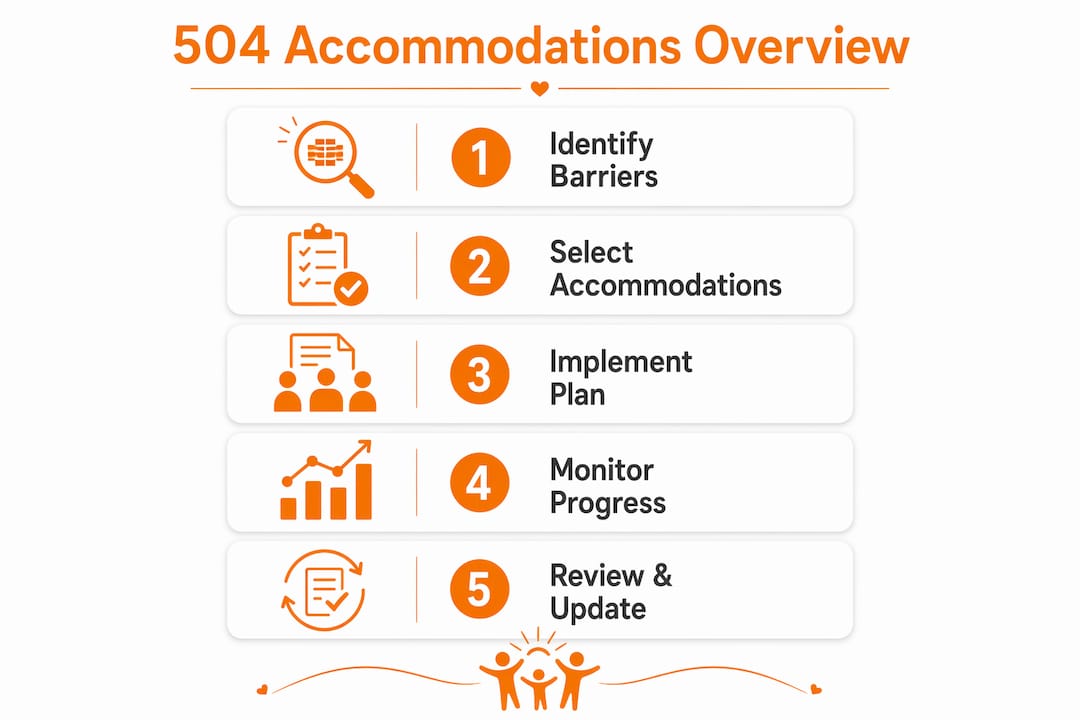
The most effective 504 plans start with a clear picture of the child’s functional barriers, not a long list of every possible accommodation. Effective advocacy means focusing on specific functional barriers and limiting accommodations to a manageable number. Starting with a small number of key accommodations focused on the most significant problem areas is a widely recommended approach, and it gives the school team a realistic target for consistent implementation.

Think of the 504 accommodations list as a conversation starter, not a prescription. Your job going into the meeting is to describe what you observe at home and what teachers report in the classroom, then let the team match those observations to specific supports.
Before the meeting
Document specific examples of how the disability affects your child’s school performance. Concrete observations (“she takes 45 minutes to complete a 20-minute homework assignment”) carry more weight than general statements.
Review your child’s most recent evaluation reports, teacher comments, and any medical documentation.
Prioritize. Identify the two or three areas where barriers are most significant and most consistent.
Bring a written list of the accommodations you want to discuss, framed as questions rather than demands (“Would extended time on tests address the issue we’re seeing with incomplete exams?”).
During the meeting
Ask the team to explain how each proposed accommodation will be implemented and by whom.
Request that the plan specify the accommodation in concrete terms. “Extended time” should read “time and a half on all tests and quizzes.”
Ask how accommodations will be communicated to all teachers, including elective and PE teachers.
Confirm the review schedule. Most plans are reviewed annually, but you can request a review sooner if the plan is not working.
After the plan is in place
Parent involvement in 504 meetings enhances plan quality and legal defensibility, even though federal law does not require parents to attend every meeting. Stay engaged.
Follow up with teachers within the first few weeks to confirm accommodations are being used.
Keep copies of all 504 documents, meeting notes, and correspondence.
If accommodations are not being implemented, put your concern in writing to the 504 coordinator.
A well-built plan with five consistently implemented accommodations will always outperform a plan with fifteen that no one tracks.
Where to find trusted support for Section 504 plans
Families navigating Section 504 do not have to figure it out alone. A range of authoritative resources exists to guide you through evaluation, planning, and advocacy.
Government and legal resources
U.S. Department of Education Office for Civil Rights (OCR): The OCR enforces Section 504 in schools. You can file a complaint at ocrcas.ed.gov if a school fails to provide required accommodations.
ADA.gov: The Americans with Disabilities Act overlaps with Section 504 in many contexts. The ADA National Network provides plain-language guidance on disability rights in education.
Your state’s Department of Education: Most state education agencies publish their own 504 guidance documents. Indiana’s Department of Education, for example, publishes a detailed accommodations guide organized by disability category.
Disability-specific organizations
CHADD (Children and Adults with Attention-Deficit/Hyperactivity Disorder): Offers parent training, advocacy resources, and a detailed breakdown of Section 504 rights for families of children with ADHD.
Understood.org: Provides plain-language guides on accommodations versus modifications, 504 plan development tips, and condition-specific accommodation examples.
National Center for Learning Disabilities (NCLD): Publishes research-backed advocacy tools and policy updates relevant to Section 504.
Support for autism families specifically
If your child has an autism diagnosis, the overlap between Section 504 and IDEA can feel confusing. Understanding whether your child needs a 504 plan or an IEP is one of the first decisions you will face, and it shapes every accommodation conversation that follows.
Autism Victory App offers families a single place to access personalized AI guidance, state-specific support resources, educational videos, and a community of caregivers who have been through this process. Whether you are preparing for your first 504 meeting or revisiting a plan that is not working, the platform connects you with practical tools and trusted information. For families who received a recent diagnosis and are still finding their footing, the guide on what to do in the first 30 days after diagnosis is a useful starting point.
Key resources to bookmark:
OCR complaint portal for Section 504 enforcement
CHADD’s parent-to-parent support network
Understood.org’s 504 plan development checklist
Your school district’s 504 coordinator (every district that receives federal funding must designate one)
Autism Victory App for ongoing caregiver support, AI-powered guidance, and state-specific resources
For families managing physical health accommodations alongside educational planning, practical medical equipment guidance from sources like Seventh Chakra Medical can help you understand what supports are available outside the school setting as well.
What are your legal rights under Section 504?
Section 504 of the Rehabilitation Act of 1973 is a civil rights statute, not an education law. That framing is deliberate and consequential. It means the school’s obligation is not just to educate your child but to ensure your child has the same access to programs, activities, and benefits as students without disabilities.
Who qualifies
A student qualifies for Section 504 protections if they have a physical or mental impairment that substantially limits one or more major life activities. Major life activities include learning, reading, concentrating, thinking, communicating, walking, breathing, and caring for oneself. The disability must actually limit the student’s functioning in school, not just exist on paper.
The 2008 amendments to the ADA (ADA Amendments Act, or ADAAA) broadened the definition of disability significantly. Conditions that were previously excluded or narrowly interpreted, including ADHD, anxiety disorders, diabetes, and epilepsy, now more clearly qualify. Schools must evaluate based on the student’s condition in its unmitigated state, meaning they cannot argue that medication or other treatments eliminate the limitation.
What the school must provide
Under Section 504, schools must:
Conduct an evaluation before determining eligibility (parental consent is required)
Develop a written 504 plan specifying accommodations
Implement accommodations consistently across all settings, including extracurricular activities and field trips
Provide a free and appropriate public education (FAPE) to eligible students
Notify parents of any significant changes to the plan
Offer procedural safeguards, including the right to review records, request an impartial hearing, and file a complaint with the OCR
The difference between a 504 plan and an IEP
Both documents support students with disabilities, but they operate under different laws and serve different purposes. An IEP is created under IDEA and provides specialized instruction as well as related services. A 504 plan provides accommodations within general education but does not include specialized instruction. Students who need changes to the curriculum itself, not just how it is delivered, typically need an IEP rather than a 504 plan.
The practical test: if your child can access grade-level content with the right supports in place, a 504 plan is likely sufficient. If the content itself needs to be modified, an IEP evaluation is the appropriate next step.
Enforcement and your right to appeal
If a school denies a 504 evaluation, refuses to implement agreed accommodations, or retaliates against a student for exercising their rights, parents have several options:
Request a meeting with the school’s 504 coordinator in writing
File a complaint with the district’s special education or student services office
File a complaint with the U.S. Department of Education’s Office for Civil Rights at ocrcas.ed.gov
Request an impartial due process hearing
Section 504 complaints to the OCR are free to file and do not require an attorney. The OCR investigates and can require schools to take corrective action. For families who feel the process has stalled or broken down, consulting a special education attorney or advocate is a reasonable next step.
Key Takeaways
A 504 accommodations list removes barriers to equal access without changing academic expectations, and the most effective plans focus on a small number of targeted supports tied directly to a student’s functional limitations.
Point | Details |
|---|---|
Accommodations vs. modifications | Accommodations change how content is delivered; modifications change the content itself, and 504 plans require the former, not the latter. |
Start focused, not exhaustive | Beginning with three targeted accommodations for three identified problem areas leads to more consistent implementation than a long, unfocused list. |
Parent involvement strengthens plans | Attending 504 meetings and documenting outcomes improves plan quality and legal defensibility, even though federal law does not mandate parent attendance. |
Section 504 covers all school activities | Accommodations apply to extracurricular activities, field trips, and all school programs, not just academic classes. |
Enforcement is available | Parents can file a complaint with the U.S. Department of Education’s Office for Civil Rights at no cost if a school fails to implement required accommodations. |

Navigating Section 504 is one of the most concrete ways you can protect your child’s right to learn. Autism Victory App was built for exactly this kind of work. The platform gives caregivers access to personalized AI guidance, state-specific resources, educational videos, and a community of families who understand the process from the inside. Whether you are preparing for a first 504 meeting or pushing back on a plan that is not being followed, you do not have to piece it together alone. Explore Autism Victory App and see what support looks like when it is built around your family’s actual needs.
Recommended
IEP vs. 504 Plan for Autism: Which One Does Your Child Need? | Autism Victory Blog
Autism Victory | Resources, Support & Tools for Autism Families
Turning 18 with Autism: Guardianship, SSI, and What Actually Changes Legally | Autism Victory Blog
Medicaid Waiver Waitlists for Autism: All 50 States (2026) | Autism Victory Blog