
Yes, parents of an autistic child can usually lower their tax bill through several tools working together: the medical expense deduction, the Child and Dependent Care Credit, ABLE accounts, and disability rules that widen age limits for the EITC and Child Tax Credit. Which ones apply depends on your adjusted gross income (AGI), whether care expenses meet the "work-related" test, and how your child's disability is documented. Before you file anything, start gathering therapy invoices, mileage logs, and a letter of medical necessity from your child's doctor or provider.
TL;DR:
Families can maximize their tax benefits by combining the medical expense deduction, Child and Dependent Care Credit, and ABLE accounts, depending on their income and documentation.
Expenses like therapy, assistive devices, and home modifications can be deducted if they exceed 7.5% of AGI, but care costs claimed for the care credit must not be double-counted.
The Child and Dependent Care Credit can be claimed for disabled children of any age if they cannot care for themselves, with caps of $3,000 to $6,000 in expenses and up to 35% credit rate depending on income.
ABLE accounts allow tax-free growth up to $19,000 annually and are a key savings tool for qualified disability expenses without risking benefits eligibility.
Proper documentation, including letters of medical necessity and organized receipts, is crucial to substantiate claims and avoid errors during tax filing.
Table of Contents
Tax Deductions for Parents of an Autistic Child: The Medical Expense Rules
EITC, Child Tax Credit, and Benefit Interactions Parents Miss
Tax Breaks for Autism: A Quick-Reference Overview
Most families supporting an autistic child qualify for more than one benefit at once, and knowing which forms to expect makes filing season a lot less stressful.
Medical expense deduction — covers therapy, assistive devices, and sometimes special-school tuition once your reimbursed costs exceed 7.5% of AGI. Claimed on Schedule A, which means you have to itemize instead of taking the standard deduction.
Child and Dependent Care Credit — applies when you pay someone to care for your child so you (and your spouse, if married) can work or look for work. Filed on Form 2441 and attached to Form 1040.
ABLE accounts — tax-advantaged savings accounts for qualified disability expenses. These do not generate an annual deduction, but earnings and qualified withdrawals are tax-free.
EITC and Child Tax Credit disability provisions — disability status can remove the usual age caps that apply to other dependents.
Here is the part people miss: the medical deduction and the dependent care credit are not mutually exclusive, but you cannot double-dip on the same dollar. If a cost qualifies for the care credit, it has to come out of your medical expense total, or vice versa. That distinction trips up more families than any IRS form itself.
The Child and Dependent Care Credit is nonrefundable, meaning it can only reduce tax that you actually owe. The EITC, by contrast, is refundable, so it can put money in your pocket even if your tax liability is already at zero. That difference matters when you are deciding which credit to prioritize on a tight income year.
Tax Deductions for Parents of an Autistic Child: The Medical Expense Rules
The medical expense deduction is usually the biggest lever available, and it starts with a math problem: you can only deduct the portion of unreimbursed medical costs that exceeds 7.5% of your AGI. If your AGI is $80,000, the first $6,000 of medical spending does not count. Everything above that line does.
What typically counts:
Therapy and intervention services — ABA therapy, speech therapy, and occupational therapy generally qualify when a doctor or licensed provider recommends them.
Assistive devices and equipment — communication devices, sensory tools, and adaptive equipment prescribed for your child's condition.
Home modifications — ramps, safety fencing, or soundproofing can qualify, but only the amount that exceeds any increase in your home's fair market value. If a modification raises resale value, get an appraisal before assuming the full cost is deductible.
Transportation and lodging — mileage to and from therapy appointments is deductible at the medical mileage rate, and lodging tied to out-of-town treatment has its own IRS caps.
Special-school tuition — deductible when the primary reason for enrollment is to remediate a disability, not general education.
That last point rests on what tax professionals call the "but for" test, rooted in the Tax Court case Jacobs v. Commissioner: would this expense exist "but for" the disability? Tax experts point to this standard as the deciding factor when a school's tuition straddles the line between education and treatment. A letter of medical necessity from your child's physician, explaining why the placement addresses the disability, is what turns a maybe into a yes.
Pro Tip: If you pay a babysitter or aide so you can work, that expense likely belongs on Form 2441 for the Child and Dependent Care Credit, not on Schedule A as a medical expense. Sort every receipt into one category before you file, since claiming the same dollar twice is the fastest way to trigger a correction notice.
Most families with an autistic child end up itemizing rather than taking the standard deduction, simply because therapy costs stack up fast. Run both numbers before you file. If your itemized total, medical expenses included, beats the standard deduction for your filing status, itemizing wins.
The Child and Dependent Care Credit for Disabled Dependents
The Child and Dependent Care Credit exists for parents who pay someone to care for a dependent so they can work. For most families, that credit disappears once a child turns 13. For families with an autistic child, it does not.
A dependent who is "physically or mentally incapable of self-care" qualifies regardless of age, as long as they meet the IRS definition. That single rule is one of the most overlooked tax breaks for autism families, because most people assume child-related credits vanish once their kid hits middle school.
How the numbers work:
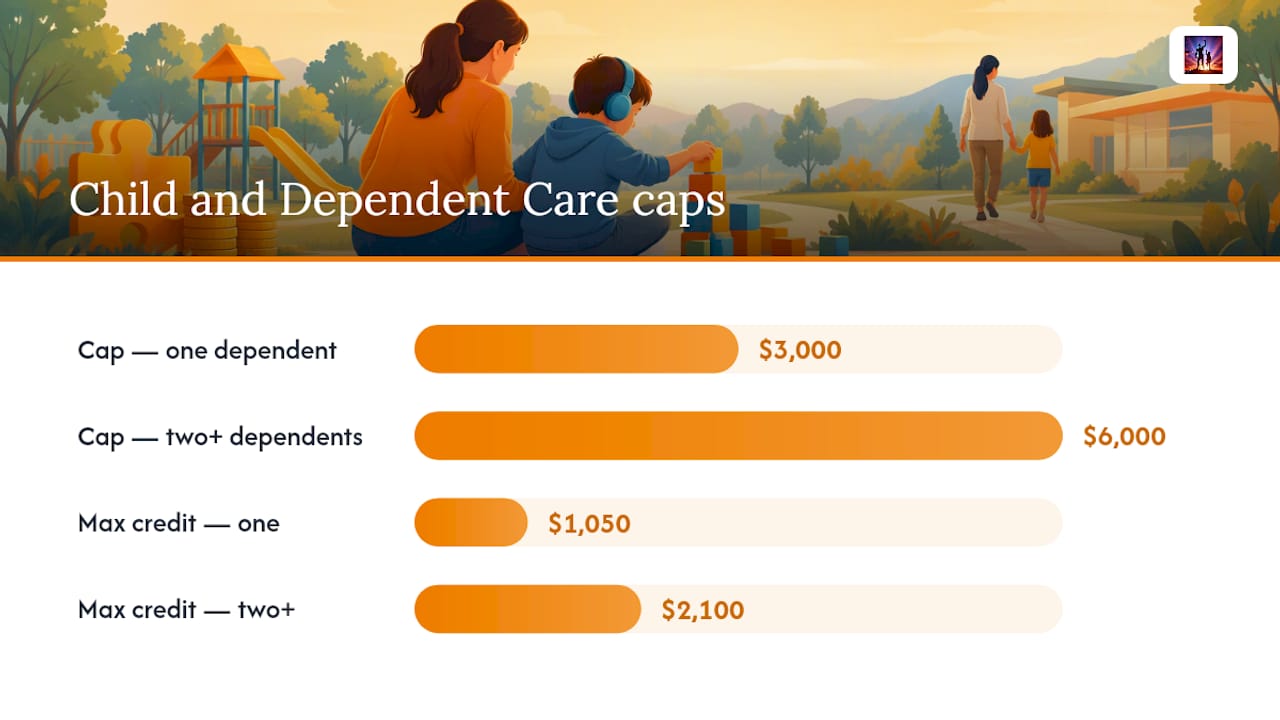
Expenses are capped at $3,000 for one qualifying person or $6,000 for two or more.
The credit rate can reach up to 35% of qualifying expenses, which tops out at $1,050 for one dependent or $2,100 for two.
The 35% credit rate phases down as income rises, so higher earners receive a lower percentage credit.
Care can include daycare, an in-home aide, day camp, or after-school supervision, but overnight camp does not qualify.
Provider and paperwork rules: you need the care provider's name, address, and taxpayer identification number to file Form 2441. If your employer offers a dependent care flexible spending account, any amount excluded from your income through that benefit reduces the dollar figure you can claim on the credit. Run the math both ways. Sometimes the FSA saves more, sometimes the credit does, and they interact rather than stack cleanly.
Before submitting, double check three things: the provider's tax ID is correct, your total claimed expenses don't exceed the $3,000/$6,000 caps, and you haven't already counted any of these costs as a medical deduction elsewhere on your return.
ABLE Accounts: Tax-Free Growth for Disability Expenses
ABLE accounts function like a 529 plan built specifically for disability expenses, and they are one of the more underused tools in a parent's financial toolkit. The 2025 annual contribution limit sits at $19,000, and earnings inside the account grow tax-free as long as withdrawals go toward qualified disability expenses.
Contribution limit: $19,000 per year from any combination of contributors (parents, grandparents, the beneficiary).
Employed-beneficiary bonus: if your child works and doesn't participate in an employer retirement plan, they may be able to contribute additional earned income above the standard limit, up to a cap tied to the federal poverty line.
Qualified expenses: education, housing, transportation, assistive technology, and healthcare not covered elsewhere.
Benefits protection: ABLE account balances up to a certain threshold do not count against the strict asset limits tied to SSI and Medicaid, which is normally what puts families in a bind when they try to save.
State rules vary: contribution matches, state tax deductions, and program administration differ by state, so check your own state's ABLE program before opening one.
Setting one up takes less time than most parents expect, usually through your state's ABLE program website, and keeping digital copies of every distribution receipt protects you if the account is ever reviewed. Our guide to ABLE account rules walks through distribution examples in more detail.
EITC, Child Tax Credit, and Benefit Interactions Parents Miss
Two credits change shape entirely once disability enters the picture, and missing this is one of the most common financial mistakes special needs parents make.
The Earned Income Tax Credit normally caps out at age 19 for a qualifying child (24 for students), but that age limit disappears entirely for a permanently and totally disabled dependent. There is no upper age limit at all.
The Child Tax Credit carries its own age and residency tests, and a dependent's disability status can affect how those tests are applied, particularly for adult dependents who otherwise would not qualify.
If your child receives SSI or Medicaid, aggressive tax planning that increases countable assets, like an oversized traditional savings account, can jeopardize those benefits. This is exactly the gap ABLE accounts were built to close.
Parents frequently assume disability tax rules mirror general dependent rules. They don't. The EITC's disability exception alone can extend eligibility for years beyond what a standard dependent chart would suggest, which is why reading the disability-specific IRS guidance matters more than skimming a generic tax checklist.
If your family relies on SSI, Medicaid waivers, or state disability benefits, loop in a benefits counselor before making major financial moves. A well-intentioned tax strategy can accidentally trigger a benefits review, and untangling that afterward costs far more time than the deduction saved.
Building Your Documentation Checklist Before You File
Good record-keeping is what separates a smooth refund from an IRS letter six months later. Keep these records for at least three years, longer if you claim a refund for a prior year or the IRS flags a discrepancy.
Letters of medical necessity (LMNs) from your child's doctor, therapist, or specialist, updated whenever treatment changes.
Itemized receipts for therapy, equipment, and school tuition, organized by month.
Mileage logs noting date, destination, and purpose for every medical-related trip.
Provider tax ID information for anyone paid for dependent care.
A running tally separating medical-deduction expenses from dependent-care-credit expenses, so nothing gets claimed twice.
Pro Tip: Photograph every receipt the same week you receive it. Faded thermal paper is the number one reason parents lose documentation during an audit two years later.
If your family juggles ABLE contributions, SSI eligibility, and multiple credits in the same tax year, that is usually the point where a tax professional earns their fee. Complex benefit interactions and "benefit cliffs," where one extra dollar of income knocks out a public benefit, are not places to guess.
How Autism Victory App Helps You Act on This Guidance
Reading the rules is one thing. Keeping the paperwork organized all year is another. Autism Victory App's state-specific resource navigator helps you find financial assistance programs specific to where you live, since eligibility rules and state ABLE benefits vary widely. The app's bilingual (English and Spanish) library includes deeper reading on autism tax deductions and how ABA therapy costs interact with insurance, which fills in gaps this article does not have room to cover.
None of this replaces a CPA or enrolled agent for complex situations, but it gives you a running head start before you ever sit down with one.
What Most Parents Get Wrong on Tax Season
The biggest missed opportunity isn't a missing credit, it's a missing letter. Parents claim therapy costs constantly but skip the letter of medical necessity that turns a shaky deduction into a defensible one. If you take one action today, request that letter from your child's provider and start a dedicated folder, physical or digital, for every receipt from this point forward. The tax code rewards documentation, not memory.
— Ronnie Talent
Keep Your Records Straight With Autism Victory App
A mobile app can provide a single place to store the documents this article just told you to collect, such as letters of medical necessity, therapy receipts, mileage notes, and ABLE contribution records, instead of scattering them across email threads and kitchen drawers. Unlike general budgeting apps, some apps are built specifically around the categories parents of autistic children commonly track: therapy invoices, school tuition documentation, and state-specific benefit deadlines.

The app also includes a state-by-state funding navigator, so you're not guessing which programs your state offers before tax season forces the question. A 5-day free trial gives you time to load in your current documentation before committing to the Monthly plan at $6.95 per month or the Annual plan at $49.95 per year. Start your trial and get this year's paperwork organized before your receipts pile up again.
FAQ
Can You Claim Anything for a Child With Autism?
Yes. Most families can claim unreimbursed medical expenses, including therapy and certain school tuition, once costs exceed 7.5% of AGI, plus the Child and Dependent Care Credit if you pay for care while working. Disability status can also extend eligibility for the EITC and Child Tax Credit beyond the usual age limits.
How Does the Child and Dependent Care Credit Work for a Disabled Dependent?
The credit applies to work-related care costs and normally caps at age 13, but that age limit does not apply if your dependent is incapable of self-care due to disability. Expenses are capped at $3,000 for one qualifying person or $6,000 for two or more, with a credit rate of up to 35% depending on income.
Does Autism Qualify for an Incapacitated Child Tax Credit?
Autism itself does not automatically trigger a special credit, but if the diagnosis meets the IRS definition of a permanent and total disability, it removes the normal age caps on the EITC and affects Child Tax Credit eligibility for older dependents. A doctor's documentation of the disability's severity and permanence is usually required.
What Resources Are Available for Parents of Autistic Adults?
ABLE accounts remain available at any age and let families save up to $19,000 per year tax-free for qualified disability expenses, and the EITC's disability exception has no upper age limit for a permanently disabled dependent. Autism Victory App's state resource navigator also lists adult-specific funding and support programs by state.
Is Special-Education Tuition Tax Deductible?
It can be, if the primary reason for enrollment is to remediate the disability rather than general education, a standard tax professionals call the "but for" test. A letter of medical necessity from a physician or specialist explaining the connection between the placement and the disability strengthens the claim significantly.
Recommended