Start with four programs: Supplemental Security Income (SSI), Medicaid Home and Community-Based Services (HCBS) waivers, ABLE accounts, and dependent care tax tools. SSI is means-tested, so not every family qualifies, and caregiver pay usually comes through a state waiver rather than a federal check. Before you apply anywhere, gather your child's diagnosis, school records, and therapy notes, then check the SSA and your state's Medicaid waiver page.
TL;DR:
In 2026, SSI pays eligible individuals $994 monthly, but countable resources cannot exceed $2,000 for an individual or $3,000 for a couple.
HCBS waivers may fund respite, personal care, and caregiver pay, but availability, eligibility, rates, and wait times vary by state; request waitlist placement early.
ABLE accounts generally protect savings from SSI resource calculations when disability began before age 26, and funds can pay qualified housing, education, and transportation costs.
Prepare diagnosis, school, therapy, and financial records before applying; if SSI denies a claim, appeal within 60 days, as approvals may come later.
Table of Contents
Which benefit categories should you understand first?
SSI vs. SSDI: which one applies to your child?
How do Medicaid and HCBS waivers actually work?
ABLE accounts, tax credits, and employer benefits
Protecting benefits with trusts and estate planning
How to apply: your documentation checklist
What the research says about caregiver wellbeing
A perspective on pacing yourself through this process
A guided next step: Autism Victory
Sources
Which benefit categories should you understand first?
Benefits for autism families split into a few clear buckets, and knowing which one you're dealing with saves you weeks of wasted paperwork. Some programs are federal and apply the same way nationwide. Others are run by your state, which means eligibility, waitlists, and even the name of the program can look completely different one state over.
Here's how the main categories break down:
Federal cash assistance: SSI provides a monthly payment to eligible children and adults with disabilities based on financial need.
Health and in-home support: Medicaid and HCBS waivers cover therapies, personal care, and sometimes caregiver pay, but rules vary by state.
Tax-favored savings and credits: ABLE accounts, dependent care credits, and flexible spending accounts reduce your tax bill or let you save without losing other benefits.
Employer and workplace supports: Dependent care assistance programs and flexible leave policies can lower your out-of-pocket costs.
Legal and estate tools: Special needs trusts and guardianship documents protect your child's long-term eligibility for benefits.
For the most current rules, go directly to the Social Security Administration, Medicaid.gov, the IRS, and your own state's waiver site rather than relying on secondhand summaries.
SSI vs. SSDI: which one applies to your child?
SSI is the program most families with a child on the autism spectrum will pursue, since it's designed for people with limited income and resources, regardless of work history. SSDI, by contrast, is tied to a worker's own earnings record. It applies when a parent becomes disabled, or later, when an adult child with a qualifying disability becomes eligible for benefits based on a parent's record.
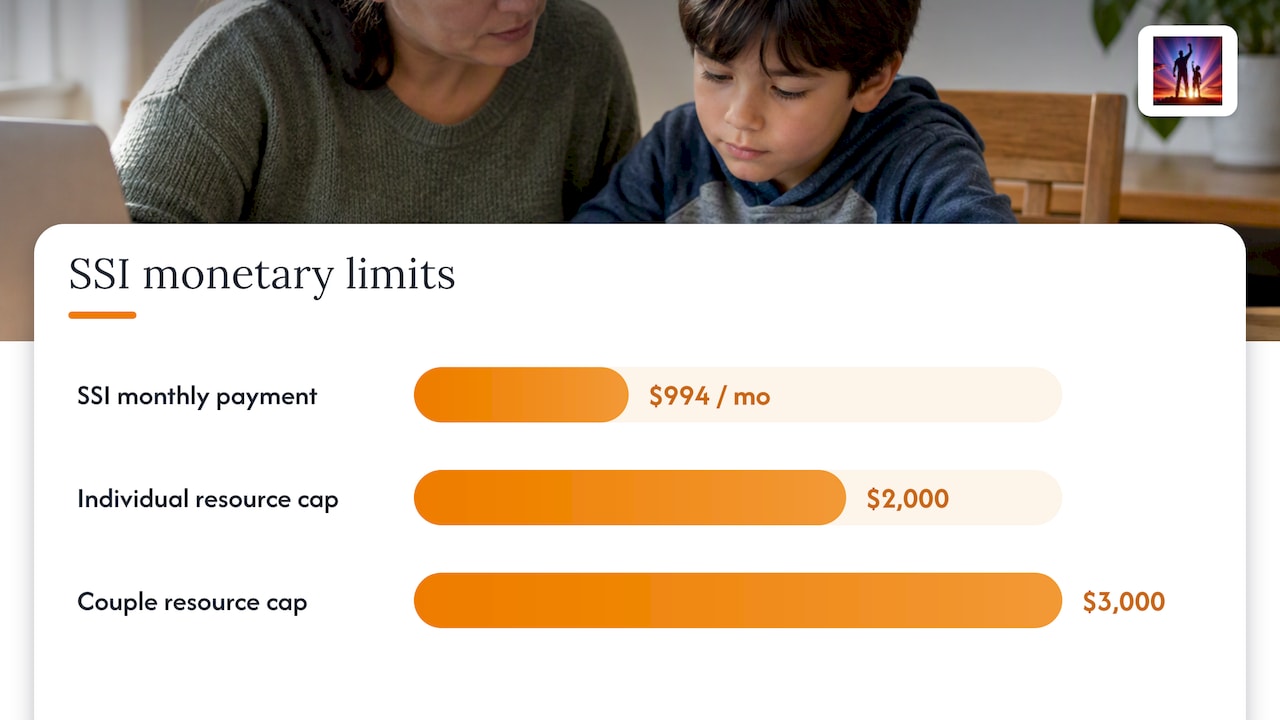
As of 2026, the federal SSI payment is $994 a month for an eligible individual, with countable resources capped at $2,000 for an individual and $3,000 for a couple. That resource limit catches families off guard more than almost anything else in the process. A savings account that creeps over $2,000 can disqualify a child, which is part of why ABLE accounts exist.
A few other things to know before you apply:
SSI counts household income differently depending on your child's living arrangement, and free food or housing can lower the monthly payment.
Expect to submit diagnostic evaluations, school IEP or 504 records, therapy progress notes, and a physician's letter describing functional limits.
If you're denied, you have the right to appeal, and many approvals happen at the reconsideration or hearing stage rather than the first review.
How do Medicaid and HCBS waivers actually work?
Medicaid covers core health services, but the real flexibility for autism families often comes through HCBS waivers, which fund respite, personal care, habilitation, and other in-home supports that Medicaid alone doesn't cover. These waivers exist because institutional care is expensive, so states get federal approval to redirect that money toward keeping kids at home instead.
Here's the part most parents don't expect: there's no single nationwide paycheck for autism caregiving. Financial support typically comes through state-run Medicaid waiver programs that sometimes let parents get paid for providing care, but eligibility, pay rates, and waitlists differ by state, sometimes dramatically. A waiver that pays parents in one state might not exist at all next door.
To move forward:
Search your state's name plus "Medicaid waiver autism" or "HCBS waiver" to find the official page.
Ask about waitlist length immediately. Some states process applications in months; others take years.
Document your child's need for a level of care comparable to institutional settings, since many states assess this formally before approving a waiver.
Pro Tip: Call your state's waiver intake line and ask to be added to the waitlist the same day you request an application. Waitlist position is often based on request date, not approval date.
For a practical walkthrough of this process, our guide on getting paid through Medicaid waivers breaks down the steps state by state.
ABLE accounts, tax credits, and employer benefits
ABLE accounts let eligible individuals with disabilities save and invest without jeopardizing means-tested benefits, as long as disability onset occurred before age 26. That last detail matters: it covers most children diagnosed with autism, since the condition is typically identified well before that age cutoff.
ABLE account balances are generally disregarded for SSI purposes, per IRS guidance, which is why they've become a go-to savings tool for families worried about the $2,000 resource limit. Funds can cover education, housing, transportation, and other qualified disability expenses without counting against eligibility.
Beyond ABLE, a few tax tools are worth checking:
The Child and Dependent Care Credit can offset costs for care that allows you to work, with dollar limits set by the IRS.
A dependent care flexible spending account lets you set aside pre-tax dollars for qualifying care expenses, within annual limits.
Employer-sponsored dependent care assistance programs sometimes stack with other credits, though limits and exclusions apply, so check IRS guidance before assuming you qualify for both.
Protecting benefits with trusts and estate planning
A special needs trust lets you set aside money for your child without disqualifying them from SSI or Medicaid, but the type of trust matters enormously. A third-party special needs trust, funded with money that never belonged to your child (grandparent gifts, your own savings), is usually preferable because it avoids the strict payback rules attached to first-party trusts, which must be funded with the child's own assets and often require reimbursing Medicaid after the beneficiary's death.
Beyond the trust itself, a few documents round out a basic plan:
A will naming a guardian for your child if something happens to you.
A durable power of attorney and healthcare proxy for your own affairs.
A letter of intent describing your child's routines, preferences, and care needs for future caregivers.
Costs for setting up a special needs trust vary widely by attorney and region. Ask your state's bar association or a local disability advocacy organization for referrals to attorneys experienced in this area specifically, not general estate planning.
How to apply: your documentation checklist
Getting organized before you apply cuts down on delays and denials. Follow these steps in order:
Collect core records: diagnosis report, developmental evaluations, IEP or 504 plan, therapy notes, and a physician's letter describing functional limitations.
Gather financial documents: income proof, bank statements, and asset records needed for SSI's resource test.
Apply for SSI through the SSA's disability benefits portal, then separately contact your state's Medicaid office about waiver waitlists.
Track every submission with a simple spreadsheet: date filed, program name, contact person, and next follow-up date.
Set calendar reminders for appeal deadlines, which are typically 60 days from a denial notice.
Pro Tip: Keep a dated folder, digital or paper, for every document you submit. Reviewers often ask for the same paperwork twice.
Our detailed breakdown of SSI payment amounts and what to do if denied walks through the appeals process step by step.
What the research says about caregiver wellbeing
Financial benefits matter, but so does your own capacity to keep going. Research on caregivers of autistic children links respite care, peer support, and psychoeducational programs to measurable improvements in caregiver quality of life, particularly when those programs include a therapeutic component rather than information alone.
Participation in meaningful activities and access to social support are consistently tied to better wellbeing outcomes for parents raising autistic children.
A few ways to put this into practice:
Look up your local Area Agency on Aging for National Family Caregiver Support Program respite funding.
Search for parent-led peer groups in your area or online; many offer paperwork navigation alongside emotional support.
If stress becomes unmanageable, ask your pediatrician for a referral or explore options like therapy designed for parents.
Our respite care guide lists funding sources by category if you want a starting point.
A perspective on pacing yourself through this process
Raising an autistic child comes with real grief and real joy, often in the same week. We've found it helps to tackle one benefit process at a time instead of all four at once, and to lean on peer support when the paperwork feels like too much. A guided checklist, ours or anyone's, only works if you give yourself room to rest between steps.
— Ronnie Talent
A guided next step: Autism Victory
Researching SSI, waivers, ABLE accounts, and trust law across multiple government websites takes real time, time most parents don't have to spare. We built a platform to put that research in one place: a state-specific benefits navigator, bilingual caregiver resources, and step-by-step checklists that mirror the process outlined above.
Inside the platform, you'll find:
A state-by-state benefits and funding navigator so you're not guessing which programs apply where you live.
Caregiver-focused books, audiobooks, and videos in multiple languages.
AI-guided support for questions that come up between appointments.
If you'd rather have a centralized guide than ten open browser tabs, visit our pricing page to start a free trial. Plans start at standard monthly or annual rates.
This article is general information, not a substitute for advice from a qualified financial advisor. Consult a qualified financial professional about your own circumstances before acting on anything here.
FAQ
What am I entitled to as a parent with an autistic child?
Entitlements depend on your child's disability severity and your household's income and resources. Most families start with SSI eligibility and Medicaid or HCBS waiver access, then layer in tax tools like ABLE accounts once basic benefits are in place.
Is life worth living with autism?
This question reflects outdated assumptions rather than current evidence. Autistic individuals, like anyone, experience a full range of wellbeing, and research on caregiver and family quality of life shows that respite, peer support, and psychoeducation meaningfully improve outcomes for the whole family.
What is a high functioning autistic?
"High functioning" is an informal, non-clinical term some people use to describe autistic individuals with fewer support needs in daily living or communication, but it isn't a diagnostic category. Support needs vary widely and can change over time, so eligibility for benefits is based on documented functional limitations rather than this label.
Do parents of autistic kids get benefits?
Parents don't typically receive a direct federal payment for caregiving, since SSI is issued to the eligible child. Some parents can get paid as caregivers through state Medicaid HCBS waivers, though eligibility and pay rates vary significantly by state.
Sources
Peer-reviewed analysis of Medicaid waiver variations and family caregiver payment
IRS Publication P907 (Disability tax benefits and ABLE accounts)
Recommended