Adult Autism Meltdown: A Guide for Adults and Caregivers
An adult autism meltdown is an involuntary neurological response to sensory, social, or emotional overload, not a choice, a tantrum, or a bid for attention. If you or someone near you is in one right now, the priority is safety and space, not conversation.
Do this right now:
Reduce noise and light where you can.
Give physical space; don’t crowd or touch without asking.
Speak in short, calm sentences, or don’t speak at all.
Wait for the wave to pass before discussing what happened.
Don’t do this:
Don’t ask “why” questions mid-meltdown.
Don’t restrain unless there’s real danger to safety.
Don’t shame, film, or narrate the moment.
Safety callout: Call emergency services if there’s a risk of injury to the person or others, or if self-harm is happening. A 2023 qualitative study of autistic adults and practical NHS guidance from Leicestershire Partnership both back the approach in this guide.
Key Takeaways
Adult autism meltdowns are involuntary responses to overload, best managed with early recognition, immediate safety and space, and a written plan built before a crisis, not during one.
Point | Details |
|---|---|
Meltdowns aren’t tantrums | They’re involuntary overload responses with no goal, unlike tantrums, which are goal-directed. |
Catch the rumble stage | Stimming, pacing, and repetitive questioning often precede a full meltdown and mark the best window to intervene. |
Safety and space come first | During a meltdown, reduce stimulation and skip conversation; save discussion for after recovery. |
Burnout raises meltdown risk | Chronic masking and unmanaged burnout deplete regulation capacity, making everyday triggers harder to absorb. |
Plan before the crisis, not during | Autism Victory App lets you build and store a personal meltdown plan, sensory tools, and caregiver resources in one place. |
Table of Contents
What Is an Autistic Meltdown, and How Is It Different From a Tantrum?
What Triggers a Meltdown, and What Are the Early Warning Signs?
What Does a Meltdown Actually Look Like in Adults?
How Should the Person and the Caregiver Respond During a Meltdown?
What Helps a Person Recover After a Meltdown?
How Do You Prevent Meltdowns Long-Term?
How Are Burnout and Meltdowns Connected?
When Should You Seek Professional or Crisis Help?
How Do You Build a Personal Meltdown Plan?
How Autism Victory App Supports Meltdown Planning
Frequently Asked Questions
Sources
What Is an Autistic Meltdown, and How Is It Different From a Tantrum?
A meltdown is an involuntary loss of behavioral control triggered by sensory, social, or emotional overload that exceeds a person’s capacity to cope in that moment. It isn’t goal-directed. Medical News Today’s clinical overview draws a sharp line here: a tantrum aims to get something (attention, an object, a changed decision), while a meltdown has no aim at all. It’s the nervous system hitting its ceiling.
The distinction matters because how people respond changes everything. Treat a meltdown like a tantrum and you escalate someone who has already lost the ability to negotiate, reason, or “calm down on command.”
Meltdown vs. tantrum vs. shutdown:
Tantrum: goal-oriented, often stops once the demand is met or the audience leaves.
Meltdown: outward loss of control (yelling, crying, lashing out) with no goal, driven by overload.
Shutdown: internal withdrawal, going quiet, losing speech, or appearing to “check out.”
During a meltdown, the parts of the brain responsible for planning and verbal reasoning are effectively offline. That’s why questions like “what’s wrong?” often get silence, repetition, or a worse reaction. Memory and executive function stall out under overload, which is also why people often can’t recall details of a meltdown afterward. Autism Victory App’s own comparison of meltdowns and tantrums breaks this down further for caregivers trying to spot the difference in real time.
What Triggers a Meltdown, and What Are the Early Warning Signs?
Most adult meltdowns trace back to five overlapping categories: sensory overload (lights, sounds, textures, crowds), social overwhelm (masking, small talk, conflict), unexpected change, unmet basic needs (hunger, sleep debt, pain), and cognitive load (decision fatigue, multitasking, deadlines). Rarely is it just one thing. Usually it’s several stacked on top of each other until capacity runs out.
Before a full meltdown, there’s almost always a “rumble stage,” a window where warning signs show up and intervention is still possible. Clinical reviews on prodromal signs before meltdowns describe this window as the most effective point for stepping in, well before things reach a boiling point.
Rumble-stage signs to watch for:
Increased stimming (rocking, hand movements, pacing)
Repetitive questioning or getting stuck on one topic
Sudden loss of masking, appearing more “obviously autistic” than usual
Irritability, snapping at small things
Slowed or foggy thinking, trouble finding words
Pro Tip: Keep a simple log with four fields: what happened, where, what the rumble signs looked like, and what actually helped. Even a phone notes app works. Patterns usually show up after just two or three entries, and that pattern is what lets you intervene earlier next time.
What Does a Meltdown Actually Look Like in Adults?
Meltdowns in adults vary enormously, and not all of them are loud. Some look like crying and shouting. Others look like someone going completely still and silent.

Emotional signs: sudden crying, intense frustration, panic, or a flat “shutting down” feeling. Verbal signs: raised voice, repeating phrases, or complete loss of speech. Physical signs: shaking, rocking, covering ears or eyes, pacing, or, in more intense cases, hitting or throwing objects. Internal (camouflaged) meltdowns: outward calm masking intense internal distress, sometimes described as feeling like “screaming inside a silent room.”
Presentation shifts by individual, too. Adults skilled at masking, and many autistic women in particular, often hold the meltdown in until they reach a safe, private space, then release it hours later. A 2023 study of 32 autistic adults found participants describing both visible and fully internalized meltdowns, and the internal version rarely gets recognized by others. Someone might say “I’m fine” while internally overwhelmed, so calm on the surface never guarantees calm underneath.
How Should the Person and the Caregiver Respond During a Meltdown?
The goal during a meltdown isn’t resolution. It’s safety and sensory regulation. Any conversation about what caused it waits until afterward.
If you’re the one having the meltdown, and you’re able to act:
Get to a quieter, dimmer space if you can move safely.
Use a grounding tool: pressure (a weighted item, tight hug if wanted), noise-canceling headphones, or a familiar object.
Slow your breathing if possible; don’t force it if it’s not working.
Give yourself permission to not speak or explain anything yet.
If you’re supporting someone else:
Lower stimulation first, dim lights, cut noise, clear the area of onlookers.
Speak less, not more. Short, calm phrases only, or silence.
Offer space rather than closeness unless they signal they want contact.
Stay nearby without hovering, and watch for safety risks.
What not to do:
Don’t interrogate (“why are you doing this?”).
Don’t restrain unless there’s genuine danger, per NHS caregiver guidance.
Don’t shame, mock, or bring it up in front of others.
Quick safety check: Is the environment as low-stimulation as it can be? Is the person physically safe from injury? Is anyone in danger, including the person themselves?
Picture three settings where this plays out: a grocery store under fluorescent lights and crowd noise (the fix is often just leaving through the nearest exit), an open-plan office after back-to-back meetings (a five-minute break in a stairwell or car), and a family gathering where masking finally breaks (a quiet bedroom, door closed, no one following to “check in” immediately).
What Helps a Person Recover After a Meltdown?
Recovery needs rest, basic care, and low stimulation, not a debrief. The body has just run a stress response at full throttle, and it needs time to come back down.
Right after a meltdown:
Offer water and food if it’s been a while.
Leave space; don’t hover or ask “are you okay?” repeatedly.
Keep the environment quiet and dim for as long as needed.
When it comes to talking about it: wait until the person is back to their baseline, sometimes hours, sometimes the next day. Use nonjudgmental language (“that looked really hard” rather than “what happened back there?”).
A simple documentation template to fill in afterward:
Date and approximate time.
What the trigger(s) seemed to be.
What the rumble signs looked like beforehand.
What helped, and what made it worse.
How Do You Prevent Meltdowns Long-Term?
Prevention comes down to reducing cumulative demands before they stack up, not eliminating every possible trigger. That’s an impossible goal. The realistic one is building enough recovery time into daily life that overload doesn’t have room to build.
Daily habits that reduce meltdown frequency:
Protect sleep, since fatigue lowers the threshold for everything else.
Build in scheduled downtime after high-demand events, not just when you notice you need it.
Use a sensory diet of planned sensory input (movement, pressure, quiet time) rather than waiting for overload to force a break.
Set boundaries around social commitments, and decline more than feels comfortable.
Accommodations worth setting up in advance:
At home: a designated low-stimulation room, visual schedules for predictability.
At work: flexible scheduling, noise-canceling headphones, a quiet space to retreat to.
Reducing masking where it’s safe to do so, at home, with trusted people, matters more than most prevention advice acknowledges. Masking all day and then trying to “relax” for twenty minutes before bed doesn’t undo the accumulated demand.
Pro Tip: If you’re raising accommodations at work, frame the request around specific triggers and specific fixes (“fluorescent lights in the open office increase my sensory load, could I move to the desk near the window or use a lamp instead?”) rather than a general ask. Specific requests get approved more often than vague ones, and HR teams typically respond better to concrete accommodation asks tied to the Americans with Disabilities Act framework than to open-ended requests.
How Are Burnout and Meltdowns Connected?
Burnout and meltdowns feed each other directly: burnout depletes the regulation capacity that would otherwise absorb everyday overload, so meltdowns start happening over triggers that used to be manageable. It’s not that the triggers got worse. The buffer disappeared.
NHS guidance on autistic burnout describes burnout as the result of demands consistently outpacing supports, producing chronic exhaustion, skill loss, and lower tolerance across the board. The 2023 lived-experience study backs this up qualitatively: participants describing meltdowns almost always described them alongside sustained stress, not isolated one-off incidents.
What to change based on this, starting now:
Reduce demands the moment early burnout signs appear, don’t wait for a crisis.
Build rest into the calendar proactively rather than reactively.
Drop masking in safe spaces, since sustained masking is one of the biggest hidden drains on regulation capacity.
Acting on rumble-stage signs early, and on early burnout signs even earlier, is consistently more effective than intervening once someone’s already in crisis.
When Should You Seek Professional or Crisis Help?
Certain red flags mean it’s time to call a professional or emergency services, not wait it out. These include self-harm or expressed thoughts of harming oneself, prolonged inability to manage basic needs (eating, hygiene, safety) over days rather than hours, and any immediate danger to the person or others.
Red flags requiring same-day contact with a provider or crisis line:
Self-harm behaviors or statements
Meltdowns escalating in frequency or intensity week over week
Complete inability to function (work, eat, sleep) for more than a few days
Who can help:
Crisis teams or psychiatry for acute safety concerns
Occupational therapists for sensory planning and regulation strategies
Therapists experienced specifically with autistic adults, not just general anxiety or mood treatment
Before an appointment, bring: your meltdown log, a list of known triggers, and notes on what’s helped or made things worse.
How Do You Build a Personal Meltdown Plan?
A personal meltdown plan is a short, written reference that tells you and the people around you exactly what to do before, during, and after a meltdown, so no one has to figure it out in the moment.
Fields to fill in:
Known triggers (be specific: fluorescent lights, unplanned schedule changes, crowded rooms).
Rumble-stage signs (what it looks like before it becomes a full meltdown).
Calming tools that work (headphones, weighted blanket, specific playlist).
Preferences during a meltdown (space vs. contact, talk vs. silence).
Recovery needs (food, quiet time, how long before check-ins are welcome).
Emergency contacts and any relevant medical information.
Example, filled in for a hypothetical adult: Triggers: open-plan office noise, sudden schedule changes. Rumble signs: repetitive tapping, short answers. Calming tools: noise-canceling headphones, a walk outside. During: wants space, no questions. Recovery: 30 minutes alone, then a text check-in, not a call.
Share the plan with a partner, close family member, or manager, whoever is actually present during your day. Practice walking through it once when calm, so it’s familiar rather than new when it’s actually needed.
A Caregiver’s Perspective on Living This Guidance
Watching someone you love go through a meltdown teaches you fast that patience beats problem-solving in the moment. The instinct to fix it, to ask questions, to explain, all of it has to wait. What actually works is smaller and quieter than most advice suggests: less talking, more space, and trusting that the person knows their own needs better than you do. Autism Victory App exists because families need this reframing early, not after years of trial and error.
How Autism Victory App Supports Meltdown Planning
Building and remembering a meltdown plan is harder when it lives only in your head or a scattered notes app. Autism Victory App gives caregivers and autistic adults a dedicated place to build that plan once and actually access it when it matters, on a phone, mid-crisis, without hunting through old texts or notebooks.
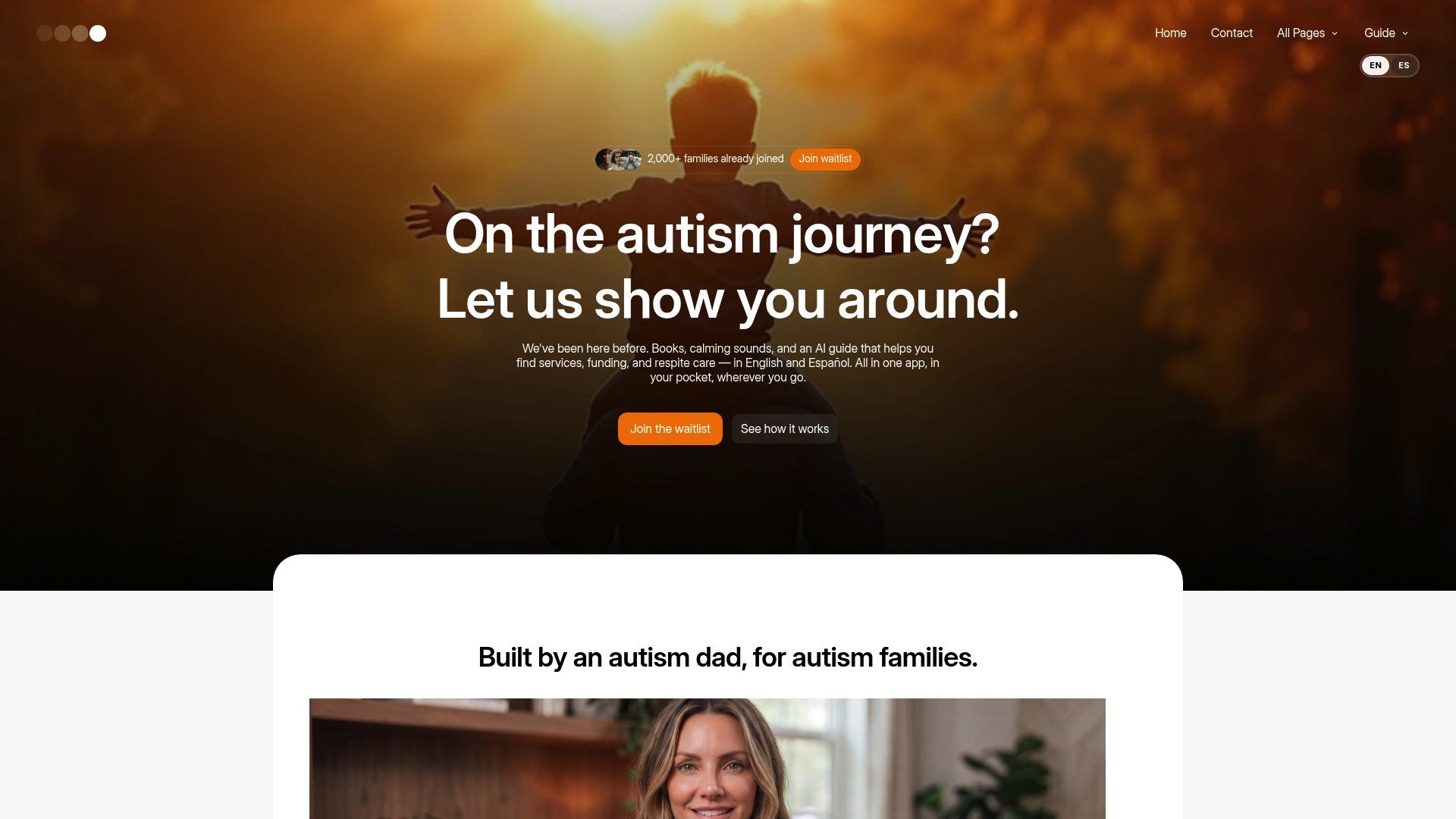
The app brings together the pieces this guide walks through: personalized AI guidance for working through triggers and strategies, a calming sound library for rumble-stage regulation, state-specific resource navigation for finding local support and funding, and a caregiver community where you’re not troubleshooting alone at 2 a.m. It also includes caregiver-focused books and audiobooks in English and Spanish, useful for the debrief and recovery stage covered earlier.
If you’ve read this far because you’re building your own plan or supporting someone who needs one, start a free trial through the Autism Victory app and set up your plan template before the next rumble stage hits, not during it.
Frequently Asked Questions
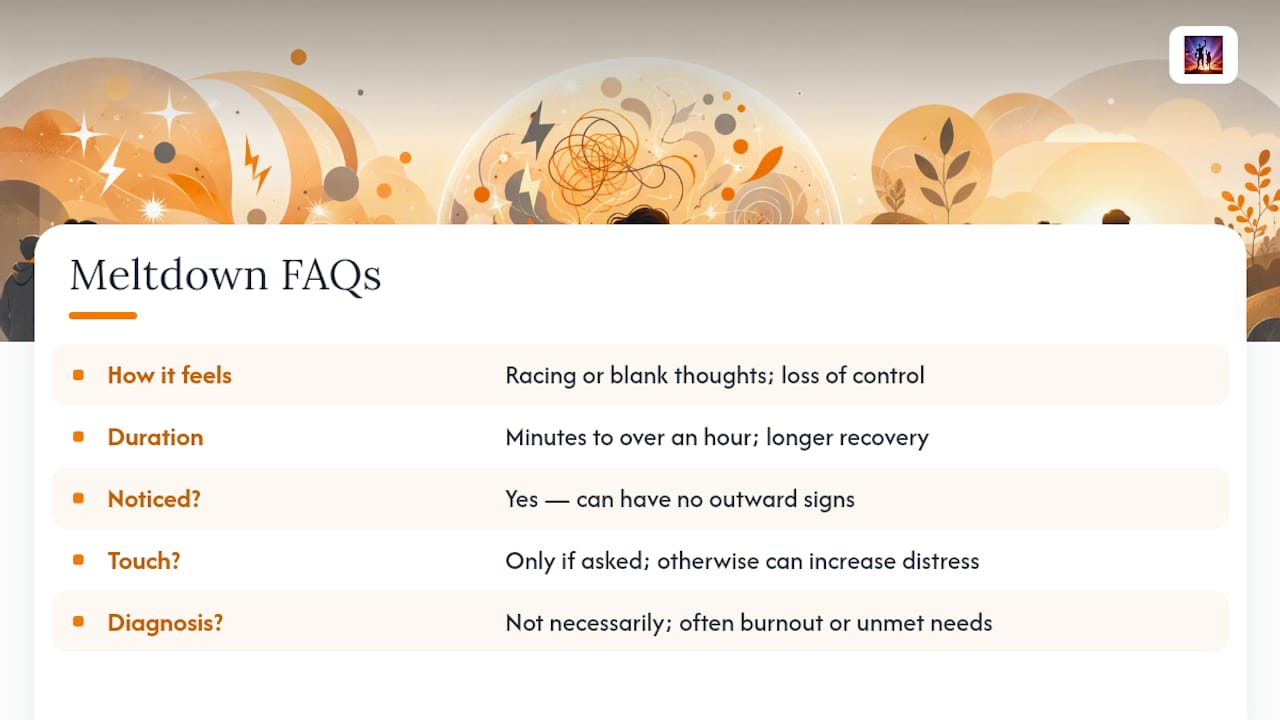
What does an adult autism meltdown feel like from the inside? Many autistic adults describe it as losing control over emotions and thinking at the same time, with racing or completely blank thoughts, according to the 2023 lived-experience study. Some describe it as their brain simply refusing to process anything else.
How long does an adult meltdown usually last? Duration varies widely by person and trigger intensity, from a few minutes to over an hour. Recovery time afterward often takes longer than the meltdown itself.
Can adults have meltdowns without anyone noticing? Yes. Internal or camouflaged meltdowns involve intense internal distress with little to no outward sign, and research on internalized presentations confirms outward calm doesn’t rule out crisis underneath.
Is it okay to touch someone during a meltdown? Only if they’ve indicated they want physical contact. Unwanted touch during sensory overload can escalate distress rather than calm it.
Do meltdowns mean someone needs a different diagnosis or treatment? Not necessarily. Frequent or intensifying meltdowns are more often a sign of unmanaged burnout or unmet accommodation needs than a separate condition, though a marked increase is worth discussing with a provider familiar with autistic adults.
This article is general information, not a substitute for advice from a qualified doctor. Consult a qualified healthcare professional about your own circumstances before acting on anything here.
Sources
Recommended