
You can appeal an ABA therapy denial, and many appeals succeed when they're built on solid documentation. Start with three moves today: preserve the denial letter and Explanation of Benefits (EOB), calendar your appeal deadline (the deadline depends on your specific plan; under the Affordable Care Act, it is typically at least 180 days from the denial), and ask your child's BCBA or clinician for a detailed medical-necessity letter. Everything else in this guide builds on those three steps.
TL;DR:
Most ABA therapy denials can be reversed if families preserve documentation, meet appeal deadlines, and include detailed medical-necessity letters from clinicians.
Fully insured plans are bound by state mandates, while self-funded plans follow federal parity laws, affecting which legal tools to leverage in an appeal.
Organizing a complete evidence packet before appealing, including diagnosis reports, treatment data, provider notes, and communication logs, significantly improves success chances.
Counter common denial reasons by providing objective impairment data, documenting provider capacity issues, and verifying coding accuracy to address administrative errors.
If internal appeals fail, external reviews and regulator complaints are available options, with the latter depending on plan type and specific violations.
Table of Contents
What Are the Deadlines and Legal Tools for an ABA Denial Appeal?
When Should You Request External Review or File a Regulator Complaint?
What Are the Deadlines and Legal Tools for an ABA Denial Appeal?
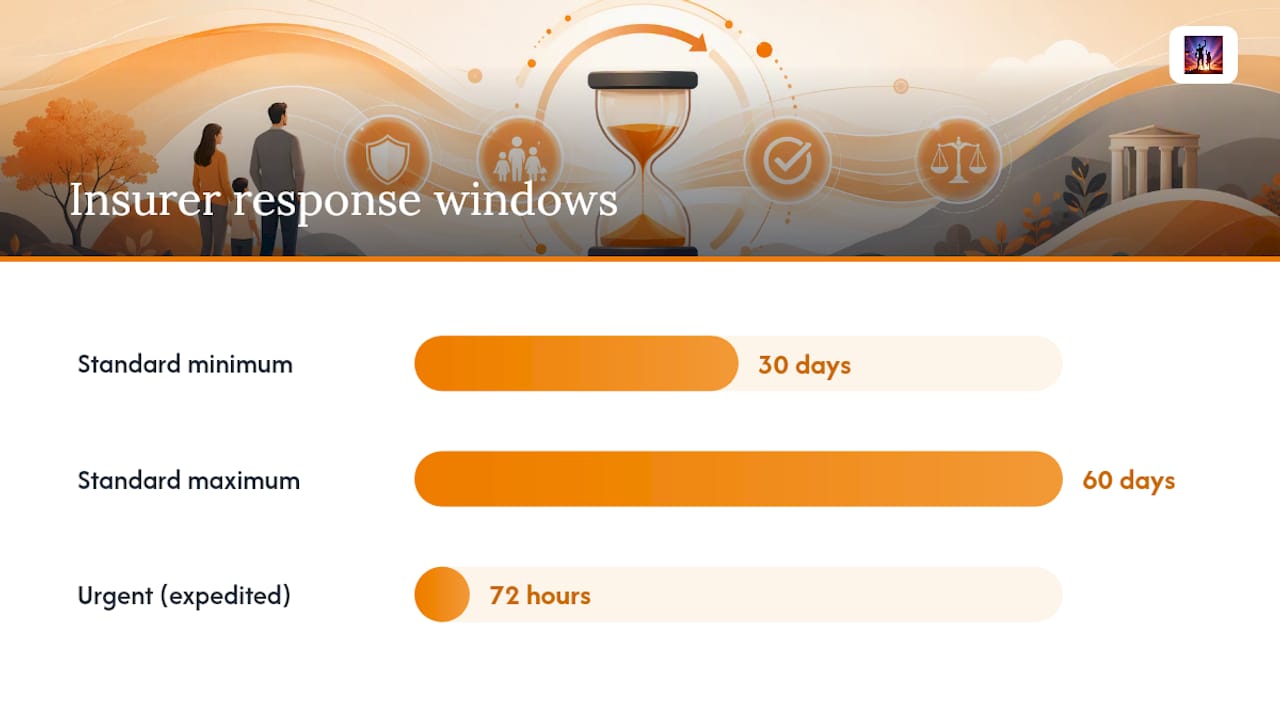
Your denial letter starts a clock. Under the Affordable Care Act, you typically have at least 180 days from that letter to file an internal appeal, and missing that window usually means forfeiting your right to challenge that specific claim. Once you file, insurers must respond within 30 to 60 days for standard appeals, or within 72 hours if your case is urgent enough to request expedited review.
Which legal tool applies depends on how your plan is structured, and that single detail changes your entire strategy.
Fully insured plans (purchased through an employer or the marketplace) are usually bound by state autism insurance mandates, which often specify minimum ABA coverage.
Self-funded plans (common with large employers) fall under ERISA instead of state law, and your strongest lever becomes the Mental Health Parity and Addiction Equity Act, enforced by the Department of Labor's EBSA division.
Not sure which type you have? Check your plan documents for "Administrative Services Only" language, or ask HR for the Summary Plan Description.
The moment the denial arrives, note the deadline on a calendar and request your file: the denial letter, EOB, and the insurer's stated review criteria.
What Documentation Do You Need Before You Write the Appeal?
A rushed appeal with thin documentation gets denied twice. A complete evidence packet, assembled before you write a single word, gives your appeal the best shot at reversing on the first try.
The denial letter and EOB, plus your claim number, authorization number, and the exact clinical criteria the insurer cited for the denial.
The official autism diagnostic report and a current BCBA assessment that spells out recommended weekly hours and specific treatment goals.
The treatment plan and progress data, showing measurable gains (or documented regression without services), along with any prior authorization records.
Provider notes covering session summaries, parent training components, and any changes to the treatment plan over time.
A communication log: certified-mail receipts, fax confirmations, call dates, names of representatives you spoke with, and reference numbers for every call.
Pro Tip: Keep every document in one physical folder and one digital folder with matching names. When an insurer asks you to resend something for the third time, you want to find it in ten seconds, not ten minutes.
Insurers deny thousands of ABA claims for missing paperwork alone. A tight, organized file removes that excuse entirely and forces a decision on the clinical merits.
Why Was Your ABA Therapy Denied, and How Do You Counter It?
Denial letters usually cite one of five recurring reasons, and each one has a specific, targeted rebuttal.
"Not medically necessary." Counter by mapping your BCBA's assessment and progress notes directly onto the insurer's own published clinical criteria, and attach a clinician letter that addresses each criterion by name.
Hour caps or session limits. Show objective impairment data (assessment scores, school reports, incident logs) that justifies the recommended hours, and point out if comparable medical benefits in the same plan carry no similar caps.
Out-of-network provider. Document that no in-network BCBA has capacity or geographic availability, then formally request a network-inadequacy exception.
Prior authorization or administrative errors. Confirm the correct codes were submitted, contact the provider's billing department, and request resubmission with corrected information.
Coding flags tied to Medically Unlikely Edits (MUEs). MUEs are screening tools, not hard caps, and when services were preauthorized and properly coded, insurers are expected to reprocess the claim rather than deny it outright.
Identifying the exact reason on your letter before you start writing saves you from submitting a generic appeal that answers the wrong question.
How Do You File the Internal Appeal Step by Step?
The internal appeal is your first formal shot at reversal, and it needs structure, not just passion.
Confirm the appeal address and deadline listed on your denial letter, and decide whether your case qualifies for expedited review (typically when a delay would seriously harm your child's health).
Structure the letter clearly: your child's identifying information and policy number, the specific denial being appealed, a point-by-point clinical rebuttal, a list of attached supporting documents, and an explicit request (reversal of denial, approval of X hours per week).
Request a peer-to-peer review if your provider hasn't had one yet, and ask the insurer to name which clinical criteria apply and to assign a reviewer with behavioral health credentials.
Send everything by certified mail or fax with confirmation, keep copies of every page, and log the date sent alongside your existing communication tracker.
Track the response window. If the insurer misses its 30 to 60 day deadline (or 72 hours for urgent cases), call to confirm receipt and consider that missed deadline itself grounds for immediate escalation.
Appeal letters carry more weight when they answer the insurer point for point. The American Psychiatric Association recommends responding directly to each stated reason for denial and including a clinical chronology with supporting literature rather than a general statement of need.
Pro Tip: Number each attachment and reference those numbers in your letter ("see Attachment 3, BCBA progress report"). Reviewers moving through a stack of appeals respond better to organized packets than loose paperwork.
When Should You Request External Review or File a Regulator Complaint?
If your internal appeal is denied, you are not out of options. You have moved to the next stage, not the last one.
External review becomes available once your internal appeal is exhausted, and the instructions for requesting it are usually printed right on your final denial letter. An Independent Review Organization conducts this review as a neutral, often binding process, and outcomes frequently favor families when clinical documentation clearly supports the requested service.
IRO reviewers evaluate the same clinical evidence your insurer saw, but without that insurer's financial stake in the outcome, which is exactly why denials get reversed at this stage.
File a state insurance commissioner complaint if you have a fully insured plan and believe the insurer violated your state's autism mandate or its own appeal timelines. Include your denial letters, appeal correspondence, and a timeline of events.
Contact EBSA/DOL if your plan is self-funded and you suspect a parity violation. The Department of Labor's Employee Benefits Security Administration investigates ERISA plans that impose stricter limits on behavioral health than on comparable medical care, and it has corrected plan practices in past enforcement actions.
How Do You Fix Billing or Coding Denials?
Not every denial is clinical. Some are pure administrative errors, and those get resolved faster once you know what to look for.
A denial is administrative, not clinical, when the letter cites a missing authorization number, a coding mismatch, or a claim submitted under the wrong billing code rather than a lack of medical necessity.
Call your provider's billing department first and ask them to confirm the CPT code used (ABA sessions are commonly billed under CPT 97153) and whether the claim was submitted with a valid prior authorization on file.
Request a corrected claim resubmission in writing, and attach a copy of the original authorization approval as proof it existed before services were rendered.
If the denial cites an MUE limit, CMS guidance treats MUEs as screening thresholds, not absolute caps, meaning payors should reprocess a properly authorized and coded claim rather than deny it on that basis alone.
Coding errors are fixable within days once billing catches them, while clinical appeals can take weeks. Running both tracks at once keeps your case moving on every front.
What Should a Medical-Necessity Letter Include?
Ask your child's clinician or BCBA for a letter built around a few essential elements, because a vague letter, even from a qualified provider, rarely moves the needle.
The formal diagnosis, referencing the DSM-5 code for Autism Spectrum Disorder.
A clear description of functional impairment, meaning the specific ways your child's daily functioning is affected without treatment.
The treatment rationale, explaining why ABA specifically, and why the recommended intensity, is appropriate for this child's presentation.
A direct reference to the insurer's own clinical guidelines, addressed point by point rather than in generalities.
Objective progress data, including baseline measurements and any documented gains or regressions tied to service levels.
An insurance denial is often little more than an automated paper review against a checklist. A letter that speaks the insurer's own clinical language, criterion by criterion, tends to carry far more weight than a passionate but generic plea.
Pro Tip: Before your clinician sits down to write, hand them your own notes: recent school reports, specific incidents at home, and any progress logs you've kept. It makes their letter sharper and saves them time.
A Caregiver's Take on Staying the Course
Every successful appeal I've studied shares one habit: relentless organization. One folder. One call log. One calendar with the deadline circled in red. The families who win aren't necessarily the ones with the strongest case on paper. They're the ones who followed up on the peer-to-peer request, resent the clinician letter when it got "lost," and filed the regulator complaint when the insurer stopped responding. Persistence, paired with paperwork, is what actually moves these decisions.
— Ronnie Talent
Managing the Appeal Without Losing Your Mind
Every step above works, but juggling deadlines, letters, and state-specific rules while caring for your child is genuinely hard to do with a shoebox of paperwork. You can find dedicated tools that offer an organized space to store denial letters, appeal drafts, and provider documents alongside state-specific funding and support resources and bilingual (English and Spanish) guides written for caregivers navigating this process.

AI-powered guidance can walk you through what a specific denial reason typically requires, and caregiver communities often include families who've been through ABA appeals themselves. If you'd rather have organized checklists than a folder full of loose paper, you can start with a 5-day free trial and see the Annual plan at $49.95 per year or the Monthly plan at $6.95 per month. Explore what's included at Autism Victory and decide if guided support fits how your family handles this fight.
Where to Go for Official Appeal Guidance
Healthcare for deadlines and process basics.
CMS's MHPAEA parity factsheet for self-funded plan rights.
Department of Labor's EBSA overview for filing ERISA parity complaints.
Pounds Health's step-by-step appeal guide for additional procedural detail.
Read more on how plan type affects ABA coverage and what to expect for ongoing therapy costs during a drawn-out appeal.
This article is general information, not a substitute for advice from a qualified doctor. Consult a qualified healthcare professional about your own circumstances before acting on anything here.
Sources
FAQ
Can Insurance Deny ABA Therapy?
Yes, insurers can and do deny ABA therapy, most often citing medical necessity, hour caps, out-of-network status, or coding errors, but the majority of these denials can be formally appealed.
What Are the Odds of Winning an Insurance Appeal?
There's no single published success rate for ABA appeals specifically, but appeals backed by a detailed BCBA letter, objective progress data, and a point-by-point rebuttal of the insurer's stated criteria succeed far more often than appeals that restate the request without new evidence.
What Should You Do When an Insurance Appeal Is Denied?
If your internal appeal is denied, request an external review through an Independent Review Organization, which offers a neutral, often binding decision, and consider filing a complaint with your state insurance commissioner or, for self-funded plans, with EBSA/DOL.
How Do You Convince Health Insurance to Approve Your Appeal?
Address each of the insurer's stated denial reasons directly, attach a medical-necessity letter that maps to the insurer's own clinical criteria, include objective progress data, and request a peer-to-peer review with a behavioral health specialist.
Does It Matter if My Plan Is Fully Insured or Self-Funded?
Yes. Fully insured plans are typically subject to state autism mandates, while self-funded ERISA plans fall under federal parity law, making MHPAEA and an EBSA complaint your strongest tool if a denial looks inconsistent with how the plan treats medical benefits.
Recommended