

Yes, adults with autism can qualify for SSI, SSDI, or Disabled Adult Child benefits, but eligibility depends on the program and on documented functional limitations under Blue Book Listing 12.10, not on the diagnosis alone. The Social Security Administration wants proof of marked or extreme limitations, or a long-term history with marginal adjustment. Your next move is simple: start gathering clinical evaluations, adaptive behavior scores, and daily-functioning records now, before you file anything.
TL;DR:
Filing with strong functional documentation, including adaptive behavior scores and clinician statements, increases the chances of approval and may reduce the need for a consultative exam.
Eligibility for SSDI depends on earning enough work credits in the last decade, while SSI requires asset limits and no work history; DAC benefits use a parent's earnings record.
Demonstrating marked or extreme limitations in at least two of the four SSA functional domains is crucial, with evidence of long-term impairment or ongoing treatment strengthening the claim.
Most claims are denied initially due to incomplete evidence, but appeals with updated reports and detailed real-world examples often lead to eventual approval.
Using state-specific resources and organization tools like the Autism Victory App can streamline documentation, improve submission accuracy, and help avoid delays or missing evidence.
Table of Contents
Which Federal Program Fits Your Situation
Three programs cover adults with autism, and picking the right one starts with understanding what each requires.
Supplemental Security Income (SSI) is need-based. It has nothing to do with work history and everything to do with financial need. Countable assets must stay under the federal asset limits for SSI eligibility, and the federal benefit rate sets the maximum monthly payment, though many states add a supplement on top.
Social Security Disability Insurance (SSDI) works differently. It requires work credits, typically 40 total with 20 earned in the last decade, so it usually applies to adults with a solid employment history. The average SSDI payment runs about the typical amount reported by the SSA (https://www.ssa.gov/benefits/disability/qualify.html).
Disabled Adult Child (DAC) benefits are the ones families most often miss. If your disability began before age 22, you can draw off a parent's work record, sometimes for more than SSI pays, and without SSI's strict asset limits.
SSI: need-based, $2,000 asset limit, no work history required
SSDI: work-credit based, averages roughly $1,580 monthly
DAC: uses a parent's earnings record, no age-22 asset restriction
Working part-time can affect any of these if your earnings exceed the substantial gainful activity (SGA) threshold, so track your hours carefully before assuming a job will disqualify you.
What Blue Book Listing 12.10 Actually Requires
Listing 12.10 is the SSA's technical definition of autism spectrum disorder, and it asks for more than a diagnosis. It asks for proof your symptoms limit your ability to function.
Paragraph A requires documented deficits in social communication and interaction, plus restricted or repetitive behaviors, interests, or activities. This is usually the easiest part to satisfy since it mirrors a standard clinical diagnosis.
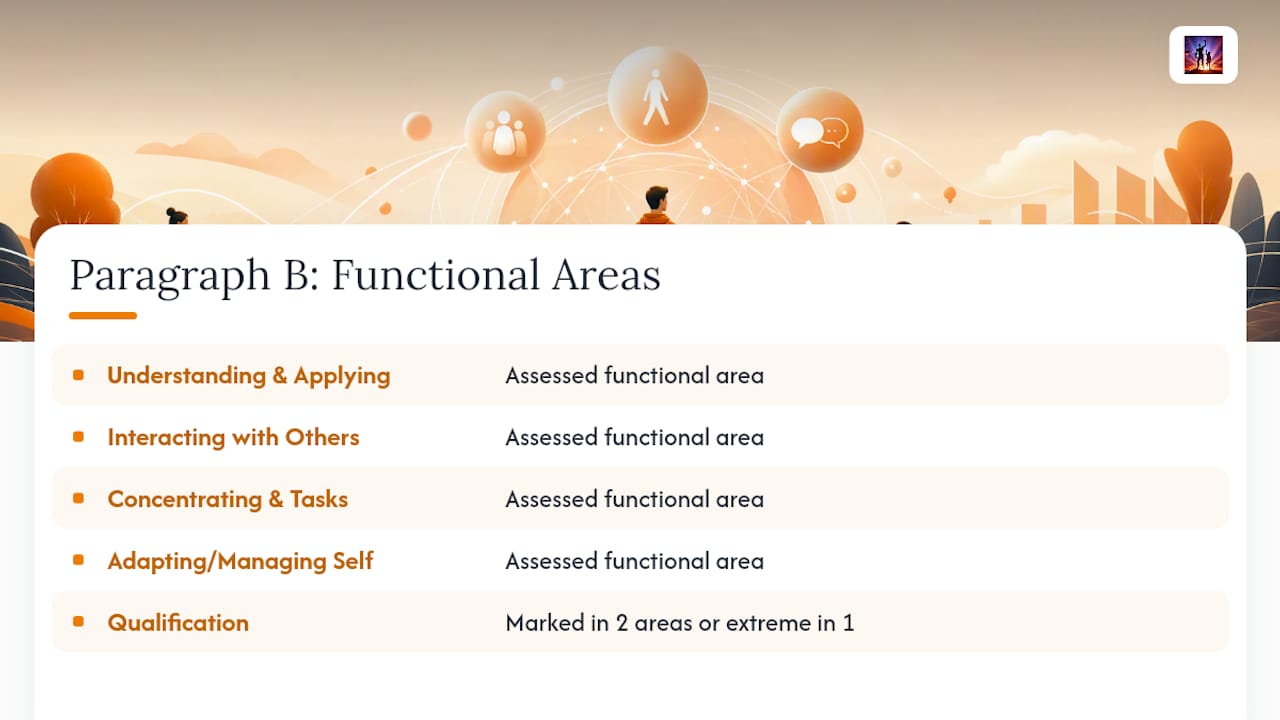
Paragraph B is where most claims succeed or fail. The SSA looks at four areas: understanding and applying information, interacting with others, concentrating and completing tasks, and adapting or managing yourself. You need a "marked" limitation in two of these areas, or an "extreme" limitation in just one. A marked limitation means the impairment seriously interferes with your ability to function independently; extreme means it's essentially impossible without support.
Paragraph C offers another path for people with a documented history of at least two years of the disorder, showing you rely on ongoing medical treatment or support to manage symptoms, combined with only marginal adjustment to changes in your environment.
A clinical diagnosis proves you have autism. Listing 12.10 wants proof of what autism prevents you from doing, and those are two different documentation tasks.
Building an Evidence File the SSA Will Trust
Your medical file needs to answer one question repeatedly: how does autism limit daily functioning? Assemble these documents in order of priority.
Diagnostic reports from a qualified provider, ideally including ADOS-2 or ADI-R results, which carry weight because SSA adjudicators recognize them as standardized tools.
Adaptive behavior assessments like the Vineland-3 or ABAS-3. These translate lived experience into scores the SSA can compare against its Paragraph B criteria.
Medical source statements, sometimes called Residual Functional Capacity forms, where a clinician directly addresses each of the four functional domains rather than describing the diagnosis in general terms.
Collateral records including school IEPs, employer performance notes, caregiver function reports, and even logs or photos documenting shutdowns, meltdowns, or missed responsibilities.
Pro Tip: Ask your clinician to write in SSA language, not just clinical language. A note that says "struggles with transitions" helps less than one that says "cannot adapt to changes in routine without significant support, consistent with a marked limitation in adapting or managing oneself."
School records matter more than most applicants expect. A decade of IEPs showing consistent accommodations can carry as much weight as a fresh psychological evaluation, because it demonstrates the limitation isn't new or situational.

Filing Your Claim and What Happens Next
You can file for SSI or SSDI three ways: online through the SSA's SSI program page, by phone, or in person at a local field office. Online works well if your paperwork is organized; phone or in-person appointments help if your case involves DAC benefits, which often need extra verification of the parent's work record.
File the initial application with your evidence file attached or ready to submit within the required window.
Wait for the initial review, which typically takes three to five months, though autism claims with strong Paragraph B documentation sometimes move faster.
Prepare for a possible consultative examination (CE) if the SSA feels your file lacks enough functional detail. Submit updated adaptive scores and a detailed functional narrative before this exam to reduce the odds of an unfavorable interpretation.
Consider naming an authorized representative early, especially for adults who need support communicating directly with the SSA.
Most delays trace back to incomplete functional evidence, not slow processing. The stronger your file at submission, the less likely a CE becomes necessary at all.
What to Do if Your Claim Is Denied
Denial isn't the end of the road, and it's more common than most applicants expect on a first submission. The appeals process has four stages, each with its own timeline.
Reconsideration: a fresh review by a different examiner, usually taking three to five months.
Hearing before an Administrative Law Judge (ALJ): often the stage where autism claims succeed, since you can testify and submit new evidence directly; wait times frequently run 12 months or longer depending on the region.
Appeals Council review: examines whether the ALJ made a legal error, not a fresh look at the facts.
Federal court: a rare last step, reserved for cases with a genuine legal dispute.
The evidence that turns a denial into an approval is usually the evidence that was missing the first time: updated adaptive testing, a supervisor or teacher statement describing real-world struggles, or a clinician's letter that finally addresses the four functional domains directly. Many families hire a disability attorney or advocate at the hearing stage. Fees are capped and only paid if you win, which makes this a low-risk decision for most applicants.
Financial Supports Beyond SSI and SSDI
Approval for SSI or SSDI often opens doors to other programs worth setting up right away.
Medicaid frequently follows SSI approval automatically, but some states, known as 209(b) states, require a separate Medicaid application. Confirm your state's rule immediately rather than assuming coverage started.
ABLE accounts let you save for disability-related expenses in a tax-advantaged account without counting against SSI's asset limit, a distinction that has changed favorably under recent legislation expanding who qualifies.
Private grants, like those from Autism Care Today, offer quarterly awards to help cover therapy or assistive technology costs that benefits don't cover.
Special needs trusts protect larger sums, such as inheritances or settlements, without disqualifying someone from means-tested programs.
The Autism Society recommends pairing public benefits with private planning, ideally with a special-needs attorney involved before large financial decisions are made.
Autism Victory App Resources for Your Application
Building a benefits file is paperwork heavy, and that's exactly the gap Autism Victory App was built to close. The app's state-specific financial assistance guides walk you through what your state offers beyond federal programs, since Medicaid rules and supplemental payments vary widely by location.
Inside the app, bilingual document navigators help families track what's been submitted and what's still missing, cutting down on the incomplete-file delays that stall so many claims. If you're weighing ABLE accounts against a special needs trust, the app's guides on ABLE account rules and special needs trust setup break down both options side by side, so you're not making that decision blind.
A Few Honest Words From Someone Who's Watched This Process
Most applicants who submit thorough functional documentation eventually get approved, even if the first answer is no. Start collecting records today rather than waiting for a "perfect" file. Lean on your community, a support group, an advocate, even a therapist who understands caregiver burnout, because self-care during this process isn't optional, it's part of doing this well.
— Ronnie Talent
Let Autism Victory App Carry the Paperwork Load
Autism Victory App gives families a state-by-state resource navigator built specifically for the kind of documentation this process demands, something a generic checklist or a one-size-fits-all guide can't match.
Instead of hunting across a dozen state websites to figure out what Medicaid actually requires after SSI approval, or guessing which adaptive assessment scores matter most, the app organizes it for you in one place, with bilingual guidance built by caregivers who've been through this exact process. That kind of state-specific detail is hard to find anywhere else, and it's the difference between submitting a file that gets flagged for missing pieces and one that moves through smoothly the first time.
Autism Victory App offers a 5-day free trial, followed by Monthly access for a low monthly fee or Annual access for an affordable yearly fee. Start your trial today and see whether your application file is missing anything before you submit it.
Sources
FAQ
What benefits can an adult with autism get?
Adults with autism may qualify for SSI, SSDI, or Disabled Adult Child benefits, depending on work history and how disability began. Many families also pair these with Medicaid, ABLE accounts, and private grants to cover therapy and daily living costs.
Can a child with autism be denied SSI?
Yes, children are frequently denied SSI when their file lacks documented functional limitations, even with a confirmed diagnosis. A detailed guide on SSI for children with autism covers common denial reasons and what to add before reapplying.
What to say to get approved for disability?
Approval hinges less on what you say and more on what your documentation proves: specific, real-world examples of how autism limits functioning in the four SSA domains. Clinician statements that address those domains directly, rather than general diagnostic language, carry far more weight.
How long does it take to get approved for SSI for a child with autism?
Initial SSI decisions typically take three to five months, though a consultative examination or incomplete evidence can extend that timeline. Submitting complete adaptive behavior assessments and functional narratives upfront is the most reliable way to avoid added delays.
Can Autism Victory App help me prepare my application?
Autism Victory App provides state-specific resource guides, document checklists, and bilingual support designed to help you organize the evidence SSA adjudicators look for. A free 5-day trial is available before choosing Monthly or Annual access.
Recommended