The Best Autism Quotes to Share and Inspire
The most impactful autism quotes don’t just sound good. They shift how people think. Here is a short, share-ready list of the most widely recognized sayings on autism awareness, each with clear attribution so you can post or reference them with confidence.
“If you’ve met one person with autism, you’ve met one person with autism.” — Dr. Stephen Shore, autism educator and professor at Adelphi University (widely cited in lectures and interviews)
“I am different, not less.” — Temple Grandin, Thinking in Pictures (1995)
“Autism is not a tragedy. Ignorance is the tragedy.” — Kerry Magro, autism advocate and public speaker (personal blog and speaking events)
“The most interesting people you’ll find are ones that don’t fit into your average cardboard box.” — Temple Grandin, The Autistic Brain (2013)
“Autism is part of my child, it’s not everything he is.” — Stuart Duncan, autism parent and community founder
“What would happen if the autism gene was eliminated from the gene pool? You would have a bunch of people standing around in a cave, chatting and socializing and not getting anything done.” — Temple Grandin, The Way I See It (2008)
“Autism offers a chance for us to glimpse an awe-filled vision of the world that might otherwise pass us by.” — Dr. Colin Zimbleman (attributed in advocacy contexts; verify via original source before reprinting)
Pro Tip: When sharing any of these on social media, include the speaker’s name and source in your caption. A quote stripped of its context can be misread. One extra line of attribution makes the difference between education and confusion.
Key Takeaways
Autistic voices are the most accurate and trustworthy source for quotes about autism, and every quote you share should carry a clear attribution and one sentence of context.
Point | Details |
|---|---|
Credit every quote | Always include the speaker’s name and original source, especially for classroom or print use. |
Center autistic voices | First-person quotes from autistic people are more accurate and respectful than third-party descriptions. |
Flag unverified sayings | Many widely shared quotes have disputed origins; note “origin unverified” rather than presenting them as confirmed. |
Add context before sharing | One sentence explaining who the speaker is prevents misinterpretation and increases trust. |
Autism Victory App | The platform offers caregivers curated resources, AI guidance, and community support beyond quote collections. |
Table of Contents
A curated collection of autism quotes organized by theme
How to share autism quotes respectfully and effectively
Where these quotes come from and how to verify attributions
Why centering autistic voices leads to better, more trustworthy content
Autism Victory App connects caregivers to trusted resources and community
Sources
A curated collection of autism quotes organized by theme
The quotes below are drawn from widely cited thematic collections and curated lists that center autistic voices. Each subsection opens with a brief framing note so you know when and how to use these sayings.
Acceptance and understanding
These quotes work well in classrooms, awareness campaigns, and social posts during Autism Acceptance Month (April). They push back on deficit-focused language and center dignity.
“Autism is not a disease to be cured but a different way of experiencing the world.” — Autism Society (paraphrased from advocacy materials; verify exact wording at Autism-society)
“Don’t think about what the child can’t do. Think about what the child can do.” — Temple Grandin, interview with NPR
“Autism is a spectrum, and so is humanity.” — widely attributed in advocacy circles; origin unverified, use with a note
“Neurodiversity may be every bit as crucial for the human race as biodiversity is for life in general.” — Harvey Blume, The Atlantic, 1998
Quotes from autistic people (first-person voices)
Centering lived experience is the most accurate and respectful way to represent autism. These quotes come directly from autistic individuals. Els for Autism’s curated collection is one of the most reliable sources for verified first-person perspectives.
“I see things differently. I don’t focus on the big picture. I focus on the details.” — Daniel Tammet, Born on a Blue Day (2006)
“My autism is not something I have. It’s something I am.” — Lydia X. Z. Brown, autistic activist and writer (personal essays and public talks)
“Being autistic does not mean being inhuman. But it does mean being alien.” — Jim Sinclair, “Don’t Mourn for Us” (1993), a foundational essay in autistic self-advocacy
“I have a different, not a lesser, mind.” — paraphrased from multiple autistic self-advocates; flag as a composite when sharing
“Autism is not a puzzle, nor a disease. Autism is a challenge, but certainly not a devastating one.” — Trisha Van Berkel, autistic writer (personal essay)
Note: Jim Sinclair’s 1993 essay “Don’t Mourn for Us” is one of the most cited first-person autistic texts in advocacy history. Read it in full before quoting it out of context.
Parents and caregivers
These sayings reflect the real, complicated love of raising an autistic child. They are honest without being pitying.
“Autism is not a burden. The burden is the lack of support.” — widely shared among autism parent communities; origin unverified
“My child is not broken. My child is extraordinary.” — Stuart Duncan, autism parent advocate
“You were given this mountain to show others it can be moved.” — commonly shared in caregiver communities; origin disputed, use with a caveat
“Every child is a different kind of flower, and all together, make this world a beautiful garden.” — widely attributed; origin unverified
For caregivers looking for practical next steps after finding inspiration in quotes like these, the first 30 days after an autism diagnosis guide offers concrete, grounded guidance.
Advocates and researchers
These quotes come from professionals, researchers, and public figures who have shaped how the broader public understands autism.
“Different, not less.” — Temple Grandin (this phrase appears across multiple books and interviews; the most cited version is from Thinking in Pictures)
“Autism is a neurological difference, not a deficit.” — Stephen Shore, widely cited in educational and advocacy contexts
“The goal of education is not to make everyone the same. It’s to help every child reach their potential.” — paraphrased from Autism Speaks awareness materials; verify exact wording at source
“We need to embrace neurodiversity in the same way we embrace biodiversity.” — attributed to multiple advocates; treat as a community sentiment rather than a single-source quote
Autism Speaks has published awareness messaging and resources for families since 2006. Some of their earlier framing has been criticized by autistic self-advocates; always pair their quotes with first-person autistic perspectives for balance.
Strength and resilience
Use these in graduation cards, support group materials, or any context where someone needs a reminder that difficulty does not define the outcome.
“The difference between high-functioning and low-functioning is that high-functioning means your deficits are ignored, and low-functioning means your assets are ignored.” — Laura Tisoncik, autistic advocate
“Autism is like a rainbow. It has a bright side and a darker side, but every shade is beautiful.” — Stuart Duncan
“I might hit developmental and societal milestones in a different order than my peers, but I am able to accomplish these small victories on my own terms.” — Haley Moss, autistic attorney and author
“You have to be odd to be number one.” — Dr. Seuss (widely shared in autism communities as a positivity quote; not autism-specific, but frequently used in that context)
Funny and uplifting
Humor, when it comes from autistic voices, can be one of the most powerful tools for connection. These lighter quotes are appropriate for social posts and community events.
“I’m not weird. I’m a limited edition.” — widely shared; origin unverified, treat as community humor
“Autism is my superpower. What’s yours?” — common in autism community merchandise and social media; no single verified origin
“I don’t suffer from autism. I suffer from other people’s inability to understand autism.” — widely shared; origin disputed, use with a note
How to share autism quotes respectfully and effectively
The short answer: always credit the speaker, preserve the original context, and prefer quotes from autistic people when the goal is education.
What to do
Credit the speaker and source every time. Include the person’s name and, when possible, the book, interview, or essay the quote comes from. This is non-negotiable for classroom and print use.
Add one sentence of context. A quote like Jim Sinclair’s “Don’t Mourn for Us” carries a specific argument. Without context, it can be misread. One sentence explaining who the speaker is and why they said it prevents misinterpretation.
Use alt text when sharing quote images. If you post a quote graphic on social media, write the full text in the image description so screen reader users can access it.
Prefer first-person quotes for awareness posts. A quote from an autistic person carries more authority on the experience of autism than a quote from a researcher or parent. Lead with lived experience.
Link to the original source when possible. This lets your audience verify the quote and read more. It also respects the speaker’s full body of work.
What to avoid
Don’t strip clinical or traumatic statements from their context. Some quotes reference pain, isolation, or struggle. Sharing them as “inspiration” without acknowledging that context can feel dismissive to autistic readers.
Don’t use quotes to speak for all autistic people. Autism is a spectrum. One person’s experience is not universal. Pair individual quotes with a note that perspectives vary.
Don’t share quotes from disputed or unverified sources without flagging them. If you can’t find the original source, say so. “Widely attributed to X, origin unverified” is honest and builds trust.
Pro Tip: For classroom use, pair each quote with a short biography of the speaker. Knowing that Temple Grandin is a professor of animal science at Colorado State University, or that Lydia X. Z. Brown is a disability justice lawyer, gives students a fuller picture of who these voices are.
For sensory-aware classroom environments, the tactile defensiveness strategies guide offers practical tips that complement quote-based discussions about sensory experience.
Where these quotes come from and how to verify attributions
Most quotes in this article come from published books, recorded interviews, personal essays, and advocacy organization websites. A smaller number are widely shared community sayings with disputed or unverified origins. Those are flagged throughout.
How to check a quote:
Search the speaker’s name plus the quote text in Google Books or Google Scholar to find the original publication.
Check the speaker’s official website or verified social media profiles for the original wording.
For advocacy organization quotes, go directly to the organization’s site rather than relying on third-party aggregators.
For video quotes, search YouTube or TED Talks for the speaker’s name and look for timestamped transcripts.
Common misattributions to watch for:
“In a world where you can be anything, be kind” is frequently shared in autism communities but has no verified autism-specific origin.
“You were given this mountain to move it” circulates widely in caregiver groups but has no confirmed single author.
“Autism is a puzzle” framing appears in older Autism Speaks materials and has been explicitly rejected by many autistic self-advocates. Use with care and context.
Temple Grandin quotes are sometimes paraphrased loosely across the web. Always verify against her published books (Thinking in Pictures, The Autistic Brain, The Way I See It) before reprinting.
Source type | What to expect | Best for |
|---|---|---|
Published books | Verbatim, verifiable quotes with page numbers | Classroom and print use |
Recorded interviews | Accurate but may require transcript verification | Social media and talks |
Personal essays | First-person, high authenticity | Awareness campaigns |
Advocacy org websites | Paraphrased or summarized; verify exact wording | General awareness posts |
Community/social media | Often unverified; flag origin when sharing | Casual sharing only |
Why centering autistic voices leads to better, more trustworthy content
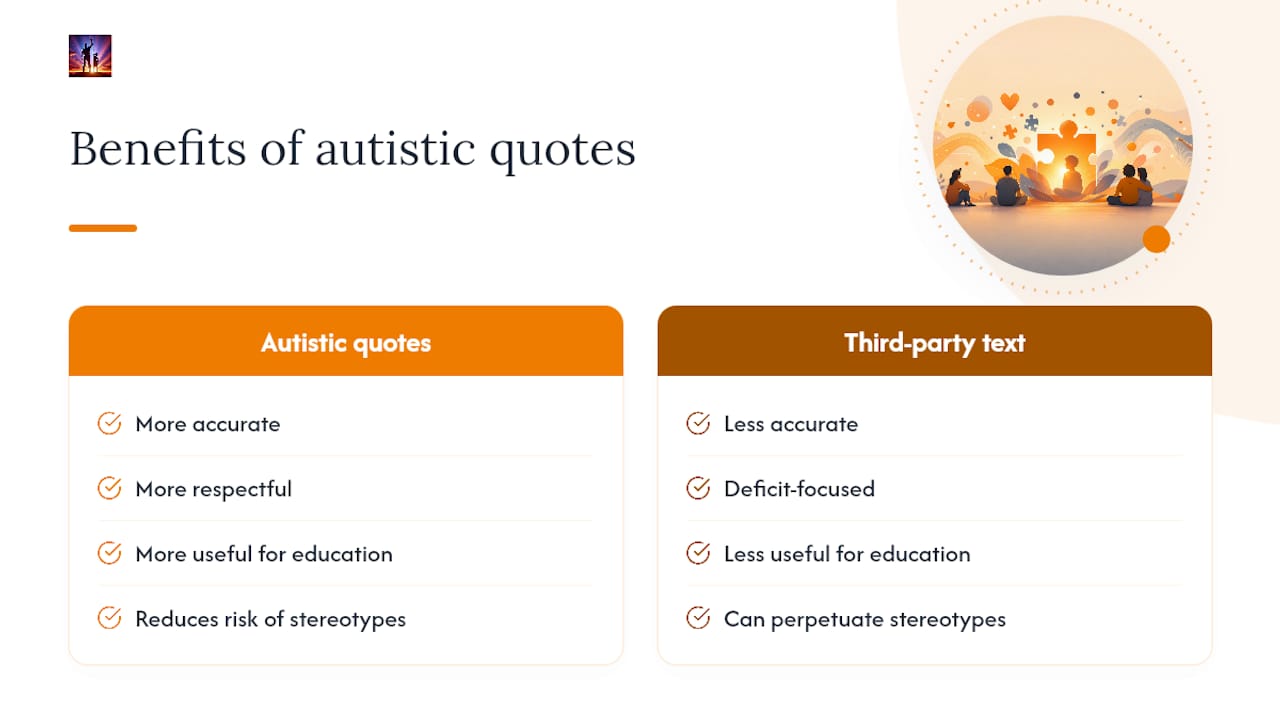
The short answer: quotes from autistic people are more accurate, more respectful, and more useful for education than third-party descriptions of autism.
The Autistic Self Advocacy Network (ASAN) has long recommended that autism-related content prioritize first-person perspectives. Their guidance reflects a straightforward principle: the people who live with autism understand it in ways that outside observers cannot fully replicate. When you lead with autistic voices, you reduce the risk of perpetuating stereotypes and increase the chance that autistic readers will recognize themselves in what you share.
The CDC’s autism data and statistics help contextualize why this matters at scale. Autism is one of the most common developmental conditions in the United States, which means the messaging that circulates about it reaches an enormous audience. Inaccurate or deficit-focused framing, repeated at that scale, shapes public perception in ways that affect autistic people’s daily lives, from how they are treated in schools to how employers perceive them.
Third-party descriptions of autism, even well-intentioned ones, often emphasize what autistic people cannot do. First-person quotes tend to emphasize perspective, capability, and difference without deficit. That shift in framing is not just ethical. It is more accurate.
Editorial practice recommendation: When building a quote collection, label first-person quotes clearly (e.g., “from an autistic speaker”) and avoid extracting clinical language from research papers without explaining the study’s context. A sentence from a diagnostic manual reads very differently than a sentence from a person describing their own life.
The Autism Society and the AWN Network’s resource library both maintain materials that model this kind of careful, first-person-centered framing.
Why these quotes were chosen
The quotes in this collection were selected to center autistic voices first, then include family and advocate perspectives that add context without speaking over lived experience. The goal is not to produce a feel-good list. It is to give you quotes that are accurate, verifiable, and genuinely useful for education, awareness, and connection.
Sharing a quote is a small act with real consequences. A well-attributed quote from an autistic person can open a conversation that changes how someone thinks about disability. A decontextualized or misattributed one can reinforce the very stereotypes it was meant to challenge. The difference usually comes down to one extra sentence of context and one accurate attribution.
Use these quotes to start conversations, not to end them. And when you share, link back to the speaker’s original work whenever you can. Amplifying a voice means pointing people toward the full person, not just the line that fits in a caption.
Autism Victory App connects caregivers to trusted resources and community
Caregivers and advocates who find meaning in these quotes often need more than inspiration. They need practical tools, verified information, and people who understand what they are going through.
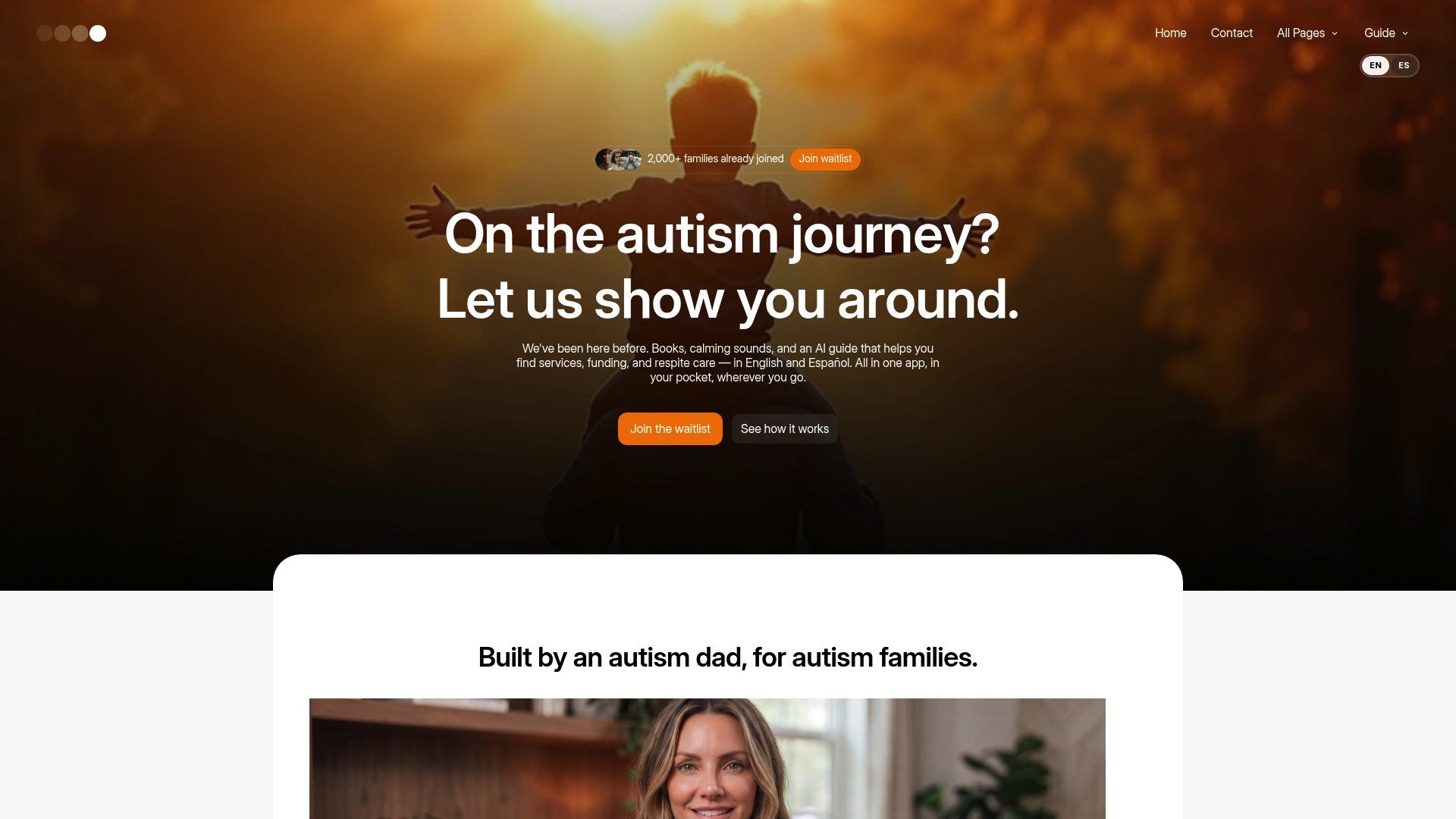
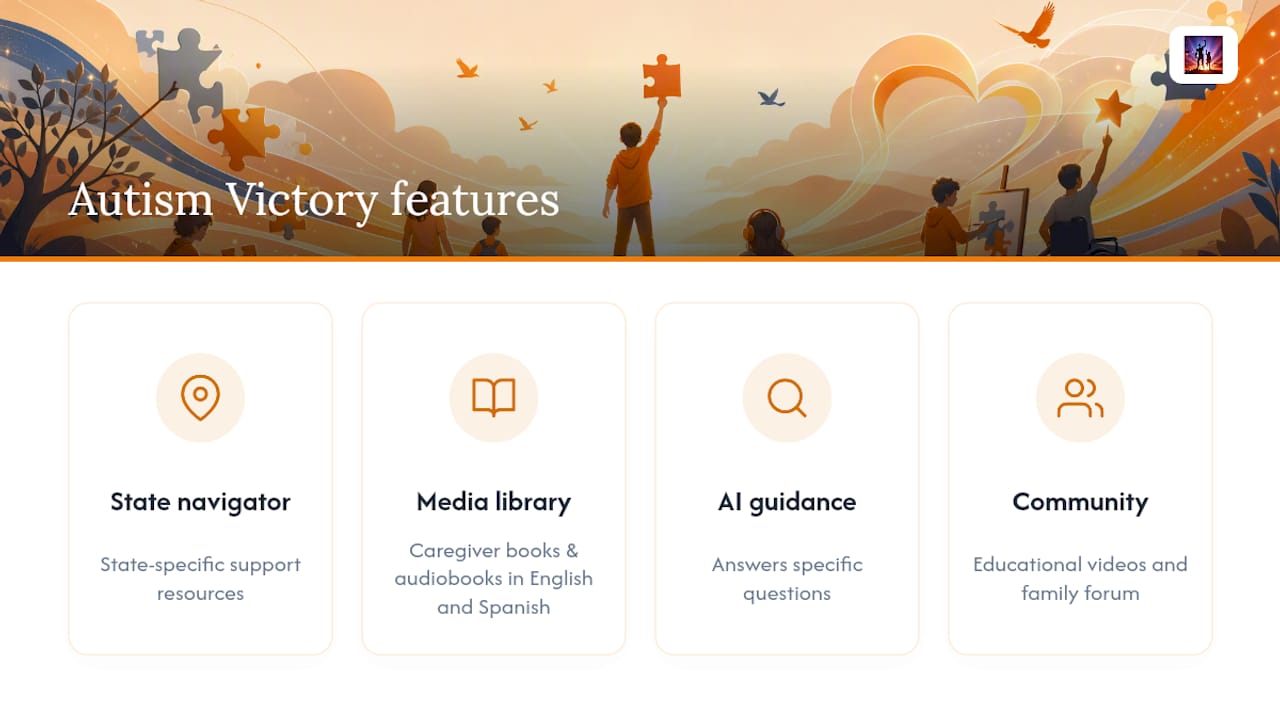
Autism Victory App is built for exactly that. The platform gives parents and caregivers access to a state-specific support resource navigator, caregiver-focused books and audiobooks in English and Spanish, educational videos, and a community of families who are navigating the same path. The AI-powered guidance feature helps you get answers to specific questions without wading through pages of generic advice. For families who want to go deeper than a quote collection, Autism Victory App offers a full library of resources and tools in one place. A 7-day free trial is available, so you can explore the platform before committing to a subscription. Caregivers supporting older family members may also find value in the caregiver support resources available through partner networks.
Sources
These are the most reliable places to verify quotes, read extended first-person accounts, and find accurate background information on autism.
Recommended