
Autism Grants for Families: Top U.S. Programs to Apply For
Yes, autism grants for families exist, and several national programs are open right now. The fastest three to research first: ACT Today (Autism Care Today), which provides up to $5,000 for therapy and services and pays pre-approved providers directly on quarterly cycles; MyGOAL’s Autism Grant Program, a $1,000 annual need-based award with 25 grants available in 2026 and a mid-July decision window; and the National Autism Association (NAA) and its regional affiliates, which offer smaller targeted awards for qualifying families. If you live in Washington state, Ben’s Fund also belongs on your shortlist.
Your immediate next step: pick two programs that match your state and your child’s specific need, then gather three documents before anything else — a current diagnostic letter, a provider treatment plan or referral, and a recent tax return or SSI award letter. Those three items unlock most applications.
ACT Today: Up to $5,000 for therapy and services; pays vendors directly; quarterly cycles
MyGOAL Autism Grant: $1,000 annual award; 25 grants in 2026; defined application window
NAA / regional affiliates: Smaller targeted awards; county or state eligibility varies
Ben’s Fund (WA): Up to $1,000 per child per year; vendor-pay model; income-based
Autism Speaks: Acts as a resource aggregator pointing families to additional funding options
Key Takeaways
Families who apply to well-matched programs with complete documentation, and who verify benefit impacts before accepting any direct-pay award, are the ones who successfully access financial help for autism.
Point | Details |
|---|---|
Start with two matched programs | Pick ACT Today or MyGOAL nationally, then add one state-specific option like Ben’s Fund (WA) or a local NAA affiliate. |
Treatment plan is the strongest document | Applications that link the request to a licensed provider’s treatment plan score significantly better with reviewers. |
Vendor-pay protects your benefits | Grants paid directly to vendors never enter your countable resources, protecting SSI and Medicaid eligibility. |
Apply early in the cycle | MyGOAL offers 25 grants in 2026; ACT Today runs quarterly. Funds exhaust quickly after portals open. |
Autism Victory App | The app’s state-specific navigator matches your family to currently open programs and flags benefit-safety risks before you apply. |
Table of Contents
How the major autism grant programs compare
How autism grant programs typically work
How to apply: documents, platforms, and what actually works
Will a grant affect your Medicaid, SSI, or other benefits?
State and regional grant examples, and where to find local options
Other funding sources to pursue alongside grants
Your pre-submission checklist
Why a state-specific resource navigator changes the outcome
Autism Victory App helps you find state-specific grants without the guesswork
Sources
How the major autism grant programs compare
The programs below cover the widest range of U.S. families. Use this to decide which two or three to prioritize.
A note on payment patterns: Most nonprofit grant programs pay vendors or service providers directly rather than transferring cash to families. This is intentional. It protects families from unintended benefit impacts and gives funders confidence that awards reach their intended purpose. NAASEO’s Pieces to the Puzzle Grant is a clear example: awards go straight to providers, and missing an invoice can get an application rejected outright.
How autism grant programs typically work
Most grant programs follow a predictable structure once you understand the mechanics. Knowing what happens behind the scenes helps you prepare the right materials and time your application correctly.
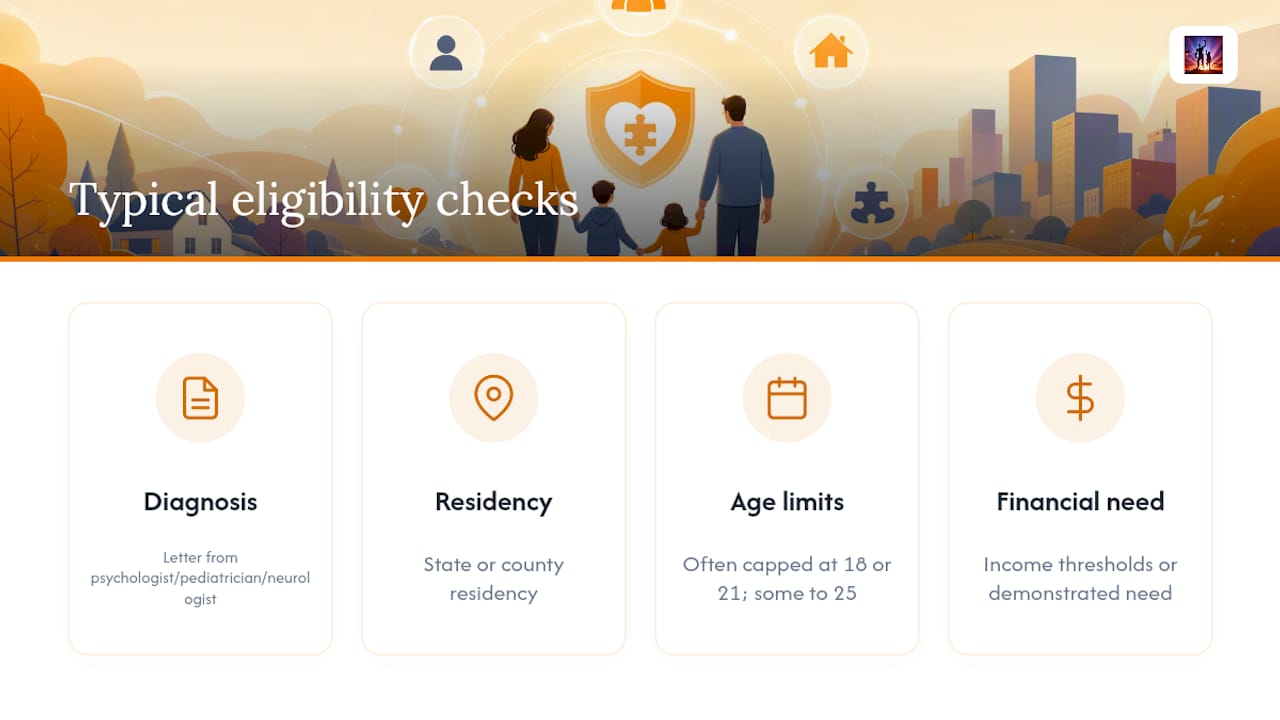
Eligibility checks come first. Programs typically verify four things: a confirmed autism diagnosis (usually requiring a letter from a licensed psychologist, developmental pediatrician, or neurologist), state or county residency, age limits (many programs cap eligibility at 18 or 21, though some extend to 25), and income thresholds or financial need. Others use a softer “demonstrated need” standard that gives reviewers more discretion.
Award decisions are made by staff or a board on a cycle. Programs like MyGOAL run once annually, with decisions rendered by mid-July. ACT Today operates on quarterly cycles. That matters because funds often run out within days of a portal opening. Families who wait until the last week of an application window frequently find awards already exhausted. Prepare your full documentation packet before the window opens, not after.
The payment mechanics matter for your benefits. When a program pays a vendor directly, the money never touches your bank account. That distinction is critical for families receiving Medicaid or SSI, as discussed in the financial considerations section below. Programs that do pay families directly require you to take extra steps to protect your benefits.
Rising costs for raising a child, documented by Brookings, make these grants meaningful even when award amounts seem modest. A $1,000 award covering a month of speech therapy or a specialized communication device can be the difference between a child accessing a service and going without it.
How to apply: documents, platforms, and what actually works
Getting organized before you open an application portal saves you from the most common failure mode: starting strong and then scrambling for a missing document at the last minute.
Documents to prepare before you apply
Diagnostic letter: Must be from a licensed clinician (psychologist, developmental pediatrician, neurologist) and include the diagnosis, date, and provider contact information.
Provider treatment plan or referral: This is the single most important document for competitive applications. ACT Today’s application guidance is explicit: successful applications link the requested item directly to the child’s treatment plan. A licensed provider’s letter stating why a specific therapy or piece of equipment is clinically necessary dramatically improves your odds.
Proof of income: A recent federal tax return (most recent year filed) or a current SSI award letter. Some programs accept both; others specify one.
Itemized invoices or vendor estimates: Most programs need to know the exact cost of what you’re requesting. Get a written estimate from your provider before applying.
Family impact statement: A brief, honest description of how the need affects your child’s development and your family’s daily life. Keep it specific and grounded in your child’s situation.
Vendor contact information: Name, address, phone, and tax ID of the provider or vendor who will receive payment if the award is vendor-pay.
Application platforms and process notes
Many national programs use Submittable or their own online portals. Create one account per family and use a consistent email address across all applications so you can track submissions. Some regional boards, including certain NAA chapter affiliates, still require mailed forms. Confirm the submission method on the program’s official page before you start.
Pro Tip: Frame your family impact statement around measurable developmental outcomes, not general hardship. “My son has not had speech therapy in four months and his IEP goal of 20 functional words is at risk” is far stronger than “therapy is expensive and we need help.”
Step-by-step application sequence
Identify two or three programs that match your state, your child’s age, and the specific service or equipment you need.
Confirm the current application window and submission deadline on each program’s official page.
Gather all documents listed above before opening the application form.
Request a provider treatment plan letter from your child’s therapist or physician, specifying the item and its clinical rationale.
Complete the family impact statement with specific, outcome-linked language.
Attach itemized invoices or vendor estimates for every item requested.
Proofread the full application for consistency between the stated need, the treatment plan, and the invoice amounts.
Submit early in the cycle, ideally within the first 48 hours of the window opening.
Save your submission confirmation and note the program’s stated decision timeline.
Follow up by phone or email if you have not received a decision within the stated window.
Will a grant affect your Medicaid, SSI, or other benefits?
This is the question most families do not think to ask until it is too late. The short answer: it depends on how the grant is structured and how the funds are paid.
Grants and public benefits are fundamentally different things. SSI (Supplemental Security Income) is a recurring monthly income program with strict resource limits. Medicaid is ongoing health coverage tied to income and asset thresholds. Grants are typically one-time, purpose-limited awards. But “one-time” does not automatically mean “safe.”
The core risk: If a grant pays cash directly to your family and you do not spend it within the same calendar month, it can count as a countable resource under SSI rules. A resource balance above $2,000 for an individual can trigger a suspension of SSI payments. That is a serious consequence for a family that accepted a $1,500 grant to pay for therapy.
Community Fund Ohio’s guidance for families makes this explicit: receiving certain grants can affect Medicaid or SSI eligibility, and consulting a professional or verified resource navigator before applying is the recommended step. This is not a rare edge case. It is a common pitfall.
How to protect yourself:
Prioritize vendor-pay programs whenever possible. When funds go directly to a provider, they never enter your household’s countable resources.
If a program pays your family directly, spend the funds within the same calendar month on the approved purpose and document every transaction.
Consult a benefits counselor or a state-specific resource navigator before accepting any direct-pay grant. Your state’s Medicaid waiver and benefits structure affects how this plays out.
Review the SSI rules for children with autism before accepting any cash award.
Pro Tip: Ask every grant program two direct questions before you apply: “Do you pay vendors directly or send funds to families?” and “Do you issue a 1099 or any tax document?” The answers tell you immediately whether you need a benefits counselor involved.
State and regional grant examples, and where to find local options
National programs are the starting point, but state and regional grants often have less competition and faster turnaround. Two concrete examples show how local programs work.
Ben’s Fund (Washington state) serves children and young adults ages 0–25 with a confirmed autism diagnosis and Washington residency. The award is up to $1,000 per child per year, and eligibility is income-based with a ceiling at 400% of the federal poverty level. Critically, Ben’s Fund purchases services or equipment directly from vendors rather than sending cash to families. Required documents include the diagnosis letter, income verification, and a description of the specific service or equipment requested. For Washington families, this is one of the most straightforward programs available.

Variety KC (Kansas City metro area) focuses on families in specific metro counties. Awards go through a board approval process, which means decisions are not instant. Variety KC also enforces a wait period between grants, with some families waiting up to three years before reapplying. If you are in the KC metro, apply early and plan for the reapplication timeline.
NAASEO’s Pieces to the Puzzle Grant is a county-limited NAA affiliate program with awards historically around $500 for biomedical and therapy costs. Physician documentation is required, and geographic eligibility is narrow. It is a good example of how local programs can have strict allowable-use rules that national programs do not.
Where to find grants in your state
State developmental disabilities councils: Every state has one. Search “[your state] developmental disabilities council grants.”
County disability services boards: Many counties fund small, local grants that never appear on national lists.
Regional foundations: Community foundations often have disability-specific grant programs. Search “[your city/county] community foundation disability grants.”
School district Parent Training and Information Centers (PTIs): The U.S. Department of Education funds PTIs in every state to help families navigate special education supports and local resources.
State autism advocacy organizations: Most states have a chapter-level autism society or advocacy group that maintains a local grant list.
Other funding sources to pursue alongside grants
Grants are competitive and time-limited. Pursuing parallel funding pathways reduces your family’s dependence on any single award cycle.
School-based services under IDEA are the most underused resource for families with school-age children. The Individuals with Disabilities Education Act requires public schools to provide a free appropriate public education, including related services like speech therapy, occupational therapy, and behavioral supports. These are not grants. They are legal entitlements. Before applying for a grant to pay for a therapy your child’s school should be providing, request an IEP meeting and ask for the service in writing. PTIs can help you advocate for covered services.
Medicaid waivers provide substantial, ongoing support for individuals with autism, covering therapies, respite care, assistive technology, and community supports. The catch is waitlists, which in some states stretch years. Apply as early as possible, even if your child is young. The state-by-state waiver waitlist guide shows current wait times across all 50 states.
Smaller supplemental funding streams worth pursuing in parallel:
Autism Speaks maintains a resource directory pointing families to additional financial aid for autism, including equipment loans and emergency funds.
The TEA’s PDSES program offers a one-time $1,500 grant for parents of Texas public school students receiving special education services, a useful state-specific option for Texas families.
Emergency assistance funds through local nonprofits and faith-based organizations can cover short-term gaps while you wait on a grant decision.
ABA insurance coverage is another avenue worth pursuing before spending grant funds on ABA therapy. Many insurers are now required to cover ABA, which means a grant request for ABA may be better directed toward a service insurance won’t cover.
Your pre-submission checklist
Run through every item below before you hit submit. A single missing document is the most common reason applications are delayed or denied.
Diagnostic letter — signed by a licensed clinician, includes diagnosis date and provider contact.
Provider treatment plan — written by your child’s therapist or physician, specifying the requested service or item and its clinical rationale.
Itemized invoices or vendor estimates — exact costs from the provider or vendor who will receive payment.
Proof of income — most recent federal tax return or current SSI award letter.
Family impact statement — specific, outcome-linked narrative (not general hardship language).
Vendor contact information — full name, address, phone, and tax ID of the payee.
Confirm payment method — verify whether the program pays vendors directly or sends funds to your family.
Confirm the application window — check the official program page for the exact open and close dates.
Confirm the submission portal — Submittable, direct email, or mailed forms; know before you start.
Check required signatures — some programs require a provider co-signature or a notarized family statement.
Save your confirmation — screenshot or email confirmation of submission; note the stated decision timeline.
Schedule a benefits check — if the program pays families directly, contact a benefits counselor or resource navigator before accepting any award.
Why a state-specific resource navigator changes the outcome
Most families applying for grants for special needs do so without a clear picture of which programs are currently open, which ones their state qualifies for, or whether accepting an award will affect their existing benefits. That gap is where applications fail, or worse, where a well-intentioned grant disrupts SSI or Medicaid coverage.
A state-specific resource navigator does three things a general web search cannot. It filters programs by your state’s current eligibility rules, not last year’s. It flags benefit-safety risks before you apply, not after. And it matches your child’s specific diagnosis, age, and need to the programs most likely to fund that exact request.
The difference between a family that applies to two well-matched programs with complete documentation and one that submits five incomplete applications to programs they don’t qualify for is almost entirely a navigation problem. The programs exist. The funding is there. What most families lack is a clear, current, state-specific map of where to look and what to bring.
Autism Victory App helps you find state-specific grants without the guesswork
Sorting through dozens of grant programs, checking which ones are open in your state, and figuring out whether accepting an award puts your SSI or Medicaid at risk takes hours most caregivers don’t have. Autism Victory App cuts that process down significantly.
The app’s state-specific resource navigator matches your family’s location, your child’s age and diagnosis, and your current benefit situation to the grants and funding programs most relevant to you. Built-in checklists walk you through the exact documents each program requires. Bilingual resources (English and Spanish) mean nothing gets lost in translation for Spanish-speaking families. And when benefit-safety questions come up, the app’s AI guidance points you to the right next step rather than leaving you to piece it together alone.
The Spanish-language resources and the full state navigator are available through the app’s subscription, with a 7-day free trial so you can run your first state-specific search before committing. Visit Autism Victory App to start your free trial and see which programs are currently open in your state.
Sources
These are the official program pages and federal resources to bookmark before you apply. Each one is a direct starting point, not a summary site.
Use these as starting points. Program eligibility, award amounts, and application windows change. A state-specific navigator, like the one inside Autism Victory App, keeps that information current so you are not applying to a closed program or missing a window that opened last week.
This article is general information, not a substitute for advice from a qualified financial advisor. Consult a qualified financial professional about your own circumstances before acting on anything here.
Recommended
Autism Financial Assistance for Families: 2026 Guide | Autism Victory Blog
Autism Job Training Programs: A Parent’s Guide | Autism Victory Blog
Autism Tax Deductions: A 2026 Guide for U.S. Families | Autism Victory Blog
Deducciones Fiscales por Autismo: Guía 2026 para Familias en EE. UU. | Autism Victory Blog